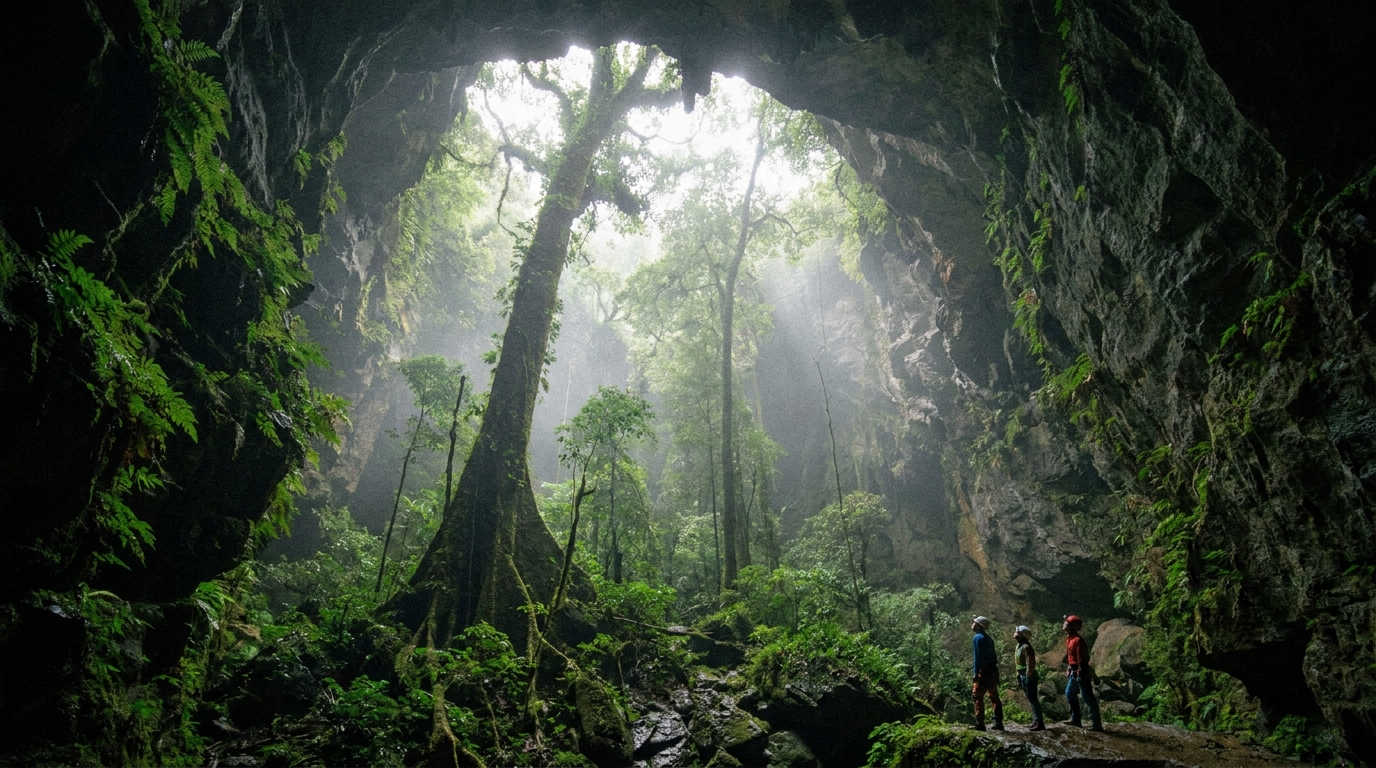
Son Doong is not a big cave. Son Doong is a landscape that happens to have a roof — and in places, a climate that does not consult the one outside.
The main passage runs more than five kilometres. In places the ceiling stands roughly two hundred metres above the floor. Those numbers are printed everywhere and they do nothing. The number that means something is this: the chamber is large enough that clouds form inside it. Humid air rises from the river on the floor, hits the cold rock above, and condenses. There is weather in there. It has nothing to do with the weather outside.
In two places the ceiling has collapsed. Daylight pours through the holes — the dolines — and where daylight lands, jungle grows. Not moss. Jungle: trees tens of metres tall, growing on the floor of a cave, in a shaft of sun that moves across them like a slow spotlight. Monkeys have been seen in it. This is the single strangest fact in the geography of the planet and it was, until very recently, unknown.
A local man, Hồ Khanh, sheltered from a storm at its entrance in 1990 and then could not find it again. It took him almost twenty years to relocate the hole.
The bottleneck that saved it
In 2009 a British caving expedition made it deep into the system and was stopped by a wall of flowstone more than sixty metres high. They named it the Great Wall of Vietnam and went home. They came back in 2010, climbed it, and found the passage continued to a second exit. That is how the largest known cave on earth was surveyed — not by drone, not by satellite, but by people climbing a wall in the dark, twice.
The most successful conservation model in caving
Here is why Son Doong scores 89 rather than 70, despite being one of the most photographed caves on the planet: the Vietnamese authorities did the hard thing. They licensed one operator, capped the number of visitors at roughly a thousand a year, and set a price that makes the cap enforceable. Ten people go in at a time, with a support team of porters, safety guides and a cave expert. Everything comes out again, including the waste.
Compare that to the alternative that was seriously proposed: a cable car, running visitors into the cave by the thousand. It was shelved after a public campaign. Do not assume it is gone forever.
The result is that the interior of Son Doong is, right now, in close to the condition the 2009 expedition found it. That is almost unheard of for a natural wonder with this much global fame. It is a demonstration that the crowd is a policy choice, not a law of nature.
What the four days actually are
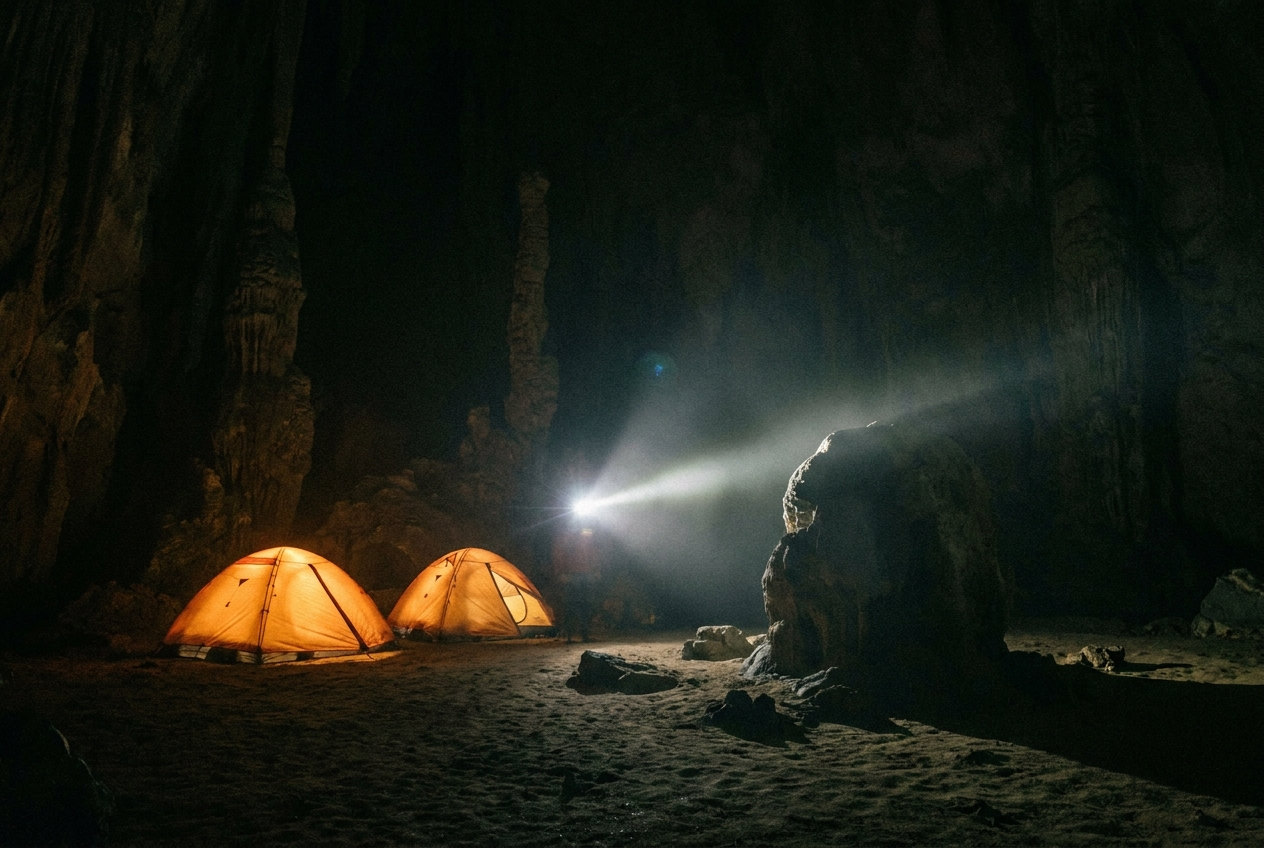
It is a real expedition, not a walk. You trek in through jungle, wade and swim river sections, abseil into the entrance, cross scree and boulder fields the size of houses, camp twice inside the cave, and climb the Great Wall on the way out. Oxalis requires evidence of fitness and trekking experience, and they turn people away. Tours are commonly booked out eight to twelve months ahead, and in practice the queue has run years deep.
If you cannot get in
Say so honestly: most readers of this dossier will not go. The waiting list and the price make that arithmetic simple. But Phong Nha–Kẻ Bàng is a karst system, not a single cave, and the region holds Hang Én — the third-largest cave chamber in the world, with its own doline and its own beach — plus Tú Làn and Hang Va. These are extraordinary in their own right and are not consolation prizes. They are the same geology, at a price and a queue a normal person can survive.
And the underrated move: go to Phong Nha and simply look at the karst from the surface, at dawn, from a bicycle. The towers you are riding between are the outside of the same rock. Every one of them has something hollow in it.
Corner Codex — D-003
- Place
- Hang Son Doong, Phong Nha–Kẻ Bàng National Park, Quảng Bình Province, Vietnam
- Coordinates
- 17.5°N, 106.2°E — base town: Phong Nha
- Getting there
- Fly to Đồng Hới, then ~45 km by road to Phong Nha. The expedition starts with a jungle trek and river crossings.
- Permits
- One licensed operator only: Oxalis Adventure. Visitor numbers are capped at roughly 1,000 people per year, maximum ~10 per departure. Expect a price in the region of US$3,000 for the 4-day expedition, and a waiting list measured in years.
- Season
- Roughly January to end of August. Outside that window the river inside the cave floods and the route closes.
- Silence Index
- 89 / 100
- Still unexplained
- Passages beyond the 'Great Wall of Vietnam' were only breached in 2010; the full extent of connected systems is not settled.
The Traveler's Panel
Practical · checked 14 July 2026Changing information. Prices, tour availability, opening seasons, permits, road access and weather all change — sometimes at short notice, sometimes in response to safety incidents. Everything in this panel is a starting point for your own confirmation, not a quote and not a guarantee. Verify directly with the operator and the relevant official body before you book anything.
- Season
- January – end of August
- Closed
- September – December (river floods)
- Days needed
- 4 days / 3 nights
- Difficulty
- Very hard — expedition grade, fitness screened
- Guide
- One licensed operator only: Oxalis
- Cost band
- $$$$ — c. US$3,000 per person
Getting there — Đồng Hới (VDH) → Phong Nha
- Book first, plan second. Departures are commonly full 8–12 months out and the queue has run years deep — check the operator's calendar before you book anything else.
- Fly or take the train to Đồng Hới, then roughly 45 km by road to Phong Nha town.
- Spend a night in Phong Nha before the expedition. There is a safety and kit briefing, and your fitness is checked.
- Day 1: trek in through jungle and a minority village, descend into Hang Én, camp on the beach inside it.
- Day 2: abseil roughly 80 m into the Son Doong entrance. Cross boulder fields, the first doline, and the cave jungle. Camp inside.
- Day 3–4: the second doline, the Garden of Edam, then the ascent of the 'Great Wall of Vietnam' and the trek out.
Indicative costs — verify before booking
| 4-day Son Doong expedition | c. US$3,000 pp (all-inclusive from Phong Nha) |
| Included | Permits, guides, safety team, porters, all meals, camping gear |
| Alternative — Hang Én 2-day | c. US$300–400 |
| Alternative — Tú Làn 2–4 day | c. US$200–500 |
What to pack
- Broken-in trekking boots you are willing to soak repeatedly
- Quick-dry clothing only; cotton is a liability
- Gloves for the wall climb
- A dry bag for electronics — you will swim
- Blister kit and tape, applied before you need it
- Head for heights: there is an 80 m abseil and a 90 m wall climb
Where to stay
Phong Nha town has everything from hostels to boutique lodges, and the town itself is one of the pleasantest bases in Vietnam. Inside the cave, you camp — tents, dry bags, and a support team who carry the kitchen in and everything, including waste, out.
Safety & responsible travel
- Book only through the licensed operator. An unlicensed 'Son Doong tour' is either a different cave or a crime.
- Support the cap. Roughly 1,000 people a year is the reason the cave is still in near-original condition.
- Touch nothing formation-wise. Cave formations do not heal on human timescales.
- The porters carry your load. Tip them properly and directly.
Nearby, and quieter
Hang Én — the third-largest cave chamber on earth, with its own doline and interior beach, at roughly a tenth of the price. Tú Làn for a wet, technical, swimming-heavy alternative. Paradise Cave and Phong Nha Cave for the accessible, show-cave version. And simply cycling the karst valley at dawn, which costs nothing.
Sources & further reading — checked 14 July 2026
- Oxalis Adventure — Son Doong expedition
- Oxalis — discovery and exploration
- Oxalis — conservation of Son Doong
- Jungle Boss — Son Doong tour guide 2026
- sondoongcave.info — why the tour is priced as it is
Official and scientific bodies are used for safety, regulatory and scientific claims. Commercial operators are used only for practical detail such as tour length, meeting points, equipment and indicative pricing — never as the authority for a safety or scientific statement.
D-003 · Written and edited by Oeun Sok Heng · Reviewed · Read our editorial policy and the Silence Index method.
Access, prices and permits age quickly. If we have something wrong, tell us — corrections are dated and shown in place.