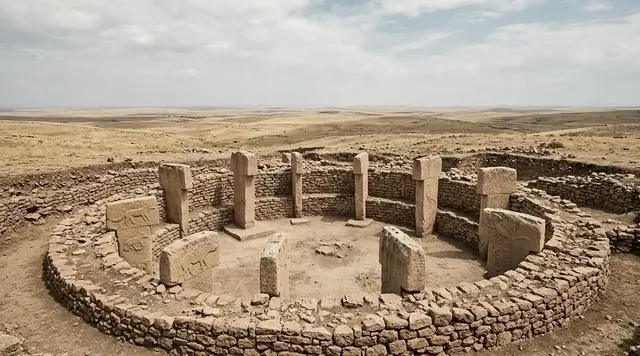
AI illustration
 Written and edited by
 In the 2025 census Naoshima counted 2,932 residents, 171 fewer than five years earlier. In the same period the island recorded its busiest year of visits on record. Both numbers are official, both are moving, and they are moving in opposite directions.
Silence Index — D-008
Busy
Ranks 94 of 99 scored dossiers — quieter than 5% of the others we have scored. A low score is not a warning; it describes who else will be standing next to you.
How the total is weighted. These are the fixed weights of the four inputs, the same on every dossier — not this place’s scores. We do not publish per-input bars, because the per-input values were never recorded article by article and inventing four plausible numbers that sum to the total would be a fabrication dressed as a chart.
This dossier was scored before 2 September 2026, when the fourth input became night darkness. It keeps the input it was reasoned with until it is re-scored at its next source re-check; the methodology page records the change.
The index is a desk instrument scored by this publication, not a field measurement. How it is calculated, and where it fails.
Naoshima is a town of twenty-seven islands, three of them inhabited, and almost everyone lives on the main one: 7.82 square kilometres of granite and pine lying roughly thirteen kilometres north of Takamatsu and about three kilometres south of the Okayama mainland at Tamano. The town's own planning documents divide it into three bands, and the division is the whole argument in miniature. The north is an industrial zone built around the Mitsubishi Materials copper smelter. The centre is administrative and educational. The south is designated a cultural and resort area. One island, three economies, stacked end to end along a road you can cycle in an afternoon.
The smelter came first. Mitsubishi established the Naoshima refinery in October 1917 to process ore from small mines across Japan, and for four decades it did what heavy industry does to a small island: it paid, it polluted, and it filled the place up. Kagawa Prefecture's own regional assessment records the town's population peak at 7,842 in 1959. By the 2000 census it was 3,705. By 2020 it was 3,103. The 2025 census, whose preliminary tabulation the prefecture published on 29 May 2026, put it at 2,932 — a fall of 171 people, or 5.51 per cent, in five years, against a household count that actually rose slightly, to 1,583. That is the signature of an ageing island: fewer people, in more, smaller homes.
Against that, the art. The project did not begin as art. Benesse Art Site Naoshima's own institutional history dates its origin to 1985 and to two men with different plans that happened to overlap: Tetsuhiko Fukutake, founding president of the Okayama publisher that would become Benesse, who wanted a place in the Seto Inland Sea where children from around the world could gather; and Chikatsugu Miyake, then mayor of Naoshima, who wanted the island's south end developed as a cultural and educational district. The Naoshima International Camp opened in July 1989. Benesse House Museum, designed by Tadao Ando, followed in July 1992. The Art House Project — artists given custody of empty houses in the village of Honmura — began in March 1998. Chichu Art Museum opened in July 2004, the Lee Ufan Museum in June 2010, Teshima Art Museum on the neighbouring island in October 2010. The most recent addition, the Naoshima New Museum of Art, opened on 31 May 2025: another Ando building, one storey above ground and two below, on a hill above Honmura, holding contemporary work from across Asia.
The waste that came the other way
The version of this story that circulates in travel writing begins in 1989 and treats the smelter as mere backdrop. The more accurate context is the island next door.
Between the late 1970s and 1990, a company called Teshima Sogo Kanko Kaihatsu accepted and dumped industrial waste on Teshima, four kilometres from Naoshima. Hyogo prefectural police moved against the operator in November 1990. In November 1993, 549 Teshima residents — later joined by a further 111 — filed for pollution dispute mediation against the company, Kagawa Prefecture and the firms that had generated the waste. A mediation settlement was reached in 2000, in which the prefecture expressed regret and undertook to remove and treat the waste. Japan's Environmental Dispute Coordination Commission, reviewing the case afterwards, recorded the scale: intermediate treatment began in April 2003, transport finished on 28 March 2017, roughly 910,000 tonnes were moved, and the cost through the 2016 fiscal year came to about ¥72.5 billion. The National Institute for Environmental Studies records the direct legislative consequence: the case led to amendment of the Waste Disposal and Public Cleansing Law and to special measures legislation written for it.
The waste was not taken to the mainland. It was barged to Naoshima and burned and processed at a facility built beside the smelter, on the island already zoned for industry.
The waste went one way and the visitors came the other, and both movements rested on the same premise: that a small island's future is largely decided by what the mainland chooses to send it.
The genuinely disputed part
Naoshima is routinely offered as proof that culture can reverse rural decline. The evidence for that claim is more interesting, and more qualified, than the claim itself.
Start with the town's own figures, published in its Fifth Comprehensive Plan, which runs from the 2025 fiscal year to 2034. Natural change has been consistently negative and is getting worse: 22 births against 35 deaths in 2018, 16 births against 47 deaths in 2022, with the total fertility rate falling from 1.56 to 1.09 across those years. Social change — people moving in against people moving out — has been positive: a net gain of 12 in 2019 and of 17 in 2023, on flows of roughly 170 to 180 in each direction. The town attributes that stability partly to employment and partly to Naoshima's standing as an art island, and notes that the rate of decline has been slowing. Meanwhile the ageing rate rose from 16.4 per cent in 1990 to 33.9 per cent in 2020.
Read carefully, that is a precise and unusual result. Art did not reverse the population curve. It reversed the migration curve — and the migration curve was never the main driver. An island losing thirty people a year to mortality cannot be held level by a net inflow of seventeen. What the museums appear to have bought is not growth but a slower descent, plus a demographic that a depopulating island almost never gets: incomers in their twenties and thirties.
The most substantial independent examination of this is the work of Meng Qu at Hiroshima University's Graduate School of Humanities and Social Sciences. His 2026 paper in the Journal of Marine and Island Cultures, drawing on a decade of mixed-methods fieldwork from 2015 to 2025 — 128 business questionnaires, which he puts at 80 to 90 per cent of the operators still trading after the 2016 festival, and 60 semi-structured and unstructured interviews across Naoshima, Teshima, Inujima, Ogijima and Megijima, 33 of which the abstract counts — puts numbers on the incomer question. Among the operators surveyed, 46.1 per cent were long-term residents, 27.3 per cent were in-migrants who had moved to the islands, 7 per cent were returnees, and 19.5 per cent commuted in from elsewhere. So the migration effect is real and visible in who runs the cafés and guesthouses.
Qu's conclusions are nonetheless sceptical. He describes an economy of "intermittent festivalness": crowding during the triennial art festival, thin trade between editions, and a commercial structure that struggles to survive the trough. His survey found 28.1 per cent of operators reporting only negative perceptions of the festival's impact and 55.5 per cent reporting mixed ones, against 16.4 per cent reporting only positive effects. He also documents a gap between official and local accounts: where organiser reporting recorded 68.4 per cent resident approval of artwork arrangements, only 39.1 per cent of his surveyed operators agreed. On the islands with major private art facilities, he records residents describing the place as belonging to the operator rather than to them. His earlier work with Joseph Cheer, published in the Journal of Sustainable Tourism, points in a different direction — towards small, locally governed festivals on far smaller islands — as the model with better odds of durability.
The visitor arithmetic explains why the scepticism has force. Kagawa Prefecture's tourism survey recorded 215,857 admissions to the Chichu Art Museum in 2025, up from 188,098 in 2024. The Setouchi Triennale organising committee counted 1,084,128 visits across its 2025 edition, over 107 festival days; Naoshima was the single busiest site, with 338,459, more than double its 166,737 in 2022. The Naoshima tourism association's long-run tally of admissions to island facilities — a count of entries, not of individual people — reached 1,128,353 in 2025, against 751,309 in 2019. The Bank of Japan's Takamatsu branch estimated the 2025 festival's economic effect within Kagawa at about ¥19.5 billion, some 89 per cent above the 2022 edition, with per-visitor spending ranging from roughly ¥14,000 for a domestic day-tripper to roughly ¥140,000 for an overnight visitor from abroad.
Set those against 2,932 residents. The island is now visited on a scale its own demography cannot absorb, and the benefit is concentrated in the overnight and overseas segments — the visitors least likely to be there in February.
Why it looks like that
The buildings are underground for a reason that is easy to misread as mysticism. The Seto Inland Sea was designated one of Japan's first national parks in 1934, and its value is a horizon: low wooded islands, one behind another, in flat light. A conventional museum on the southern headland would have been a mass in that horizon. Chichu is set into the hill instead, its galleries reached by concrete corridors and courtyards open to the sky, so that the collection — five Monet water-lily canvases, three works by James Turrell, an installation by Walter De Maria — is lit by daylight and changes with the weather and the hour. The Naoshima New Museum of Art repeats the logic thirty years on: one floor visible, two buried.
The consequence is that the museums are small. A building sunk into a hillside and lit from above cannot be widened at will, and works that depend on a viewer's eyes adjusting to darkness cannot absorb a coach party. Benesse Art Site states plainly that the timed-ticket system exists to reduce congestion on the islands and waiting times at the doors. The rationing is architectural before it is commercial.
The Art House Project is the opposite move and the source of most of the friction Qu records. Rather than concentrating art in a compound at the island's southern end, it distributed it through Honmura, a working village, from 1998 onward. The lanes between the installations are residential streets. There is no boundary at which the visit begins.
 AI illustration
How to actually see it
The practical picture has changed enough that older guidance is now actively misleading. The following reflects the operators' and the site's current published information; verify before you commit money, because fares and hours on this route have been revised more than once in recent years.
- The booking window is shorter than almost anyone tells you, including our own earlier version of this page. Benesse Art Site's own support pages state that online tickets go on sale at 10:00 on the second Friday of each month, for the following month. You cannot book a year ahead, and you cannot book two or three months ahead either: the practical horizon is about four to seven weeks, and popular slots go quickly once released. Advice to "book the moment your dates are fixed" is only useful if your dates are inside that window.
- Fewer places require a reservation than is commonly claimed. Timed online tickets are required for the Chichu Art Museum, the Hiroshi Sugimoto Gallery: Time Corridors, the Art House Project sites "Minamidera" and "Kinza", the night viewing of "Ring of Fire", and Teshima Art Museum. Benesse House Museum, the Lee Ufan Museum, Valley Gallery, the Naoshima New Museum of Art, Miyanoura Gallery 6 and the Naoshima Bath do not require one, though buying online is cheaper.
- Current published admission. Chichu ¥2,500 online on weekdays and ¥2,700 at weekends and holidays, rising to ¥2,800 and ¥3,000 on site. Benesse House Museum ¥1,300 online, ¥1,500 on site. Lee Ufan Museum ¥1,200 and ¥1,400. Naoshima New Museum of Art ¥1,500 and ¥1,700. Teshima Art Museum ¥1,800 and ¥2,000. Children of 15 and under are admitted free.
- Hours differ more than people expect. Chichu opens 10:00 to 17:00, last admission 16:00, closed Mondays — or, when the Monday is a public holiday, the following day. Benesse House Museum is open year-round from 08:00 to 21:00, with last admission at 20:00, which makes it the one substantial building on the island you can enter before breakfast or after dinner.
- Come from Uno if you can. The Uno crossing to Miyanoura is about 20 minutes at ¥370 for an adult; a smaller service runs from Uno to Honmura at the same fare. From Takamatsu the ferry takes roughly 50 minutes at ¥680, with a high-speed passenger boat at around 30 minutes for ¥1,590.
- On the island, the cheap options are the good ones. The town bus runs Miyanoura–Honmura–Tsutsujiso for ¥100 adult, ¥50 child. Benesse Art Site runs a free shuttle from Tsutsujiso to the Chichu Art Museum, calling at Benesse House Museum and the Lee Ufan Museum, roughly every thirty minutes and every fifteen on heavy days. Bicycles, including electric ones, are rented at both ports; the island is hillier than the map suggests.
- The quieter option is a calendar, not a place. The Setouchi Triennale is held every three years, and 2025 was the sixth edition. A midweek day outside a festival year, outside spring and autumn, is a materially different island — with the caveat that a good many festival works are open only during the festival.
- Staying over buys hours, and one specific privilege. Benesse House guests are admitted free to Benesse House Museum, the Valley Gallery and the Sugimoto gallery, and may enter Benesse House Museum until 23:00, two hours past general closing. Accommodation opens for booking about 180 days ahead — far earlier than the museum tickets. Below that price point the island has guesthouses, minshuku and a campsite, none of which include the after-hours access but all of which include the evening.
- The neighbours are the honest recommendation. Teshima drew 145,364 festival visits in 2025 against Naoshima's 338,459; Inujima far fewer. Both are reached from Naoshima or Uno and both are what Naoshima's admirers usually claim Naoshima still is.
Why the Silence Index is 38
This dossier previously scored Naoshima at 47. The 2025 figures do not support that, and the score is revised down to 38. The justification is arithmetic rather than mood.
Access friction is close to zero: a twenty-minute crossing for ¥370, a ¥100 bus, a free shuttle, and an English-language booking system. Pressure is high and rising: 1,128,353 recorded entries in 2025 on an island of 7.82 square kilometres with 2,932 residents, and the highest visitor count of any site in a festival that itself drew over a million. The reservation system rations the museums but not the roads, the ferries or Honmura's lanes, and the busiest sites are precisely the ones a first-time visitor will book. Independent research on the island records a resident population with mixed-to-negative views of the crowding and, on Naoshima specifically, complaints about visitors entering private property.
The score is not lower because measurable quiet genuinely exists and is obtainable by anyone willing to plan around it. Chichu's 215,857 admissions in 2025, spread across an opening calendar of roughly three hundred days, average out at around seven hundred people a day through a building designed for slow movement. Two-thirds of the island — the industrial north, the reservoirs, the wooded interior — receives almost no visitors at all. And the daily rhythm is unusually sharp: the great majority of arrivals are day-trippers tied to afternoon and early-evening sailings, so the island's population effectively collapses back toward its census figure by nightfall. A 38 records a place that is busy, well-organised, and still capable of being empty at predictable hours.
What is actually worth watching
Naoshima is neither the triumph nor the cautionary tale it is usually made into. It is a small, ageing island that used industrial money and a publisher's private collection to buy itself a second economy, and that second economy has done exactly one measurable demographic thing: it has kept net migration marginally positive on an island where deaths outnumber births two or three to one. That is not nothing. It is also not a reversal, and the town's own plan treats population retention and tourism development as separate objectives rather than as cause and effect.
The number to watch is not the visitor count, which will keep rising, nor the economic-impact estimate, which will keep rising with it. It is the census: 3,705 in 2000, 3,103 in 2020, 2,932 in 2025. The next confirmed figures are due from Japan's statistical authorities during 2026. If the decline continues to slow, the argument that art-led revival changes who lives somewhere will have earned a little more of its reputation. If it does not, Naoshima will have proved something narrower and still valuable — that culture can change who visits an island long before it changes who stays.
Corner Codex — D-008
- Place
- Naoshima, Kagawa Prefecture, Seto Inland Sea, Japan
- Coordinates
- 34.46°N, 133.99°E — ports: Miyanoura, Honmura
- Land and people
- Main island 7.82 km²; town population 2,932 at the 2025 census, down 5.51 per cent in five years
- Getting there
- Ferry from Uno, Okayama — about 20 minutes, ¥370 adult — or from Takamatsu, roughly 50 minutes by ferry.
- Permits
- None. Timed online tickets are required for Chichu Art Museum, the Hiroshi Sugimoto Gallery, Art House Project 'Minamidera' and 'Kinza', 'Ring of Fire' at night, and Teshima Art Museum. Most other sites, including Benesse House Museum, do not require one.
- Season
- Year-round. Chichu and most art facilities close Mondays; Benesse House Museum opens daily. Triennale years are the busiest by a wide margin.
- Silence Index
- 38 / 100
- Still unresolved
- Whether art-led revival changes who lives on an island, or only who visits it.
The Traveler's Panel · checked
Changing information. Prices, permits, seasons and road access change, sometimes at short notice. Everything here is a starting point for your own confirmation — not a quote, and not a guarantee. Verify with the operator and the relevant official body before you book.
| Season | Year-round; spring and autumn busiest, festival years busiest of all |
| Closed | Chichu and most art sites close Mondays; Benesse House Museum daily |
| Days needed | 2 days / 1 night |
| Difficulty | Very easy |
| Guide | Not required |
| Cost band | $$ — admissions are the main expense |
Getting there — Okayama → Uno Port · or Takamatsu
- Online tickets are released at 10:00 on the second Friday of each month, for the following month. The booking horizon is about four to seven weeks, not a year and not the two to three months this dossier previously stated — plan your dates around the release, not the other way round.
- Timed tickets are required for Chichu Art Museum, the Hiroshi Sugimoto Gallery: Time Corridors, Art House Project 'Minamidera' and 'Kinza', the night showing of 'Ring of Fire', and Teshima Art Museum. Benesse House Museum, Lee Ufan Museum, Valley Gallery and the Naoshima New Museum of Art do not require reservations, though online prices are lower.
- Shinkansen to Okayama, local train to Uno, then the ferry to Miyanoura — about 20 minutes, ¥370 adult. A smaller service also runs Uno to Honmura at the same fare.
- From Takamatsu, the ferry to Miyanoura takes roughly 50 minutes at ¥680; a high-speed passenger boat covers it in about 30 minutes for ¥1,590.
- On the island, the town bus links Miyanoura, Honmura and Tsutsujiso for ¥100. Benesse Art Site's free shuttle runs Tsutsujiso to Chichu via Benesse House Museum and the Lee Ufan Museum, roughly every 30 minutes.
- Bicycles and e-bikes are rented at both ports. The interior climbs more than the map suggests.
- Stay the night if the budget allows. Benesse House Museum's 08:00–21:00 opening, and 23:00 for house guests, is the only way to see a major building on this island without a crowd.
Indicative costs — verify before booking
| Chichu Art Museum (online) | ¥2,500 weekdays / ¥2,700 weekends and holidays |
| Chichu Art Museum (on site) | ¥2,800 / ¥3,000 |
| Benesse House Museum | ¥1,300 online / ¥1,500 on site |
| Lee Ufan Museum | ¥1,200 online / ¥1,400 on site |
| Naoshima New Museum of Art | ¥1,500 online / ¥1,700 on site |
| Teshima Art Museum | ¥1,800 online / ¥2,000 on site |
| Ferry, Uno–Miyanoura | ¥370 adult one way |
| Ferry, Takamatsu–Miyanoura | ¥680 adult; ¥1,590 by high-speed boat |
| Town bus | ¥100 adult, ¥50 child |
| Children 15 and under | Free at Benesse Art Site facilities |
What to pack
- Cash — parts of the island remain cash-only
- Shoes you can walk Honmura's lanes in for an hour
- A wind layer for the southern coast road
- Printed or offline copies of your timed tickets; mobile signal is uneven inside the buried galleries
- Patience with the no-photography rules, which are enforced and are the point
Where to stay
Benesse House is the headline: four buildings above the southern coast, with free admission to Benesse House Museum, the Valley Gallery and the Sugimoto gallery for guests, and museum entry until 23:00 against a general 21:00 close. Rooms open for booking about 180 days ahead, well before museum tickets are released, and the reservation system itself changed in August 2026 — check which platform applies to your dates. Below that, the island has guesthouses, minshuku and a campsite. None of them include the late museum hours; all of them include the evening, which is the part that does not sell out.
Safety & responsible travel
- The 2025 census counted 2,932 residents. Honmura's lanes are their streets; independent research on the island records complaints about visitors entering private property.
- Observe the photography bans inside the museums. The works are about the act of looking, and the rules exist for that reason rather than for copyright.
- Spend on the island — restaurants, cafés, the bathhouse, a guesthouse — rather than arriving provisioned from Okayama. Surveyed island businesses report the between-festival trough as their central problem.
- Consider a non-festival year. Visits to Naoshima during the 2025 Triennale doubled the 2022 figure; the pressure is concentrated in known windows.
- The northern third of the island is a working smelter site and residential area, not part of the visit.
Nearby, and quieter
Teshima is a short crossing away and recorded 145,364 festival visits in 2025 against Naoshima's 338,459; the Teshima Art Museum there requires the same timed ticket. Inujima, with the Seirensho Art Museum built into a ruined copper refinery, is quieter still. Teshima is also where the region's turn to art actually begins: 910,000 tonnes of illegally dumped industrial waste were removed from it between 2003 and 2017, and barged to Naoshima for treatment.
Getting there, in order
- 1Okayama
- 2Uno Port · or Takamatsu
Each leg is a separate booking and a separate chance to be weathered out. Build spare days into the chain, not onto the end of it.
Where it is
Naoshima, Kagawa, Japan · 34.4589°N 133.9958°E · Open in Google Maps · OpenStreetMap
Key locations
- Miyanoura Port — the main ferry landing and the island's front door
34.4556°N 133.9717°E - Honmura — the village whose empty houses became the Art House Project in 1998
34.4606°N 133.9969°E - Chichu Art Museum — the Ando building of 2004 in the southern cultural and resort zone
34.4481°N 133.9847°E - Benesse House — the 1992 museum and hotel that started the southern development
34.4450°N 133.9903°E - Uno, Tamano — the Okayama-side ferry port, about 3 km north across the water
34.4925°N 133.9539°E - Teshima — where 910,000 tonnes of illegal waste were dumped and then barged here
34.4796°N 134.0742°E - Takamatsu — the Shikoku port about 13 km south, and the other way in
34.3426°N 134.0465°E
Coordinates are for orientation and are accurate to roughly the width of the feature named, not to a doorway. Several of these points are inside protected areas or need a permit, a guide or a boat — read the access notes above before you plan a route to any of them.
Sources & further reading — checked
- Kagawa Prefecture — 2025 Population Census, Kagawa preliminary tabulation (PDF). Current verified population of Naoshima town — 2,932 at 1 October 2025, down 5.51 per cent on 2020 — and the household count; published 29 May 2026.
- Naoshima Town — Fifth Comprehensive Plan, FY2025–FY2034 (PDF). Island area and zoning, births and deaths, net migration figures, ageing rate, visitor baseline and the town's own 2034 targets.
- Kagawa Prefecture — regional conditions assessment, Naoshima eco-island programme. Historical population peak of 7,842 in 1959 and the 2000 census figure; the smelter's role in the island's economy.
- Environmental Dispute Coordination Commission / Ministry of Internal Affairs and Communications — review of the Teshima industrial waste case (PDF). Official chronology of the Teshima dumping case: the 1990 police action, the 1993 mediation filing by 549 residents, the 2000 settlement, transport to Naoshima from 2003, completion on 28 March 2017, ~910,000 tonnes and ~¥72.5 billion.
- National Institute for Environmental Studies — lessons from the Teshima illegal dumping problem. Independent institutional assessment: that the case led directly to amendment of the Waste Disposal and Public Cleansing Law and to special measures legislation, and roughly 900,000 tonnes processed over fourteen years.
- Setouchi Triennale Executive Committee — total visitor figures for the 2025 edition. Festival attendance of 1,084,128 over 107 days, Naoshima's 338,459 and Teshima's 145,364, and the comparison with 2022.
- Bank of Japan, Takamatsu Branch — economic impact of Setouchi Triennale 2025 (PDF). Independent estimate of the festival's ¥19.5 billion effect in Kagawa and the per-visitor spending range by origin and by whether visitors stayed overnight.
- Kagawa Prefecture — 2025 Tourism Visitor Survey, preliminary report (PDF). Verified admissions to the Chichu Art Museum: 215,857 in 2025 against 188,098 in 2024.
- Meng Qu, 'Revitalization at a Price? Intermittent Art Festivals on Peripheral Archipelagos', Journal of Marine and Island Cultures 15(1), 2026. Ten years of fieldwork across five Setouchi islands: in-migrant share among island businesses, the clustering of positive and negative resident perceptions, and the gap between organiser and resident accounts.
- Meng Qu and Joseph M. Cheer, 'Community art festivals and sustainable rural revitalisation', Journal of Sustainable Tourism, 2021. Comparative scholarship on small, locally governed island art festivals as an alternative model to large exogenous events.
- Benesse Art Site Naoshima — ticket reservations and admission fees. Which facilities require timed tickets and which do not, and the current online and on-site admission prices used throughout this dossier.
- Benesse Art Site Naoshima — reservation release schedule (support centre). The actual booking window, in the operator's own words: online tickets go on sale for the following month on the second Friday of each month at 10:00.
- Benesse Art Site Naoshima — history of the project. Founding chronology from 1985, and the opening dates of Benesse House, the Art House Project, Chichu, Lee Ufan and Teshima Art Museum.
- Benesse Art Site Naoshima — access and island transport. Ferry fares and durations from Uno and Takamatsu, the ¥100 town bus and the free site shuttle.
- Benesse Art Site Naoshima — benefits for Benesse House guests. The 23:00 museum access and free admissions granted to overnight guests, against the 21:00 general close.
- The Art Newspaper — 'Japan's art islands gain a new attraction with museum designed by Tadao Ando', 28 May 2025. Independent reporting on the Naoshima New Museum of Art's opening, its architecture and its curatorial remit.
- Mitsubishi Materials — history of the Naoshima Smelter & Refinery. The refinery's founding in October 1917 and its later role in recycling and in treating waste brought from Teshima.
- Naoshima Town Tourism Association — annual admissions series, 1990–2025 (PDF). The island's own long-run count of facility entries: 751,309 in 2019 and a record 1,128,353 in 2025. Used only for that series, and it counts entries rather than individuals.
Official and scientific bodies are the authority for safety, regulatory and scientific claims. Commercial operators are used only for practical detail such as tour length, meeting points and indicative pricing — never for a safety or scientific statement.
How this was made
Desk research. Compiled from official bodies, scientific and conservation sources, established journalism and licensed operators. Not based on a personal visit.
Editor’s method note — what we checked, corrected and could not verify
- Desk research only. Nobody from this publication has been to Naoshima. The dossier is built from the 2025 population census as published by Kagawa Prefecture, Naoshima Town's own comprehensive plan, the prefecture's eco-island assessment and tourism survey, the Environmental Dispute Coordination Commission's chronology of the Teshima case, the National Institute for Environmental Studies, the Setouchi Triennale organising committee, the Bank of Japan's Takamatsu branch, two peer-reviewed papers by Meng Qu, The Art Newspaper, Mitsubishi Materials, and Benesse Art Site Naoshima's own published information.
- Every one of the eighteen source URLs was reopened for this audit in August 2026. All eighteen still load. Two descriptions were corrected and one body claim was wrong.
- The correction that matters most to a reader planning a trip concerns the booking window, and it is a full month. This dossier said tickets are released at 10:00 on the second Friday of each month for the month after next. Benesse Art Site's own support page says they go on sale for the following month. The practical horizon is therefore about four to seven weeks, not two to three months. Anyone who read the earlier version and planned around it would have been looking for tickets that had already gone.
- We removed an unsupported superlative. The dossier attributed to the National Institute for Environmental Studies the statement that Teshima was the largest illegal-dumping case of Japan's postwar era. Reopening the page, NIES makes no such ranking claim. What it does establish is that the case led directly to amendment of the Waste Disposal and Public Cleansing Law and to special measures legislation, and that roughly 900,000 tonnes were processed over fourteen years. Both the source description and the body sentence now say that instead.
- The two accounts of the waste volume and cost differ slightly and we use the official one. The Environmental Dispute Coordination Commission's chronology gives about 910,000 tonnes and about ¥72.5 billion through the 2016 fiscal year; NIES rounds to about 900,000 tonnes over fourteen years. We cite the Commission for the figures and NIES for the legal consequence.
- One counting convention is flagged rather than smoothed. The Setouchi Triennale committee's own release notes that the number of baseline facilities differed between the 2022 and 2025 editions and that the counting conditions were not identical, so the doubling of Naoshima's figure from 166,737 to 338,459 is not a like-for-like comparison. The tourism association's 1,128,353 is likewise a count of entries to facilities, not of people.
- Two academic sources could be read only in part. The Journal of Sustainable Tourism paper by Qu and Cheer returned a 403 through its DOI and is behind Taylor and Francis' paywall; it is retained because it is correctly identified and used only for its argument, not for a figure. Qu's 2026 Journal of Marine and Island Cultures paper is open and its residency shares — 46.1 per cent long-term residents, 27.3 per cent in-migrants, 7 per cent returnees, 19.5 per cent commuters — verified exactly.
- We withdrew a disclaimer that was itself wrong. The previous method note listed the resident-perception percentages as unconfirmed. Reopening Qu's 2026 paper in full for the August 2026 audit, all of them are there: the cluster analysis gives 16.4 per cent of respondents positive only (C1), 28.1 per cent negative only (C2) and 55.5 per cent mixed (C3), and the paper states that official Triennale surveys found more than 68.4 per cent of locals rated the artwork very or moderately good against only 39.1 per cent of the small tourism businesses he surveyed. The body figures stand and the disclaimer has gone.
- One sample size in the body is the abstract's, not the methods section's. Qu's abstract describes 128 business surveys and 33 interviews; the methods section states that 60 semi-structured and unstructured interviews were conducted across the five islands over two years, of which the 33 appear to be a subset. The body now gives both rather than the smaller figure alone.
- Things we could not verify: the 20:00 last admission at Benesse House Museum, where we could confirm the 08:00–21:00 general hours and the 23:00 guest access but not the last-admission time; the claim that the accommodation reservation system changed in August 2026, which we could not corroborate from the operator; the 180-day accommodation booking horizon, likewise; Chichu's stated 10:00–17:00 hours and Monday closure, which are not on the general information page we cite for prices; whether the 2025 census figure of 2,932 has moved since, the next tabulation being years away; and how much of the ¥19.5 billion the Bank of Japan estimates for Kagawa actually lands on Naoshima rather than in Takamatsu.
- Coordinates for the key locations are from the GeoNames gazetteer for Miyanoura port, Honmura, the Chichu Art Museum, Benesse House, Uno and Takamatsu, and from OpenStreetMap for Teshima. Two things are not pinned: the Mitsubishi Materials smelter and the waste-processing plant beside it, which carry half the argument but which no gazetteer we could open positions; and the Naoshima New Museum of Art, opened on 31 May 2025 and too recent to have reached one. The Uno pin is the station beside the ferry berth.
AI is used to draft this text, and a human checks it. Every figure, date and quotation above was verified by Tony Hall against the source cited for it in the reference list; where sources disagree, the disagreement is shown rather than resolved, and where a claim could not be confirmed it is either marked unverified or left out. The illustrations are AI-created and labelled as such — no photograph on this site is presented as a record of a real place. Full disclosure · Editorial policy.
Access details change — recheck before you travel. Found an error? Tell us — corrections are dated and shown in place.