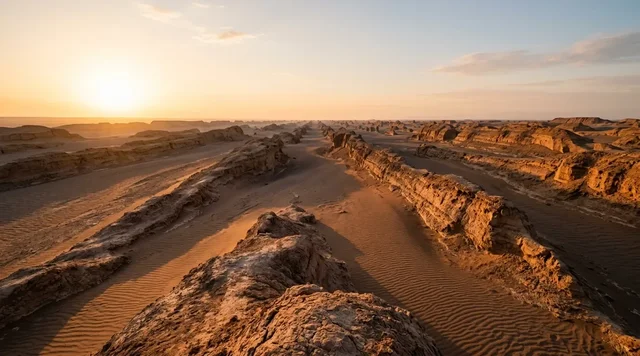
AI illustration
 Written and edited by
 The dragon's blood trees of Socotra are not dying. That is the part everyone gets wrong. They are failing to be born — and the ledger that records it runs on a timescale of centuries, which is why you can stand in a forest that has already ended and see nothing at all.
Silence Index — D-001
Effectively unvisited
Ranks 1 of 99 scored dossiers — the quietest place we have scored. A low score is not a warning; it describes who else will be standing next to you.
How the total is weighted. These are the fixed weights of the four inputs, the same on every dossier — not this place’s scores. We do not publish per-input bars, because the per-input values were never recorded article by article and inventing four plausible numbers that sum to the total would be a fabrication dressed as a chart.
This dossier was scored before 2 September 2026, when the fourth input became night darkness. It keeps the input it was reasoned with until it is re-scored at its next source re-check; the methodology page records the change.
The index is a desk instrument scored by this publication, not a field measurement. How it is calculated, and where it fails.
What the island is
This is a desk-researched dossier. Nobody from this publication has been to Socotra, and in the current conditions we would not encourage anyone to go. What follows is assembled from the UNESCO and IUCN record, peer-reviewed botany and ecology, UN agency reporting, and established news, with the disputes left visible.
Socotra is not an oceanic island that rose from the sea and was colonised. It is a fragment of continent that broke away and drifted, isolated for at least eighteen million years. Everything that was aboard when it left has been evolving alone since.
The result is written into the property's legal Statement of Outstanding Universal Value, which is worth quoting rather than paraphrasing: Socotra has 825 plant species of which 307, or 37%, are endemic. The same document records 34 reptile species at 90% endemism, 96 land snail species at 95%, 253 reef-building corals, 730 coastal fish, and 22 Important Bird Areas designated by BirdLife. When UNESCO inscribed the archipelago in 2008 it did so under criterion (x) alone — biodiversity. Not landscape, not culture. The living inventory was the entire case.
 AI illustration
The ledger
Dracaena cinnabari, the dragon's blood tree, grows nowhere on earth but here — Kew's Plants of the World Online gives its native range as Socotra, full stop. It is the image that sells the island: an upturned umbrella of a crown on a bare limestone plateau, resin the colour of dried blood.
The most rigorous island-wide survey counts 80,134 individual trees, occupying 51,963 hectares in twenty subpopulations ranging from fifteen trees to 32,195. That sounds like a forest in reasonable health. It is not, and the reason is age structure rather than mortality.
Between 2011 and 2021 a team measured 1,077 individual trees repeatedly to estimate age from growth rather than guesswork. The smallest size class they measured — trunks of 10.1 to 15 cm diameter — came out at around 111 years old. The largest, at 90.1 to 95 cm, returned about 672 years, with a confidence interval running from 447 to 1,911. Their finding, in their own words, was low natural regeneration with an evident absence of younger individuals.
Hold those two numbers together. A sapling here is a century old. The population is overwhelmingly composed of trees that were already standing when the ledger was opened. Nothing has meaningfully replaced them for generations, and because these trees measure their lives in many hundreds of years, the forest looks exactly as it always did. The modelling puts subpopulation extinction between 31 and 564 years depending on location, with roughly a 40% decline projected inside a century.
This is what makes Socotra genuinely singular among threatened places. There is no dramatic felling to photograph, no burning, no obvious wound. There is simply an absence — of small trees — and it is invisible unless you know to look for it.
The goats, and why this is not a simple story
The mechanism is no longer inferred. It has been tested.
A 2024 experiment fenced paired 50-metre plots around Socotra's endemic Boswellia trees — the frankincense group, facing the same problem. Inside the exclosures, up to 772 seedlings emerged and 560 survived after two to three years. In the grazed control plots, up to 296 emerged and only 176 survived. Seedling mortality was significantly higher and height increment lower in the open plots at four of the five sites. The authors are careful: mortality remained high even inside the fences, so other impacts remain a challenge. But the direction is not in doubt.
The agent is a herd. Socotra carries an estimated 480,000 semi-feral goats, at 1.33 animals per hectare, with an average of 107 per family — herds described in the literature as fivefold greater than in climatically comparable regions, producing fundamental overgrazing that prevents the natural regeneration of tree species.
Here is where the conservation story stops being comfortable. Those goats are not an invasive accident or a commercial enterprise. They are the household economy of the Socotri, the people who have lived on this island for millennia and whose land management UNESCO's own file credits with keeping the cultural landscape intact. Fencing the forest means dismantling the subsistence system of the families who kept it there in the first place.
There is no version of this in which someone is the villain. That is precisely why it has not been solved.
Everything else arriving at once
IUCN's World Heritage Outlook rates Socotra Significant Concern as of October 2025, and the supporting figures describe a compounding assault rather than a single threat.
Over 900 kilometres of road have been built on Socotra Island since 2001. One hundred and thirty-five introduced or invasive species are recorded, including rats on seabird islands and a recent Red Palm Weevil detection. Severe water erosion threatens 36% of the island, with extreme erosion on 8%. A 2024 assessment projects a rise of 2.5 °C and a 16% increase in mean annual rainfall by 2100.
Then the cyclones. In November 2015 two arrived within eight days: Chapala, then Megh, which made landfall on Socotra on 8 November and killed six people and injured sixty, destroying houses, damaging the power station and flooding the hospital. Yemen's own report to UNESCO put the wider damage at roughly 7,500 houses destroyed and 5,000 severely damaged. In May 2018 Cyclone Mekunu crossed the island before hitting Oman, with at least seventeen people reported missing and feared dead in the flooding.
What that does to a slow-growing endemic forest is measurable. At Homhil, 38% of the Boswellia elongata trees were destroyed outright by cyclone, and a further 29% were lost over the following two years. Trees that take a century to reach sapling size do not recover from that inside a human lifetime.
Who is in charge, and the honest answer
We cannot tell you. That is not evasion — it is the finding.
Since 2018 the island has passed through an Emirati deployment in April of that year, described in the hundreds and called an act of aggression by Yemen's Saudi-backed government; a Saudi-brokered withdrawal on 17 May 2018 under which Saudi troops replaced Emirati ones; clashes between UAE-backed Southern Transitional Council forces and government forces over Hadibo on 1–2 May 2020, followed by a truce; and several years in which, according to Yemeni government officials themselves, foreign tourists flew in directly from the Emirates without a Yemeni visa. Those are claims from one side of a dispute and we attribute them as such.
Then, in December 2025, Saudi Arabia and the UAE fell out over Yemen. Fighting on the mainland halted flights, and around 609 foreign tourists were ultimately evacuated from Socotra to Jeddah in January 2026 after air traffic at the island's airport stopped. On 9 January the STC's secretary-general announced on television that the council was dissolving; its spokesman, in Abu Dhabi, called the announcement ridiculous and said decisions required full council approval.
Saudi Arabia has moved into the space. On 4 February 2026 Yemenia Airways operated the first direct flight between Jeddah and Socotra, backed by the Saudi development programme, with officials saying the aim was to double visitor numbers. Saudi infrastructure on the island predates this: two power stations and three wells serving around 30,000 residents were commissioned in 2020.
Any sentence naming a single controlling authority on Socotra in August 2026 would be an invention, and we are not going to write one.
The institution that is supposed to referee
UNESCO's file reads like a body trying to protect a site inside a state at war.
The 2024 decision regretted that Yemen had failed to submit its report and listed infrastructure development, invasive species, and the January 2023 oil release from the Gulf Dove, a tanker stranded at Delisha Nature Sanctuary since November 2019. The 2025 decision, 47 COM 7B.53, expressed serious concern that ongoing political instability and economic crisis continue to limit effective protection, noted that a joint World Heritage Centre and IUCN Reactive Monitoring mission was conducted in May 2025, requested an updated report by 1 February 2026, and stated that the property may require inscription on the List of World Heritage in Danger.
Yemen did file, in January 2026, welcoming the mission and naming invasive species, climate impacts and pressure on sensitive habitats as priorities.
Two things we could not establish, and you should know both. The May 2025 mission's report is not publicly posted — it is the single most important missing document in this file. And we could not verify either way whether Socotra was placed on the Danger List at the Committee's July 2026 session; the relevant pages would not resolve. As of the last record we could confirm, it was not.
Why the Silence Index is 94
This remains the highest score in the archive, and the reasoning has changed rather than weakened. Access friction is now close to absolute: two governments advise against all travel, the island can only be entered on a permit arranged by a licensed operator, and the flight routes were severed entirely for part of this year. Footfall is genuinely low — Yemen's own filing recorded a collapse from 4,000 visitors in 2010 to under 200 in 2015, and while IUCN describes a post-2018 surge, no verified current figure exists. The acoustic floor is a small population on a large island with almost no industry. And the unresolved column is unusually full: the population is unknown, the governance is unsettled, the monitoring mission is unpublished, and the island's signature species is on an IUCN assessment dated 2004 that appears never to have been revised despite two decades of demographic work suggesting it understates the problem.
If you are thinking about going
Read this part before the practical section below, because the practical section is not a recommendation.
The UK's Foreign, Commonwealth and Development Office advises against all travel to the whole of Yemen. The US State Department's Level 4 advisory names the island specifically and warns that some companies outside Yemen have misrepresented the safety of the Yemeni island of Socotra. The US Embassy in Sana'a suspended operations in February 2015; there is no consular assistance. Most ordinary travel insurance will be void.
Six hundred and nine people found out in January what that means in practice. Socotra is now, along with the Lut Desert, one of two entries in this archive that we describe rather than recommend — places whose Silence Index is high precisely because the world cannot currently reach them.
If you go anyway, the honest ecological note is this: "licensed" currently guarantees legal entry, not ecological standards. IUCN's assessment describes tourism concentrating at sensitive sites such as Detwah Lagoon with inadequate management, and no Conservation Zoning Plan has been adopted. The island's problem is not that visitors arrive. It is that nothing yet governs where they stand.
Corner Codex — D-001
- Place
- Socotra Archipelago, Arabian Sea — roughly 350–380 km off mainland Yemen
- Coordinates
- 12.5°N, 53.9°E
- Status
- UNESCO World Heritage 2008, criterion (x) only. Property 410,460 ha, buffer zone 1,740,958 ha. Man and the Biosphere Reserve 2003; Detwah Lagoon a Ramsar site 2007
- Isolation
- A continental fragment adrift for at least 18 million years
- Endemism
- 825 vascular plant species, of which 307 — 37% — occur nowhere else. Land snails 95% endemic; reptiles 90%
- Dragon trees
- 80,134 individuals across 51,963 ha in 20 subpopulations
- Goats
- About 480,000, at 1.33 per hectare — roughly 107 per household
- Population
- Genuinely unknown. Estimates run 50,000 to 80,000; Yemen's last census was 2004
- Silence Index
- 94 / 100
- Advisories
- The UK advises against all travel to Yemen. The US Level 4 advisory names Socotra explicitly
The Traveler's Panel · checked
Changing information. Prices, permits, seasons and road access change, sometimes at short notice. Everything here is a starting point for your own confirmation — not a quote, and not a guarantee. Verify with the operator and the relevant official body before you book.
| Season | October to April; peak November and February–March |
| Closed by weather | June to late September — the southwest monsoon |
| Permit | Socotra-only, arranged by a licensed operator. No visa on arrival |
| Independent travel | Not possible. The permit requires an operator, guide and vehicle |
| Advisories | UK: against all travel to Yemen. US: Level 4, naming Socotra |
| Verify before booking | Flight routes changed twice in 2026 and may change again |
Getting there — Hadibo (main town) · Socotra International Airport (SCT)
- Jeddah to Socotra with Yemenia, weekly on Tuesdays, roughly US$1,100 return. This route began on 4 February 2026 with Saudi backing. It requires a Saudi e-visa for the transit.
- Cairo to Aden to Socotra with Yemenia, the island leg on Thursdays and Sundays, roughly US$1,100–1,195. This involves an overnight on the Yemeni mainland — a materially different risk from the Jeddah routing.
- The Abu Dhabi charter that was the main tourist artery for years is listed by operators as suspended following the January 2026 crisis, with no announced resumption. Confirm directly before you plan anything around it.
- There is no visa on arrival and no way to arrange entry independently. A licensed local operator submits your passport page and the Socotra-only permit is issued by email one to three weeks out, then finalised at the airport.
- During the monsoon, operators report sustained winds around 80 km/h day and night in Hadibo with gusts recorded at 180 km/h at the port, and ships cannot land at all.
Indicative costs — verify before booking
| Permit | About €200 / US$150–200, arranged through the operator |
| Flight to the island | About US$1,100 return from Jeddah or via Cairo–Aden |
| 8–9 day land package | About €1,695 per person, excluding the flight and permit |
| Realistic all-in | US$2,900–3,400 before flights to Jeddah or Cairo |
| Insurance | Assume standard policies are void. A specialist policy is a real cost, not a formality |
What to pack
- Everything you need for camping. Most itineraries sleep outdoors; there is very little conventional accommodation.
- Cash in US dollars. Do not plan on cards or ATMs.
- A serious water plan and rehydration salts.
- Any medication you might conceivably need, in quantity. Medical facilities are minimal and evacuation is not a service that reliably exists here.
- Sun and wind protection well beyond what the season suggests.
- A power bank; the electricity supply is limited outside Hadibo.
- Documentation of your permit and itinerary, on paper as well as on a phone.
Where to stay
Hadibo is the main town and the administrative centre; almost everything else is camping. Operators run camps at Detwah, Dihamri, Homhil, Shuab and the Diksam plateau, generally meaning tents, mats and food cooked on site. There is no resort infrastructure, and the power and water systems that exist — including the two Saudi-commissioned power stations and three wells serving around 30,000 residents — are for the island's residents, not for visitors. Expect to be a guest in a place that is not set up to host at scale.
Safety & responsible travel
- Do not walk among the dragon trees where you are not led. The problem here is seedling survival, and the ground beneath the crowns is where the next century of the species has to start.
- Detwah Lagoon is named in IUCN's assessment as a sensitive site where tourism is concentrating without adequate management. Treat it accordingly.
- Take nothing biological off the island and bring nothing on. Socotra already carries 135 recorded introduced or invasive species.
- Spend money locally and directly. The goats are an economy, not a vice, and any conservation outcome that works will be one that replaces household income rather than removing it.
- Be honest with yourself about whether your presence is defensible while both the UK and US governments advise against all travel and consular help does not exist.
Nearby, and quieter
There is no 'nearby' in the ordinary sense — that is the point of the place. On the island itself the set pieces are the Diksam plateau and Firmihin forest for the dragon trees, Homhil for the frankincense and the infinity pool, Detwah Lagoon in the west, Shuab beach reachable only by boat, the Hoq cave, and the dunes at Arher and Zahek. Reaching any of them means a 4x4 and a guide, and the road network that makes them accessible — over 900 km built since 2001 — is itself one of the pressures IUCN names.
Getting there, in order
- 1Hadibo (main town)
- 2Socotra International Airport (SCT)
Each leg is a separate booking and a separate chance to be weathered out. Build spare days into the chain, not onto the end of it.
Where it is
Socotra, Yemen · 12.5000°N 53.9000°E · Open in Google Maps · OpenStreetMap
Key locations
- Socotra International Airport (SCT) — the only way in, and the runway that went quiet in January 2026
12.6321°N 53.9062°E - Hadibo — the main town, and the ground fought over in May 2020
12.6486°N 54.0189°E - Homhil Protected Area — where cyclone killed 38% of the Boswellia elongata outright
12.5905°N 54.3137°E - Detwah Lagoon — a Ramsar site where IUCN records tourism concentrating unmanaged
12.7038°N 53.5030°E - Qalansiyah — the fishing village at the lagoon, and the island's second town
12.6894°N 53.4879°E
Coordinates are for orientation and are accurate to roughly the width of the feature named, not to a doorway. Several of these points are inside protected areas or need a permit, a guide or a boat — read the access notes above before you plan a route to any of them.
Sources & further reading — checked
- UNESCO World Heritage Centre — Socotra Archipelago. Inscription in 2008 under criterion (x) alone; property 410,460 ha and buffer 1,740,958 ha; and the Statement of Outstanding Universal Value giving 825 plant species of which 307 (37%) are endemic, with 90% reptile and 95% land snail endemism
- UNESCO — Decision 47 COM 7B.53 (2025). Serious concern that political instability and economic crisis limit effective protection; the joint World Heritage Centre and IUCN Reactive Monitoring mission of May 2025; the request for an updated report by 1 February 2026; and the statement that the property may require inscription on the List of World Heritage in Danger
- UNESCO — State of Conservation 2024, Socotra Archipelago. The regret that Yemen had not submitted its report, and the listed threats including infrastructure development, invasive species and the January 2023 oil release from the Gulf Dove, stranded at Delisha Nature Sanctuary since November 2019
- Republic of Yemen — State of Conservation report, January 2026. Yemen's filing welcoming the May 2025 mission and naming invasive alien species, climate change impacts and pressures on sensitive habitats as priorities
- Republic of Yemen — State of Conservation report, February 2016. The tourism baseline: a drop from 4,000 visitors in 2010 to fewer than 200 in 2015, and the 2015 cyclone damage of roughly 7,500 houses destroyed and 5,000 severely damaged
- IUCN — World Heritage Outlook: Socotra Archipelago (assessed 11 October 2025). The 'Significant Concern' rating; over 900 km of roads built since 2001; 135 introduced or invasive species; erosion threatening 36% of the island with extreme erosion on 8%; the projection of +2.5 °C and +16% rainfall by 2100; the loss of 38% of Boswellia elongata at Homhil to cyclone with a further 29% over two years; and tourism concentrating at Detwah Lagoon without adequate management
- Maděra et al. — Sustainable Land Use Management Needed to Conserve the Dragon's Blood Tree (Sustainability, 2019). The island-wide count of 80,134 individual trees across 51,963 ha in 20 subpopulations ranging from 15 to 32,195 trees, and modelled subpopulation extinction times of 31 to 564 years
- Bauerová, Maděra, Šenfeldr & Habrová — Age estimation of Dracaena cinnabari (Forests, 2023). Ages derived from repeated measurement of 1,077 trees between 2011 and 2021: about 111 years for the 10.1–15 cm diameter class and about 672 years for 90.1–95 cm, and the finding of low natural regeneration with an evident absence of younger individuals
- Identifying Suitable Restoration and Conservation Areas for Dracaena cinnabari (Forests, 2022). The structurally overmature population and the projection of roughly a 40% decline within 100 years
- Hamdiah et al. — Overgrazing strongly impedes the natural regeneration of the endemic Boswellia species (Journal of Forest Science, 2024). The fenced and unfenced paired-plot experiment: up to 772 seedlings emerging and 560 surviving inside exclosures against 296 emerging and 176 surviving in grazed plots, and the caveat that mortality remained high even inside the fences
- Maděrová, Šipoš, Maděra & Suchomel — Socioeconomic importance of the semi-feral goat population (Tropical Animal Health and Production, 2025). The estimate of 480,000 goats at 1.33 per hectare with an average herd of 107 per family, described as fivefold greater than climatically comparable regions
- Royal Botanic Gardens Kew — Plants of the World Online, Dracaena cinnabari. Confirmation that the species' native range is Socotra alone
- Banfield, Van Damme & Miller — Evolution and biogeography of the flora of the Socotra archipelago (Cambridge University Press, 2011). The archipelago as a continental fragment isolated for at least 18 million years
- Scholte & De Geest — The climate of Socotra Island (Journal of Arid Environments, 2010). The southwest monsoon running June to late September, mean annual rainfall of 216 mm, and fog-derived moisture adding up to 800 mm at altitude
- UN OCHA — Yemen: Cyclones Chapala and Megh, Flash Update 6. Megh's landfall on Socotra on 8 November 2015, six killed and sixty injured, and the damage to the power station and hospital
- World Meteorological Organization — Extremely severe cyclonic storm Mekunu. Mekunu crossing Socotra in May 2018 with at least seventeen people reported missing and feared dead in the flooding
- Reuters, via Yahoo News — Yemen completes evacuation of stranded tourists on Socotra. The completion of the evacuation on 10 January 2026 and the halt of air traffic at the island's main airport amid the Saudi–UAE crisis
- Al Jazeera — Hundreds of tourists stuck on Yemeni island. The initial reports of roughly 400–416 foreign tourists stranded on Socotra in early January 2026
- Al Jazeera — Yemen's separatist Southern Transitional Council announces its dissolution. The 9 January 2026 televised announcement of the STC's dissolution and its own spokesman's rejection of it from Abu Dhabi
- Asharq Al-Awsat — Saudi Support Puts Yemen's Socotra Back on Global Tourism Map. The first direct Yemenia flight between Jeddah and Socotra on 4 February 2026, backed by the Saudi development programme, with the stated aim of doubling visitor numbers
- Middle East Eye — UAE military withdraws from Yemen's Socotra under Saudi deal. The April 2018 Emirati deployment, Yemen's description of it as an act of aggression, and the 17 May 2018 Saudi-brokered replacement
- UK Foreign, Commonwealth & Development Office — Yemen travel advice. The advice against all travel to the whole of Yemen, as updated 31 July 2026
- US Department of State — Yemen Travel Advisory, Level 4. The 19 December 2025 advisory naming Socotra explicitly, the warning that some companies outside Yemen have misrepresented the island's safety, and the absence of consular services since the Sana'a embassy suspended operations in February 2015
Official and scientific bodies are the authority for safety, regulatory and scientific claims. Commercial operators are used only for practical detail such as tour length, meeting points and indicative pricing — never for a safety or scientific statement.
How this was made
Desk research. Compiled from official bodies, scientific and conservation sources, established journalism and licensed operators. Not based on a personal visit.
Editor’s method note — what we checked, corrected and could not verify
- Desk research only. No one from this publication has been to Socotra.
- We do not give a population figure. Verified estimates run from 50,000 (IUCN, 2008) to about 80,000, with 75,725 attributed at second hand to OCHA's 2025 needs overview. Yemen's last full census was 2004 and there has been no post-war count.
- Every claim about who governs the island is attributed to the party making it. The STC's own dissolution announcement was publicly rejected by its own spokesman, and no source we could open confirms a formal transfer of control.
- Two documents we could not obtain: the May 2025 joint monitoring mission report, and any decision from the Committee's July 2026 session. Whether Socotra has since been Danger-listed is therefore unverified in either direction.
- The IUCN Red List category for Dracaena cinnabari appears to date from a 2004 assessment. We have relied on the demographic literature instead and say so.
- Coordinates for the key locations come from the GeoNames gazetteer for Hadibo and Qalansiyah, from OurAirports for Socotra International, and from OpenStreetMap for Detwah Lagoon. Homhil is the weak one: it appears in no gazetteer we could open, and its position here is taken from a field panorama's own GPS tag, so treat it as good to about a kilometre rather than to a path. Delisha, where the Gulf Dove is aground, and the Firmihin dragon-tree forest on Diksam are both named in the piece but neither has a coordinate we could verify, so neither is pinned.
- Things we could not verify: the island's current population, for which estimates run from 50,000 to about 80,000 and no census has been taken since 2004; who formally governs the island, since no source we could open confirms a transfer of control; the contents of the May 2025 joint monitoring mission report, which we could not obtain; any decision from the World Heritage Committee's July 2026 session, so whether Socotra has since been Danger-listed is unverified in either direction; the date and basis of the current IUCN Red List category for Dracaena cinnabari; and a gazetteer position for Homhil, Delisha and the Firmihin forest, so Homhil is pinned only to about a kilometre and the other two are not pinned at all.
AI is used to draft this text, and a human checks it. Every figure, date and quotation above was verified by Tony Hall against the source cited for it in the reference list; where sources disagree, the disagreement is shown rather than resolved, and where a claim could not be confirmed it is either marked unverified or left out. The illustrations are AI-created and labelled as such — no photograph on this site is presented as a record of a real place. Full disclosure · Editorial policy.
Access details change — recheck before you travel. Found an error? Tell us — corrections are dated and shown in place.