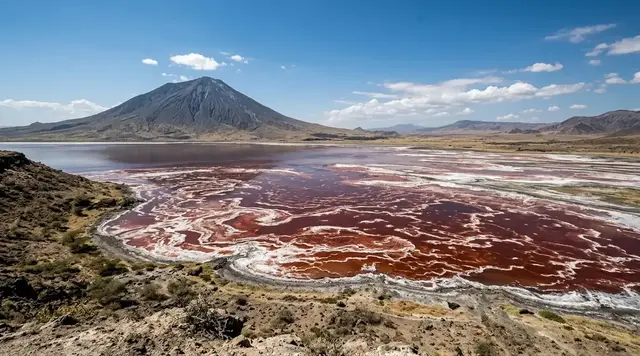
AI illustration
 Written and edited by
 Every itinerary in travel media is organised by country. This one is organised by a question, and the question has an answer with a number in it. Eleven nights across Iceland, the Finnish north and Svalbard costs roughly 2.9 tonnes of carbon dioxide equivalent per traveller. On the one relationship in polar science that has been reduced to a per-tonne constant, that is about nine square metres of September Arctic sea ice — a little more than the deck space one passenger occupies at the rail while looking at it.
Silence Index — R-001
Genuinely remote
Ranks 38 of 99 scored dossiers — quieter than 62% of the others we have scored. A low score is not a warning; it describes who else will be standing next to you.
How the total is weighted. These are the fixed weights of the four inputs, the same on every dossier — not this place’s scores. We do not publish per-input bars, because the per-input values were never recorded article by article and inventing four plausible numbers that sum to the total would be a fabrication dressed as a chart.
This dossier was scored before 2 September 2026, when the fourth input became night darkness. It keeps the input it was reasoned with until it is re-scored at its next source re-check; the methodology page records the change.
The index is a desk instrument scored by this publication, not a field measurement. How it is calculated, and where it fails.
Desk research, and what this is for
This is desk research. Nobody from this publication has flown this route. It is built from Vatnajökull National Park's own announcements, the Association of Icelandic Mountain Guides, Oulu2026, the Sámi Parliament of Finland, the Governor of Svalbard, the Norwegian Polar Institute and MOSJ, Statistics Norway, the IPCC and peer-reviewed climate science.
A Whisper Route is a sequence of places joined by one unresolved question. This one asks the hardest version available: what is the ethical position of a person who travels to see something because it is disappearing? The previous version of this piece asked it and declined to answer. This one does the arithmetic instead.
Stop 01 — Vatnajökull, Iceland. Four nights.
Start with the correction, because it changes the calendar. On 25 August 2024 an ice wall collapsed at a cave on Breiðamerkurjökull during an organised tour, killing one visitor and seriously injuring another. The park's statement the next day asked every operator to stop running ice-cave tours in park territory; all of them did.
What followed was contractual rather than legislative, which is why so little travel coverage registered it. Operators' agreements with the park expired at the end of September 2024 and were extended into November while new conditions were negotiated. By mid-October those were settled: each operator must designate an experienced lead guide who assesses the caves and ice walls daily, must avoid any site the joint assessment group judges unsafe that day, must pay a per-client fee funding a professional council, and must waive any claim for compensation when the park restricts access. We could not confirm from the park's own material that the regime commenced precisely on 1 November 2024, the date usually given; what is documented is the October settlement and the November expiry.
The season that emerged is not November to March. Caves inside the national park are closed roughly May through September, with the season running from October. Operators advertise accordingly — one park contract holder at Hali lists its crystal cave tour as November to April and its blue-ice tour as October to April, while its glacier walks and ice climbing run May to September, the exact inverse. Guide-to-guest ratios sit between 8 and 16 depending on tour type. Thirty companies held permits for the 2025-26 season out of thirty-four applicants, on two-year contracts the park intends to lengthen to five, and the national nature conservation authority may cap numbers outright if crowding demands it. Roughly 200,000 people take a glacier hike or an ice-cave tour in the park in a season, worth 4 to 5 billion ISK.
The park has been here before: an earlier pilot set daily ceilings of 650 people on each side of Breiðamerkurjökull, then dropped them in January 2021 when the pandemic emptied the country. The ice is not what sets your window. A contract is.
The qualification, precisely
The common shorthand is that your guide should hold "Jökla 3". Close, but not quite right. The Association of Icelandic Mountain Guides runs a three-step glacier ladder — Jöklaleiðsögn 1, 2 and 3, published in English as Hard Ice 1 to 3 — and Hard Ice 3 is a four-day assessment on outlet glaciers requiring a year and 100 working days since Hard Ice 2, twenty training days in complex terrain and a 70-hour advanced first-aid certificate. But ice caves are a separate two-day certification, built after a January 2021 workshop at Hali attended by six operators, AIMG and the national park, and the authorisations stack: Hard Ice 1 plus the cave course covers terminal zones, Hard Ice 2 plus the course adds outlet glaciers, and only Hard Ice 3 plus the cave course makes someone a lead guide for caves. So the right question is not "is your guide Jökla 3" but "who is the designated lead guide, and what did they assess this morning".
Fly to Keflavík; the south-east is then a drive on Route 1, with Skaftafell 130 km west of Höfn and accessible year-round weather permitting — a qualification that does a great deal of work in February. Eagle Air's 55-minute hop from Reykjavík to Hornafjörður is the alternative, and skipping it is the cheapest carbon saving here. Tours from a park contract holder run 24,900 ISK for a 3.5 to 4-hour crystal cave and 36,900 ISK for a five to six-hour blue-ice day, group size eight. Beds are scarce: Hótel Höfn has 68 rooms, and Fosshótel Vatnajökull has 66 and closes entirely from 4 December to 1 February. Neither publishes a rate card.
Stop 02 — Oulu and the Finnish north. Four nights.
Oulu holds the European Capital of Culture title for 2026 jointly with Trenčín in Slovakia, under a scheme that designates cities four years ahead. The year is genuinely running: the Oulu2026 Opening Festival took place 16 to 18 January 2026, drew about 250,000 visits across roughly 200 events, and premiered Ovllá, described by the organisers as the first full-length opera ever premiered in Finland in North Sámi. The programme runs in three seasonal strands and closes with the Lumo Art and Tech Festival on 13 to 22 November.
The scale of the region is stated three ways by three official pages and we are not going to reconcile them: Oulu2026's founding page says 33 municipalities, its front page 39, its programme page 40. Visit Oulu calls Oulu Finland's second largest airport; Finavia, which runs it, calls it the third busiest.
This is the leg most worth doing slowly. Finnair flies direct from Helsinki; but there is a railway, single fares start at €17.90, and VR advertised private sleeper cabins from €49 on autumn 2026 dates. A night train removes an entire flight sector and takes a night you were going to spend horizontal anyway.
On Sámi culture, said plainly
Sámi culture is not a tourist attraction. It is the living culture of the only Indigenous people in the European Union, whose status is written into the Constitution of Finland, and it is not a component of an itinerary the way an ice cave is.
Two things follow. The first is geographic, and most coverage gets it wrong: the Sámi Homeland in Finland is the municipalities of Enontekiö, Inari and Utsjoki plus the northern part of Sodankylä. Oulu is not in it — Inari is more than 430 km further north in a straight line. About 10,000 Sámi live in Finland, more than 60 per cent of them outside the Homeland, and the three Sámi languages spoken in Finland — North Sámi with some 2,000 speakers, Inari Sámi with about 400, Skolt Sámi with about 300 — are all endangered. Four nights in Oulu does not put you in Sápmi, and saying it does is the flattening the guidelines below exist to stop.
The second is that the guidance already exists and is not ours to paraphrase into something softer. The Sámi Parliament adopted its Principles for Responsible and Ethically Sustainable Sámi Tourism on 24 September 2018, and states its purpose directly: to terminate tourism exploiting Sámi culture and to eliminate incorrect information about the Sámi distributed through tourism. It distinguishes tourism based on Sáminess, offered by members of the community, from tourism utilising Sáminess, which it treats as appropriation. It says a person in Sámi dress who is not working in the travel industry must not be photographed without consent, and it names performing as a shaman on the basis of Sámi spiritual heritage, without connection to or consent from the community, as cultural identity theft. Read the original rather than a summary — including this one.
 AI illustration
Stop 03 — The ice edge, Svalbard. Three nights.
Longyearbyen is about three hours from Oslo and ninety minutes from Tromsø on SAS or Norwegian; Svalbard sits outside Schengen, so everyone shows a passport or national ID in both directions, and a NOK 150 environmental fee is collected through the ticket. Then the rules, which changed twice in fourteen months and are the most under-reported development in Arctic travel.
From 1 January 2025, in the large protected areas covering most of the archipelago, tourist landings may take place only at specific mapped sites listed in the regulations; vessels calling in the national parks are capped at 200 passengers; visitors must stay at least 300 metres from polar bears, rising to 500 metres between 1 March and 30 June, with an obligation to withdraw at close range; boats must keep 150 metres from walrus haul-outs. Drones are banned outright in protected areas, breaking fast ice is prohibited, and all camping needs a permit four weeks ahead.
From 1 January 2026, a second layer: an application or notification requirement for almost any activity outside the five inhabited places that make up the travel area — Longyearbyen, Svalbard Airport, Pyramiden, Barentsburg and Ny-Ålesund. Organised tourism applies eight weeks ahead; a private traveller at least four weeks ahead, carrying communication equipment. Search-and-rescue insurance is mandatory at NOK 120,000, 350,000 or 650,000 per incident by zone. From 1 July 2027 guides outside the settlements must be approved Svalbard guides — a scheme still being built in spring 2026.
Outside the settlements you must carry a means of scaring off polar bears; the Governor recommends a firearm, weapons applications are taking up to eight weeks, and in town firearms must be unloaded. Bears have been protected since 1973, and the most recent population figure the Norwegian Polar Institute publishes for the Barents Sea is a 2004 survey range of 1,900 to 3,600 animals — a twenty-two-year-old number, worth knowing before repeating any confident claim about the trend.
Seasons are formalised locally — Polar Summer 17 May to 30 September, Northern Lights Winter 1 October to 28 February, Sunny Winter 1 March to 16 May — and ship-based access to the marginal ice runs in the light half of the year. The ice edge has no fixed coordinates.
What the ice has done is measured, and is not one-directional. On the MOSJ record from 1979 to 2025, Barents Sea ice extent has fallen 28.9 per cent per decade in September and 9.2 per cent in April; in the Fram Strait the decadal figures are 13.6 and 5.7 per cent — and the same source notes an increase in Fram Strait extent over the most recent decade, against a long-term trend that remains clearly negative. Anyone who says it has simply gone is compressing that.
The arithmetic, in public
The assumptions are stated so you can disagree with them. Routing: London to Keflavík; Keflavík to Helsinki; rail Helsinki to Oulu; Oulu via Helsinki and Oslo to Longyearbyen; Longyearbyen via Oslo home. Great-circle sector distances, computed by us, total about 10,850 km flown. At the UK government's short-haul factor of 154 g CO₂e per passenger-kilometre — which already includes a 1.9 multiplier for non-CO₂ effects at altitude — that is 1.67 t CO₂e. Strip the multiplier out, as ICAO's official calculator does by reporting CO₂ only, and the same flying is 0.88 t. Both are defensible; anyone quoting one without naming the convention is being careless. The rail leg counts as zero.
The ship is the weak number and we are flagging it rather than hiding it. Take a small expedition vessel of about 120 berths burning marine gas oil. The IPCC default for gas/diesel oil is 74,100 kg CO₂ per terajoule at 43.0 TJ per gigagram — about 3.19 tonnes of CO₂ per tonne of fuel. At 6 to 18 tonnes a day, a bracket rather than a measurement, a four-day voyage is 0.64 to 1.91 t per passenger, central estimate 1.27 t. We could find no published emission factor for any named polar expedition vessel.
Total: about 2.9 tonnes of CO₂e per traveller, range 2.3 to 3.6.
Now the part usually left out. Notz and Stroeve established that observed September Arctic sea-ice area declines as a near-linear function of cumulative CO₂ emissions, at about 3 square metres per tonne; the IPCC's Sixth Assessment states that relationship with high confidence. Multiply. This itinerary removes roughly nine square metres of September sea ice — between about seven and eleven.
That is not a metaphor. It is the only place in polar science where the physics has been reduced to a constant a traveller can multiply by. Glaciers do not work this way — nobody can attribute one flight to one metre of Vatnajökull, and any operator offering you that conversion invented it. Sea ice is the exception, and the ice edge is stop three.
What popular coverage gets wrong about last-chance travel
The standard complaint about last-chance tourism is that it is hypocritical. That is a mood, not a correction. Here is a checkable one, specific to the itinerary format.
Last-chance itineraries treat the deadline as belonging to the landscape, then print a season to match: "Iceland's ice caves, November to March." That sentence is now wrong in both directions. It is too narrow — the park's season opens in October and runs to April — and it is wrong about the mechanism, because the closed months are closed by a contract written after a death, not by the ice being absent. The same coverage that dates the caves by the weather has almost nothing to say about the 200-passenger cap in Svalbard's national parks, the 500-metre polar-bear distance between March and June, or the fact that from January 2026 a private traveller must apply four weeks ahead to walk out of Longyearbyen. Those are the constraints that will actually cancel a trip, and they arrived while the listicles were counting down glaciers.
The second half of the correction is structural. An itinerary organised around imminent loss sells urgency, and urgency sells more trips rather than one final one — three destinations in eleven nights rather than one. Fold three vanishing places into a single route and you have tripled the flying required to witness what you are mourning. The format is the emission.
Why the route scores 82, and whether to go
Iceland pulls the average down: an easy flight, a car park, 200,000 people a season on the same five outlet glaciers. Svalbard pulls it back up hard — not because it is empty of visitors but because the friction is now real and legal. The Finnish north sits between the two and, for one year only, is deliberately louder than usual.
The point of the third stop is that a graph becomes a person telling you about a route they can no longer take. The point of the arithmetic is that you are also on the graph.
So: 2.9 tonnes, about nine square metres, eleven nights. We will not tell you that seeing the ice makes you care enough to justify it, because there is no published evidence that witnessing changes what a person flies — nor that staying home is a moral act, because the guides, the rescue infrastructure and much of the monitoring behind these numbers exist partly because these places are visited. What a route piece can honestly do is put both quantities where you see them and concede the conclusion it does not benefit from. If you decide that nine square metres of September sea ice is too much to spend on looking at sea ice, that is coherent and we have no argument against it. Not going is a legitimate outcome of reading this. If you do go: night train, no hop to Höfn, longer in fewer places, and ask your guide what changed on their own route.
Corner Codex — R-001
- Route
- Vatnajökull → Oulu and the Finnish north → Longyearbyen and the ice edge, 11 nights
- Season
- The three stops have three different seasons, and they do not fully overlap
- Iceland ice caves
- Closed inside Vatnajökull National Park roughly May to September
- Guide ratio, Iceland
- 8 to 16 guests per guide, set by contract with the park
- Oulu2026
- European Capital of Culture, opened 16–18 January 2026 with Trenčín, Slovakia
- Sámi Homeland
- Enontekiö, Inari, Utsjoki and northern Sodankylä — 440+ km north of Oulu
- Svalbard, from 1 Jan 2025
- 200-passenger cap in national parks; 300–500 m from polar bears
- Svalbard, from 1 Jan 2026
- Permit or notification for almost everything outside five settlements
- Flown distance
- About 10,850 km per traveller, London out and back
- Carbon cost
- About 2.9 t CO₂e per traveller — range 2.3 to 3.6
- What that is
- Roughly 9 m² of September Arctic sea ice, on the observed relationship
- Silence Index
- 82 / 100 (route average)
The Traveler's Panel · checked
Changing information. Prices, permits, seasons and road access change, sometimes at short notice. Everything here is a starting point for your own confirmation — not a quote, and not a guarantee. Verify with the operator and the relevant official body before you book.
| Season | Iceland caves Oct–Apr · Oulu2026 all year · Svalbard ice edge in the light half |
| Duration | 11 nights, 13–15 with weather buffer |
| Flown distance | About 10,850 km per traveller, London out and back |
| Carbon cost | About 2.9 t CO₂e (range 2.3–3.6) ≈ 9 m² of September sea ice |
| Iceland ratio | 8–16 guests per guide, set by contract with Vatnajökull National Park |
| Svalbard paperwork | Permit or notification outside the travel area from 1 January 2026 |
| Svalbard wildlife | 300 m from polar bears; 500 m from 1 March to 30 June; 150 m from walrus |
| Difficulty | Hard — winter driving, short daylight, and three separate regulatory regimes |
Getting there — Keflavík (KEF) → Helsinki (HEL) → Oulu (OUL) → Longyearbyen (LYR)
- Fly into Keflavík. The south-east is a drive on Route 1: Skaftafell is 70 km east of Kirkjubæjarklaustur and 130 km west of Höfn, accessible year-round subject to weather and road conditions. Eagle Air flies Reykjavík city airport to Hornafjörður in 55 minutes, twice daily Mon/Wed/Thu/Fri and once on Sunday — the easiest flight on this route to leave out.
- Book ice caves only with an operator holding a current contract with Vatnajökull National Park, and ask who the designated lead guide is and what they assessed that morning. Caves inside the park are closed roughly May to September.
- Keflavík to Helsinki, then take the train north rather than flying. Single fares to Oulu start at €17.90 and VR runs an overnight service with private sleeper cabins; the night train removes a whole flight sector from the itinerary.
- Oulu to Longyearbyen means Helsinki and Oslo. SAS and Norwegian serve Longyearbyen from Oslo in about three hours and from Tromsø in about ninety minutes. Svalbard is outside Schengen: carry a passport or national ID in both directions.
- For anything outside Longyearbyen, Svalbard Airport, Pyramiden, Barentsburg or Ny-Ålesund, check the Governor's application rules first. Organised tourism applies eight weeks ahead; private travellers at least four. Search-and-rescue insurance is mandatory outside the travel area.
- Build in two spare days. On this route weather will cancel something — and in Svalbard, so may an ice condition, a bear in the wrong place, or a permit.
Indicative costs — verify before booking
| Crystal ice cave, 3.5–4 hrs, group of 8 | 24,900 ISK (park contract holder, 2026 rates) |
| Blue ice cave, 5–6 hrs, group of 8 | 36,900 ISK |
| Helsinki–Oulu rail | Singles from €17.90 · night-train cabins advertised from €49 |
| Svalbard environmental fee | NOK 150, collected through your ticket |
| Svalbard SAR insurance (mandatory) | NOK 120,000 / 350,000 / 650,000 per incident by zone |
| Carbon, per traveller | ≈ 2.9 t CO₂e — the one cost nobody invoices you for |
| Note | We could not obtain published rate cards for accommodation at any of the three stops. Treat any all-in figure, including ours, as an estimate rather than a quote |
What to pack
- A genuine expedition-weight layering system, not a fashionable coat.
- Waterproof boots rated for cold rather than only for wet.
- A power bank carried warm against the body — cold flattens batteries fast.
- Ski goggles for wind on the ice, and a headtorch for Icelandic mornings that begin dark.
- Communication equipment for Svalbard outside the travel area — it is a legal requirement, not a precaution.
- Proof of search-and-rescue insurance for Svalbard, and your permit or notification confirmation.
- Two spare days in the calendar. Still the most important item on the list.
Where to stay
South-east Iceland is a small bed stock, not a resort coast. Hótel Höfn has 68 rooms across three buildings in the town; Fosshótel Vatnajökull, the nearest large hotel to the glacier tongues, has 66 and closes completely from 4 December to 1 February — so a deep-winter route has fewer options than a shoulder-season one. Guesthouses at Hali and around Höfn put you close enough for an early glacier departure. In Oulu, stay in the city for the Capital of Culture programme and take a night out toward the reserves. In Longyearbyen the accommodation is genuinely limited — Statistics Norway counted 16,704 guest nights in the whole settlement in June 2026, the peak month — and on a ship-based leg your berth is your accommodation.
Safety & responsible travel
- Reduce trip count, not trip length. The emissions on this route are in the flying: about 10,850 km and 1.67 t CO₂e of the 2.9 t total. Days on the ground cost almost nothing.
- Take the night train from Helsinki to Oulu and skip the domestic flight to Höfn. Those two decisions are worth more than every other choice on this list combined.
- Read the Sámi Parliament's Principles for Responsible and Ethically Sustainable Sámi Tourism before booking anything described as Sámi, and read the original rather than a summary. Do not photograph a person in Sámi dress who is not working in the travel industry without their consent.
- Do not describe a trip to Oulu as a visit to Sápmi. The Sámi Homeland is Enontekiö, Inari, Utsjoki and northern Sodankylä, more than 430 km north.
- In Svalbard, keep 300 m from polar bears and 500 m between 1 March and 30 June, 150 m from walrus haul-outs, and stay off fast ice. Camping needs a permit four weeks ahead.
- Discount any carbon-neutral-by-offset claim to roughly zero, and ask instead what the operator's fuel consumption per passenger-day actually is. Almost none of them publish it.
- Treat an operator who never cancels for weather as a warning rather than a convenience.
Nearby, and quieter
If Svalbard is beyond your budget or your conscience, the substitution that actually reduces harm is not a nearer glacier — it is fewer flights. Spend the third leg's budget and days extending the Finnish north instead: the Oulu2026 programme runs to the end of December 2026 and closes with the Lumo Art and Tech Festival on 13–22 November, and the Bothnian Bay ice is a sea-ice landscape you can reach by train. Around Vatnajökull, Skaftafell and Jökulsárlón are the obvious anchors; the glacier walks there run May to September, the inverse of the cave season, which means a summer visit is a different trip rather than a worse one.
Getting there, in order
- 1Keflavík (KEF)
- 2Helsinki (HEL)
- 3Oulu (OUL)
- 4Longyearbyen (LYR)
Each leg is a separate booking and a separate chance to be weathered out. Build spare days into the chain, not onto the end of it.
Where it is
Iceland · Finland · Svalbard · 64.9000°N 1.0000°W · Open in Google Maps · OpenStreetMap
Key locations
- Keflavík International Airport (KEF) — arrival for stop one; the south-east is then a drive on Route 1
63.9850°N 22.6056°W - Breiðamerkurjökull — the outlet glacier where the August 2024 collapse closed every cave tour
64.1170°N 16.3402°W - Höfn í Hornafirði — base for stop one; Hótel Höfn has 68 rooms and beds are scarce
64.2536°N 15.2119°W - Oulu Airport (OUL) — the flight the article argues you should replace with the night train
64.9301°N 25.3546°E - Oulu — stop two — European Capital of Culture for 2026, jointly with Trenčín
65.0122°N 25.4681°E - Svalbard Airport, Longyear (LYR) — one of the five inhabited places that make up the Svalbard travel area
78.2461°N 15.4656°E - Longyearbyen — stop three; from January 2026 you must apply weeks ahead to walk out of it
78.2233°N 15.6467°E
Coordinates are for orientation and are accurate to roughly the width of the feature named, not to a doorway. Several of these points are inside protected areas or need a permit, a guide or a boat — read the access notes above before you plan a route to any of them.
Sources & further reading — checked
- Vatnajökull National Park — Tilkynning vegna slyss á Breiðamerkurjökli. The ice-wall collapse on 25 August 2024 during an organised tour; the park's requirement that operators hold day-tour permits and their own safety plans; and the request that all ice-cave tours in the park stop, with which every operator complied
- Iceland Review — Stricter Safety Rules Imposed for Vatnajökull Ice-Cave Tours (16 October 2024). The new contract conditions — designated experienced lead guides assessing caves daily, avoidance of sites judged unsafe, a professional council funded by per-client fees, waiver of compensation claims — and the timing: previous contracts expired end September 2024 and were extended through November while the new terms were agreed
- The Reykjavík Grapevine — Visitor Numbers May Be Limited On Vatnajökull Ice Cave Tours (16 September 2025). The season beginning in October with caves closed May to September; guide ratios of 8–16 guests; about 200,000 glacier-hike and ice-cave participants a season; 30 companies permitted out of 34 applicants; ISK 4–5 billion a year; and contracts moving from two years to five
- Vatnajökull National Park — Niðurstöður á afgreiðslu umsókna um gerð samninga um íshellaferðir og jöklagöngur á suðursvæði. The earlier pilot's daily ceilings — 650 a day on each side of Breiðamerkurjökull, 1,000 on Falljökull and Virkisjökull, 500 each on Skeiðarárjökull and Skálafellsjökull — and the one-year trial contracts issued to 27 companies
- Vatnajökull National Park — Tilkynning um niðurfellingu fjöldatakmarkana í íshella. The board's decision of 20 January 2021 to remove the ice-cave and glacier-hike capacity limits then written into 26 companies' contracts — evidence that the ceiling on this landscape has been imposed, lifted and reimposed within a decade
- Vatnajökull National Park — Vinnustofa um gerð íshellanámskeiðs. The January 2021 workshop at Hali and on Breiðamerkurjökull that created the ice-cave guiding course, attended by six operators, three AIMG representatives and the national park, and the commissioning of an ice-cave handbook
- Association of Icelandic Mountain Guides — Hard Ice 3 (Jöklaleiðsögn 3). The four-day assessment on outlet glaciers; prerequisites of Hard Ice 2, one year and 100 working days, 20 training days in complex terrain and a 70-hour advanced first-aid certificate; and the certified guide's authority to set client-to-guide ratios
- Association of Icelandic Mountain Guides — Ice Caves (Íshellaleiðsögn). The separate two-day ice-cave certification and how authorisations stack: Hard Ice 1 plus the course for terminal zones, Hard Ice 2 plus the course for outlet glaciers, and Hard Ice 3 plus the course for lead-guide status in caves
- Vatnajökull National Park — Skaftafell. Skaftafell's position on Route 1, 70 km east of Kirkjubæjarklaustur and 130 km west of Höfn, and year-round access subject to weather and road conditions
- Isavia — Hornafjörður Airport. Eagle Air's Reykjavík–Hornafjörður service: about 55 minutes, twice daily on Mondays, Wednesdays, Thursdays and Fridays and once on Sundays, with extra summer frequencies
- Glacier Adventure (Vatnajökull National Park contract holder) — tours. Published 2026 prices and seasons: crystal ice cave 24,900 ISK for 3.5–4 hours at a group size of 8 in November–April; blue ice cave 36,900 ISK for 5–6 hours in October–April; and glacier walks and ice climbing running May–September, the inverse season
- Fosshótel Vatnajökull — hotel information. 66 rooms at the nearest large hotel to the glacier tongues, and its closure from 4 December to 1 February — a fact that materially constrains a deep-winter itinerary
- Hótel Höfn — hotel information. 68 rooms across three buildings at Víkurbraut 20 in Höfn, and the absence of any published rate card on the hotel's own site
- European Commission — European Capitals of Culture. Oulu and Trenčín as the 2026 titleholders, and the designation process in which cities are selected six years and formally designated four years before the title year
- Oulu2026 — Opening Festival. The Opening Festival on 16–18 January 2026, about 200 events and roughly 250,000 visits in the city centre, and the premiere of Ovllá, described as the first full-length opera premiered in Finland in North Sámi
- Oulu2026 — Programme. The three seasonal strands — Brave Hinterland, Wild City and Cool Contrasts — the 31 December 2025 countdown event at Ouluhalli, the Lumo Art and Tech Festival on 13–22 November 2026, and the figure of 40 municipalities
- Oulu2026 — front page. Confirmation that the Capital of Culture year is running through 2026 across the northern region, and the figure of 39 municipalities — one of three different official counts
- Oulu2026 — about the partnership. The implementation area across Northern Ostrobothnia, Kainuu and Meri-Lappi, and the figure of 33 municipalities, which conflicts with the 39 and 40 given elsewhere on the same site
- Visit Oulu — arrival and transport. Finnair's direct service from Helsinki and airBaltic from Riga, daily rail and bus connections, and the claim that Oulu has the second largest airport in Finland
- Finavia — Oulu Airport. The airport operator's own description of Oulu as the third busiest airport in Finland — directly contradicting Visit Oulu's 'second largest'
- VR (Finnish Railways). Helsinki–Oulu single fares from €17.90 and the overnight service, with private sleeper cabins advertised from €49 and cabins with a shower from €74 on autumn 2026 dates
- Sámi Parliament of Finland — About us. The Sámi Homeland as Enontekiö, Inari and Utsjoki plus northern Sodankylä; about 10,000 Sámi in Finland with over 60% living outside the Homeland; and the three endangered Sámi languages spoken in Finland — North Sámi (~2,000 speakers), Inari Sámi (~400) and Skolt Sámi (~300)
- Sámi Parliament of Finland — Responsible Sámi tourism. The stated purpose of the guidelines — to terminate tourism exploiting Sámi culture and eliminate incorrect information distributed through tourism — and the distinction between tourism based on Sáminess and tourism utilising Sáminess
- Sámi Parliament of Finland — Principles for Responsible and Ethically Sustainable Sámi Tourism (PDF). Adoption on 24 September 2018; the seven principles; the rule that a person in Sámi dress not working in the travel industry must not be photographed without consent; and the naming of performing as a shaman without connection to or consent from the Sámi community as cultural identity theft
- Governor of Svalbard — New environmental regulations enter into force on 1 January 2025. Landings for tourism only at specific mapped sites; a 200-passenger maximum for vessels calling in the national parks; 300 m minimum distance from polar bears rising to 500 m from 1 March to 30 June; 150 m from walrus haul-outs with 5 knots inside 300 m; drone and speed limits near bird cliffs from 1 April to 31 August; the fast-ice breaking ban; and camping permits four weeks ahead
- Governor of Svalbard — Application and registration requirement for trips (from 1 January 2026). The travel area (Management Area 10) as Longyearbyen, Svalbard Airport, Pyramiden, Barentsburg and Ny-Ålesund; eight-week applications for organised tourism and four weeks for private travellers outside it; mandatory communication equipment and reporting; insurance at NOK 120,000, 350,000 or 650,000 by zone; and approved guides required from 1 July 2027
- Governor of Svalbard — New regulations on field safety from 1 January 2026. The scope of the field-safety regulations across tourism, field activity and research, the insurance zones and amounts, and the 1 July 2027 start of the approved-guide requirement
- Governor of Svalbard — Travel in Svalbard. Landing restricted to mapped sites listed in the protected-area regulations; the 100 m safety zone around cultural monuments; the NOK 150 environmental fee collected via airlines and cruise lines; and SafeSeaNet pre-notification for vessels
- Governor of Svalbard — Weapons. The requirement to carry suitable means of scaring off polar bears outside the settlements, the recommendation of a firearm, processing times of up to eight weeks for weapons applications, and the rule that firearms in settlements are unloaded and barred from shops
- Norwegian Polar Institute — Polar bear. Protection since 1973; the most recent published Barents Sea survey range of 1,900–3,600 animals from 2004; late sea-ice arrival at the Kongsøya and Hopen denning areas; and up to three bears shot a year in self-defence
- MOSJ (Environmental Monitoring of Svalbard and Jan Mayen) — Sea ice extent in the Barents Sea and Fram Strait. Decadal decreases of 28.9% in September and 9.2% in April for the Barents Sea and 13.6% and 5.7% for the Fram Strait over 1979–2025 — and the increase in Fram Strait extent over the most recent decade against a clearly negative long-term trend
- Visit Svalbard — How to travel to Svalbard. SAS and Norwegian services to Longyearbyen, about three hours from Oslo and ninety minutes from Tromsø, and the passport or national ID requirement because Svalbard is outside Schengen
- Visit Svalbard — seasons. The three formal seasons: Polar Summer 17 May–30 September, Northern Lights Winter 1 October–28 February and Sunny Winter 1 March–16 May
- Statistics Norway — Accommodation statistics. Svalbard in June 2026: 7,884 arrivals and 16,704 guest nights, 82% of them foreign, at an average stay of about 2.1 nights
- AECO — Guidelines. The mandatory guideline set binding Arctic expedition cruise members across wildlife, vegetation and cultural remains, communities, small boats and site-specific Svalbard rules
- AECO — News (Svalbard guide certification). Member updates of 27 February and 27 March 2026 showing the Svalbard guide certification scheme and its course and training requirements still under construction ahead of the 2027 deadline
- Our World in Data — Which form of transport has the smallest carbon footprint?. The UK government emission factors used here: 154 g CO₂e per passenger-km for short-haul flights, 246 g for domestic and 35 g for rail, with a 1.9 multiplier for non-CO₂ effects at altitude already applied
- UK Government — Greenhouse gas reporting: conversion factors 2025. The current official UK factor set (condensed, full and flat-file editions) that underlies those per-passenger-kilometre values
- ICAO — Carbon Emissions Calculator. The only internationally approved aviation emissions tool, its 2026 methodology across four cabin classes — and the fact that it reports CO₂ only, which is why it and the UK factors give different answers for the same flight
- IPCC — 2006 Guidelines for National Greenhouse Gas Inventories, Volume 2 Chapter 1. Default emission factor of 74,100 kg CO₂ per TJ for gas/diesel oil at a net calorific value of 43.0 TJ/Gg — about 3.19 t CO₂ per tonne of marine gas oil, the basis of the ship estimate
- Simonsen, Walnum & Gössling — Model for Estimation of Fuel Consumption of Cruise Ships, Energies 11(5) (2018). That hotel load is a large share of a cruise ship's total energy use and that modelled consumption fits observations best at 70–75% of service speed — the reason a per-day figure is the right shape for a ship leg
- Notz & Stroeve — The Trajectory Towards a Seasonally Ice-Free Arctic Ocean, Current Climate Change Reports 4 (2018). The observed sensitivity of about 3 m² of August–September sea-ice area loss per tonne of CO₂ emitted, and the 500–1,100 Gt range for an ice-free Arctic summer around a central 800 Gt
- Notz & Stroeve — Observed Arctic sea-ice loss directly follows anthropogenic CO₂ emission, Science 354(6313), 747–750 (2016). The original finding of a linear relationship between monthly September sea-ice extent and cumulative anthropogenic CO₂ emissions, and that most climate models underestimate the observed rate of decline (record accessed via OpenAlex; the publisher page is paywalled)
- IPCC — Sixth Assessment Report, Working Group I, Chapter 9. High confidence that observed Arctic sea-ice area decline is well described as a linear function of global mean surface temperature and thus of cumulative anthropogenic CO₂ emissions, with superimposed internal variability
- Cordero et al. — Black carbon footprint of human presence in Antarctica, Nature Communications 13 (2022). Black carbon at 2–4 ng/g around stations and tourist sites against a ~1 ng/g background, snowpack losses up to 23 mm water equivalent a summer, and an estimated 83 ± 43 tonnes of snow melted per average Antarctic visitor — a parallel per-visitor attribution from the other pole
Official and scientific bodies are the authority for safety, regulatory and scientific claims. Commercial operators are used only for practical detail such as tour length, meeting points and indicative pricing — never for a safety or scientific statement.
How this was made
Desk research. Compiled from official bodies, scientific and conservation sources, established journalism and licensed operators. Not based on a personal visit.
Editor’s method note — what we checked, corrected and could not verify
- Desk research only. Nobody from this publication has travelled this route, and every logistical claim below should be re-checked against the issuing authority before you book.
- The single largest correction is to the season. The previous version of this article gave the route as 'November to March' and said the Icelandic ice caves are stable 'for roughly November to March'. That is now wrong in both directions. Ice caves inside Vatnajökull National Park are closed roughly May to September and the season runs from October to April, and the closure is the consequence of a fatal collapse on 25 August 2024 and the contract conditions settled in October 2024 — not of the ice melting on a calendar.
- We corrected the guide-qualification shorthand. 'Jökla 3' is the Icelandic name for AIMG's Hard Ice 3 glacier certification, but ice caves are a separate two-day course, and it is Hard Ice 3 plus that course which confers lead-guide status in caves. Asking whether a guide is 'Jökla 3' is a weaker question than asking who the designated lead guide is and what they assessed that morning.
- We corrected a geographic error implicit in the previous version, which offered 'access to Sámi cultural life' from a base in Oulu. The Sámi Homeland in Finland is Enontekiö, Inari, Utsjoki and northern Sodankylä, more than 430 km north of Oulu in a straight line. We have also stopped paraphrasing responsible-visiting advice and now point to the Sámi Parliament's own 2018 principles, which are more specific and more binding than anything we would write.
- We added the Svalbard regulatory layer, which the previous version omitted entirely while describing the third stop as 'the ice edge' with 'the exact location depends on the year'. The 1 January 2025 environmental rules and the 1 January 2026 application and insurance rules are the practical constraints on that leg and they are stricter than most 2026 travel coverage reflects.
- The carbon total is our own calculation and is stated with its assumptions: great-circle sector distances totalling about 10,850 km London out and back; the UK short-haul factor of 154 g CO₂e/pkm including the 1.9 non-CO₂ multiplier, with the CO₂-only figure of 0.88 t given alongside because ICAO's official calculator uses that convention; the rail leg counted as zero; and a 120-berth expedition vessel burning 6 to 18 tonnes of marine gas oil a day at the IPCC default of about 3.19 t CO₂ per tonne of fuel. Total 2.9 t CO₂e, range 2.3 to 3.6.
- We deliberately did not average the sources that disagree. Oulu2026's own pages give 33, 39 and 40 municipalities; Visit Oulu calls Oulu Finland's second largest airport and Finavia, which operates it, calls it the third busiest; the Barents Sea sea-ice trend is sharply negative while the Fram Strait has seen an increase over the most recent decade against a negative long-term trend. All three conflicts are shown rather than resolved.
- Things we could not verify: a published rate card for accommodation at any of the three stops, which is why the cost figures are labelled estimates; the exact number of designated landing sites in Svalbard's protected areas, which the Governor's regulations list by map rather than by count in the material we could open; whether the Vatnajökull contract conditions formally commenced on 1 November 2024, the date usually given, as against the documented October settlement and November expiry of the extension; any published fuel-consumption or emissions-per-passenger-day figure for a named polar expedition vessel, which is the weakest input in our carbon total; the current Barents Sea polar bear population, the most recent published Norwegian Polar Institute survey being from 2004; the registration status and governing body of the Sámi Duodji trademark, for which we could not open a primary source and which we therefore do not describe; the fastest scheduled Helsinki–Oulu rail journey time, which VR publishes only through its live trip search; and the 2026-27 ice-edge sailing schedules and prices from Longyearbyen, which operators had not published in a form we could verify.
- Coordinates for the key locations are from the GeoNames gazetteer for Breiðamerkurjökull, Höfn, Oulu and Longyearbyen, and from OurAirports for Keflavík, Oulu and Svalbard Longyear. This is a route rather than a place, so the points are the three stops and the three airports the itinerary actually uses; the Breiðamerkurjökull pin is the glacier as a body of ice, not a cave entrance — the caves move each season and the park does not publish their positions. The ice edge, stop three's real object, has no fixed coordinates and is not pinned.
AI is used to draft this text, and a human checks it. Every figure, date and quotation above was verified by Tony Hall against the source cited for it in the reference list; where sources disagree, the disagreement is shown rather than resolved, and where a claim could not be confirmed it is either marked unverified or left out. The illustrations are AI-created and labelled as such — no photograph on this site is presented as a record of a real place. Full disclosure · Editorial policy.
Access details change — recheck before you travel. Found an error? Tell us — corrections are dated and shown in place.