From seawater to a harvest: follow the sequence
Solar salt production uses evaporation, but the sun does not organise a farm. A producer must prepare surfaces, manage water and decide when the brine is ready for the next stage. Think of the landscape as a sequence of tasks rather than a collection of identical ponds. The field closest to you may be doing a different job from the one beyond it.
In a WIPO IP Advantage account of Kampot-Kep salt, producer Sophal Chhun describes preparations around the start of the dry season, usually November. The account explains cleaning and compacting pans, concentrating seawater, filtering it and moving it through production stages before crystals are gathered. Its roughly week-long final crystallisation example depends on intense sunshine; it is not a timetable promised to visitors.
That sequence suggests useful questions for a guide. Which compartment holds incoming water? Which is used for concentration? Where is salt ready to collect, and what visible clue tells the producer that it is ready? Asking about a particular feature is easier to answer than asking someone to summarise their whole livelihood while they are working.
You do not need to measure the brine yourself. Do not dip a hand, bottle or instrument into a production pan. A clear explanation, a permitted view and perhaps a sample offered in an appropriate setting provide plenty to learn from. If a tasting is available, let the producer decide which finished product is suitable; the field is a place of manufacture, not a self-service tasting counter.
Try making a four-part note: water arrives; water becomes more concentrated; crystals form; the harvest is handled. Then write one local detail beside each stage you actually learn about. Perhaps you are shown a channel, told why a surface is prepared a particular way, or shown how salt is packed. Leave a blank where you have no evidence. A partly completed sequence is more accurate than a confident explanation built from assumptions.
The finished packet tends to conceal this chain of decisions. A visit restores some of it. It also changes the meaning of waiting: a pause may belong to the weather or the production stage, rather than indicating that a farm is abandoned or that nothing happens there.
Read one pan before photographing the whole horizon
Choose a permitted stopping place where you are not obstructing a road, a worker or a water channel. Start with the edge of the nearest compartment. Notice its height, width and continuity. Then look for an opening or connection. The question is not simply where the water sits, but how it can be managed.
Now compare surfaces. One may reflect the sky; another may show earth, ridges or a pale deposit. Record those appearances without automatically naming the production stage. Cloud, viewing angle and water depth can change a photograph dramatically. A white patch is not enough evidence to explain an entire harvest, and a brown surface does not prove a failed season.
Next look beyond the foreground. Can you see storage, a working route, a dwelling or a different land use? Which details show that this landscape has practical connections to the surrounding settlement? A wide view becomes much more informative when the small structures within it are treated as part of the story rather than distractions to crop out.
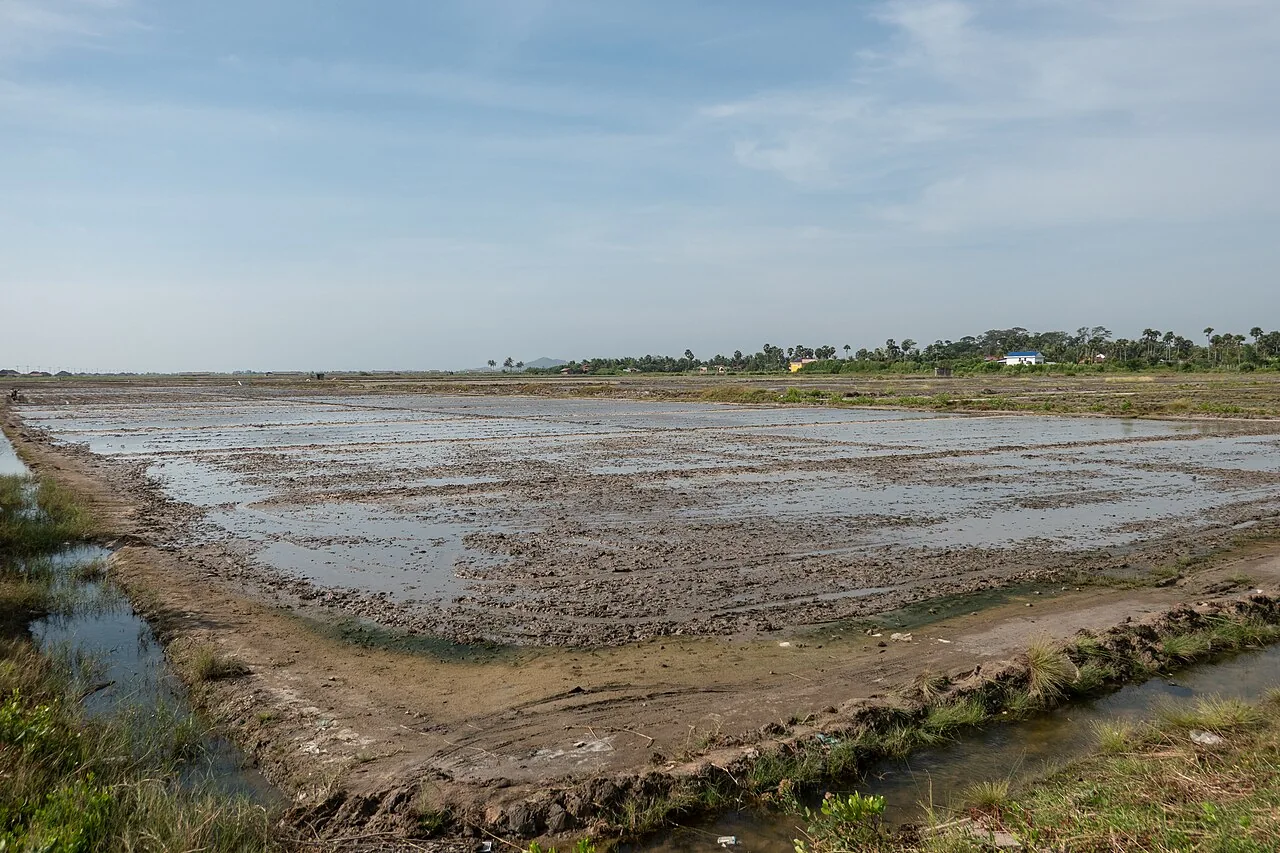
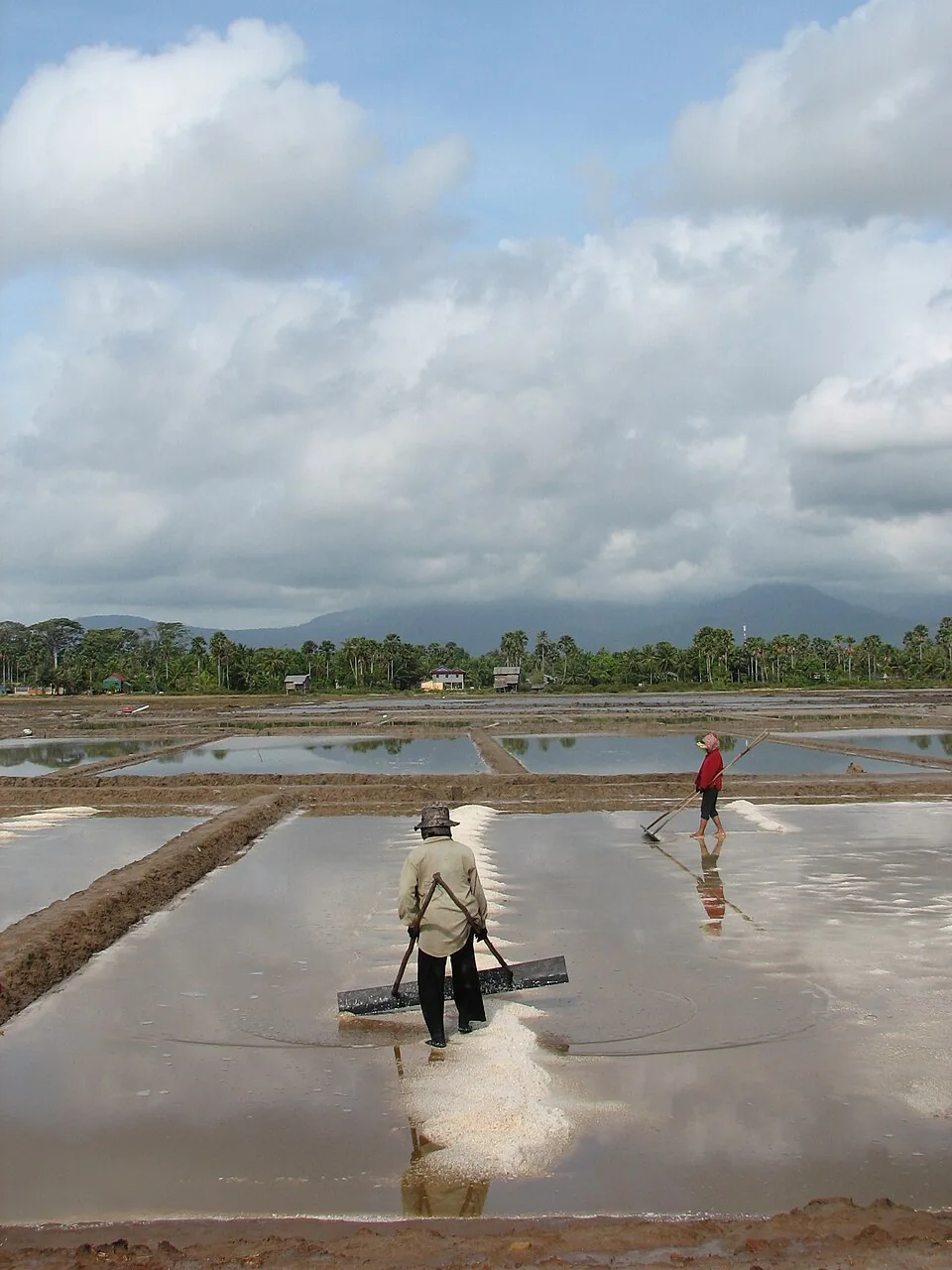
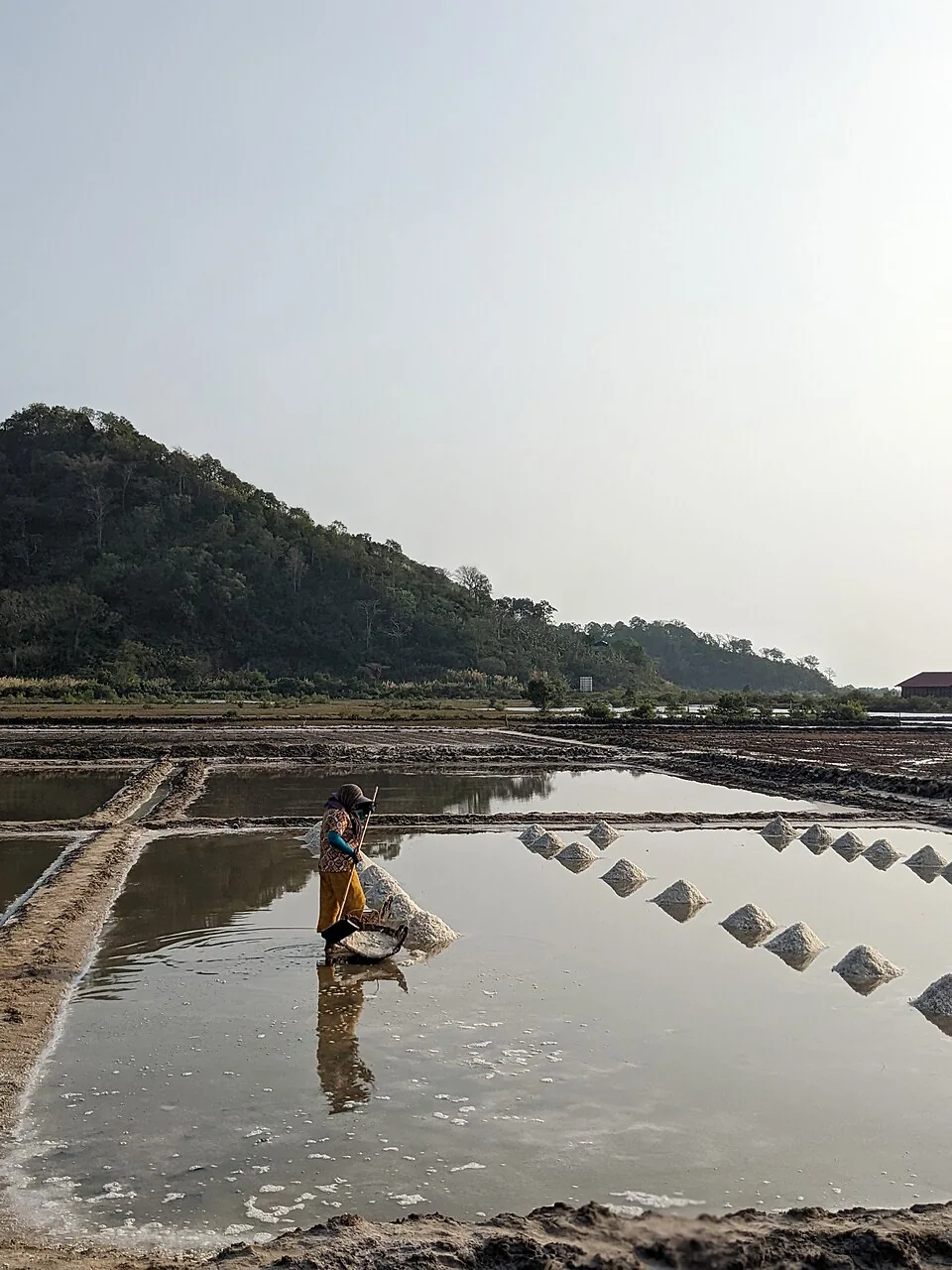
The photographs in this guide offer an exercise in that distinction. The wet pans photographed in December 2019 and the salt work photographed in March 2023 come from different dates and locations. They illustrate variety; they do not document successive stages on the same farm. Even a correctly dated photograph cannot tell you what will be happening during your own visit.
For your own notes, make three columns: visible, explained, still unknown. Under visible, describe the shape of a channel or a person's action. Under explained, record what an identified guide or producer tells you. Under unknown, keep questions such as why a particular pan is not in use. This simple separation makes a travel journal more useful and prevents an attractive view from becoming an invented account of somebody else's work.
There is an interesting comparison with Tonlé Sap's changing water landscape. Both reward attention to timing, although the processes and livelihoods are very different. At the lake, the guide helps you choose a visit around a changing waterscape; here, it helps you recognise how a producer manages water within a working field.
When to visit Kampot salt fields—and when to change the plan
If watching salt production is your main reason to go, choose a dry-season trip and ask about current activity shortly before your outing. November can involve preparation rather than the white heaps seen in harvest photographs. A calendar gives you a starting point; recent rain and the stage of work determine what is available to see.
Make the distinction clear when booking. “We would like an explanation of the salt-making process, with a field visit if production and access permit” gives a provider room to arrange something useful. “We need workers harvesting at sunset” turns a weather-dependent livelihood into a requested performance. The first brief is also more likely to produce an honest answer about whether your day is suitable.
For a hot-season trip, including an April itinerary, choose a shorter exposed stop and arrange a shaded break. An earlier visit may be more comfortable, but only agree on a time after checking what the host can offer. Photographic light, visitor comfort and the producer's work schedule are separate considerations. There may not be a single hour that serves all three perfectly.
After rain, ask about both production and the access route. A road that is passable for the driver's vehicle may still leave an awkward final walk for someone who needs firm footing. Be specific about your needs: a short walk from the vehicle, no narrow banks, or a place to sit. A general answer that “the fields are open” does not resolve those details.
During a wetter period, decide whether seeing the landscape itself interests you. If it does, a brief permitted stop with a good explanation can still work. If your interest is entirely in active harvesting, substitute a product-focused visit rather than spending a long journey hoping the weather will reverse. Buying labelled salt and learning how it is made is a reasonable alternative, not a failed version of the holiday.
Leave flexibility in the rest of your day. Keep a town walk, reading time or meal as an alternative that does not require another long transfer. The best seasonal itinerary has a clear purpose and a changeable route. It does not collapse because one field looks different from an old image.
A working landscape also carries difficult history
It is tempting to describe traditional production as an unbroken, peaceful continuity. That would flatten Cambodia's twentieth-century history. Salt fields can be places of present-day skill and livelihood while also belonging to a landscape with painful historical associations. Neither layer cancels the other.
In their public final submission in Case 002, the ECCC Co-Prosecutors described forced labour at the Srae Ambel salt worksite, including confinement and inadequate food. This is an attributed historical prosecutorial account. It should not be used to claim that a particular farm you pass today was the exact location of a described event, or to assign a personal history to a worker you photograph.
For a visitor, that distinction changes how questions should be asked. Arrange historical interpretation with someone who offers it. Do not assume an older person wants to discuss the Khmer Rouge period, and do not approach workers as if they are exhibits in a history lesson. A person's presence in a landscape is not consent to tell you their family story.
If you want to learn more, read a broad history of Cambodia before trying to connect particular sites and testimonies. Note the date, type and purpose of each source. A court filing, a witness account, an academic history and a tourism description answer different questions. They should not be blended into one dramatic anecdote whose origin the reader cannot trace.
This guide keeps the historical note separate from the photographic invitation for that reason. There is no need to stage an emotionally charged image to acknowledge the past. You can make room for history through reading, careful language and a willingness to hear only what a host chooses to share.
A useful journal entry might record the question you need to investigate next, rather than a conclusion about how a community has “recovered.” Recovery is not something a passing visitor can establish by looking at a productive field. The most respectful account may be the one that recognises the limit of the visit while taking the history seriously enough to continue learning.
What the Kampot-Kep name tells you on a packet
The name on a bag of salt can connect a purchase to a defined place and production system. It can also be used loosely in marketing. When buying, move beyond the largest lettering and look for the producer, origin and traceability information that supports the claim.
The Kampot-Kep salt producers' association explains its geographical indication through a delimited production area, a specification and verification. Its labelling information includes a producer's name and address and a batch number. Those details give you something more concrete to check than an attractive photograph of a salt field on the front of the package.
The legal story has also moved forward. EU Regulation 2025/1514, dated 28 July 2025, grants protection in the European Union to the registered geographical indication Kampot-Kep Salt. Older material describing European protection as a future application therefore needs to be read in its publication context.
For a traveller buying one small packet, the practical task is straightforward. Check who made or packed it, what origin is stated, whether a batch is identifiable and how it should be stored. If you are offered several products, ask what differs between them: crystal size, processing, added ingredients or intended use. A blend containing pepper is a different purchase from plain salt, even when both carry local branding.
A protected origin is not a reason to make health claims. “Artisanal,” “mineral” and “traditional” do not by themselves establish that a salt is medically preferable. Buy for provenance, flavour, texture or your interest in the producer's work. Follow any dietary advice you already have rather than treating a travel purchase as a health intervention.
Keep the packaging if you plan to write about the product later. A photograph of both sides records far more than a memory of the shop display. It also helps you distinguish the seller from the producer. If the two are different, describe them accurately; buying in Kampot does not automatically mean you bought directly from the person who made the salt.
Meet the work without turning people into scenery
A salt field is somebody's workplace. The first courtesy is to arrive through an arrangement the host recognises, or remain in a genuinely public viewing position without entering production areas. A road beside a field is not a standing invitation to cross its banks. If access is uncertain, ask your driver or guide to clarify it before anyone walks in.
For portraits, ask before raising the camera and accept a refusal without trying again from farther away. Permission to photograph a field does not automatically include every person in it. If the photograph will appear on a public website or social page, explain that use in a way the person can understand. A nod to a quick holiday photo may not communicate the same thing.
Do not ask someone to repeat a movement, change clothing or stand in a more picturesque position while they are working. A producer who offers a paid demonstration can explain its terms; a spontaneous request to carry salt for your camera is different. Record a demonstration as a demonstration rather than presenting it as an unnoticed scene of everyday work.
Clothing can be practical and considerate without becoming a costume. Lightweight coverage, a hat and footwear suited to the agreed route make more sense than copying a worker's outfit from a photograph. A krama can be a useful personal cloth if you choose to carry one, but wearing it does not grant cultural expertise or replace suitable protection from sun and weather.
For conversation, a few short questions are enough: What is happening in this pan today? What changes after rain? Is there a finished product available to buy? May I take a photograph? Use a guide for interpretation where needed, and allow the answer to determine your next question. The aim is an exchange, not a checklist of local facts extracted in a hurry.
Pay for the service you agreed to receive. If someone has set aside time to explain production, that time has value even if the weather prevents a harvest. Buying salt can be an additional choice, but it should not quietly replace an agreed guiding fee. Clear arrangements make the encounter easier for both visitor and host.
A small shot list with a larger story
Three well-chosen photographs can explain more than twenty similar horizons. Plan an establishing view, one process detail and one image connecting the product to its maker or place. The third might be a labelled packet, a permitted view of a working structure or a portrait made with clear consent. It does not have to include a face.
For the establishing view, include the relationship between compartments and their surroundings. Keep enough of an edge or channel in the frame to show how the landscape is organised. If you crop everything except the reflection, the result may be beautiful but less informative. Decide whether you are making an abstract image or documenting a place, and caption it accordingly.
For a detail, choose something you can identify correctly: a channel you have had explained, salt offered for inspection, or the lettering on a packet. Do not touch production equipment or step onto a narrow bank to remove an inconvenient object from the frame. Change your position only within the area your host says is suitable.
When light is harsh, watch the bright parts of the image. White crystals and reflected sky can lose detail even when the rest of the scene looks well exposed. On a phone, try tapping a bright area and making a small exposure adjustment, then review the result. This is a photographic suggestion, not a reason to linger in heat after you or your host want to leave.
Keep captions short and factual: subject, place, month or year, and any essential context. “Salt gathering near Kampot, March 2023” says something useful. “An ancient tradition untouched by time” makes a sweeping claim that the photograph cannot prove. If the image is licensed from another photographer, retain their required credit and link; it should never look like evidence of a team visit that did not occur.
For a return assignment, the most useful new photographs would show a permitted preparation stage, a producer explaining the water sequence, and a finished product with traceable labelling. Those would fill genuine gaps in this guide. Another sunset silhouette would add less information, however attractive it might be.
Plan a specific outing from Kampot, not a vague pin
“Kampot salt fields” describes a landscape with different plots and approaches, not one single visitor gate. Before leaving town, agree on the actual place your host expects to use. Save the meeting point, the provider's contact and the return arrangement. A photograph's coordinates can locate a historical view, but they do not establish today's right of access.
The embedded map marks a documented salt-field area for orientation. It is not a ticket office or a recommended place to enter private land. Ask your host for the correct stopping position and route. This is particularly important if you are meeting independently rather than travelling with someone who has already arranged the visit.
For a hired vehicle, discuss the whole outing: collection from your accommodation, the field stop, waiting time, any additional destination and the return. If you want a long conversation or photography time, say so before the price is agreed. A short roadside stop and a hosted explanation use different amounts of time, even if both appear in an itinerary as “salt fields.”
If you are considering a bicycle or motorbike, assess the actual route, your ability and the relevant licence and insurance conditions before choosing it. Do not let the short distance suggested by a map stand in for those checks. Heat, traffic, surface conditions and a return after dark can change the character of an otherwise simple outing. A driver may be the more comfortable choice for a visit centred on learning rather than riding.
Travellers with mobility needs should ask for concrete information: distance from the vehicle, surface type, steps, width of the permitted route and availability of a seat or toilet. Send those questions before booking. An attractive flat landscape can still have narrow, uneven access, and the absence of hills does not establish accessibility.
Keep any onward connection separate from the field stop. If you must reach a bus departure, allow a comfortable margin and tell the driver when you need to be back. The outing should fit the journey you actually have, rather than forcing a tightly timed transfer around an uncertain production visit.
Budget for time, transport and an explanation
There is no single admission price established here for every salt-field visit. An independently arranged stop, a producer-hosted explanation and a wider countryside tour can have different charging arrangements. Ask what you are paying for, who receives it and whether the amount is per person or for the whole group.
Start with transport. Is the quote for a return journey with waiting, or only a drop-off? Then add any guide or host fee. If admission or a visit contribution is charged separately, record it as a separate item. Food, drinking water, purchases and accommodation belong in the budget only to the extent that you want them included in this excursion estimate.
Here is an arithmetic example, not a current price recommendation: two people enter a transport allowance of US$20, a whole-party guide allowance of US$15 and food of US$6 per person. The total is US$47 before any separate visit fee or purchases. If a US$5-per-person visit charge is later confirmed, the estimate becomes US$57. Replace every example amount with your own quote.
The calculator below follows that logic. Shared costs are counted once; per-person costs are multiplied by the number of travellers. Accommodation is optional, because many readers are already staying in Kampot and only need the outing's additional cost. A blank box means no amount has been entered, not that the service is free.
Use one currency throughout. If a provider quotes in riel and another in US dollars, convert the amounts consistently using a rate you have checked for your transaction. Keep the original quotes in your notes so you can explain any difference later. A precise-looking total is not especially useful if its inputs mix currencies or count the same service twice.
Finally, separate a souvenir allowance from the price of access. You should be able to decide whether to buy a product without wondering whether an unspoken purchase is expected in return for the visit. Clear terms are good for the producer too: they distinguish a paid service from an optional sale and make comparisons between providers fairer.
Choose the host before adding more stops
For this outing, a useful description of the visit matters more than the number of attractions in the package. Look for someone who can explain what is likely to be happening in the fields and who will make the necessary access arrangements. A long list of countryside stops may leave very little time for the one subject that interests you.
Send a short brief: your dates, number of people, preferred language, any mobility needs and the fact that salt production is the main interest. Ask whether a producer will be present, whether interpretation is included and what replaces the field visit if rain or work conditions make it unsuitable. These questions are more informative than asking whether the tour is “authentic.”
Check the difference between a guide and a driver. Some providers offer both skills; others offer transport and a brief introduction. Neither arrangement is inherently wrong, but the price and your expectations should reflect what is promised. If you want a detailed explanation of the production stages, make that requirement explicit.
Ask about cancellation and changes before payment. In a weather-dependent visit, the important detail is what happens when the planned activity cannot take place. Will there be a different stop, a shorter outing, a new date or another arrangement? Read the actual terms rather than assuming every provider handles weather in the same way.
For accommodation, compare the address and journey from your room to the meeting point. A property described broadly as Kampot may not suit a traveller who wants to walk to town services or return easily between activities. Look at room arrangements, cancellation conditions and transport needs together; a lower room rate can be offset by journeys you had not planned.
The links below are starting points for checking the product's identity and finding a base. They do not certify a particular tour, promise field access or imply that Hidden Corners has personally tested a provider. Choose an arrangement whose details match the visit you want.
Pack for an exposed workplace, especially in April
Keep the bag small enough that you can move comfortably along the permitted route. The essentials are drinking water, practical sun protection, a phone with your meeting details, suitable footwear and any personal items you need away from your accommodation. Add rain protection when conditions call for it; leave specialist equipment behind unless you have a clear use and permission for it.
For an April or other hot-weather visit, think about exposure before thinking about accessories. A lightweight long-sleeved shirt, a secure brimmed hat and sunglasses can be more practical than repeatedly adjusting a loose covering in the wind. Arrange a shaded pause and shorten the stop if the conditions become uncomfortable. Carry enough water for your own needs without assuming a field has a visitor shop.
WHO's sun-protection guidance recommends shade and protective clothing, with broad-spectrum sunscreen of at least SPF 30 on uncovered skin. Use sunscreen as directed and reapply as needed; it is not a reason to extend time in strong sun. Choose products you can use comfortably rather than buying something solely because it appears in a travel packing photograph.
Footwear should suit the route your host confirms. A firm roadside viewpoint and a damp uneven path call for different decisions. Do not copy barefoot working practices seen in photographs. Workers know their tasks and environment; a visitor's brief access is not the same situation. Keep out of production water and ask before entering any area beyond the agreed path.
A krama is optional. You might use your own cloth for comfort or to protect a personal item, but it does not replace a hat, suitable clothing or a dry bag. If you buy one, ask about material and origin rather than assuming every checked textile in a local shop was woven nearby. Practical curiosity makes a better purchase than a demand for a single “correct” Cambodian look.
Use a dry pouch for your phone if rain is possible, and keep a small bag for your own litter. A notebook can be useful for recording the process and the producer's name with permission. The best item in the bag may be a saved question: knowing what you want to learn reduces the temptation to carry equipment for a visit you have not actually arranged.
Three ways to give the day a clear purpose
The production-focused outing: begin with a confirmed appointment or arrangement for a field explanation. Give that stop the most flexible part of the day. Follow it with a place to sit, review notes and buy a finished product if you want one. Add another attraction only if travel time and the host's schedule leave room. This plan works best when seeing and understanding the current work is your priority.
The weather-flexible food day: start with a producer or retailer who can explain the salt's origin and labelling. Keep the fields as a short optional stop if conditions permit. Choose a meal for your interests and ask how ingredients are used rather than expecting a staged tasting everywhere. This version still has a coherent theme if the pans are not harvesting.
The photography-and-notes visit: agree on a permitted location and a realistic amount of time. Make an establishing view, an identified detail and a product or contextual image. Set aside time afterwards to caption them while the explanation is fresh. The result can be a small, accurate visual story instead of a large folder whose subjects you cannot identify.
Each version can fit within a broader Kampot stay, but none requires a fixed minute-by-minute timetable. Choose a comfortable return time and protect it. If travelling with children or anyone who tires in heat, keep the exposed portion short and the next stop easy to reach. Explain beforehand that a working field is not a playground and that touching water or equipment is not part of the visit.
For a longer Cambodia journey, the contrast with the temple guides is valuable. At Sambor Prei Kuk, brickwork records choices made by builders; at Kampot's salt fields, you can ask about decisions being made in the current production cycle. Seeing both expands the trip beyond a list of monuments without treating contemporary livelihoods as a lesser form of heritage.
Leave a little space after the outing. A useful follow-up might be reading about geographical indications, checking a book's chapter list or finding the producer's details on the packet you bought. The visit becomes richer when the understanding continues after the vehicle returns to town.
Three books, three different questions
Choose your reading by the question the visit leaves you with. If you are interested in how an ordinary ingredient became historically important, begin with Mark Kurlansky's Salt: A World History. Its scope is global. Use it to broaden the subject, not as evidence for a particular Kampot farm or as a substitute for a local production explanation.
David Chandler's A History of Cambodia provides a wider historical frame. It belongs beside the short historical note in this guide because a landscape cannot be understood only through its most photogenic activity. Check the edition and contents before buying, especially if your main interest is a specific period. A general history will answer different questions from a detailed court record or specialist study.
Kate Reavill's Cambodia — Culture Smart! offers another kind of preparation: an introduction to social customs and everyday interactions. Read a cultural guide as context rather than a script that every Cambodian person will follow. Your host's own preferences, the purpose of the visit and the situation in front of you remain more important than an assumed national rule.
The three selections below are based on publisher information, not a claim that the editorial team has read and reviewed every page. The Amazon buttons search for the specified title and author; compare editions, format, delivery and availability yourself. The current links contain no affiliate tracking.
You can also follow the free sources at the bottom of this article. Start with the producer account for the process, then the association's information for product identity. If you read the legal protection document, remember that it concerns a name and its protection; it is not a visitor-access policy. Choosing the right source for the question is part of learning to travel with better information.
Questions worth settling before you leave town
Are the Kampot salt fields worth visiting when there is no harvest?
Yes, if the landscape and process interest you and you can arrange a useful explanation or permitted view. If your only aim is to watch salt being gathered, check current activity and change the plan when necessary. A product-focused stop may suit you better than a long outing built around an image you cannot reasonably expect.
Can I walk anywhere between the pans?
No. Agree on the permitted route with the host or landholder. Narrow banks, water channels and production surfaces serve working purposes. A map pin or another visitor's photograph does not establish public access. Remain outside uncertain areas and choose a different viewing position if permission is not available.
Do I need a guide?
A guide is useful if you want interpretation, access arrangements or help communicating with a producer. For a brief public roadside view, you may need only transport, but that is a different experience. Ask whether the person you hire provides detailed explanation or simply drives the route, and book according to what you want to learn.
Should I combine the fields with a pepper visit?
That can make sense if you are interested in food production and the travel time is comfortable. Keep the two products distinct and arrange each visit on its own terms. Do not let a package's shared Kampot branding imply that the farms are adjacent, that the same host makes both products or that one geographical indication covers everything sold there.
Can I buy salt to take home?
Choose a packaged product with clear producer and ingredient information, then check the food-import rules for your destination and any transit restrictions that apply. Keep the label and receipt. The amount and packaging suitable for your journey depend on those rules; this guide does not promise that every country admits every food souvenir.
What should I remember most?
The field you see belongs to a particular day in a working cycle. Ask what is happening, notice how the place is organised and let the answer shape the visit. A thoughtful hour with a clear explanation can leave you with more understanding than a whole day spent chasing the perfect white-salt photograph.
A closer look.
Three documentary photographs from different dates and locations. They show a working landscape in varied conditions, not successive stages on a single farm.

Sok Heng Oeun
Sok Heng Oeun is the owner and editor of Hidden Corners. The Hidden Corners Editorial Team supports image preparation and editorial checks under his direction.
Sok Heng Oeun on Facebook ↗Research and AI-assisted editorial preparation. Publication authorized by Sok Heng Oeun; an individual owner reading review is not recorded. This guide does not claim a firsthand team visit.
Sources & image credits
Sources supporting this guide. Dated prices and access reports can change; confirm with the responsible authority before travelling.
- WIPO IP Advantage account of Kampot-Kep salt ↗
- ECCC Co-Prosecutors described forced labour at the Srae Ambel salt worksite ↗
- Read about Kampot-Kep salt ↗
- EU Regulation 2025/1514, dated 28 July 2025 ↗
- WHO's sun-protection guidance ↗
- Salt: A World History — Mark Kurlansky ↗
Photograph credits
- Kampot Pans · PsamatheM / psamathe.net · 2019-12-03 · CC BY-SA 4.0. Publisher-provided resized photograph, converted to WebP; display may crop to fit. No generative alteration. These adaptations remain available under their respective licences.
- Kampot Workers · Les cordonsbleus · 2023-03-07 · CC BY-SA 4.0. Publisher-provided resized photograph, converted to WebP; display may crop to fit. No generative alteration. These adaptations remain available under their respective licences.
- Kampot Field · Gonzo Gooner · 2011-03-05 · CC BY 3.0. Publisher-provided resized photograph, converted to WebP; display may crop to fit. No generative alteration. These adaptations remain available under their respective licences.
Packing and outfit graphics: AI-generated editorial illustrations. Portrait: supplied by Sok Heng Oeun.