A capital with a longer life than one reign
Sambor Prei Kuk is identified with ancient Ishanapura, a capital associated with the Chenla period. UNESCO inscribed its Temple Zone on the World Heritage List in 2017. The site makes early Khmer architecture visible through surviving buildings and the relationships between them, rather than through a single intact palace or a complete reconstructed city.
It is tempting to put one date beneath a temple photograph and treat the whole place as a product of that moment. Archaeological landscapes rarely cooperate with such a simple caption. Construction, modification, reuse, loss and repair can leave different histories within the same compound. A royal name gives political context, but it does not date every brick you can see.
A 2019 study by Ichita Shimoda, Etsuo Uchida and Kojiro Tsuda examined brick dimensions and chemical composition to investigate the construction sequence. The Waseda research record explains why material comparison can add detail to the chronology inferred from architecture and inscriptions. Buildings that appear to belong together visually may preserve a more complicated sequence of work.
For a visitor, the useful lesson is to separate recognition from dating. You may recognise a similar tower form in two places without knowing whether the buildings were constructed together. Ask a guide which features support the date they give. An answer based on an inscription, a building relationship or a published study tells you more than an unexplained century label.
Keep the broader chronology flexible enough to include later activity. A pre-Angkorian origin does not mean a monument was sealed off from the centuries that followed. Its survival may include adaptation and restoration as well as continuity. When you see a repaired opening or a changed surface, ask what is known about that intervention rather than assuming that everything visible belongs to the first construction.
This way of reading the site also changes the comparison with Angkor. Instead of hunting for a small version of a later monument, you can ask which design questions were already being explored here. How should a sacred chamber be enclosed? How should an entrance be marked? How could a wall carry an image? The answers can differ without one building being merely an imperfect version of another.
Brick, sandstone and the work between them
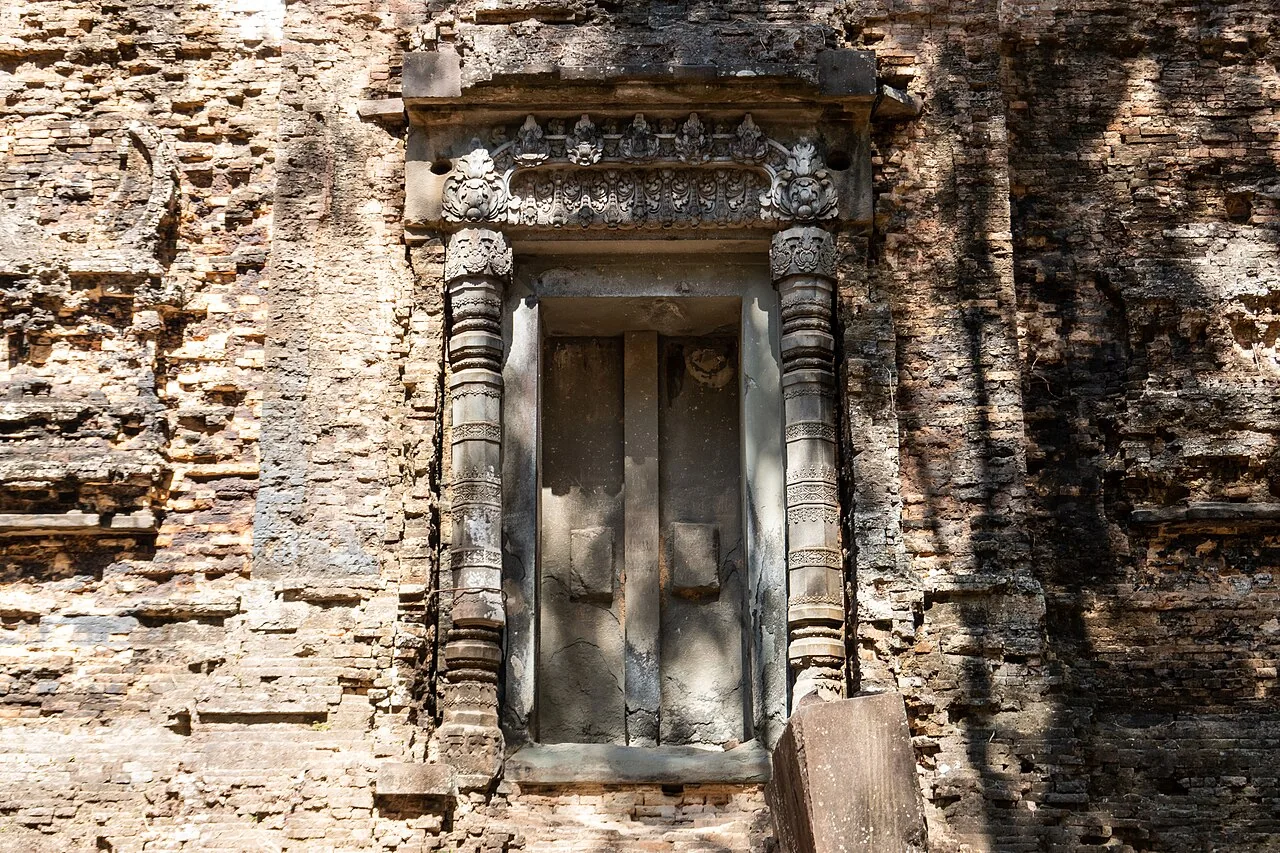
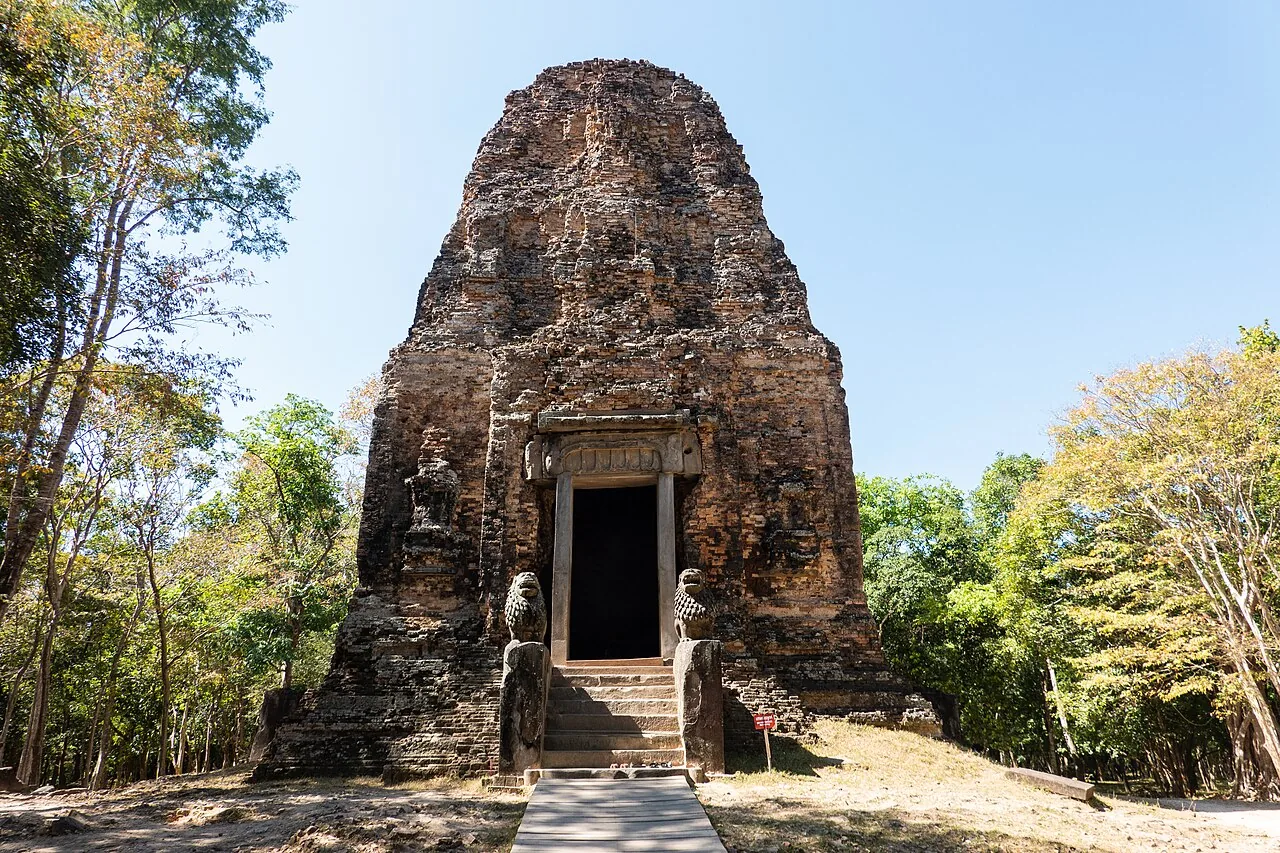
Start at a respectful distance where the whole tower is visible. Notice the balance between solid wall and opening. Then look for the point where the brickwork meets a sandstone frame or decorative element. The change in material gives the doorway an emphasis that may be less obvious in a photograph dominated by colour and vegetation.
The Smithsonian's material description is useful here because it asks you to distinguish construction roles. Brick forms much of the sanctuary, while sandstone appears selectively. Laterite has a place in the supporting and auxiliary parts of the complexes. Treat those categories as an introduction to looking, not a licence to identify every weathered stone without help.
Brick is a made unit. A temple wall brings many units into a particular arrangement, and the arrangement matters as much as the colour of any individual piece. Look at the lines of the courses, the way an opening interrupts them and the transitions near the top. You can recognise deliberate organisation without touching the surface or stepping onto a fragile base.
Do not assume that a neat surface is necessarily modern or that an irregular one is necessarily untouched. Exposure, missing finish, earlier alterations and later repairs can complicate those impressions. The published brick study is a reminder that a confident construction history takes more than visual resemblance. A casual visitor can ask informed questions while leaving the technical diagnosis to the evidence.
For photography, make one wider image that shows where a detail belongs before photographing the detail itself. A close-up of a doorway becomes more informative when paired with the tower containing it. Keep the building name or recorded identifier in your notes. Otherwise, a collection of similar brick textures becomes difficult to distinguish by the time you return home.
The material story is also a reason to avoid the usual language of effortless survival. A standing wall is not proof that it has needed no care. Where conservation work is visible, it belongs in the record of the place. The skill of the original builders and the work of later conservators can both deserve attention within the same visit.
For a later architectural comparison, continue with Angkor Wat architecture and history. Notice how the questions you ask about materials and layout change between the two visits.
What an octagonal tower asks you to notice
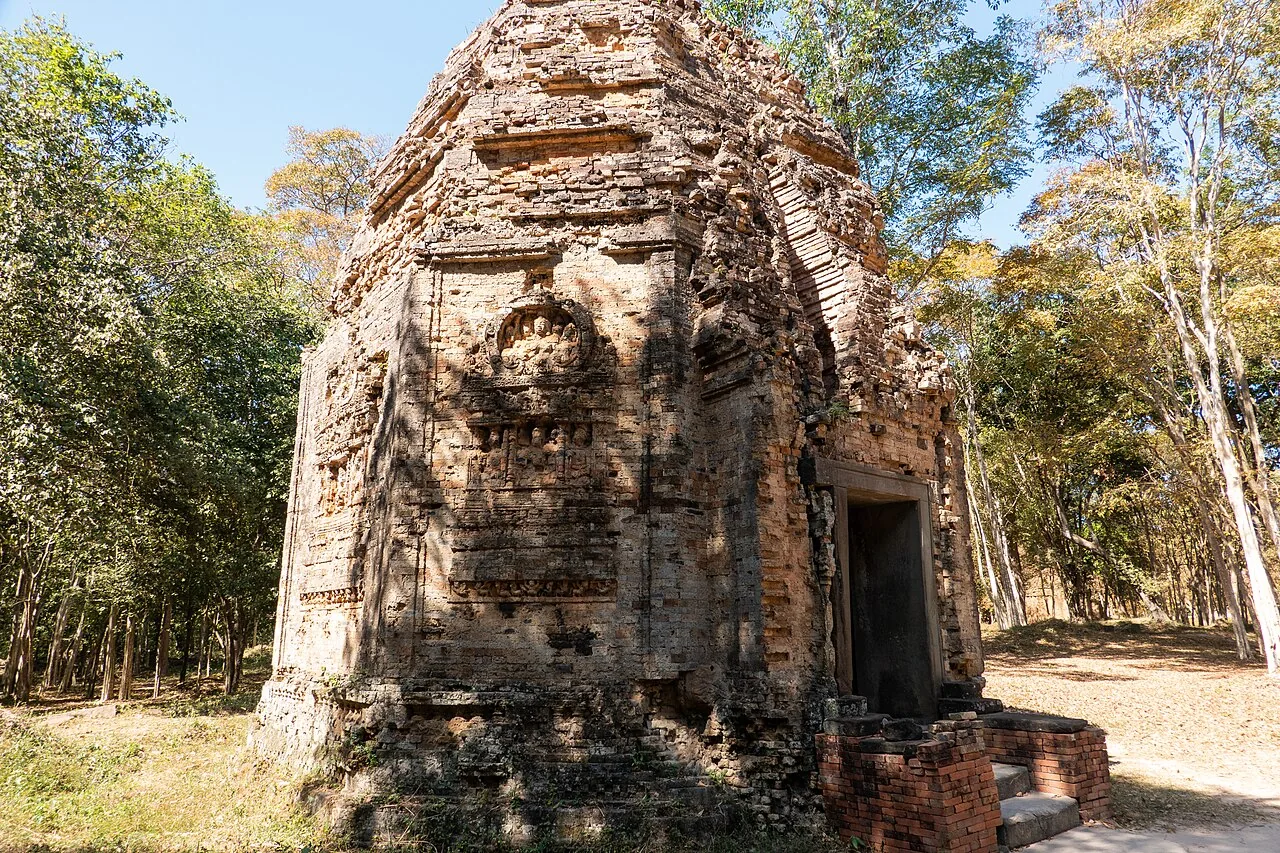
One of Sambor Prei Kuk's distinctive features is the use of octagonal sanctuary plans. The shape changes the relationship between a building's faces as you move around it. From a permitted position, look for the change of angle between adjacent walls and the way an entrance sits within the overall form. A frontal photograph alone can conceal much of that design.
The architectural study of the site's diversity treats differences in plan and construction as meaningful features of early Khmer design. This is a useful correction to the idea that every tower follows one standard pattern. Looking for variation gives a visit a purpose beyond counting how many buildings you have reached.
Use a simple comparison. Choose one accessible sanctuary whose plan you can understand, then compare it with another on the guide's route. Look at the number and direction of visible faces, the height relative to the base and the position of the opening. You are comparing decisions made in shaping a building, rather than ranking which tower is more attractive.
The octagon should not become a claim that no other culture ever explored a related form. Accounts of architectural influence and comparison can be more complex than a travel slogan allows. Sambor Prei Kuk's value does not depend on erasing connections with other places. The interesting question is how forms and ideas were developed here within a particular landscape and religious setting.
When a wall or part of a base is missing, resist mentally completing it too quickly. A plan drawing can help, but a reconstruction is an interpretation that should be labelled as such. Ask whether a diagram records what survives, what was excavated or a proposed original arrangement. Those are three useful kinds of image with different meanings.
For children or companions new to architecture, this can be the easiest observation task of the day. Find a change of angle, identify an opening and describe the shape without climbing onto anything. It turns an abstract label into something visible. A short, attentive comparison often stays in memory longer than a long sequence of building names.
Let the small architecture on the wall slow you down
Some of the site's most intriguing decoration is described as flying palaces: architectural forms presented within sculptural compositions on temple walls. Rather than treating the phrase as a mysterious riddle, begin with what it directs you to see. There is architecture within architecture, an image of a built setting placed on the surface of another building.
UNESCO identifies these depictions among the features of the Sambor Prei Kuk style. Ask your guide which examples are appropriate to view on the day's route and what remains legible in them. Weathering can make a small image difficult to read. An explanation should distinguish the visible surviving forms from a fuller interpretation based on comparison or earlier documentation.
Take the whole composition first. Where is it placed on the wall? What frames it? How does its scale relate to the larger sanctuary? Only then try to identify the smaller figures or supporting forms. This order helps you avoid turning an isolated fragment into a story it cannot support by itself.
A doorway can offer another kind of visual focus. Notice the relationship between its horizontal upper element, vertical sides and the darker space within. You do not have to enter a chamber to understand how an entrance directs attention. If entry is restricted, the threshold still has an architectural role you can examine from the authorised route.
Keep interpretation attached to its source. If a guide explains an image as a particular divine setting, ask which features support that reading and whether it is a widely accepted identification. This need not become an interrogation. It is a way to learn the difference between identifying a figure, explaining a symbol and offering a possible meaning.
A useful caption might identify the temple, the decorative feature and the date of your photograph. It does not need to claim that a carving conceals an unknown secret. The surviving work already offers something substantial: evidence of the ways people gave sacred ideas a visible form. Clear description gives that work more room than invented mystery.
Three groups, three chances to look differently
Use the principal groups as orientation: Prasat Sambor in the north, Prasat Tao in the centre and Prasat Yeai Poeun in the south. Spellings vary between guides and records, so pair the name with its position or recorded identifier. UNESCO's site description provides a reliable starting point for this arrangement.
Do not turn the three names into an obligation to hurry through every structure. Ask a local guide to select a route based on the day's access, weather and your interests. A visitor interested in carved surfaces may choose differently from someone studying plans or travelling with young children. A coherent route is one whose stops build on each other.
At the first group: learn the setting
Use the first stop to understand a compound rather than immediately looking for a close-up. Ask where the main sanctuary sits, how the surrounding buildings relate to it and which paths you will use. Once the layout is clear, choose a single material or shape detail to carry into the next group.
At the next group: make a comparison
Look for a difference you can describe: a change in plan, a different entrance treatment or a different relationship between the central building and its surroundings. If your guide points out a chronological distinction, connect it with the actual feature under discussion. Comparisons become useful when they explain something you can recognise.
At the final stop: follow your strongest interest
By now you may have a clearer sense of what interests you. Spend the remaining attention on that subject instead of collecting more names. It may be a carved panel, a conservation intervention or the way a path reveals one tower gradually. Leave time for a question before returning to the vehicle or the community arrangements you have made.
Current access should determine the order and extent of this outline. It is an observation plan, not a turn-by-turn walking route. A map showing a structure does not establish that visitors may enter it, and an old photograph does not establish the condition of its approach. The best guide is one who can explain both what you are seeing and why a particular route is appropriate today.
Another guide built around looking beyond one famous structure is Koh Ker’s wider temple landscape. Keep it as a separate journey rather than an extra stop promised without a travel plan.
The trees do not tell the whole city's story
The wooded setting can make Sambor Prei Kuk feel like a collection of isolated towers. The archaeological record asks you to think more broadly. The temple area formed part of a larger settlement landscape, with the remains of a moated urban zone and connections involving water and movement. The standing structures are the most immediately visible part of that system.
The Sambor Prei Kuk digital archive brings together records of structures, drawings, objects and landscape features. Its mapping uses terrain data to help reveal relationships that vegetation can hide at ground level. It also distinguishes buildings that retain substantial upper parts from remains visible mainly as mounds.
That distinction matters when you look at a visitor map. A symbol may mark an archaeological feature rather than a standing temple. A research inventory is not a list of attractions waiting to be visited in order. Use it to understand the wider landscape, while choosing an actual visitor route through current local advice.
Try reading a map at two scales. At the wider scale, locate the main groups and the urban area. At the closer scale, look at the arrangement of one compound. Moving between those views prevents two common misunderstandings: assuming that the whole ancient settlement fits inside one temple group, or assuming that every mapped remain should be added to an afternoon walk.
The forest also belongs to the present condition of the site, with practical implications for maintenance and access. A tree-root photograph can be striking, but the relationship between vegetation and fragile masonry is not automatically beneficial. The presence of roots should prompt a question about conservation, not an invitation to climb or a claim that nature has repaired a building.
Look at the space between the monuments as carefully as the monuments themselves. Paths, changes of level and the direction of movement can help you understand an arrangement even where much is missing. Keep the difference between an observation and an interpretation clear. You can notice a relationship without pretending to reconstruct the entire ancient city.
Conservation is part of the place you came to see
A forest sanctuary survives through more than the endurance of brick. Research, maintenance, documentation and structural work have all contributed to the site visitors encounter. The conservation project's history records work interrupted by conflict, later efforts to stabilise vulnerable structures and joint Cambodian–Japanese conservation activity. It describes restoration of brick structures beginning in 2009 within that programme.
When a support, repaired area or restricted section interrupts a photograph, it is easy to regard it as something that spoils the view. Try another interpretation: it is evidence that keeping the monument available requires decisions and labour. A photograph that includes the work can sometimes explain the present life of the site more honestly than one framed to hide it.
Do not diagnose a repair from colour alone. New and old material may look different, but exposure and earlier interventions complicate the surface. Ask what the work is intended to do and which part of the structure is vulnerable. A conservator's decision may be about stability, drainage or preserving an existing fragment rather than recreating a complete original appearance.
Visitor conduct has a simple role in this setting. Stay on permitted routes, follow barriers and avoid touching carved or unstable surfaces. A loose brick is not a souvenir. Do not rearrange fragments for a photograph or use a wall as a seat simply because another visitor has done so. The object of the visit is to understand the place without adding avoidable damage.
Interpretive drawings deserve similar care. A measured record of the surviving structure and an image of a possible original form do different jobs. The digital archive labels different types of documentation; carry that distinction into anything you share. A reconstruction can help explain an argument, but it should not be presented as a historical photograph.
The same care applies to missing sculpture. An empty position does not tell you where an object is now or why it moved. A museum, a storehouse, loss and theft are different possibilities requiring particular evidence. Ask about the documented object history instead of filling the gap with a dramatic assumption. Sometimes the most accurate answer is that a specific history remains incomplete.
Make room for the people who work beside the temples
The community around Sambor Prei Kuk should not appear only as a background to the ruins. Guiding, accommodation, meals and craft production can make a visit part of the present-day local economy. The provincial tourism directory lists community services including guides, homestays, cycling, food and woven products. Availability and arrangements should be confirmed with the people providing them.
A local guide can offer two kinds of help: understanding the monuments and arranging a route that works on the day. Ask about the language used, the expected duration and the interests the guide can cover. If you want to concentrate on construction, say so. If your family needs a shorter walk with frequent pauses, make that clear before agreeing to the outing.
For a homestay, the useful details are ordinary and specific. Ask where you will sleep, which bathroom arrangements apply, whether meals are included and how transport will work. Explain dietary requirements in advance and confirm what the host can provide. A community label does not tell you the layout of a house or the services included in a particular booking.
Crafts can provide a second point of connection. If weaving or a product demonstration is available, ask who makes the item and whether the visit is welcome at that time. Learn what the material is and how the finished object is used. A purchase made with that information has a more meaningful relationship to the place than an item selected solely because it looks traditional.
The krama is one possible textile to ask about, but avoid treating every scarf on sale as locally woven. UNESCO's account of krama practices describes a living Cambodian textile tradition. Its broader cultural importance does not authenticate the origin of a particular product. Ask the seller about that object, its maker and its material.
Photography belongs within the same relationship. Ask before close portraits, household pictures or images of a making process. A person may welcome a conversation and still prefer not to appear online. Keep names and credits accurate when someone wants to be identified, and do not imply that a photographed host or guide endorses a booking link on this website.
Plan for attention in the heat, and footing after rain
A temple visit asks for more sustained attention than a quick stop at a viewpoint. You may spend time standing beside a wall while a guide explains a detail, then walk between groups. The useful seasonal question is therefore how the conditions affect your ability to look, listen and move comfortably over the whole outing.
For a hot-season visit, including an April itinerary, ask about an earlier start and a route with sensible pauses. Carry water from the beginning rather than assuming it will be available exactly when you need it. Include a meal or rest break before attaching a long onward journey to the same day. The forest setting should not be treated as a promise of continuous shade.
After rain, ask about the current paths and any sections better left out. Choose footwear that suits uneven ground, and protect the phone or notes you will use for orientation. A light rain layer may be useful when the forecast calls for it. Changing the order of a route can be more practical than trying to preserve a plan made under different conditions.
Use a current forecast and local advice together. A regional forecast helps you prepare for the day, while a guide or host may be able to explain how recent conditions affect the actual approach. Neither should be replaced by a generic best-month list. A favourable season does not guarantee a dry path, an open structure or a comfortable afternoon for every traveller.
If your purpose is photography, choose a small number of subjects and allow time to wait within the permitted area. Do not make a particular beam of light or empty scene essential to the success of the visit. A photograph showing the relationship between a doorway and its brick wall can remain useful under ordinary light. Understanding the subject gives you more options than chasing one effect.
Use Kampong Thom as the planning point
Kampong Thom is the practical town to consider when arranging a Sambor Prei Kuk visit. Decide whether you want a return excursion from town, a community stay near the site or a stop within a longer journey between cities. Those choices affect luggage, transport, the time available for walking and how much flexibility you have if conditions change.
Agree on the destination by name and confirm the current visitor entrance. The map below gives regional orientation to the heritage area; it does not identify every active ticket point, permitted path or vehicle access. Save the name of the accommodation or meeting point separately so that the return journey does not depend on finding it again in a long message thread.
For a hired vehicle, ask whether the price includes waiting time, the return trip and any additional stop you want to make. A simple transfer and a driver remaining available for an excursion are different services. Confirm the meeting arrangement at the end of the walk. If the driver and guide are different people, make sure both understand the same plan.
If you are stopping while travelling onward, allow space for the visit to take longer than the walk itself. Meeting the guide, organising admission, eating and returning to the vehicle all need time. Avoid attaching a tight onward departure to an unfamiliar route. It is better to understand one group properly than to rush between several because transport was planned too tightly.
Discuss access needs before arrival. Ask about walking distance, surfaces, steps, shade, toilets and the possibility of a shorter route. Explain the needs of your own party rather than asking only whether the site is easy. A visit that suits someone comfortable on uneven paths may not suit another traveller, and current conservation work can change the available approach.
Separate admission, guiding and the road journey
Build the estimate around the arrangement you intend to use. Admission is normally a different cost category from a local guide, transport or a community meal. Ask for the current admission amount and any applicable visitor categories through the site or your confirmed local arrangement. This draft leaves that amount for you to enter rather than presenting a disputed online price as settled.
Write down the units beside each quote. Is the guide price for the party or for each person? Does transport include the return and waiting? Is a meal priced per person? A budget becomes useful when those distinctions are clear. Two offers that appear different may cover different parts of the outing.
The calculator uses US dollars for comparison. If a quote is in Cambodian riel, convert it using the rate relevant to your payment and enter the converted amount consistently. Do not type a riel amount into a dollar field. Keep the original quote in your notes so you can check what was agreed.
For an overnight stay, confirm how rooms or sleeping arrangements are priced and whether food is included. A homestay package may combine several services that the calculator lists separately. Enter the combined amount once, or split it into its components only when those amounts are known. Counting the same meal in both a package and a food allowance inflates the estimate.
Leave purchases outside the basic outing total until you know what you want. A textile or craft item can be a worthwhile part of a visit, but it should be an optional choice rather than a compulsory cultural expense. Ask about the object and its price directly. The article's purpose is to make the costs understandable, not to turn every encounter into a shopping opportunity.
Choose interpretation before a long list of stops
For Sambor Prei Kuk, the quality of the explanation can matter more than the number of attractions named in a package. Look for a clearly described route, suitable guiding language and enough time for the subject you care about. A trip promising several distant sites may leave little opportunity to understand the brick temples themselves.
Ask whether the guide works with the local community and what the booking includes. A transparent answer should identify the service and its provider without relying on a vague claim that all spending benefits residents. If a community contribution is mentioned, ask how it is handled. You can support a local service while still comparing practical details carefully.
For accommodation, compare a stay in Kampong Thom with a confirmed community arrangement near the site. Town may fit an onward journey; a homestay may suit someone who wants more time locally. Neither is automatically the more authentic choice. The right arrangement is one whose facilities, expectations and schedule work for both guest and host.
The Booking.com link below is an ordinary accommodation search without affiliate tracking. It does not replace direct confirmation of a homestay or local guiding service. Read the address and conditions of the specific option before making a booking. A broad destination search can include properties that are not convenient for the route you have planned.
A temple day bag with a reason for each item
Choose clothing that is comfortable for walking and respectful in a religious heritage setting. Coverage of shoulders and knees is a sensible starting point, with any specific site instructions taking priority. Loose clothing that already provides the coverage you need is easier to manage than repeatedly rearranging a scarf at each stop.
A krama can be an optional personal item or a purchase made with an interest in its craft. It does not replace the clothing required by a particular site, and a souvenir scarf should not be assumed to provide a tested level of sun protection. Wear it because it suits you, not because a visitor is expected to dress as an example of Cambodian culture.
Carry water, a secure hat and suitable sun protection for the conditions. Make room for a break as well as the objects in the bag; packing more equipment does not compensate for an overfilled day. In hot weather, keep the main walking route manageable and discuss places to pause with the guide before everyone becomes uncomfortable.
Choose shoes for uneven paths and keep a light rain layer available when appropriate. Protect electronics and essential documents from rain. A small notebook or offline note on your phone can be particularly useful here: record the group, building identifier and one observation with each important photograph. That is a more useful addition than a heavy accessory you will not use.
Bring personal essentials and any medication you normally require. Keep enough room to carry your own litter out. If travelling with children, pack what helps them remain comfortable between breaks and choose one observation game, such as comparing tower shapes. The bag should support the visit you are making, rather than become a checklist for every possible journey in Cambodia.
Build a visit around three discoveries
A useful outing can have three discoveries rather than a fixed number of temples. First, understand how a sanctuary is built. Second, find a shape or decorative feature that differs from the first example. Third, connect the surviving monument with the work and community that keep the place meaningful today.
Begin by agreeing on the route and a realistic walking period with the guide. At the first group, allow time for orientation and material identification. At the next, make a deliberate comparison. Keep the final part flexible enough for your strongest interest, a question about conservation or a shorter route if the conditions call for it.
Arrange a meal or community activity only when it is actually available and welcomed. Ask what time works for the provider and how long to allow. Do not treat a household, workshop or demonstration as something that can be inserted into any spare gap. The people hosting it have a day of their own.
For a shorter visit, choose one main group and one clear theme. For a longer stay, use the extra time to deepen a subject or explore a confirmed community activity rather than automatically adding more monuments. A slower pace is useful when it allows you to notice and understand more; it does not require stretching a simple stop into an artificial full-day programme.
If you want a different kind of Cambodian landscape in the same trip, read about Tonlé Sap village visits by season. Choose the route and water conditions before adding it to your itinerary.
Read a plan before reading a whole history
The free Sambor Prei Kuk digital archive is a strong place to begin. Select one recorded structure and compare its photograph with an available plan or drawing. Notice what each format makes easier to understand. A photograph shows a particular view; a plan can clarify relationships that are hard to see from one position on the ground.
For wider Khmer context, Angkor and the Khmer Civilization by Michael D. Coe and Damian Evans offers a general historical route into the subject. The Angkorian World, edited by Mitch Hendrickson, Miriam T. Stark and Damian Evans, is a deeper research collection. These are broader contextual suggestions, not substitutes for site-specific documentation or current visitor information.
Use the reading shelf according to your question. If you want to understand one tower, start with the archive. If you want to connect several Cambodian destinations, choose a broader history. Check the publisher's contents and formats before buying. These suggestions are based on the stated scope of the resources, not an assertion that every book has been fully reviewed by our team.
What to settle before you go
Is this worthwhile if I am already visiting Angkor?
It can be, particularly if construction, early Khmer architecture or a more focused temple study interests you. Its value is not that it reproduces Angkor on a smaller scale. Decide whether the material and design questions in this guide appeal to you, then allow enough time for them rather than adding the site only to increase a temple count.
Can I understand the site without specialist knowledge?
Yes. Begin with visible relationships: brick and stone, wall and opening, one plan compared with another. A guide and a small amount of preparation can help connect those observations with history. You do not need to memorise every date to recognise a thoughtful explanation.
Should every mapped temple be part of the route?
No. An archaeological map includes remains with different conditions and purposes. Some records are valuable for research without describing a suitable visitor stop. Follow a route based on current access, your interests and the time available.
What should I remember after the names fade?
Remember one wall and what it taught you. Perhaps it was the change from brick to a stone doorway, the turn of an octagonal face or a repair that kept a vulnerable opening standing. Sambor Prei Kuk becomes more than a place before Angkor when you can describe something its builders and later carers did here.
A closer look.
Three photographs from December 2019: overall sanctuary form, brickwork and carved stone detail. Access and conservation conditions may have changed.

Sok Heng Oeun
Sok Heng Oeun is the owner and editor of Hidden Corners. The Hidden Corners Editorial Team supports image preparation and editorial checks under his direction.
Sok Heng Oeun on Facebook ↗Research and AI-assisted editorial preparation. Publication authorized by Sok Heng Oeun; an individual owner reading review is not recorded. This guide does not claim a firsthand team visit.
Sources & image credits
Sources supporting this guide. Dated prices and access reports can change; confirm with the responsible authority before travelling.
- Smithsonian's National Museum of Asian Art ↗
- Waseda research record ↗
- architectural study of the site's diversity ↗
- Read the UNESCO site overview ↗
- Sambor Prei Kuk Digital Archive ↗
- conservation project's history ↗
- provincial tourism directory ↗
- account of krama practices ↗
Photograph credits
- Sambor Tower · PsamatheM / psamathe.net · 2019-12-10 · CC BY-SA 4.0. Uses the publisher-provided resized version, converted to WebP; display may crop to fit. These adaptations remain available under their respective licences.
- Sambor Detail · PsamatheM / psamathe.net · 2019-12-10 · CC BY-SA 4.0. Uses the publisher-provided resized version, converted to WebP; display may crop to fit. These adaptations remain available under their respective licences.
- Sambor Tao · PsamatheM / psamathe.net · 2019-12-10 · CC BY-SA 4.0. Uses the publisher-provided resized version, converted to WebP; display may crop to fit. These adaptations remain available under their respective licences.
Packing and outfit graphics: AI-generated editorial illustrations. Portrait: supplied by Sok Heng Oeun.