
Maros-Pangkep: at least 51,200 years old, and flaking
At least 51,200 years. That is the minimum age, published in Nature on 3 July 2024, of a painting in Leang Karampuang, a limestone cave in the Maros-Pangkep karst of South Sulawesi. It shows three human-like figures and a pig, and on current evidence it is the earliest known representational art and the earliest known scene: people and an animal placed together so that something appears to be happening between them.
Sixty-three years. That is the gap between photographs of painted panels in the same karst taken in 1950 and the state of those panels recorded in 2013. The comparison, published in Scientific Reports in May 2021, documented substantial loss of painted surface. The rock is coming away in flakes, and the paint is coming with it.
Put the two numbers side by side and they describe two clocks running in opposite directions. The first runs backwards. Every few years since 2014 a new result has pushed the art in this karst older: 39,900 years, then 43,900, then 45,500, then 51,200. The second runs forwards. Every survey of the walls finds less on them than the one before, and the people who live around the caves have told researchers that the loss in recent decades is worse than anything in living memory.
This guide follows both clocks in turn, a chapter each, because neither makes full sense alone. The dates explain why the loss matters. The loss explains why the dates are a race. And the two turn out to be written on the same few millimetres of rock.
It is built entirely from the published papers, UNESCO's documentation and Indonesian reporting, each checked in September 2026; nobody from Hidden Corners has been to Maros. The most famous panels are research sites and closed to visitors, and the chapter on what you can see says so before it says anything else.
A hand at Leang Timpuseng
Clock one · 2014. The backwards clock starts in October 2014, with a short paper in Nature by Maxime Aubert, Adam Brumm, Muhammad Ramli and colleagues. Its title was plain — "Pleistocene cave art from Sulawesi, Indonesia" — and its central number was a hand.
The Maros-Pangkep paintings had been known for a long time. The paper notes that they were first recorded in the 1950s, and that researchers had since sorted them into two broad periods by which images sat on top of which. What nobody had was a date, and without one there was no reason to think the paintings were especially old.
The team sampled small knobbly growths of calcite, called coralloid speleothems and sometimes "cave popcorn", that had formed on top of the paintings. They took nineteen samples associated with fourteen motifs — twelve hand stencils and two animal paintings — across seven cave sites in the Maros karst. The deposits were thin, up to about a centimetre, and the samples small. Then they measured the uranium in them.
The oldest result was a hand stencil in Leang Timpuseng, with a minimum age of 39,900 years. The paper called it the oldest known hand stencil in the world, which at the time it was. In the same cave, a painting of a babirusa — the Sulawesi "pig-deer", a wild pig with tusks that curve up through its snout — came out at a minimum of 35,400 years. In a second cave, Leang Barugayya 2, a large painting of an animal the authors thought was probably a pig came out at a minimum of 35,700.
The weight of those numbers lay in where they were. The paper opened by naming a long-standing puzzle: a rich body of sophisticated art appears in Europe between about 40,000 and 35,000 years ago, and nothing comparable had been found along the routes modern humans took to get there. The Sulawesi dates, the authors wrote, showed that humans were making rock art by 40,000 years ago "at opposite ends of the Pleistocene Eurasian world".
That reframed the question rather than relocating the answer. European cave art had been discovered first and studied hardest, and it survives because limestone caves preserve paint. Sulawesi has limestone caves too; it simply had not had anyone dating them. If people at both ends of Eurasia were painting at roughly the same time, the obvious reading — and the one many researchers drew — is that the habit was older than either and travelled with the people who made it, on surfaces that mostly have not lasted.
Keep the Leang Timpuseng figure in mind, because it is the first mark on the backwards clock. Every later result in this karst is older.
The wall in two photographs
Clock two · 1950 to 2013. The forwards clock starts earlier, with a camera rather than a laboratory.
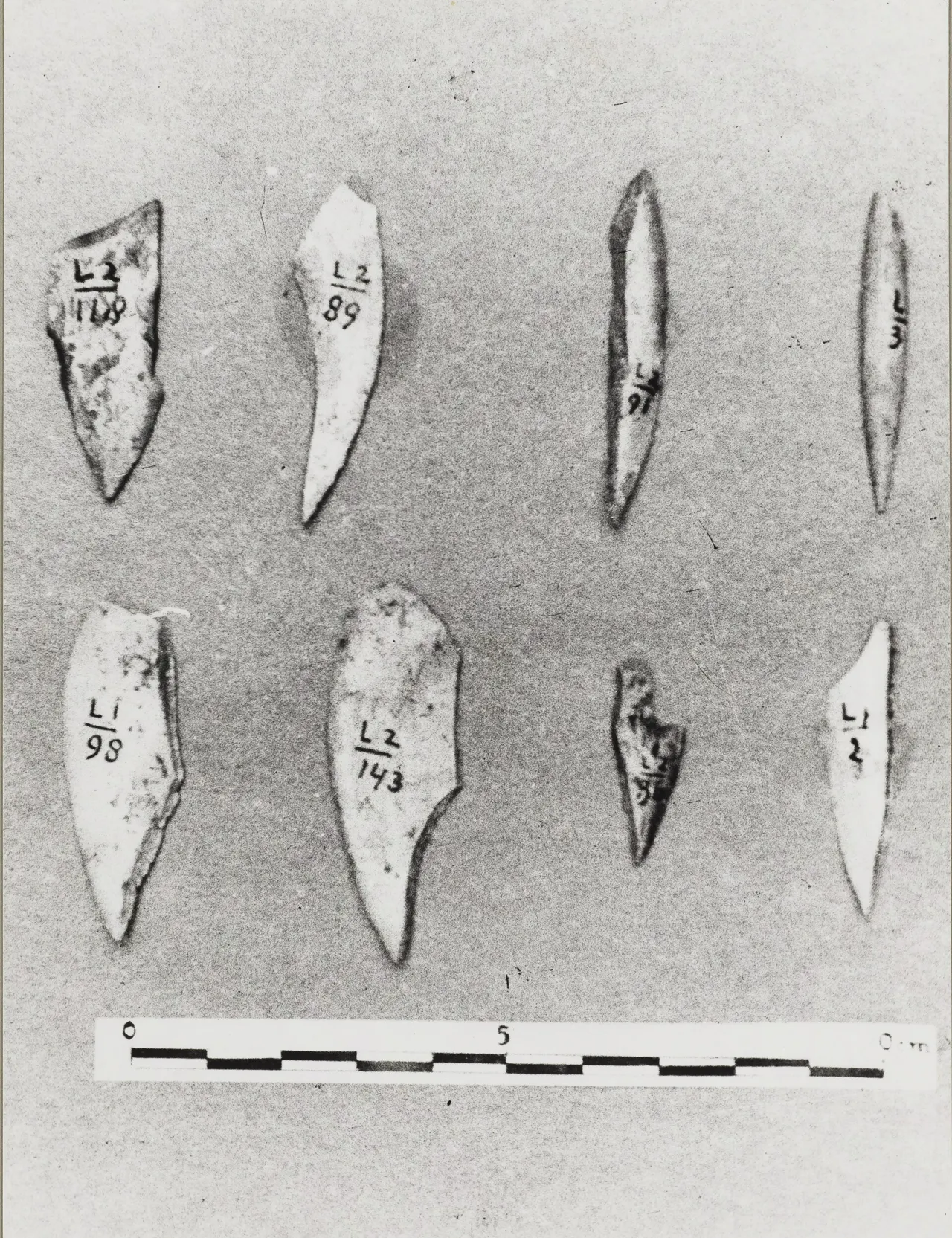
The first recording of these paintings in the 1950s left something the researchers of the 2010s could use: photographs. A photograph of a painted panel is a measurement of how much paint was on the wall on the day it was taken. Photograph the same panel again decades later, and the difference is a measurement of loss.
That comparison is one of the central pieces of evidence in the 2021 Scientific Reports paper led by Jillian Huntley, with Aubert and Brumm among the co-authors — several of the same people who had started the backwards clock. Setting documentation from 1950 against the condition of the same panels in 2013, they recorded substantial loss of painted area at individual sites. Panels that had been photographed with paint on them had, in places, bare rock where the paint had been.
A photographic comparison has limits, and they are worth stating. It shows that surface has gone; it cannot, by itself, show when within those sixty-three years it went, or whether the rate was steady. That gap matters later, because the scientific dispute in this story turns on exactly that question.
The team recorded something a camera cannot. People living in the karst around these caves told the researchers that panels had lost more to flaking in recent decades than at any time in living memory. That is testimony rather than measurement, and the paper presents it as such. But it comes from the people who have looked at these walls longest, and it points the same way as the photographs.
The scale is the other thing to hold on to. The 2021 survey examined eleven rock art sites. The same paper counts more than three hundred sites with Pleistocene imagery in the Maros-Pangkep karst, and the provincial heritage office's own reporting, as summarised by Mongabay Indonesia in 2021, puts the number of caves with rock art in the region at around three hundred. Most of those walls have never had a before-and-after comparison, because most of them were never photographed in 1950.
So by 2013, before the first date was even published, the forwards clock had already been running for at least sixty-three years, and nobody had been timing it.
The figures that are not people
Clock one · 2019. In December 2019, Nature published "Earliest hunting scene in prehistoric art", by Aubert, Rustan Lebe, Adhi Agus Oktaviana and colleagues. It described a panel in a cave called Leang Bulu' Sipong 4, dated from the calcite over it to a minimum of 43,900 years — four thousand years further back than the Timpuseng hand.
The age was not the most striking thing in the paper. The panel shows, in the authors' words, "several figures that appear to represent therianthropes hunting wild pigs and dwarf bovids". The dwarf bovids are anoa, small wild buffalo found only on Sulawesi. The therianthropes are the part that is easy to skip and hard to stop thinking about.
A therianthrope is a being that combines qualities of people and animals. The figures in the Bulu' Sipong 4 scene have human-like bodies with features that are not human. They are not drawn as people and they are not drawn as animals.
That matters for a reason that is more philosophical than artistic. A painting of a pig is a record of something its painter had seen. So is a hand stencil — the most direct statement possible that a particular body stood in a particular place. Neither requires anyone to have imagined something that does not exist. A figure that is part human and part animal does. Nobody has ever seen one. To paint it, someone has to assemble it in the mind from parts of real things, decide it is worth depicting, and depict it in a way other people will recognise.
The paper's own framing makes the comparison with Europe explicit. In the European record, it notes, scenes in cave art are rare and late — mostly about 21,000 to 14,000 years old — and clear therianthropes are uncommon; the oldest is a carved figurine from Germany of a human with a feline head, dated to about 40,000 to 39,000 years. Therianthropes, the authors wrote, arguably communicated narrative fiction of some kind: folklore, religious myth, spiritual belief. On that reading, the Bulu' Sipong 4 panel was, in 2019, both the oldest pictorial record of storytelling and the oldest figurative artwork known.
The caveats are real and the paper carries them. "Appear to represent" is the authors' phrase, not a softening added here. Identifying a muzzle or a tail on a figure a few centimetres high, on a wall that has been weathering for tens of thousands of years, is a reading of damaged pigment, not a measurement, and specialists can reasonably differ over any individual figure. Nor does a therianthrope prove a belief system; it shows a capacity to imagine, not a doctrine.
And the damage is not a figure of speech. The same paper, describing one of the pigs in the scene, records that much of its body and some of its head and mouth are missing "owing to at least two temporally distinct phases of erosion and flaking of the cave-wall surface". Of another pig, it says most of the head and large parts of the body are gone. The oldest story then known was already missing pieces when it was published.
If the reading holds, it puts imaginary beings on a Sulawesi cave wall alongside a hunt, tens of thousands of years ago. The oldest surviving story is not simply a record of something that happened. Parts of it were made up.
The wall is coming off
Clock two · 2021. The Huntley paper appeared in Scientific Reports on 13 May 2021 under the title "The effects of climate change on the Pleistocene rock art of Sulawesi". Its fieldwork had been done in two stages: chemical analysis with a portable X-ray fluorescence instrument in late 2015, and the collection of fallen flakes of painted rock in 2017. The eleven sites surveyed include Leang Timpuseng itself, where the 2014 hand stencil is, along with Leang Bulu Bettue, Leang Pattae, Leang Lambatorang, Leang Lompoa and Leang Balang Pakalu 5.
The mechanism the team identified is haloclasty, or salt weathering. Saline water moves through porous limestone and evaporates at or just below the surface. Salt crystals form, and they swell and shrink as temperature and humidity change. The repeated stress breaks the outer rind of the rock away in flakes, a process called spalling, and whatever was painted on that rind goes with it.
The paper's explanation for why it is happening now was climatic. El Niño brings long droughts; the monsoon brings intense rain. That alternation of wetting and drying is precisely what drives salt crystallisation, and a warming climate intensifies it. On that account the oldest art known is being lost to climate change, and at the level of an individual cave there is little to be done.
What is often left out of summaries is that the 2021 paper did not name climate as the only threat. It set it beside another. "Aside from continuing limestone quarrying for the burgeoning domestic cement and marmer (marble) industries," the authors wrote, "global warming should be regarded as the greatest threat." Elsewhere they describe the industrial-scale quarrying of limestone in the region as a threat in its own right, "with associated pollution yet to be quantified".
Keep that last phrase. It is the thread the next paper on the forwards clock pulled.
The 2021 paper also said what it thought should happen. It pointed to the long-term physical and chemical monitoring that has been running at the Franco-Cantabrian cave art sites of France and Spain, called for the same in Maros-Pangkep, and said plainly that the effort needed more support, especially infrastructure investment. An article on the findings in The Conversation's Indonesian edition put the case more simply: more research, monitoring and conservation work, and detailed documentation of the art, including by 3D scanning.
The survey was eleven walls out of more than three hundred. It was a bleak and coherent account, it was reported worldwide, and it was not the last word.
Three pigs at Leang Tedongnge
Clock one · January 2021. Wind back four months from the salt paper. On 13 January 2021, Science Advances published "Oldest cave art found in Sulawesi", by Brumm and colleagues, including Oktaviana and Aubert. It reported two caves the team had found in 2017 and 2018, neither previously known to researchers.
Leang Tedongnge, found in 2017, holds a panel with at least three large paintings of Sulawesi warty pigs, a species still living on the island. The best preserved, which the paper calls pig 1, measures about 136 by 54 centimetres, with two hand stencils placed above and near its hindquarters. A small coralloid deposit, around twelve square millimetres, had grown over the pig's rear foot. When the team removed it, a layer of red pigment came away stuck to its base: direct physical proof that the calcite had formed on top of the paint. Its uranium put a minimum age on the pig of 45,500 years.
The paper described that pig as the earliest known representational work of art in the world. It held that title for three and a half years.
The second cave, Leang Balangajia 1, found in 2018, holds a large red pig with hand stencils nearby. The paper brackets that painting between 73,400 and 32,000 years and adopts the conservative figure: at least 32,000.
Now read the same paper for the other clock. Pigs 2 and 3 on the Tedongnge panel, it says, are "only partially preserved owing to exfoliation of the cave wall". A fourth animal figure is there but "too heavily exfoliated for analysis". So the scene that briefly held the world record consisted of one measurable pig, two partial pigs and one that could no longer be read.
That is worth sitting with, because it shows how the clocks interact. The Tedongnge paper does not discuss causes, threats, quarrying or cement; it mentions exfoliation only to explain why most of its panel could not be studied. But the fourth figure had been painted and was then lost before anyone arrived with a laboratory. Whatever date its calcite might have held is gone with it.
Pigs were painted over and over in this karst — Timpuseng's babirusa, Barugayya's probable pig, Tedongnge's three, Balangajia's one. The 2021 paper also argued that there was no reason to suppose this early art was unique, in Island Southeast Asia or the wider region. The backwards clock had further to run.
Two papers, one journal, different culprits
Clock two · December 2022. Eighteen months after the climate paper, in the same journal, a team led by Michael Gagan — with Halmar Halide, Raden Cecep Eka Permana, Rustan Lebe and Gavin Dunbar among the authors — published "The historical impact of anthropogenic air-borne sulphur on the Pleistocene rock art of Sulawesi".
It gave a different answer. The dominant driver of the flaking, on this analysis, is airborne sulphur from human activity, not climate. Sulphur compounds react with limestone to form gypsum; gypsum crystals grow and shrink in the rock and produce the same spalling. The sources the paper identifies are specific and mostly local: domestic fires inside the rock shelters, potentially going back 40,000 years; rice-straw burning across roughly three and a half thousand years of cultivation in the region; diesel exhaust; and cement manufacturing and construction dust.
And it reached a conclusion that runs directly against the popular version of the 2021 story: most of the damage occurred before 1950, with rates possibly declining since, tracking the fall in domestic fire use inside the shelters even as rice cultivation grew.
Recall the limit of the photographic comparison. Photographs from 1950 and 2013 prove that loss happened between those years; they cannot show whether it was accelerating. The 2021 paper read the loss as climate-driven and worsening. The 2022 paper, working from a different line of evidence, reads the worst of it as already behind us.
Hold the two side by side and the stakes are plain. If the 2021 account is right, the loss is driven by a global process, it is getting worse, and intervention at a single cave is close to futile: the responsible thing is to document everything, as fast as possible, while it is still there. If the 2022 account is right, much of the loss comes from local and historical pollution, the worst is already behind us, and the remaining threats — diesel, cement dust, burning — are things a regulator can act on. Those imply different priorities for money and attention.
This guide does not adjudicate between them. Both papers are peer-reviewed, both appeared in Scientific Reports, both include serious specialists, and Rustan Lebe is an author on the 2022 paper as well as the 2019 dating paper. The mechanisms are also not mutually exclusive: salt crystallising beneath a hardened limestone surface is common to both accounts, and the argument is over which source of salt dominates and in which period.
What can be said precisely is narrower. The art is being lost; that is not in dispute. The cause is. And the cement industry appears in both papers, in different roles: in 2021 as limestone quarrying, a threat in its own right whose pollution was "yet to be quantified"; in 2022 as cement manufacturing and construction dust, one of the named sulphur sources. Neither paper, in what was read for this guide, names a company, and this guide does not either.
Three figures and a pig at Leang Karampuang
Clock one · 2024, and then 2026. The paper that set the current Maros-Pangkep record appeared in Nature on 3 July 2024: "Narrative cave art in Indonesia by 51,200 years ago", led by Oktaviana, Renaud Joannes-Boyau, Brumm and Aubert.
It did two things. First, it dated a panel in Leang Karampuang showing three human-like figures and a pig. The calcite over it came out at 53,500 years, give or take 2,300, which puts the minimum age of the painting at 51,200 years. That made it the earliest known representational art, and the earliest known scene.
Second, it went back to Leang Bulu' Sipong 4, the hunting scene with the therianthropes. Published in 2019 at 43,900 years, it now came out at 50,200 years, give or take 2,200: a minimum of about 48,000, and at least four thousand years older than first reported.
The painting at Bulu' Sipong 4 had not changed. The method had. The 2024 team used laser-ablation uranium-series imaging, which samples tiny spots across a calcite crust and maps how its age varies, so that the layer lying directly on the paint can be dated on its own rather than averaged in with everything that grew on top of it. The next chapter explains why that pushes dates older. For now, notice the pattern: every date on this clock has been revised in one direction only.
The clock did not stop in Maros. On 21 January 2026, Nature published "Rock art from at least 67,800 years ago in Sulawesi", again led by Oktaviana, with Joannes-Boyau and Aubert among the authors. It dated a hand stencil in Liang Metanduno, a cave on Muna Island off the south-eastern arm of Sulawesi — not in the Maros-Pangkep karst — using the same laser-ablation method. The calcite gave 71,600 years, give or take 3,800, and a minimum for the stencil of 67,800. The paper notes that this exceeds the published minimum for rock art in Maros-Pangkep by 16,600 years, and a hand stencil in Spain attributed to Neanderthals by 1,100.
Two things about Muna matter for this guide. The first is the qualifier. The Muna stencil is a hand outline, not a picture of anything, so Leang Karampuang still holds the record for the oldest known figurative art and the oldest scene, on the evidence checked in September 2026. "The oldest rock art" and "the oldest story" are now in different places, and headlines that merge them are wrong either way.
The second is its condition. The paper describes the Muna stencil as poorly preserved: a patch of faded pigment about 14 by 10 centimetres, holding part of the fingers and palm, partly covered by old calcite. The oldest securely dated cave art known anywhere survives as a fragment the size of a postcard. The backwards clock had reached further than ever, and the forwards clock had got there first.
What the dates actually date
This is the chapter where the two clocks physically touch, and it is the part that almost never survives a press release.
Nobody has dated the paint. The pigments are mineral — iron oxides, ochre — with no carbon for radiocarbon to measure and no clock of their own. What can be dated is the calcite that water deposits on a cave wall over the painting afterwards: the popcorn-like crusts sampled in 2014, the twelve-square-millimetre nub over the Tedongnge pig's foot.
Uranium-series dating measures the decay of uranium into thorium within that calcite. Uranium dissolves in water and is taken up as the calcite forms; thorium does not dissolve, so effectively none is present at the start. Measure how much thorium has built up relative to the uranium, and you have the age of the crust.
Every published figure is a floor, for two separate reasons. The first is physical: the crust grew on top of the paint, so the paint is at least as old as the crust and possibly much older. The second is statistical. Leang Karampuang's calcite dated to 53,500 years, give or take 2,300; the headline 51,200 is the young end of that range. Muna's dated to 71,600, give or take 3,800; the headline 67,800 is its young end too. The number in the news is the youngest the painting can reasonably be, not an estimate of when it was made.
Why the 2024 dates went up. Earlier work drilled or scraped a sample of crust and dissolved it whole. That averages calcite layers of different ages together — and because the outer layers are younger, it drags the result young. Laser-ablation imaging maps age across the crust in fine detail and isolates the layer nearest the paint. No new art was needed for Bulu' Sipong 4 to gain four thousand years; a better method removed a bias that had been making the old dates too young.
The honest caveats. Uranium-series dating on cave calcite can be affected by open-system behaviour: water moving through the crust later and adding or removing uranium. Careful studies test for it and report it, and the field states minimum ages rather than ages precisely because it knows the technique is not infallible. For a Southeast Asian site where a dating claim went the other way and the paper was withdrawn, see Gunung Padang; read together, the two show how to judge the next "oldest ever" headline.
Now the point where the clocks meet. Everything the backwards clock measures lives in the outermost skin of the wall: a crust of calcite, on a film of pigment, on the hardened outer rind of the limestone. That rind is exactly what the forwards clock removes. When salt or gypsum crystallises behind it and a flake comes away, it takes the paint and any calcite on the paint with it. What remains is a pale, fresh scar with nothing on it to date.
Nobody can date a painting that is no longer there. The Tedongnge paper's fourth pig, "too heavily exfoliated for analysis", is the plainest example. The backwards clock can only read surfaces the forwards clock has not yet reached — which means the oldest dates anyone will ever publish from this karst are limited by how much wall is left.
Not a World Heritage site — and what it is instead
Most coverage gets this wrong, so it is worth being exact. Maros-Pangkep is not on the World Heritage List. It has two other UNESCO relationships, both real and both different.
UNESCO Global Geopark, designated 2023. The Maros Pangkep UNESCO Global Geopark covers 5,077.25 square kilometres across Maros and Pangkep regencies — 44.6 per cent land and 55.4 per cent water, because it takes in the coral islands of the Spermonde Archipelago as well as the karst and Bantimurung-Bulusaraung National Park. UNESCO's description records 572 caves, the longest running to 27 kilometres, more than 332 types of prehistoric artefact, and 1,437 recorded species, 153 of them endemic to Sulawesi. A Global Geopark is a designation about geological heritage and its link to local development. It is not the World Heritage Convention and carries different obligations.
World Heritage tentative list, 2025. "Karst Landscape Maros Pangkep Prehistoric Cave Area" appears on Indonesia's tentative list with a 2025 date — the queue of sites a country intends to nominate. A tentative listing is a statement of intent, not a protection, and entries can wait for many years.
For context, Indonesia has ten inscribed World Heritage properties: six cultural properties — Borobudur and Prambanan (1991), Sangiran Early Man Site (1996), the Bali Subak landscape (2012), Ombilin Coal Mining Heritage of Sawahlunto (2019) and the Cosmological Axis of Yogyakarta (2023) — and four natural properties: Ujung Kulon and Komodo (1991), Lorentz (1999) and the Tropical Rainforest Heritage of Sumatra (2004). Not one is in Sulawesi.
That gives this story a third, slower clock: the paperwork. The first dates were published in 2014; the geopark came nine years later; the tentative listing two years after that. Meanwhile the forwards clock kept running. For a very different case — a UNESCO listing that went ahead against expert advice — see Yên Tử.
What you can actually see, and what you cannot
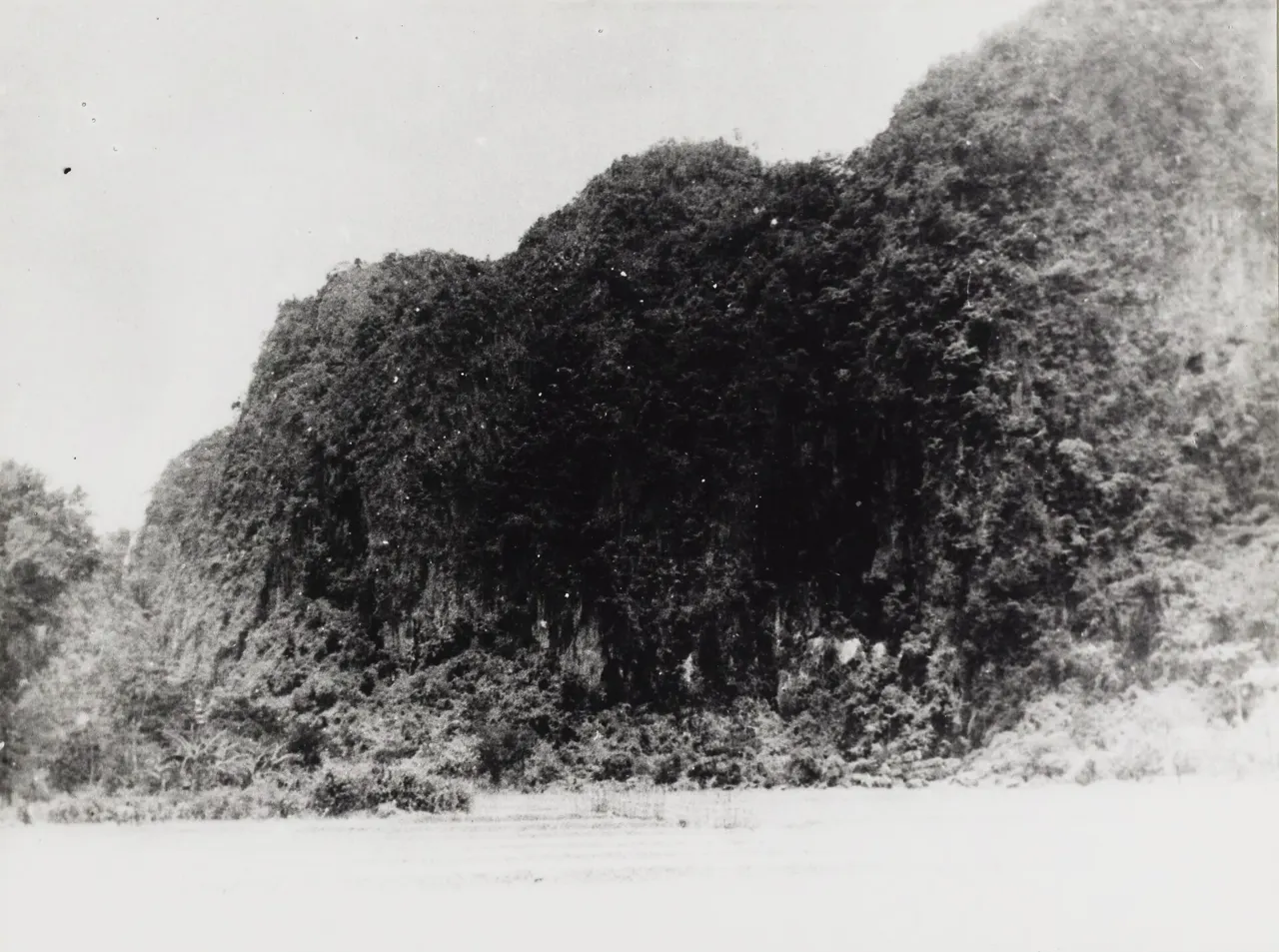
Start with the disappointment. Leang Karampuang, Leang Bulu' Sipong 4 and Leang Tedongnge are research sites. They are not visitor attractions, not signposted and not open. The panels in the papers are not available to be looked at, and after the last few chapters the reason should be clear: an actively flaking painted surface does not need breath, body heat and camera flash added to its problems.
Leang-Leang is the visitor starting point. The archaeological park in Maros, known as Taman Arkeologi Leang-Leang, includes Leang Pettae and Leang Petta Kere. Indonesia’s heritage service describes hand stencils and a pig image, called babirusa in that account, at Pettae; local heritage descriptions also identify hand stencils and pig imagery at Petta Kere. Do not confuse either cave with the record-setting Karampuang panel. Published names have variant spellings, and a date established for one painted panel does not automatically apply to every visitor-site image. Ask the heritage staff which cave and panel the current route includes. Confirm opening arrangements and any restrictions before travelling rather than relying on an old timetable.
The caves open high in the limestone above the valley and are reached by a metal stair, which one visitor account puts at about twenty-five steps.
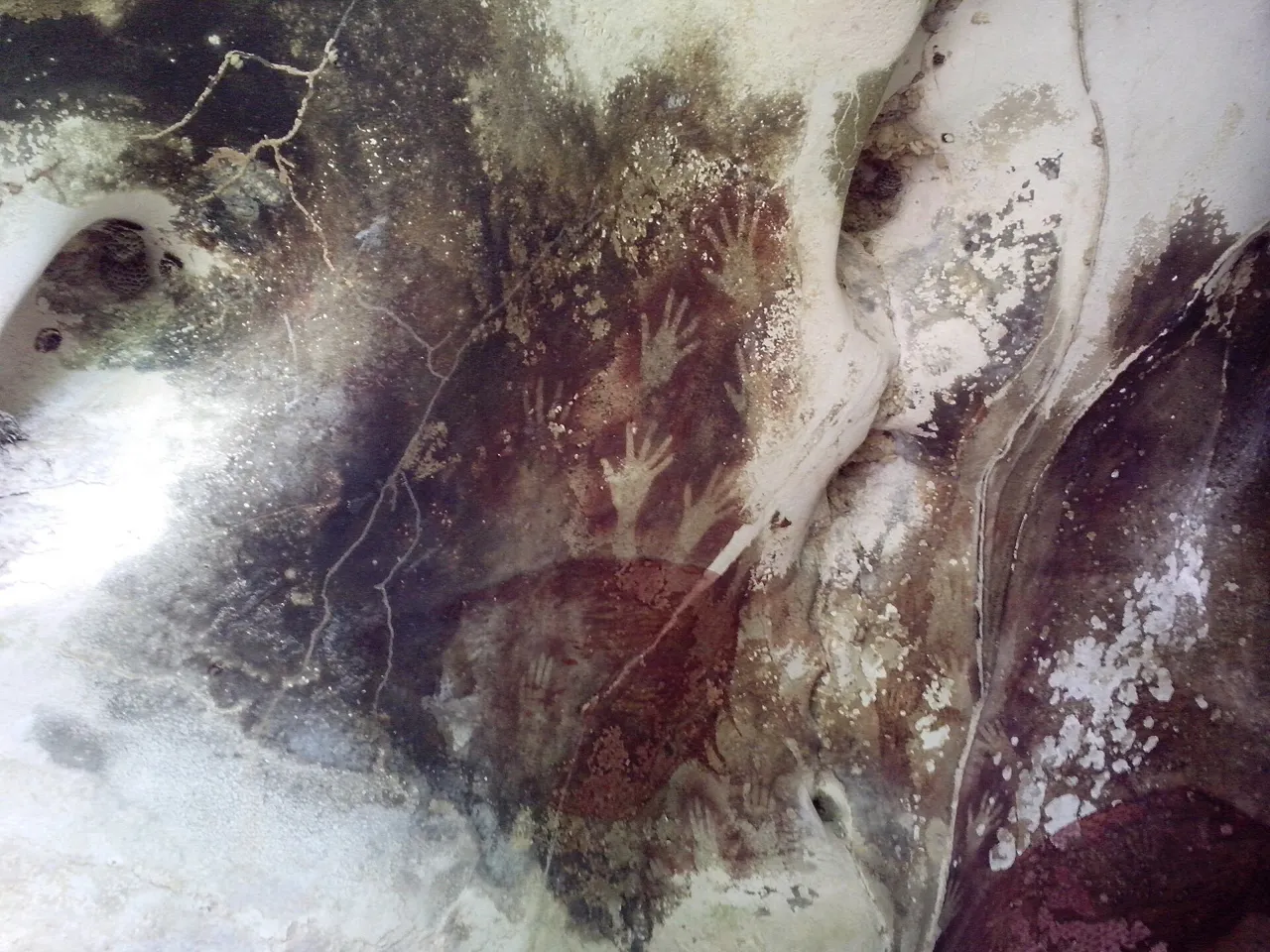
Look properly at a hand stencil. Someone placed a hand flat on this wall and sprayed pigment around it, and the outline is the exact size and shape of that hand. There is no other kind of prehistoric object that closes the distance quite so completely. It is worth a full minute.
Then look for the other clock. After reading this far, the most informative thing on the wall may not be the paint. Look for pale, sharp-edged patches where the outer surface has come away, and for raised, slightly glassy crusts over surviving pigment — the calcite that makes dating possible. On a single square metre of wall you may see the evidence for both clocks at once.
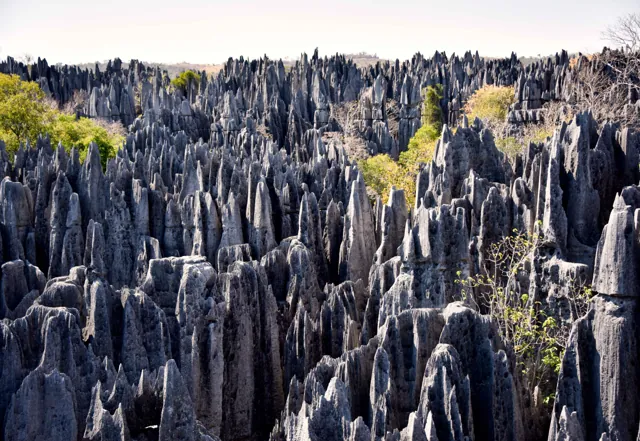
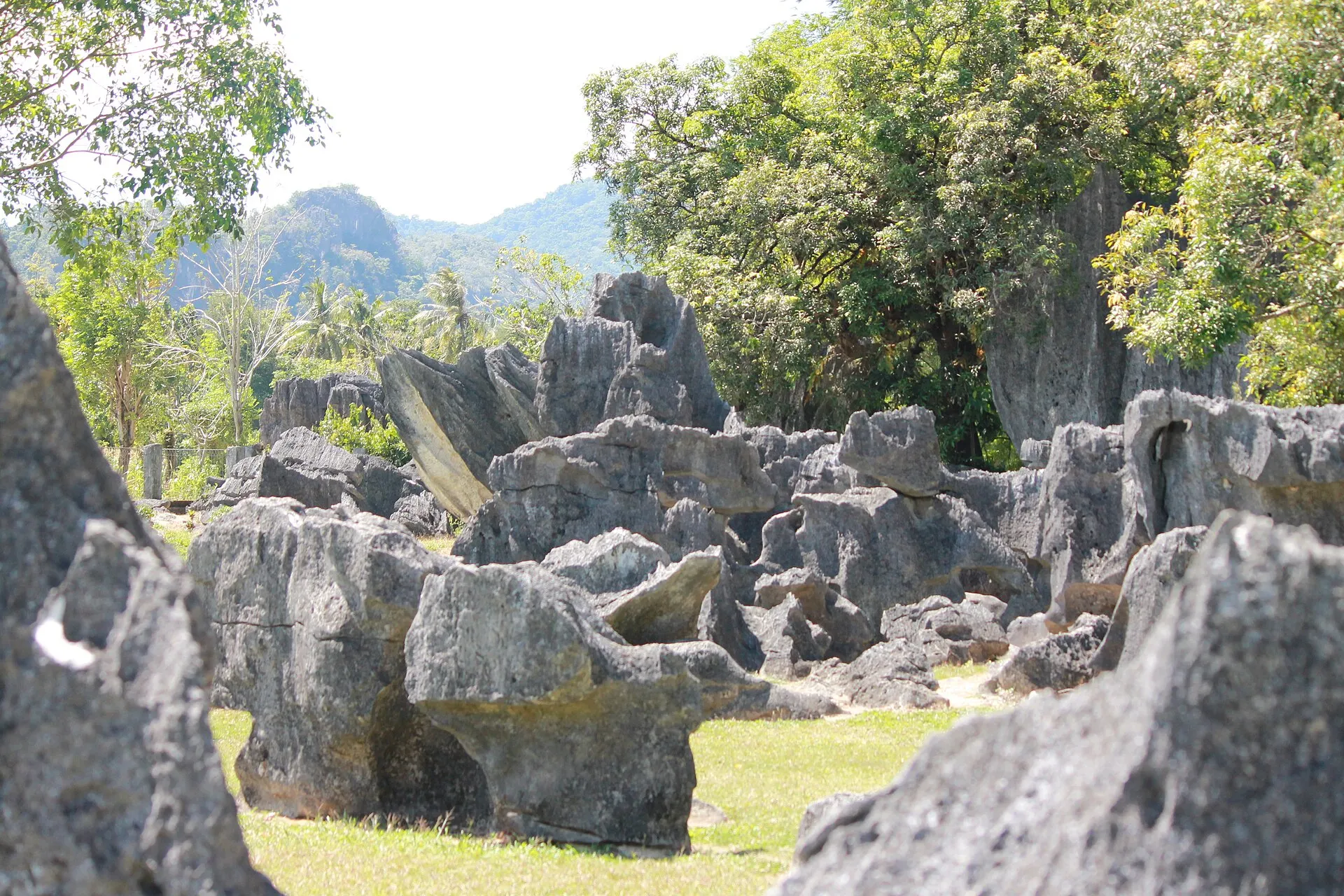
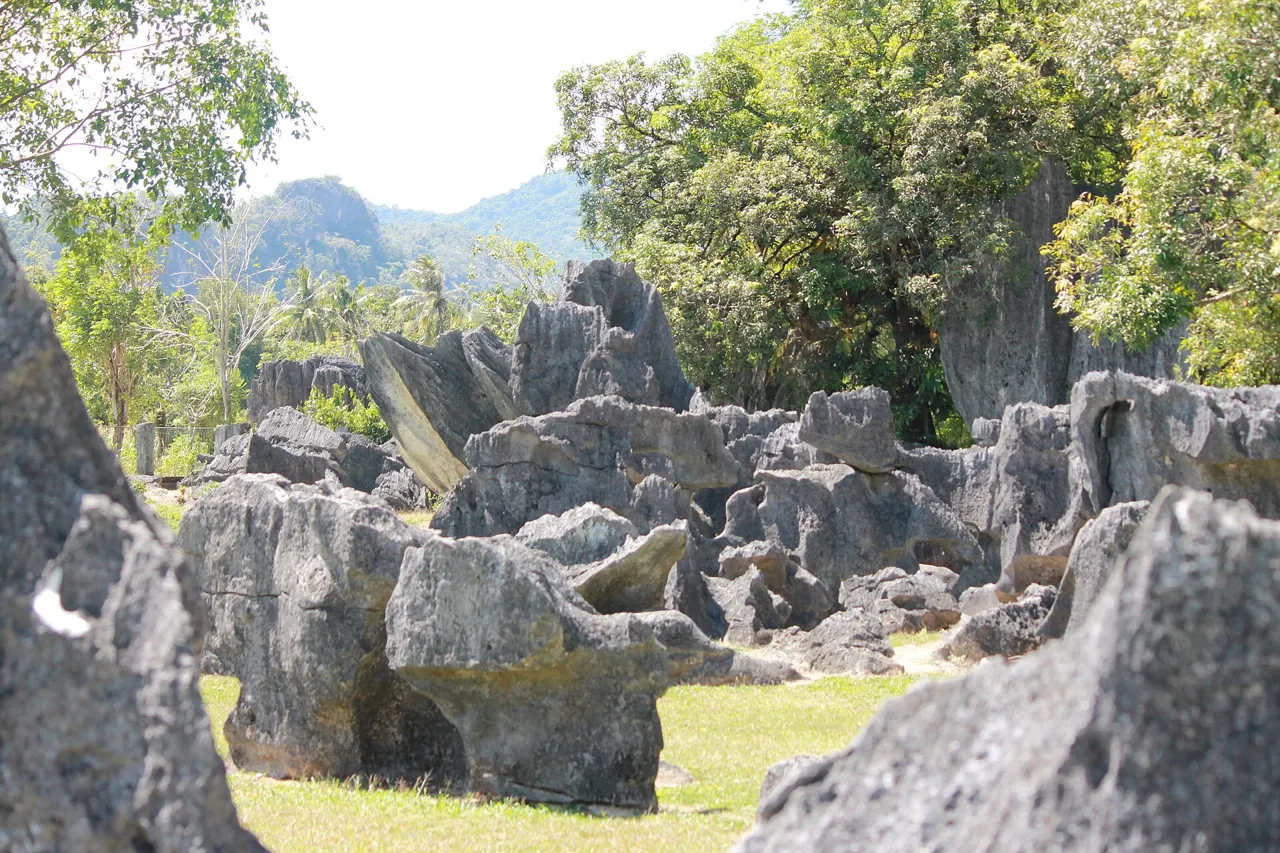
The rock garden and the towers. Outside the caves, the weathered limestone and the tower karst are the reason the geopark exists as much as the art is.
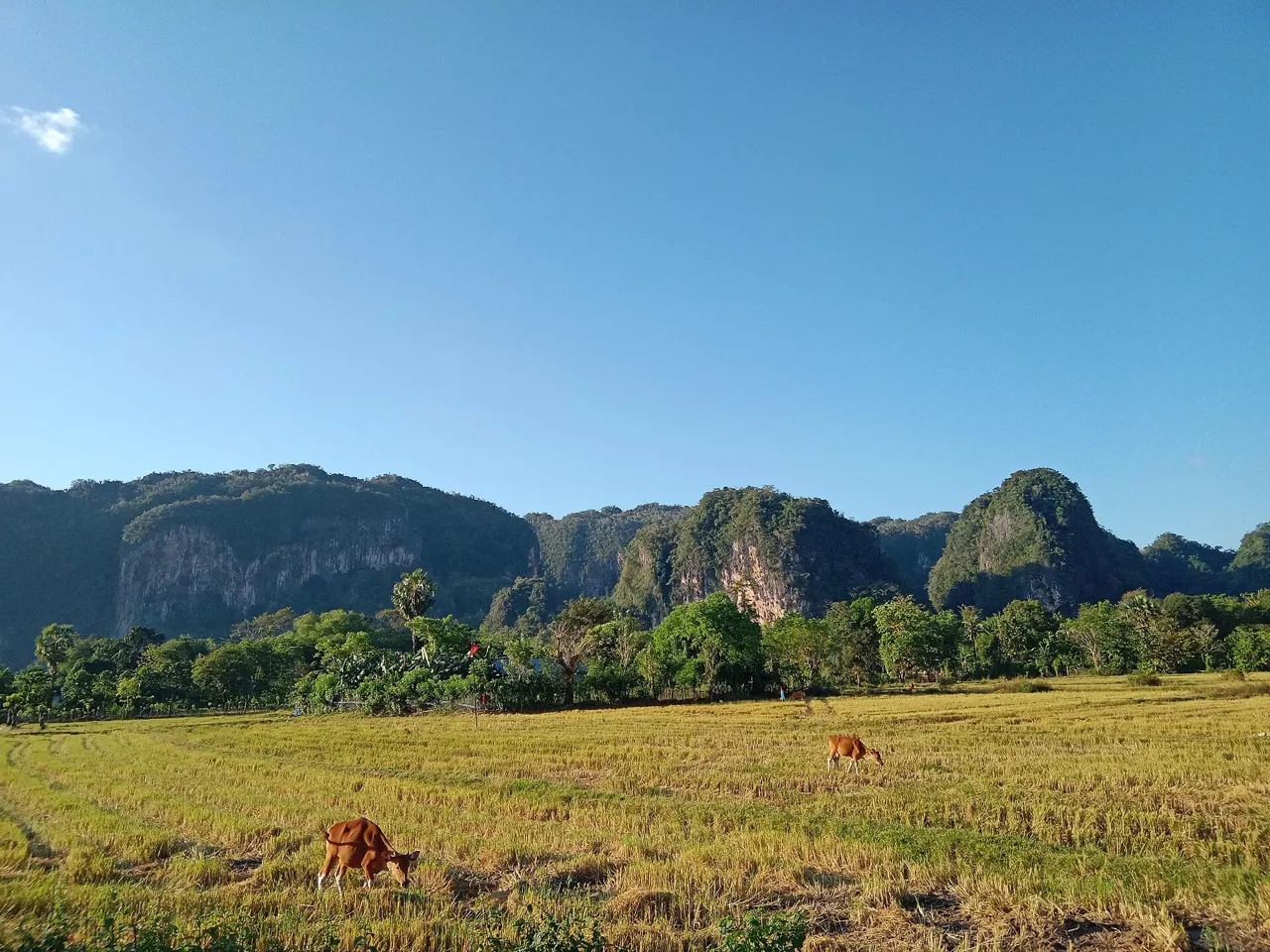
Rammang-Rammang, also in Maros, is the landscape visit rather than the archaeology one: boat trips between karst towers along the river.
Touch nothing. Not the paint, not the crust, not the wall near either. On a surface this fragile, the oil on a fingertip is a conservation event.
If the limestone itself is your main interest, the Bemaraha guide offers a contrasting karst landscape, with its own access and conservation conditions.
When to go
Wet and dry conditions affect travel in South Sulawesi. Treat the broad seasonal windows below as planning context and check the forecast and access notices for your dates.
The dry season, roughly April or May to September or October, is the straightforward window. Drier periods can simplify the approach, but wet stone, closures and permitted viewing positions still determine a visit. Do not approach other caves because a track looks passable.
The wet season, roughly November to March, brings heavy monsoon rain. Tracks to less developed sites become difficult, humidity in the caves rises, and the landscape is at its most striking, with the towers in cloud and the rice at its greenest.
Heat is the real constraint. Hot, humid daytime conditions can be tiring, and the caves are reached by climbing exposed limestone on a metal stair. Go early: cooler, quieter and better light for the art, and the park opens at 07:30 according to the most recent report found.
The season is part of the science. The alternation the 2021 paper blames — long dry spells, then intense rain — is this region's annual cycle, intensified in El Niño years. At the end of a long dry season, salt efflorescence may be visible on cave walls. White crystalline deposits can be relevant to the conservation problem; a visitor cannot diagnose a wall from appearance alone and must not touch or sample it.
Ramadan and Eid shift hours and local transport across Indonesia; check locally if your dates fall then.
Location and access
Base. Makassar, the capital of South Sulawesi, served by Sultan Hasanuddin International Airport (UPG), which is well connected domestically.
Leang-Leang. Roughly an hour from the airport and about ninety minutes from central Makassar; the park sits some twelve kilometres from the town of Maros and around thirty from Makassar. There is no useful public transport. The practical options are a hired car with driver, a guided tour, or a taxi with an agreed return.
The return journey is what people get wrong. Ride-hailing coverage out at the caves is not something to rely on. Agree a return with your driver, or book a tour that includes it.
Combining. Leang-Leang, Rammang-Rammang and the Bantimurung waterfall and butterfly area can be covered in one long day from Makassar with a chartered vehicle. That is the standard shape of the trip, and it works.
Inside the park. The painted caves are reached by metal stairs from the valley floor, with entrances well above the fields. It is short, but it is a climb, in heat, on metal.
Accessibility. Limited. The stair is the barrier and there is no alternative route to the cave mouths. The valley floor, the rock garden and the surrounding karst are approachable.
Guides. Local guides are available and worth taking, both because the figures are faint and hard to find unaided and because guiding income is one of the few ways this landscape pays locally.
Muna is a separate journey. Liang Metanduno, the 2026 record-holder, is on Muna Island in Southeast Sulawesi province, a different part of Sulawesi entirely and a different trip. Its access has not been researched for this guide, which gives no route to it.
The map on this page shows the Leang-Leang area and deliberately does not show the research caves.
Budget
Very cheap at the gate. The real cost is transport.
- Leang-Leang entry — no official tariff found. An undated visitor account reports IDR 20,000 for foreign visitors and IDR 5,000 for Indonesians. Indonesian press is lower and less specific: Tribun Timur (January 2025) headlines a charge of Rp 15,000, and IDN Times Sulsel (23 May 2026) gives Rp 5,000 to Rp 15,000 for local and foreign visitors without separating the two. The heritage office's website and the national park's published tariff page could not be read for this guide. Budget on the higher reported figure and treat all of them as indicative.
- Rammang-Rammang: a separate site with its own entry and a per-boat charge for the river trip. Current figures unverified; no guess published.
- Bantimurung: national park entry, charged separately. The park publishes a tariff page, but it could not be retrieved, so no figure is given here.
- Guides: negotiated on site, not published. Agree the fee before you start walking, and pay properly; it is a small sum in absolute terms and it matters locally.
- Transport: by far the largest cost, and charged per party. A chartered car and driver for a full day covering Leang-Leang, Rammang-Rammang and Bantimurung is the normal arrangement.
- Accommodation: Makassar, at ordinary Indonesian provincial-city rates.
Book the car, not the cave
Nothing needs booking in advance except the vehicle, and the vehicle does.
- A car and driver for the full day is the practical arrangement. Agree the whole route and the waiting time in advance; the standard failure is a driver expecting a twenty-minute photo stop.
- A guided tour from Makassar removes the return-transport risk entirely.
- Do not try to arrange access to the research caves. They are not visitor sites. Anyone offering "the 51,000-year-old painting" is either describing Leang-Leang loosely or proposing something you should decline.
- Check nothing is closed for fieldwork. This is an active research and monitoring landscape, and access to individual caves can change.
We have no affiliate links or commercial relationships for this destination and name no operator.
Packing
Tropical heat, a metal stair, limestone, and a surface you must not touch.
Footwear with grip. Limestone is slick when damp and the stairs are metal.
Sun protection. Brimmed hat, sunglasses, sunscreen. The approach and the rock garden are fully exposed and heat limits the whole visit.
Far more water than the distances suggest. Short walks, serious humidity.
Light long sleeves for sun and mosquitoes, in fabric that breathes.
A hand torch, not a flash, for seeing into cave interiors without photographing anything.
Insect repellent for rice fields and standing water.
Small rupiah notes for entry, guides, boats and stalls.
A rain layer from November to March, and realistically in any month.
What not to bring: a drone; a tripod to set against a cave wall; a flash you intend to use on pigment; and any impulse to touch a painted surface. Chalk, water or any other "enhancement" of faint art is destructive, and at these sites unforgivable.
One long day from Makassar
This is a day trip, and it deserves to be a full one.
Leave Makassar early — before the heat and before the tour vehicles. Allow about ninety minutes to Leang-Leang.
Leang-Leang first, while it is cool. Take a guide. Climb to the caves. Find the hand stencils, then spend longer than feels necessary on one of them. Then look deliberately for the flake scars and the calcite crusts, using What you can actually see as the checklist. Twenty minutes of close looking is worth more here than two hours of walking.
The rock garden and the towers on the way back down.
Rammang-Rammang in the middle of the day for the boat trip through the karst — the landscape half of the visit, and cooler on the water.
Bantimurung in the afternoon if there is energy left: waterfall, butterflies, and the national park the geopark is partly built around.
Back to Makassar for the evening, where the seafood is a real reason to stay rather than an afterthought.
Further reading
Unusually for this collection, the primary literature is the best reading available, and the key papers on both clocks are open access.
- Oktaviana, Joannes-Boyau, Brumm, Aubert et al., "Narrative cave art in Indonesia by 51,200 years ago", Nature, 3 July 2024. The current Maros-Pangkep record and the laser-ablation method described in What the dates actually date. nature.com
- Brumm et al., "Oldest cave art found in Sulawesi", Science Advances 7(3), 13 January 2021. The Leang Tedongnge pigs, with the most readable account of how a single calcite sample is taken and dated — and, in passing, of what exfoliation had already removed. Open access via PubMed Central. pmc.ncbi.nlm.nih.gov
- Huntley, Aubert, Brumm et al., "The effects of climate change on the Pleistocene rock art of Sulawesi", Scientific Reports, 13 May 2021. Haloclasty, the eleven-site survey, the 1950–2013 comparison, and the passage on quarrying. Open access. nature.com
- Gagan, Halide, Permana, Lebe, Dunbar et al., "The historical impact of anthropogenic air-borne sulphur on the Pleistocene rock art of Sulawesi", Scientific Reports, 13 December 2022. The counter-argument. Read it straight after the 2021 paper; the pair is the most instructive thing published on this subject. Open access. nature.com
- The Maros Pangkep UNESCO Global Geopark page for the geology, the cave inventory and the boundaries. unesco.org
The 2014, 2019 and 2026 Nature papers are listed in the sources below; their abstracts are free to read. Anyone wanting a book-length treatment should note that the field is moving faster than publishing: a monograph from before July 2024 predates the Karampuang date, and one from before January 2026 predates Muna.
Continue with Kampot, before the salt turns white, for another place where the current season and the people using the landscape shape the visit.
Questions travellers ask
Is this a World Heritage site?
No. It is a UNESCO Global Geopark, designated in 2023, and "Karst Landscape Maros Pangkep Prehistoric Cave Area" is on Indonesia's World Heritage tentative list with a 2025 date. A tentative listing is an intention to nominate, not a protection.
Is Maros-Pangkep still home to the oldest cave art?
For figurative art and for scenes, yes, on the evidence checked in September 2026: Leang Karampuang, at least 51,200 years. For rock art of any kind, no. Since January 2026 the oldest dated example is a hand stencil in Liang Metanduno on Muna Island, also in Sulawesi but outside this karst, at a minimum of 67,800 years.
Can I see the 51,200-year-old painting?
No. Leang Karampuang is a research site and is not open. At Leang-Leang you can see genuine Pleistocene rock art of the same tradition — hand stencils and a babirusa — reached by a metal stair.
How can they date a painting?
They do not date the paint. They date the calcite that grew over it, by uranium-series decay, and publish the young end of that date's range. The result is a minimum; the art could be considerably older.
Why do the dates keep going up?
Because every date is a floor and the method keeps improving. The 2024 laser-ablation technique isolates the calcite layer nearest the paint instead of averaging the whole crust, which moved the Bulu' Sipong 4 hunting scene from 43,900 to about 48,000 years.
Is the art really disappearing?
Yes. Substantial loss is documented between 1950 and 2013, and residents report worse loss in recent decades than in living memory. The dating papers themselves describe figures lost to flaking. What is disputed is the cause: climate-driven salt weathering, or historical and present airborne sulphur.
How much does it cost, and how long does it take?
Entry at Leang-Leang is reported between IDR 5,000 and 20,000 depending on the source; no official tariff was found. The caves take under an hour; the usual trip is a full day from Makassar combining Leang-Leang, Rammang-Rammang and Bantimurung.
Where the two clocks meet
The backwards clock has a laboratory, a method and a publication record. The forwards clock has, mostly, the weather. What sits between them is the slow, unglamorous work of recording.
Monitoring. The government heritage office for South Sulawesi set up a team to monitor the rate of damage to the cave paintings. By September 2021, Mongabay Indonesia reported, it had been running for four years, measuring temperature, wind and water pH and identifying plants around cave mouths, and trying to keep existing trees at the entrances and plant new ones. The office's own website carried notices of periodic damage-monitoring rounds in Maros and Pangkep through 2021 and 2022; those pages could not be opened for this guide, so their findings are not reported here.
Documentation. The 2021 climate paper called for long-term physical and chemical monitoring, drawing on the Franco-Cantabrian caves. The call for detailed documentation including 3D scanning appears in The Conversation's commentary on those findings; it should not be confused with the paper's own wording. One concrete answer has since appeared. In March 2026 a team from Hasanuddin University in Makassar — led by Yadi Mulyadi, with Nur Ihsan as first author and Rustan Lebe among the co-authors — published a workflow for recording and physically reproducing endangered panels. They built a photogrammetric model of the Leang Bulu' Sipong 4 hunting scene from 149 photographs and printed a half-scale replica, matching the original's overall dimensions to within 2.5 per cent, for display in museums and educational institutions. The paper calls it a "purpose-bound surrogate", not a substitute. The underlying data is publicly archived.
That is where the clocks meet. A photograph taken in 1950 became, sixty-three years later, the evidence of loss. A model archived in 2025 will one day be the evidence of what was there. Some of the same people who pushed the dates back are now keeping that record: Rustan Lebe is an author on the 2019 hunting-scene paper and on the replica.
Neither clock is going to stop. The dates will probably move again, because every one is a floor. The flaking will continue, whatever its cause turns out to be. Between them, somewhere above a rice field outside Maros, someone once put a hand flat on the rock and blew pigment around it. At Leang-Leang you can still see hands like that, at the size they were. Go early, take a guide, touch nothing, and give one of them a full minute while it is there.
Sources
- Aubert, M., Brumm, A., Ramli, M. et al., "Pleistocene cave art from Sulawesi, Indonesia", Nature 514, 223–227, 9 October 2014 — first recorded in the 1950s; 19 coralloid samples, 14 motifs (12 hand stencils, 2 animals), 7 cave sites; Leang Timpuseng hand stencil ≥39.9 kyr and babirusa ≥35.4 kyr; Leang Barugayya 2 animal ≥35.7 kyr; "opposite ends of the Pleistocene Eurasian world" — nature.com
- Aubert, M., Lebe, R., Oktaviana, A. A. et al., "Earliest hunting scene in prehistoric art", Nature 576, 442–445, 11 December 2019 — Leang Bulu' Sipong 4, ≥43.9 kyr; therianthropes hunting pigs and dwarf bovids; European comparison; weathering of the pig figures — nature.com
- Brumm, A. et al., "Oldest cave art found in Sulawesi", Science Advances 7(3), eabd4648, 13 January 2021 — Leang Tedongnge found 2017, pig 1 136 × 54 cm, ≥45.5 kyr; pigs 2–3 partly lost to exfoliation, a fourth figure too exfoliated for analysis; Leang Balangajia 1 ≥32 kyr — pmc.ncbi.nlm.nih.gov (publisher page science.org blocked automated reading)
- Huntley, J., Aubert, M., Brumm, A. et al., "The effects of climate change on the Pleistocene rock art of Sulawesi", Scientific Reports, 13 May 2021 — haloclasty, eleven sites, fieldwork 2015 and 2017, the 1950–2013 comparison, resident testimony, El Niño cycles, limestone quarrying for cement and marble, call for long-term monitoring — nature.com
- Gagan, M. K., Halide, H., Permana, R. C. E., Lebe, R., Dunbar, G. B. et al., "The historical impact of anthropogenic air-borne sulphur on the Pleistocene rock art of Sulawesi", Scientific Reports, 13 December 2022 — the sulphur/gypsum mechanism, the four source types, and the finding that most damage predates 1950 — nature.com
- Oktaviana, A. A., Joannes-Boyau, R., Brumm, A., Aubert, M. et al., "Narrative cave art in Indonesia by 51,200 years ago", Nature 631, 3 July 2024 — Leang Karampuang at 53.5 ± 2.3 ka (minimum 51,200 years), Leang Bulu' Sipong 4 redated to 50.2 ± 2.2 ka, laser-ablation U-series imaging — nature.com
- Oktaviana, A. A., Joannes-Boyau, R. et al. (Aubert, M., corresponding), "Rock art from at least 67,800 years ago in Sulawesi", Nature 650, 652–656, published online 21 January 2026 — Liang Metanduno, Muna Island; 71.6 ± 3.8 ka, minimum 67.8 ka; 16.6 kyr beyond the Maros-Pangkep minimum; 14 × 10 cm surviving patch — nature.com
- Ihsan, N., Mulyadi, Y., Bintang, I., Latief, A. N. K., Muda, K. T., Yusriana, Lebe, R., Sir, M. M., Jusdi, A., "3D-printed replicas for rock art preservation: a workflow development and fidelity assessment", Digital Applications in Archaeology and Cultural Heritage, online 23 March 2026 — sciencedirect.com; supplementary data (Bulu Sipong 4 panel, 149 photographs, 1:2 print files), Zenodo, 31 May 2025 — zenodo.org
- Eko Rusdianto, "Perubahan Iklim Ancam Lukisan Purba di Sulawesi?", Mongabay Indonesia, 7 September 2021 — heritage office monitoring team, four years, measurements taken, tree planting at cave mouths, around 300 rock art caves — mongabay.co.id
- "Bagaimana perubahan iklim menghapus seni cadas tertua di dunia", The Conversation (Indonesian edition) — call for monitoring, conservation and 3D-scanning documentation — theconversation.com
- UNESCO International Geoscience and Geoparks Programme, Maros Pangkep UNESCO Global Geopark — 2023 designation, 5,077.25 km², 572 caves, the 27 km cave, 332 artefact types, 1,437 species and 153 endemics — unesco.org
- UNESCO World Heritage Centre, State Party page for Indonesia — the ten inscribed properties, and "Karst Landscape Maros Pangkep Prehistoric Cave Area" on the tentative list with a 2025 date — whc.unesco.org
- ANTARA News, Maros Pangkep Geopark designated a UNESCO Global Geopark, 2023 — en.antaranews.com
- Taman Arkeologi Leang-Leang, Indonesian Wikipedia — renaming from Taman Prasejarah, management by the South Sulawesi heritage office, Leang Pettae and Leang Petta Kere and their paintings (encyclopaedic source) — id.wikipedia.org
- Caves in the Maros-Pangkep karst, English Wikipedia — distances from Maros and Makassar (encyclopaedic source) — en.wikipedia.org
- Nur Danil Kaimuddin, "Wisata Taman Arkeologi Leang-Leang: Lokasi, Tiket, dan Fakta Menarik", IDN Times Sulsel, 23 May 2026 — hours 07:30–17:00, entry Rp 5,000–15,000 (press report, not an official tariff) — sulsel.idntimes.com
- Tribun Timur, "Serunya Liburan di Taman Arkeologi Leang-leang, Piknik sambil Belajar Sejarah Cukup Bayar Rp 15 Ribu", 19 January 2025 — headline figure only; article body could not be read — makassar.tribunnews.com
- Visitor practicalities at Leang-Leang — reported entry of IDR 20,000 foreign and IDR 5,000 Indonesian, the metal stair, travel times, combining with Rammang-Rammang — theworldtravelguy.com (visitor reporting, not an official tariff — see research.md)
- Griffith University news, "Cave painting in Indonesia is the oldest known 'picture story'", 4 July 2024 — news.griffith.edu.au
- Griffith University news, "Climate change could erase ancient Indonesian cave art", 14 May 2021 — news.griffith.edu.au
Photograph credits
- Maros Pangkep Documentary 1 · Nurulrahayu09 · 2019-07-14 12:32:54 · CC BY-SA 4.0. Resized and converted to WebP; the hero may be cropped by the layout. These adaptations remain available under their respective licences.
- Maros Pangkep Documentary 2 · Cahyo · 2014-02-14 10:54:41 · CC BY-SA 3.0. Resized and converted to WebP; the hero may be cropped by the layout. These adaptations remain available under their respective licences.
- Maros Pangkep Documentary 3 · Anhar Karim · 2024-07-12 16:49:48 · CC BY-SA 4.0. Resized and converted to WebP; the hero may be cropped by the layout. These adaptations remain available under their respective licences.
- Maros Pangkep Documentary 4 · Anonymous Unknown author · Unknown date · CC BY 4.0. Resized and converted to WebP; the hero may be cropped by the layout. These adaptations remain available under their respective licences.
- Maros Pangkep Documentary 5 · Anonymous Unknown author · Unknown date · CC BY 4.0. Resized and converted to WebP; the hero may be cropped by the layout. These adaptations remain available under their respective licences.
Packing graphics: AI-generated editorial illustrations. Portrait supplied by Sok Heng Oeun.
A closer look.
The place, its details and its setting in dated photographs. Historical views do not establish today’s access or visitor conditions.

Sok Heng Oeun
Sok Heng Oeun is the owner and editor of Hidden Corners. The Hidden Corners Editorial Team supports image preparation and editorial checks under his direction.
Sok Heng Oeun on Facebook ↗AI-assisted preparation · Editorial review by Sok Heng Oeun, 19 October 2026. This article does not claim a firsthand team visit.