02 / NATURE & TRANSFORMATION
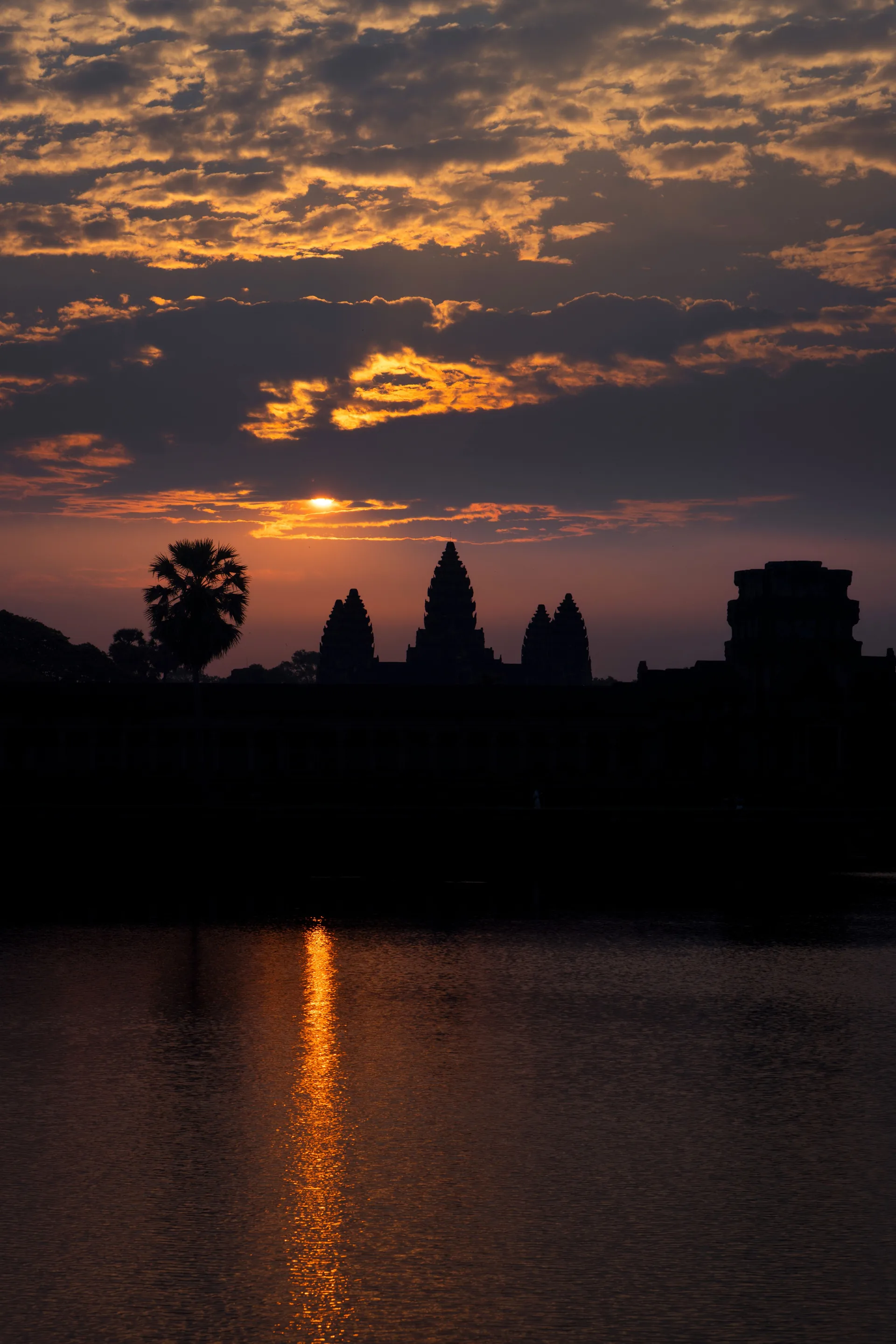
Before the towers, look at the water.
A visit to Angkor Wat begins with an engineered landscape. The water around the temple is an invitation to look outward as well as upward. Ask where the water comes from, how it moves, and what it means to maintain a monumental place in a region with strong seasonal differences. Nature is part of the story, but so are the people who shaped and continue to care for it.
Across Angkor, reservoirs and waterways helped organize life on the plain. NASA’s account of the ruins describes the West and East Barays in relation to water storage, river management and irrigation. The surviving water features therefore belong in the same mental picture as the temples, even when an itinerary presents them as separate stops. NASA’s landscape account
A city that does not look like our idea of a city
Remote sensing helped researchers examine features that are difficult to grasp from ground level. NASA’s explanation of a 2007 mapping study describes a broad, low-density settlement, connected by roads and water infrastructure. Its radar images record different surface responses, not the natural colors a visitor would see. Straight lines visible in those images can represent several kinds of human-made features; identifying them requires other evidence. Read about the mapping research
This is a useful adjustment to make before your visit. Empty-looking space between monuments need not have been historically empty. A modern road journey can pass through a landscape whose former organization is only partly legible to a casual observer. You do not need to identify every bank or depression yourself. The point is to keep the questions open and avoid treating the standing stone buildings as the whole city.
What nature changed—and what we should not assume
The romantic shorthand is that a jungle swallowed a civilization. Research offers a more complicated picture. A 2019 study of sediments from Angkor Thom found evidence supporting a gradual reduction in activity in the area examined, rather than a single abrupt fifteenth-century collapse. That is evidence from a particular part of the larger landscape, not a complete biography of every temple. The 2019 study
A later synthesis likewise emphasizes long-term transformation and adaptation. It discusses continued worship and pilgrimage at Angkor Wat within a changing regional society. The careful lesson is that political change, land use, water management and religious life did not necessarily follow one shared timetable. Research on transformation and adaptation
When you stand near the moat, try holding those different timescales together. There is the daily movement of visitors, the seasonal movement of water, the lifespan of a repair, and the much longer history of settlement. That is the nature-and-history connection this guide wants you to notice: a landscape repeatedly shaped by human choices and environmental conditions, rather than a frozen ruin with one dramatic ending.
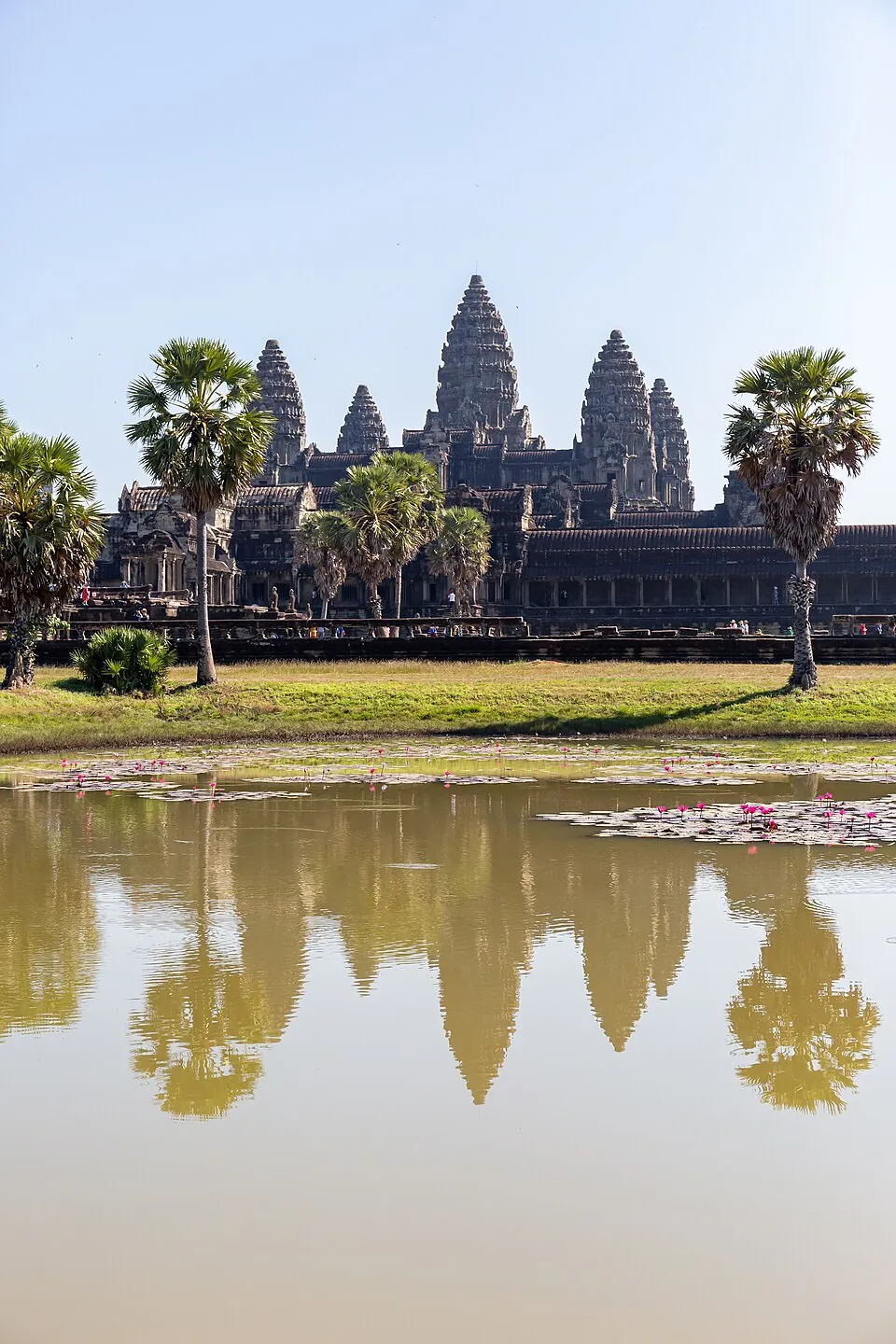
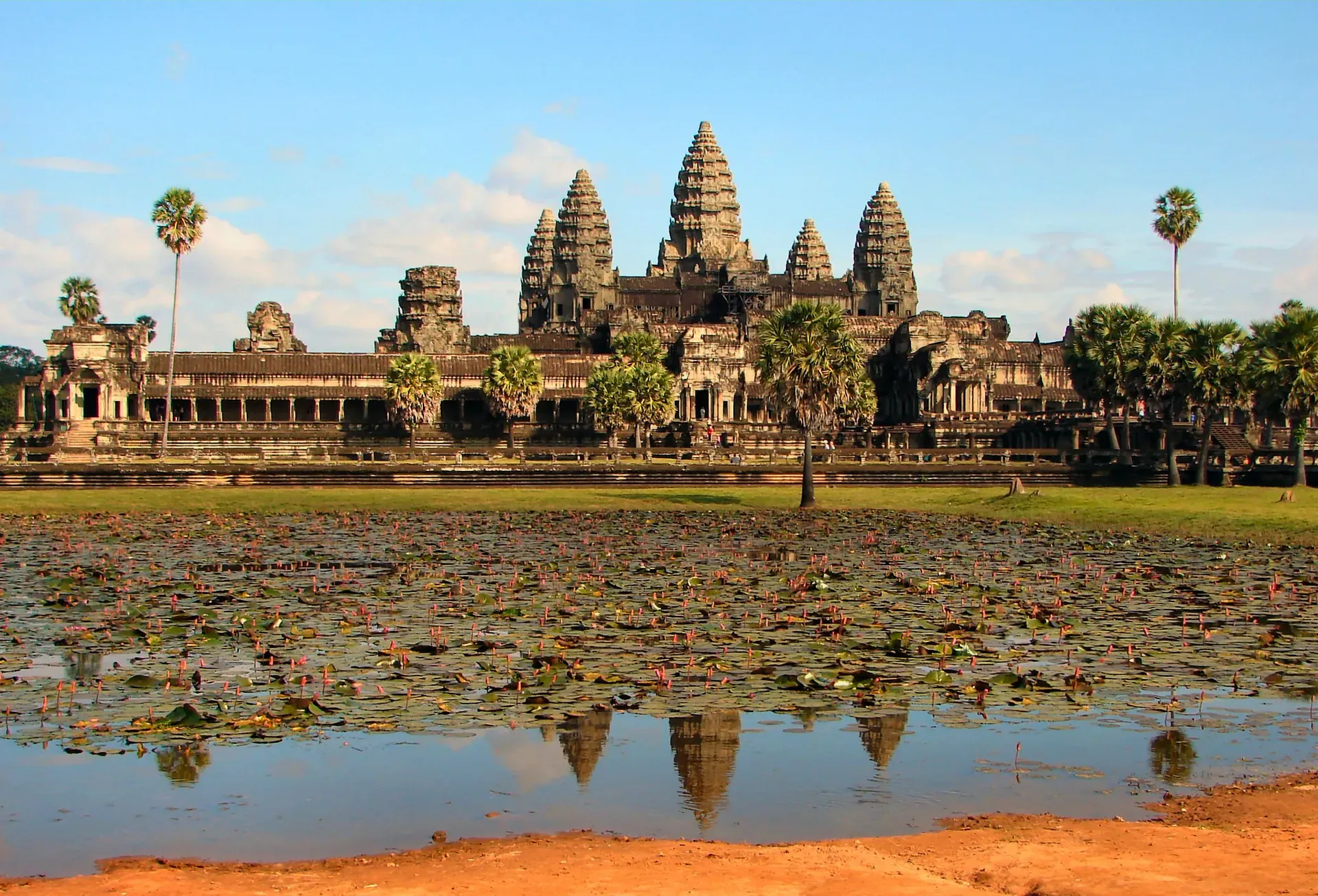
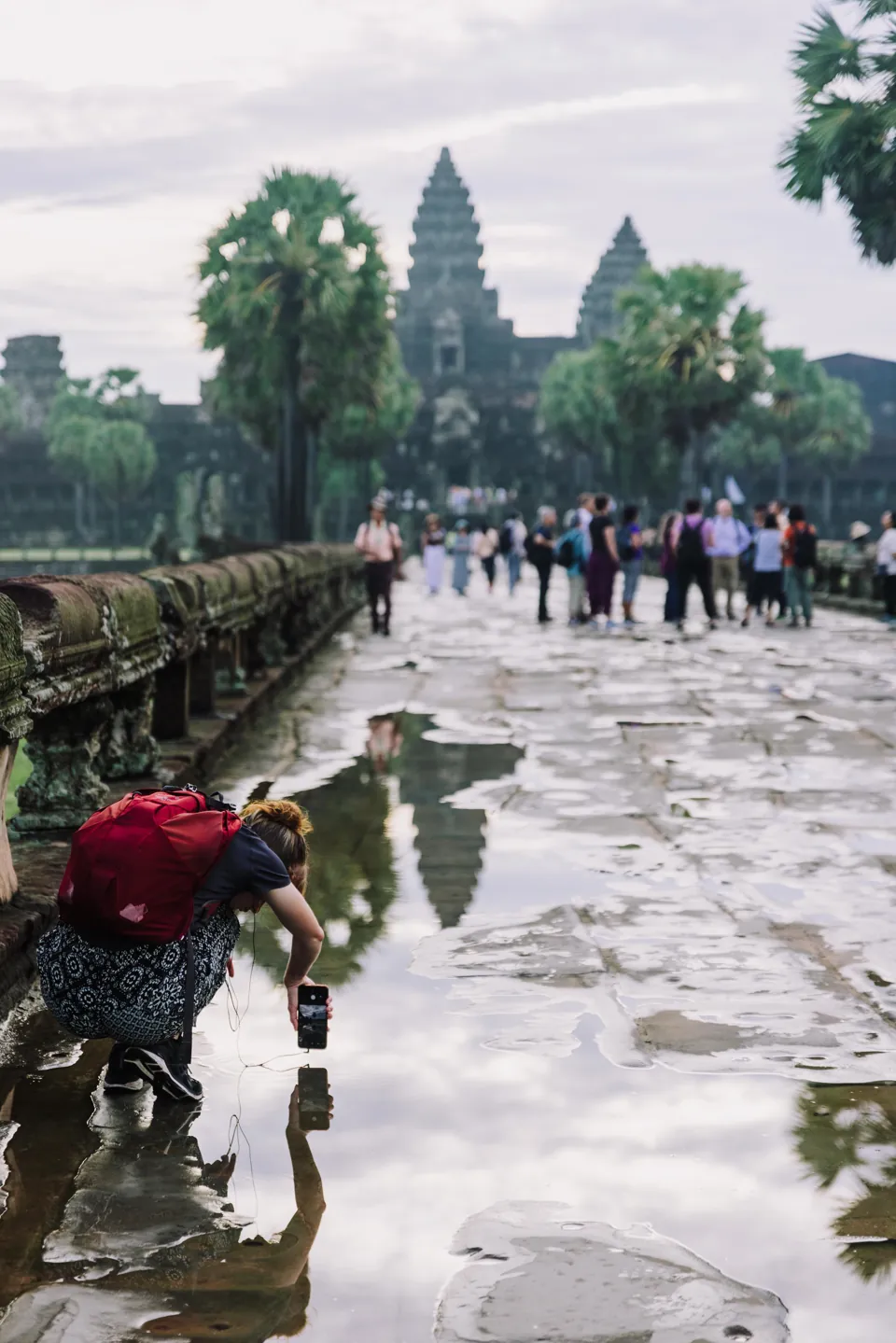
Start with the reflection.
Then look beyond it. The temple sits within a much wider landscape of settlement and water management.
For a separate lake visit, read our guide to Tonlé Sap’s changing water landscape. It explains how the water level changes what you can see and how to choose a village visit.
03 / HIDDEN HISTORY
The building survived. Its meaning kept evolving.
Angkor Wat was built in the twelfth century under Suryavarman II and originally dedicated to Vishnu. Its later history includes important Buddhist transformations. APSARA’s temple account points to inscriptions, images and alterations associated with that changing religious use, including significant work in the sixteenth century. The temple you visit is therefore the result of more than its founding moment. APSARA’s temple history
The journey behind Angkor Wat’s sandstone
Stone is also a story of work. Uchida and Shimoda’s quarry investigation, published in 2013, documented more than 50 sandstone quarries at the southeastern foot of Mount Kulen and examined a canal connecting the quarry area with Angkor. Their findings support a likely water-transport route. The research concerns the Angkor monuments collectively; it does not establish a total weight of stone for this temple. The quarry study and its limits
That changes the question you can take into a gallery. Before admiring a finished carving, consider the sequence behind it: selecting material, moving it, shaping it and placing it. The surviving building makes the scale of that coordination visible, even where the individual workers’ names are absent from the account in this guide.
Read the place as a sequence
It is tempting to search for a single “original” Angkor Wat and consider everything later an interruption. A more useful approach is to ask what each period added, retained or reinterpreted. Architecture can survive changes in worship, while particular spaces acquire new meanings. A guide who can explain that process may be more valuable than one who only supplies dates and dimensions.
Keep three different kinds of explanation separate in your notes. A historical claim describes something supported by documents, archaeology or a scholarly interpretation. A religious narrative explains a belief or story represented in the temple. A modern visitor’s impression describes how the place feels to that individual. All three can matter, but they answer different questions. Confusing them produces attractive writing and unreliable history.
Water also had symbolic meaning
For context beyond this temple, the Smithsonian’s exhibition on Vishnu examines a sculpture associated with the West Mebon and its reservoir setting. It shows why water in the Angkor landscape can carry religious meaning as well as practical significance. The West Mebon is a different monument; its story should not simply be transferred onto every feature at Angkor Wat. Smithsonian’s exhibition text
That distinction is worth taking into the galleries. Similar imagery across different temples does not mean that the buildings had identical patrons, purposes or histories. If you are visiting several sites, write down the name of each one beside your photographs. Later, a small note can prevent a Bayon story from being attached to an Angkor Wat image.
A simple way to ask better questions
Instead of asking only how old a feature is, ask how its age is known. Is there an inscription? A comparison with other carvings? An archaeological context? If an explanation is disputed, ask which part is uncertain. You do not need a specialist vocabulary to have a thoughtful conversation, and a candid “we are not sure” can be more informative than a highly precise answer without supporting evidence.
Leave space for the present as well. A caretaker, worshipper or visitor is not merely a figure passing through an ancient backdrop. The temple’s continuing significance belongs to its history. Looking at that living use respectfully is one way to avoid treating Cambodia’s heritage as something that ended long ago and now exists only for outsiders to interpret.
For an earlier architectural comparison, explore Sambor Prei Kuk’s brick temples. Use it to look more closely at materials and layout.
04 / WHAT TO SEE & DO
Trade a checklist for a closer look.
You can structure a visit around four kinds of attention: the overall approach, the carved stories, changes in scale, and the details you notice when you stop moving. This is a flexible way to explore, not a prescribed walking direction. Follow current signs, barriers and staff instructions, and let your guide adapt the order if a space is crowded or temporarily unavailable.
Begin with the approach
Before moving toward the main temple, take a moment to see how water, open ground and the architecture work together. Look at the changing relationship between the towers as you move along an authorized route. A wide view explains the setting; a closer view begins to reveal the work of individual builders and carvers. Neither view makes the other unnecessary.
For photographs, try making one frame that includes the setting and another that isolates a detail. This gives you more than a collection of nearly identical tower images. Avoid backing into other visitors while looking at your screen, and do not step beyond a barrier to remove people from the frame. Sharing the view is part of visiting a major monument.
Give one carved story your full attention
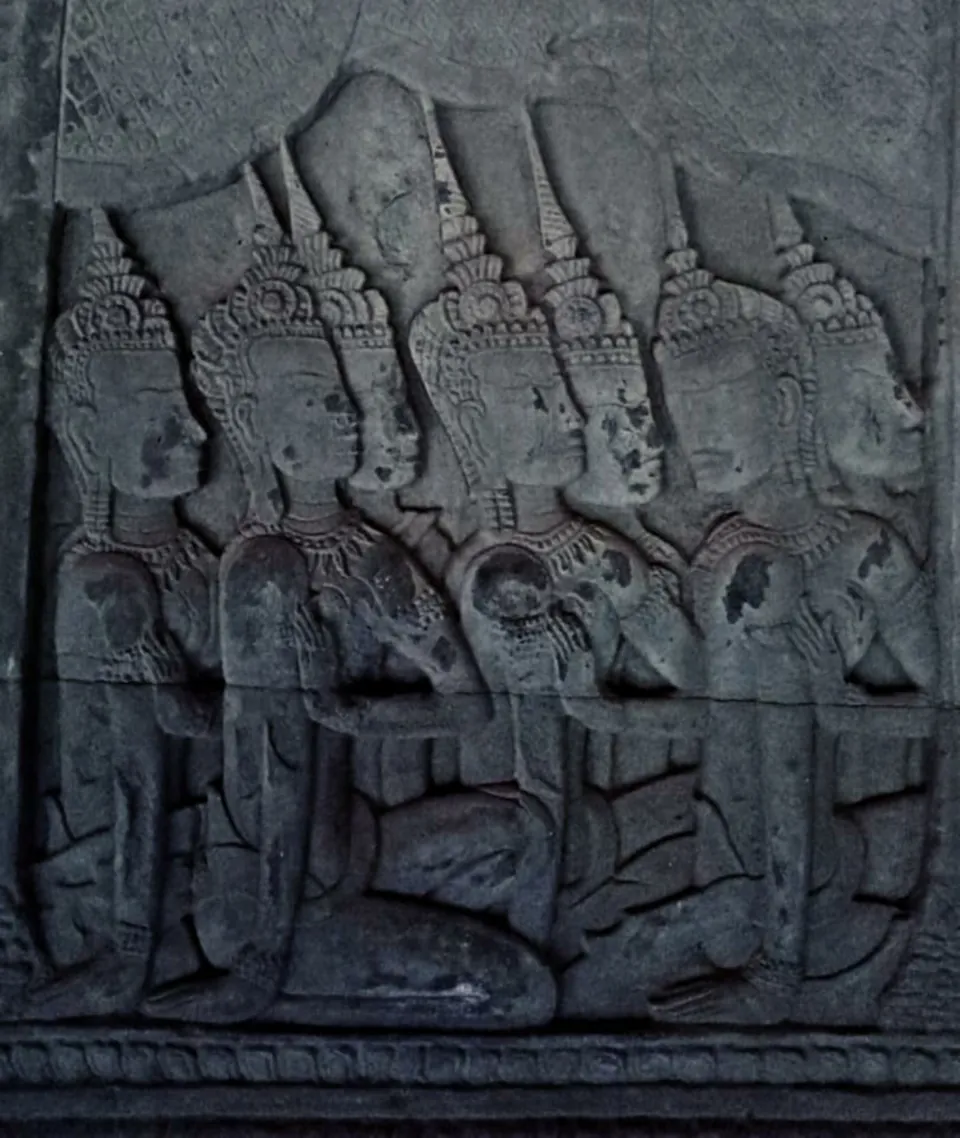
APSARA identifies historical and epic subjects in the bas-relief galleries, including scenes associated with Suryavarman II and the Churning of the Ocean of Milk. Pick one scene to understand rather than rushing past every panel. Ask where the narrative begins, how the figures are arranged, and which visual clues distinguish the participants. Gallery descriptions
Then spend a few minutes looking without an explanation running beside you. Notice repeated gestures, changes in scale and the way a carver organized a crowded composition. You need not identify every person or deity to appreciate the visual decisions. If you photograph the panel, take a separate picture of any relevant permitted label so the context survives after the trip.
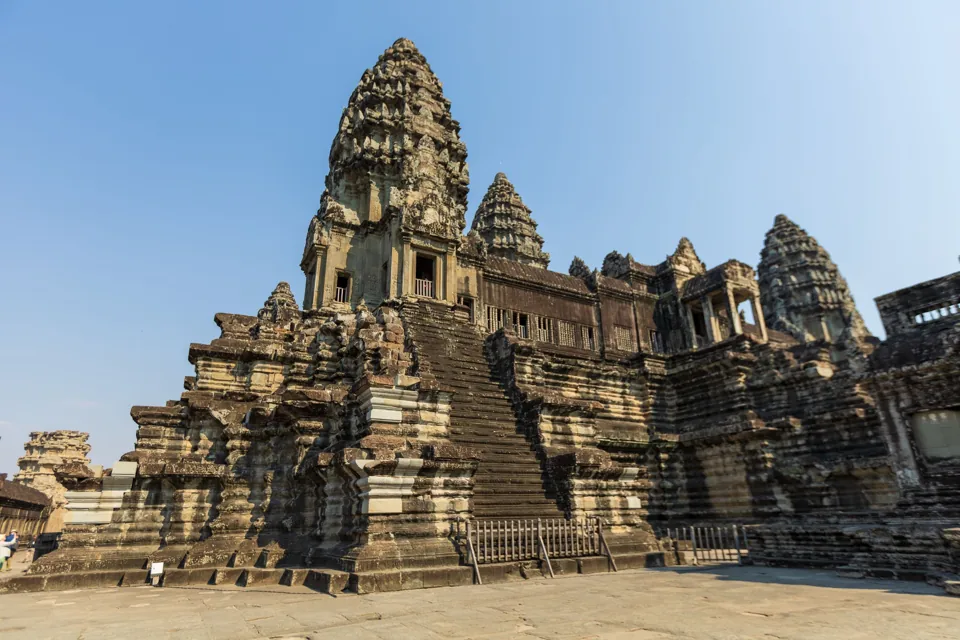
Consider the upper level as optional
The Bakan, or upper level, has additional access restrictions, including closures on Buddhist holy days and restrictions for some visitors. Consult APSARA and the staff on the day. It should be an optional part of your plan, not the single experience on which the day depends. Upper-level visitor guidance
If steep steps are uncomfortable or access is closed, use the time for a slower lower-level visit. There is no need to treat the highest viewpoint as proof that you have seen the temple properly. Travel companions can also agree in advance whether to split briefly and where to meet again, rather than making a rushed decision at a queue.
Notice the care around the object
A support, protective barrier or repaired surface can look like a distraction from an ideal photograph. It can also prompt a valuable question about how the monument survives. World Monuments Fund’s account of its work at Angkor describes conservation challenges, including those associated with the carved galleries. Preservation is active work, not the automatic consequence of calling a place heritage. Conservation context
Finish this chapter of your visit with one detail you can describe in your own words. Perhaps it is the rhythm of a row of figures, the framing of a doorway, or the shift from open ground into shade. The detail need not be rare. The aim is to leave with something you actually noticed, alongside what you were told.
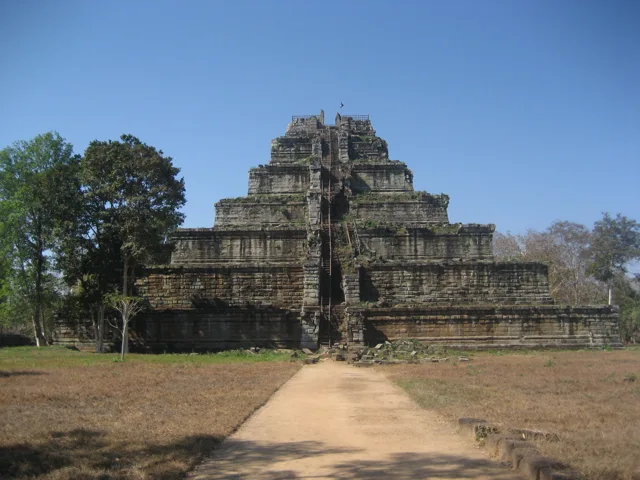
To give another temple day a different focus, explore Koh Ker’s temple landscape. Plan it as a separate journey with enough time beyond the pyramid.
05 / PEOPLE & CULTURE
A living place deserves a human introduction.
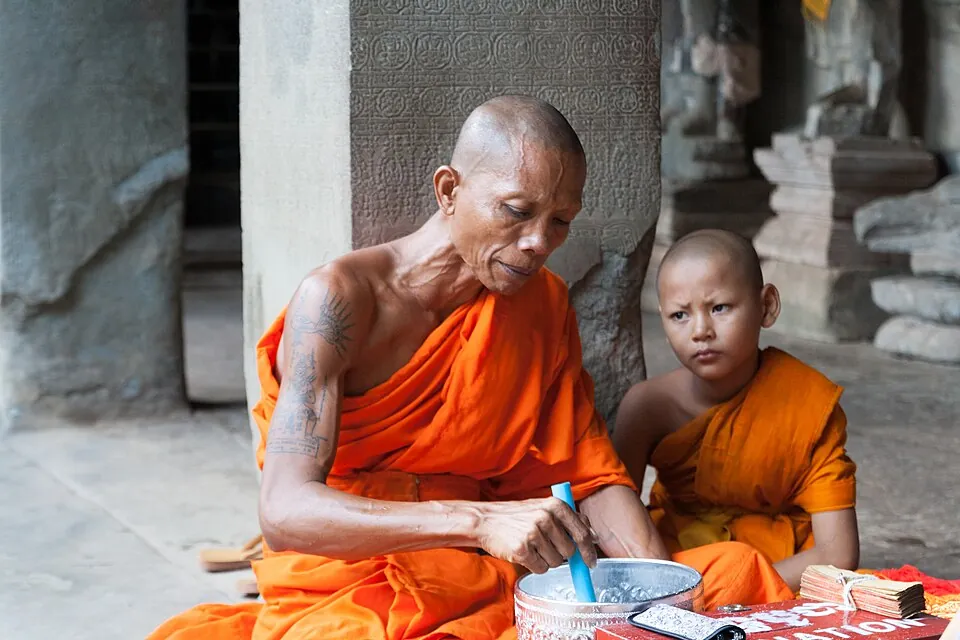
A respectful visit starts with a simple change in perspective: the people around you are not part of the scenery. Guides, drivers, sellers, caretakers and worshippers have their own work, responsibilities and reasons for being there. Courtesy is not a complicated performance. It is attention to the person in front of you, and a willingness to listen when you do not know what is appropriate.
People belong to Angkor’s present tense
APSARA describes continuing monastic life in Angkor’s pagodas. This is a useful correction to the idea that everyone within a historic landscape is either a tourist or someone serving tourists. A visit can pass through spaces that matter for worship, work and daily life as well as heritage conservation. APSARA on living heritage
Let the people you meet set the terms of the encounter. A guide may enjoy explaining a carved scene; a worshipper may want privacy. Ask a craftsperson about a technique without demanding a performance, and agree a price before a driver begins a journey. Curiosity works best when it leaves the other person room to say no.
Begin with a greeting
A formal greeting commonly written as “chum reap suor” is associated with the sampeah, the gesture of bringing the palms together with a slight bow. Published spellings vary because Roman letters only approximate Khmer pronunciation. Let a local speaker guide your pronunciation instead of expecting a phonetic card to capture every sound. Greeting and etiquette reference
The phrase cards below are a starting point. Use a greeting when beginning a conversation, say thank you when someone helps, and allow time for a response. You do not need a long list of phrases to make an interaction warmer. Nor should a few learned words be presented as expertise in a language or culture.
Make a guide part of the experience
If you choose a guide, describe what interests you before booking: carved narratives, water systems, religious history, photography or an unhurried first introduction. Ask which language they guide in, what the agreed duration includes, and whether the fee is separate from transport and entry. A shared understanding is more useful than assuming that every “Angkor tour” provides the same experience.
During the visit, give the guide room to answer. Ask how they distinguish documented history from a traditional story. If a subject is outside their expertise, an honest boundary is a strength. For detailed specialist interests, ask in advance whether the guide is comfortable with them rather than testing someone unexpectedly during a general tour.
Connect through food and everyday choices
In Siem Reap, make room for an ordinary meal instead of treating every hour as temple time. Ask a restaurant what it cooks particularly well, check ingredients if you have dietary needs, and choose an amount you are likely to finish. A locally owned business may offer a useful connection, but ownership and working conditions should not be inferred from a rustic sign or a claim of authenticity.
The same applies to crafts. Ask what an item is made from, who made it, and whether the seller knows its origin. You can appreciate a contemporary object without requiring it to be ancient or unchanged. Avoid buying anything represented as an excavated antiquity. A meaningful souvenir does not need to carry a story of removal from a historic site.
For photographs of people, ask before taking a close portrait, and accept a refusal immediately. Worship deserves particular space. If you are unsure whether it is appropriate to enter a religious area or photograph an activity, ask a guide or caretaker. The quality of a visit is partly measured by how comfortably the people who belong there can continue their day.
Khmer classical dance: culture carried through practice
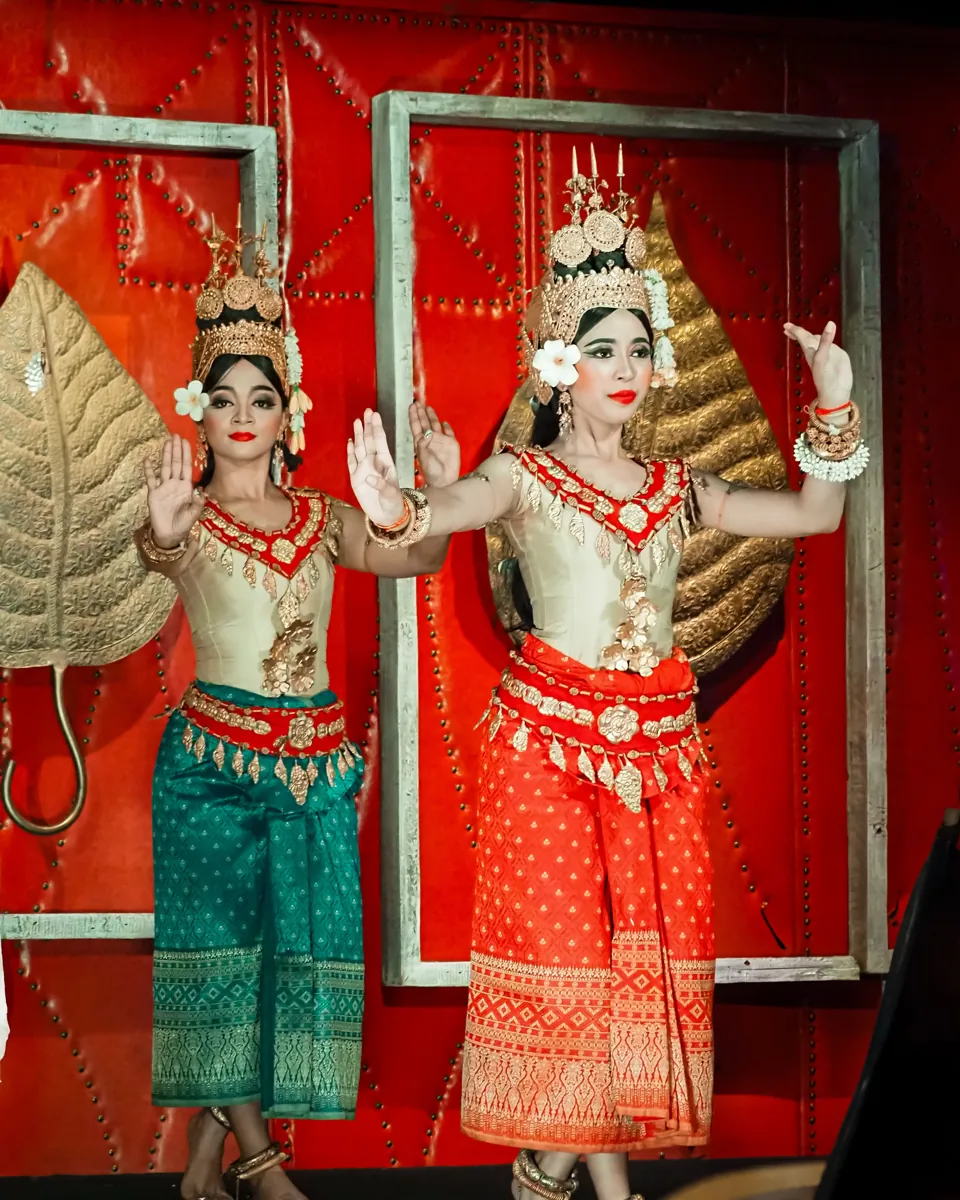
The expressive hands and elaborate costumes of Khmer classical dance belong to a trained performing tradition. UNESCO’s account of the Royal Ballet of Cambodia describes years of preparation, symbolic character types, music and storytelling, as well as the devastating losses suffered in the 1970s and subsequent revival. These histories deserve more attention than a quick description of an “ancient show.” UNESCO’s cultural account
If you choose a performance in Siem Reap, look for information about the artists and the programme. Read a synopsis, give the performers your attention and follow the venue’s photography rules. A modern presentation is not evidence of exactly how a twelfth-century ceremony looked. It is a chance to appreciate living skill on its own terms.
06 / SEASONS & TIMING
Choose your season. Leave room for the day.
There is no month that guarantees an empty temple, perfect light and comfortable weather. Choose the conditions you are most willing to work with. A photographer may prioritize changing skies; a traveler sensitive to heat may favor the cooler part of the dry season; someone with limited days may place more value on an itinerary that can absorb rain without falling apart.
Cambodia’s Ministry of Tourism describes a wet season broadly running from May to October and a drier period around the rest of the year. It notes relatively cooler conditions around November to January and substantial heat toward April. These are general patterns, not predictions for your travel dates. Seasonal transitions can be untidy. Official seasonal overview
Plan for conditions, not just months
For a dry-season visit, give special attention to shade, drinking water and the length of time you intend to spend outside. For a wet-season visit, consider how you will protect your bag and electronics, where you can pause safely, and how a downpour could affect your transport plan. Neither approach requires filling your day with equipment; it requires a little preparation.
Check the forecast close to your visit and ask your driver or guide about local conditions. A general season label does not tell you whether a particular route is comfortable that day. If conditions are poor, shorten the visit, delay an exposed section or reorganize the order. An itinerary is useful precisely because you can change it.
Sunrise is a choice, not a requirement
Ask yourself what you want from an early start. If the aim is a particular photograph, accept that weather, water conditions and other visitors may change the result. If the aim is attentive exploration, a less demanding start may suit you better. Do not assume that arriving for sunrise means every interior space opens at the same time.
Arrange pickup and breakfast with that decision in mind. An early departure followed by several hours of walking can feel very different from a relaxed morning in town. Discuss a realistic stopping point before setting out. A proper meal and a rest can make the second half of a day more worthwhile than adding another temple while exhausted.
The seasonal selector below offers planning prompts rather than live crowd estimates or a weather service. Use it to decide what to ask next, then check current conditions through appropriate local sources. That is more honest—and more useful—than assigning each month an unsupported numerical travel score.
07 / LOCATION & ACCESS
Start in Siem Reap. Agree on the whole journey.
Use Siem Reap as your planning base and identify Angkor Wat specifically when arranging transport. A destination name alone does not define the service you need. A one-way ride, a waiting driver, a day circuit and a guided visit are different arrangements. Agree on the pickup, return, waiting time and included stops before you pay.
Choose the transport that fits your day
When comparing a tuk-tuk arrangement with a car, think about comfort, weather, the people traveling with you, and the length of the route. Ask about shade or rain protection, passenger capacity, and how you will find the driver again after leaving the temple. A clear meeting point is particularly useful if your phone loses power or mobile service is unreliable.
If cycling appeals to you, evaluate the whole journey rather than only the distance to the temple. That includes road conditions, your experience with local traffic, heat, secure parking and the return when you are tired. Request current advice from a reputable local operator. This guide does not certify a cycling route or imply that every road is suitable for every rider.
Use maps for orientation, then follow site instructions
The embedded map in this guide identifies Angkor Wat; it is not a turn-by-turn walking route through the monument. APSARA provides official visitor information and a visitor map. Consult those resources alongside current signs, especially when planning where to enter, where to meet transport, and which areas are open. APSARA’s visitor resources
Save the address of your accommodation and the agreed pickup point before departure. Keep a simple backup that does not depend on a mobile signal, such as a screenshot or written note. If you use a transport app, check that the destination and pickup pin match what you mean rather than accepting an automatically suggested location without looking.
Accessibility needs a specific conversation
A broad label such as “easy visit” cannot describe every part of a large historic monument. Ask about the exact route, surface changes, thresholds, steps, distances between rest opportunities and any equipment you use. A car transfer does not by itself make the temple route accessible, and a guide’s willingness to help is not a substitute for accurate route information.
For a group with different mobility or stamina needs, choose a shared core visit and optional additions. Agree where people can wait comfortably and how you will reconnect. The same approach helps families: a shorter, engaging visit with time for questions can work better than a long route organized around adult expectations.
If access information cannot be confirmed, keep the uncertainty visible in your plan. Do not build the day around an assumed staircase, shortcut or entrance. A useful guide should make the unknowns easier to resolve, not hide them beneath a confident promise.
08 / TICKETS & BUDGET
Know the fixed price. Adjust everything else.
Separate the official pass from the rest of your spending. Angkor Enterprise lists a one-day pass at US$37, a three-day pass at US$62 with a seven-day validity window, and a seven-day pass at US$72 with a thirty-day validity window. These published prices were checked on 30 September 2026. Confirm eligibility, conditions and the current price with the official seller before buying. Official tickets and validity
Choose a pass by usable days
A longer pass can make sense when you genuinely have time for several visits. It is not automatically better value because the price per possible day is lower. Write down the days you can actually use, including arrival, departure and any other plans. A pass that gives you flexibility is useful only if your schedule can take advantage of it.
Check what your tour price includes. A product called an Angkor tour may still exclude the temple pass. Avoid adding the ticket again if it is already included, and avoid assuming it is included when the listing only covers transport. Read the inclusions and exclusions together; promotional titles are not detailed cost breakdowns.
Build a budget from separate decisions
The calculator below combines a selected pass with transport, food, a guide and accommodation. The non-ticket amounts start as illustrative allowances, not surveyed market prices or bookable offers. Replace them with quotes for your dates. This lets you test a plan without mistaking a convenient example for a guaranteed local rate.
Transport and guide fees are entered for the whole party for the planned visit; food is per person per day; accommodation is per room per night. Those units matter. A shared car cost should not be multiplied once for every passenger, and a room cost should not be mistaken for the price per person. The displayed breakdown keeps those assumptions visible.
Leave a little flexibility
Beyond the calculator, consider expenses specific to your journey: airport or onward transfers, extra stops, purchases, tips if you choose to give them, and payment fees. International flights, visas and insurance are outside this local visit estimate. Do not use the total as a complete Cambodia trip budget.
Before accepting a quote, confirm the currency and what happens if the itinerary changes. Ask whether an early pickup, a longer wait, or a more distant temple adds a fee. It is easier to compare two clear offers than to negotiate around an attractive starting price whose limits remain unclear.
Accommodation is another place where headline prices can mislead. Check taxes, cancellation rules, breakfast and the room configuration. Two travelers sharing one room and two travelers wanting separate rooms have different budgets. Choose the arrangement that suits you, then adjust the estimate rather than forcing your trip into a supposed “budget traveler” category.
The aim is a budget you understand. If you can explain what each line covers and where its amount came from, you have a better planning tool than a single daily-cost number copied from another traveler’s trip.
09 / YOUR DAY BAG
Carry what helps you stay curious.
A good temple day bag supports walking, respectful dress and a few hours of attention. It does not have to contain every item on a generic international packing list. Begin with the conditions you expect, the time away from your accommodation, and anything you personally need to feel comfortable. Then remove duplicates.
Clothing and footwear
For an Angkor visit, start with a loose shirt that already covers your shoulders and trousers or a skirt that covers your knees while walking and sitting. Choose breathable fabric and shoes with grip for worn stone. The practical aim is to stay comfortable without needing to rearrange a covering at each entrance. Follow staff instructions at the monument. Official visitor guidance
The Cambodian detail: an optional krama
A krama is a rectangular woven cloth used in Cambodian daily life, commonly recognizable by its checked pattern. UNESCO inscribed the cultural practices associated with it in 2024. It is a living textile tradition, not a costume every visitor must wear. Read about the krama
Our suggested visitor outfit pairs a light cotton krama, draped loosely around the neck, with a sleeved shirt and long trousers. In warm weather, keep it easy to remove and stow. If buying one locally, ask who wove it, where it was made, and whether it is cotton or silk; a market location alone does not establish handmade or local production. Ask the seller to show a comfortable everyday way to wear it. A scarf is not a substitute for temple-appropriate clothing or tested sun protection.
Wear footwear you already trust on a long walk. A pair that looks suitable but causes discomfort after an hour can dominate the rest of the day. Think about grip and fit as well as appearance. Pack lightly enough that keeping your balance and moving through busy areas remains easy.
Water, weather and the small essentials
March–April: make room for the heat
April is typically among Siem Reap’s hottest months. Plan exposed walks early, arrange a shaded rest before you feel exhausted, and agree with your driver where drinking water can be replenished. Carry a refillable bottle, a brimmed hat and sunscreen in an accessible pocket. Avoid turning a hot afternoon into a race to finish every temple. These are seasonal planning suggestions; check the forecast close to your visit. Local climate context
For exposed skin, the American Academy of Dermatology recommends broad-spectrum, water-resistant sunscreen with SPF 30 or higher. Apply before going outdoors and reapply about every two hours, and after swimming or sweating, following the product label. Use shade and protective clothing too. Sun protection belongs in the bag throughout the year, including cloudy days. Sunscreen guidance
May–October: prepare for rain without overpacking
Add a compact rain layer and a water-resistant pouch for your phone and pass. Choose footwear with a secure sole, and slow down on wet stone rather than sheltering under unstable structures. Keep a flexible afternoon: a forecast shower may change your sequence, while actual closures and safe routes are decided locally. Dry-season dates do not guarantee a rain-free day. Seasonal patterns
Keep your pass accessible, with your booking information and agreed transport details saved. Charge your phone before leaving. A power bank can help if you rely on the phone for photographs, maps and communication, but it is still sensible to keep a simple backup of your accommodation address and meeting point.
Pack for the visit you actually want
If photography is central to your visit, decide in advance which equipment you will really carry for several hours. Confirm any restrictions that apply to specialist equipment. If you mainly want to learn, a small notebook may be more useful than another lens. Writing down three questions can change how you engage with a guide.
Bring your own essential medication and personal supplies as appropriate. Consider the needs of each traveler separately; a shared bag may not be enough if the group splits for an optional section. Keep anything you need frequently within easy reach so you do not have to unpack everything in a busy doorway.
The interactive checklist stores ticks on this device when browser storage is available. Use it as a reminder, not a rulebook. You can reset it for a new trip or print the guide, and there are no shopping links attached to the items. The best packing recommendation is often to use something suitable that you already own.
A day bag, and two ways to dress.
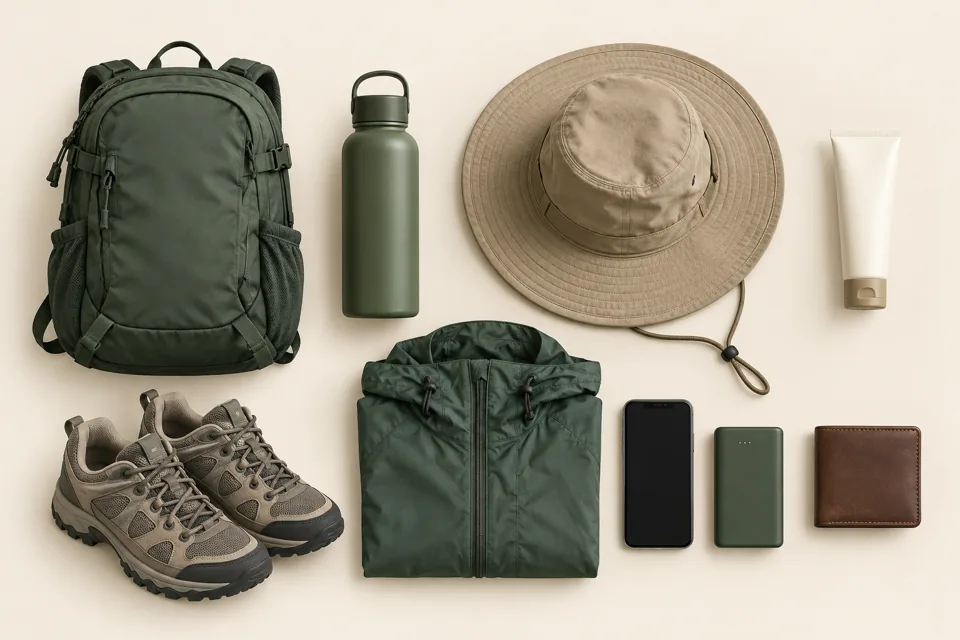

Krama cultural reference · Official visitor guidance. The photographs in the place gallery are credited separately.
10 / A FLEXIBLE ITINERARY
One temple, properly explored.
This suggested day gives Angkor Wat the main share of your attention and makes anything afterward optional. It is an editorial plan, not a timed tour or a guarantee that every space will be accessible. Discuss the sequence with your driver or guide and adjust to opening arrangements, weather, mobility and the interests of your group.
The evening before: make the morning simple
Confirm your pass arrangements, pickup, breakfast and return plan. Check the forecast, charge your phone and prepare a light bag. If sunrise matters to you, tell the driver explicitly and agree on the meeting time. If it does not, choose a departure that lets you arrive ready to concentrate rather than exhausted from an unnecessarily early alarm.
First part: orientation and the wider view
On arrival, identify your return meeting point before walking away from the vehicle. Give yourself a little time to understand the approach and the setting. If you are with a guide, ask for a short orientation: what you are about to see, what the planned route includes, and where the group will pause.
Take the broad photographs you want, then put the camera away for a while. Notice how the building’s scale changes as you approach. Let the first part of the visit establish a sense of place before trying to absorb every historical detail. It is easier to remember an explanation once you know where its subject sits in the larger setting.
Middle part: one story and one optional addition
Spend focused time in a carved gallery. Choose one narrative and ask the guide to explain its organization. Then decide whether the upper level is available and suitable for you. If it is not, use the time to revisit something that caught your attention rather than rushing to compensate with another attraction.
Leave room for a drink, a comfortable pause and questions that arise after the initial explanation. A good visit often includes a second look. Once you understand what a panel represents, returning to it can reveal more than continuing mechanically to a new section.
Afterward: lunch, then choose honestly
Return for a proper meal or take a planned break before deciding what comes next. If you are tired, finishing the temple day is a reasonable choice. If you still have energy and an appropriate pass and transport arrangement, another monument can provide a useful comparison. Avoid choosing only because an itinerary says you should fill every remaining hour.
Bayon offers a distinct context: APSARA identifies it with Jayavarman VII, a Buddhist foundation and reliefs that include scenes of everyday life. It is a separate temple with its own history, not an extension of Angkor Wat. Check current access before adding it, and allow travel time rather than assuming the two form one walkable building complex. APSARA’s Bayon overview
If you have several days
Spread the visits out and choose a theme for each: architecture, carved stories, water landscapes or local life. Make time for Siem Reap beyond transport and sleep. A multi-day trip becomes richer when it lets you connect ideas, not merely expand a list of sites. Keep a brief note of what you learned each day and use it to shape the next.
11 / RESPONSIBLE EXPLORATION
Leave the place with more than a photograph.
Angkor’s value does not depend only on how it looks from a visitor’s preferred viewpoint. The setting includes religious activity, livelihoods, conservation work and the physical survival of vulnerable surfaces. A thoughtful visit makes room for those things even when they interrupt a picture or change the route you hoped to take.
APSARA’s visitor guidance asks travelers to respect worshippers and monks, dress appropriately, avoid touching or climbing, take litter away, and refrain from giving money to children. Read the current code before you go and follow the instructions given at the site. Official visitor code
Keep your hands off the story
A carving may feel solid enough to withstand one touch, but a popular monument receives many such decisions. Look closely without using your fingers to trace a line or posing against a carved surface. If you need support while walking, ask about a suitable route rather than assuming historic stonework is an appropriate handhold.
Stay within authorized areas. A quiet path or open-looking doorway is not evidence that visitors may enter. If a barrier interrupts your route, ask staff whether there is an alternative. Respecting the answer helps protect both the monument and your day from avoidable trouble.
Pay for work, not for a performance of authenticity
Agree fair, clear terms for guiding and transport, and honor the arrangement. Ask about extra time before extending the visit. If you value someone’s knowledge, attention or care, treat that as skilled work. The lowest possible price is not the only measure of a good travel decision.
When considering a community activity or business, look for an explanation of who runs it and who benefits. A label such as “local” or “sustainable” is a starting point for questions, not independent proof. Choose activities in which participation and photography are clearly welcomed, and avoid turning private life into an attraction without consent.
Share what you learned accurately
When you post photographs, keep the temple names correct and separate a legend from a historical claim. Credit a guide’s explanation when appropriate, without publishing personal contact information without permission. If you do not know what a feature represents, describe what is visible rather than inventing a dramatic meaning.
There is no need to call Angkor Wat a secret to make it interesting. You can tell a more distinctive story by explaining a detail that changed your understanding. That approach supports the purpose of Hidden Corners: curiosity grounded in evidence, with enough practical care that the next visitor can experience the place responsibly too.
12 / FINAL QUESTIONS
The useful details, without the guesswork.
How much time should I allow for Angkor Wat itself?
For this guide, we suggest protecting roughly half a day in your schedule for the temple visit, including the approach, pauses and possible queues. That is a planning recommendation, not an official minimum. Your walking pace, interest in the galleries and access choices can change the time substantially. Keep transport time separate when planning the rest of the day.
Do I need a guide?
A guide can be especially useful if you want to understand imagery and history or organize a route around particular needs. Independent exploration can also suit someone who prefers to read beforehand and move slowly. Compare the experience you want rather than treating one approach as universally better. Confirm any current requirements with the site or your operator.
Can I see everything in one day?
One day requires choices. Define what “everything” means before buying a tour that promises it. Angkor Wat itself can sustain a focused visit; the wider Angkor landscape contains many separate places. A manageable day with clear priorities is more useful than a plan that only works if you never pause, encounter a queue or change your mind.
Should I book activities through this page?
You can compare Siem Reap tours through the Viator link in this guide. It is an affiliate link: Hidden Corners may earn a commission if you book through it. Booking.com and book links currently have no affiliate tracking. Check the itinerary, inclusions and cancellation terms before booking. We have not personally reviewed every listed tour; independent visitors can also use the official Angkor pass link.
Are the budget calculator amounts current prices?
Only the pass amounts are drawn from the official ticket page checked for this guide. The other starting amounts are editable examples that demonstrate the calculator. Replace them with current quotes for your party and dates. The calculation is a transparent estimate of the entered items, not a live price comparison or a complete trip quotation.
What should I verify immediately before traveling?
Recheck ticket conditions, site access, your transport arrangements and the weather. If you have particular accessibility needs, confirm the exact route rather than relying on a general description. Check relevant official travel information for the wider journey. This article focuses on the temple experience and does not replace entry requirements or destination-wide travel advice.
What is the most useful thing to remember?
Arrive with a few questions and enough room in your day to follow them. A photograph can record the shape of the towers. An attentive visit can help you understand how a landscape, a building and a living tradition relate to one another. You do not have to see every corner to leave with a deeper sense of the place.
Arrive with a little more context.
Choose one book for the journey, or begin with the free cultural introduction below. These suggestions are based on publisher descriptions and listed contents; they are not full-book reviews.
Book links currently lead to publisher or distributor information. No affiliate tracking or commission is active.
Angkor and the Khmer Civilization
Second edition · e-book availableA broad archaeological introduction that connects the temples to the wider Khmer civilization, including discoveries that changed older interpretations of Angkor.
Check editions & availability Find this book on Amazon ↗Cambodia — Culture Smart!
2022 edition · EPUB / PDF editions listedA practical companion on customs, communication and social expectations. Use it to prepare thoughtful questions, while allowing for differences between people and generations.
Check editions & availability Find this book on Amazon ↗The Angkorian World
Academic collection · e-book + selected open-access chaptersFor readers who want a more detailed view of Angkorian society and scholarship. Routledge identifies several chapters as freely available; the complete book is a separate purchase.
Check editions & availability Find this book on Amazon ↗Royal Ballet of Cambodia
UNESCO’s short introduction explains the training, storytelling and survival of Khmer classical dance. This is a free online resource, rather than an e-book.
Read the cultural introductionFormats, availability and territorial rights vary. Check the edition and device compatibility before buying. A historical or cultural book does not replace current access advice.
Amazon links search by title and author. Compare the edition and format before buying. These are ordinary links; Hidden Corners receives no commission.
A researched guide, open about its limits.
This 6,253-word preview was prepared with AI assistance using the sources below. It does not claim a recent firsthand visit, a local interview, or approval by a Cambodian specialist. Site-specific historical and practical claims link to supporting references.
Official pass prices were checked on 30 September 2026. Other budget values are examples. Photographs are credited historical images; they do not document current conditions. Human editorial review, local pronunciation review and a final access check remain necessary before publication.
The Viator booking link is an affiliate link: we may earn a commission if you book through it. Booking.com and book links are ordinary links with no affiliate tracking. No advertising or booking-widget scripts load in this guide.
Suggest a factual correction