Three historic towns, more than one role
UNESCO's Historic Town of Sukhothai and Associated Historic Towns brings together Sukhothai, Si Satchanalai and Kamphaeng Phet. Its account describes Si Satchanalai as a spiritual centre with numerous temples and monasteries, and recognises the importance of archaeological evidence for a ceramic export industry. The property was inscribed in 1991.
For a visitor, this is a useful starting point because it shifts attention away from the idea of one capital and two lesser copies. A connected historical landscape can contain places with different roles, resources and surviving evidence. The fact that several towns share a heritage listing does not mean each should be visited with the same checklist.
At Si Satchanalai, try holding two questions beside one another. What do the monuments tell you about religious patronage and architectural choices? What do production remains and objects tell you about skilled work and exchange? Neither question gives a complete social history, but together they make the visit broader than a sequence of royal dates.
Names need a little care. Si Satchanalai, Sangkhalok and Sawankhalok can appear in discussions of the area and its ceramics. Their use depends on whether a source is identifying a place, a historical production tradition or a class of objects. Keep the wording attached to its context rather than assuming every similar-looking label identifies the same modern stop.
A museum label is particularly useful here. It may separate where an object was made, the period to which it is assigned and the name used for its ware. Read all three. A date in an object's description is not automatically the foundation date of the town, and an excavation location is not necessarily where that object was used during its working life.
There is no need to memorise a complete chronology before arriving. Learn enough to avoid putting everything in one century, then allow the buildings and collections to complicate the story. Historical understanding often improves when a confident single date becomes a better question about construction, reuse or production.
Wat Chang Lom: begin at the base
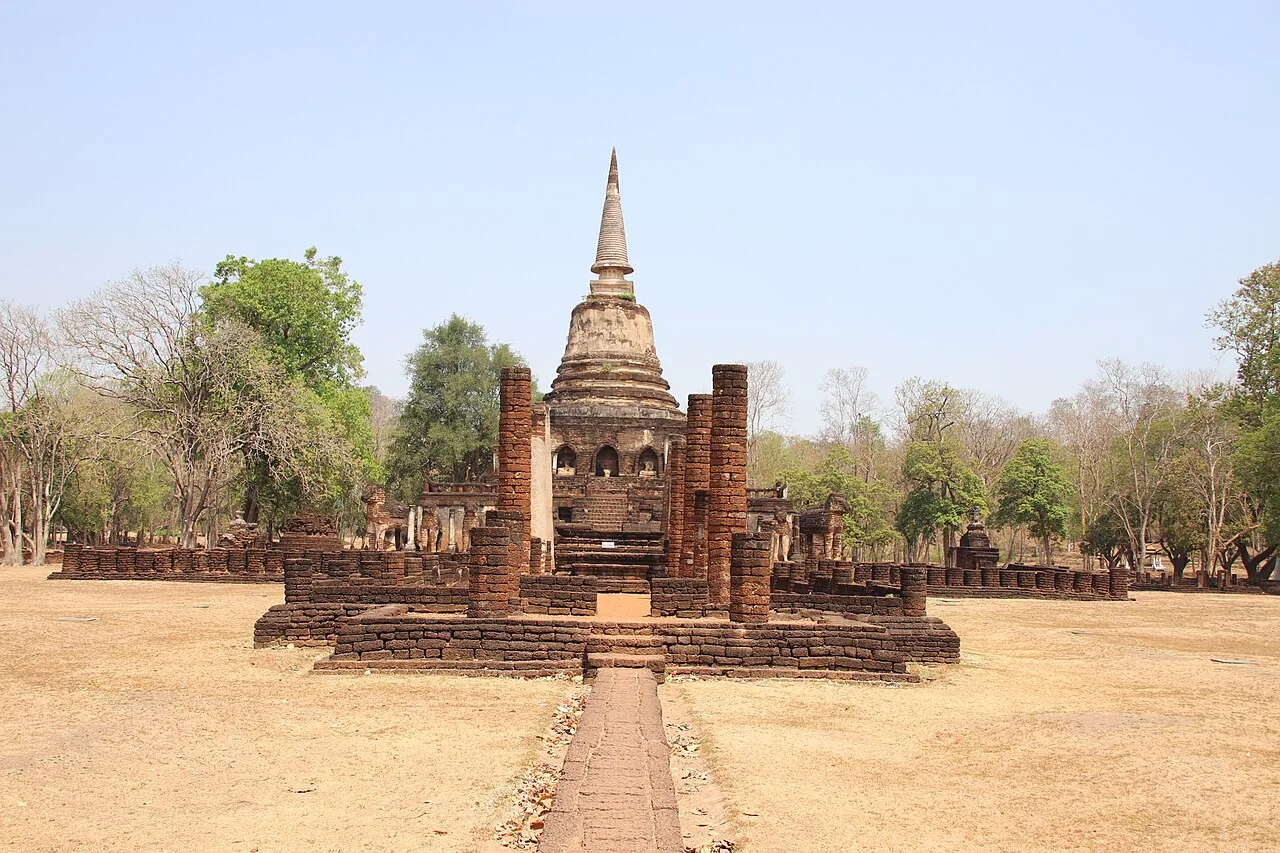
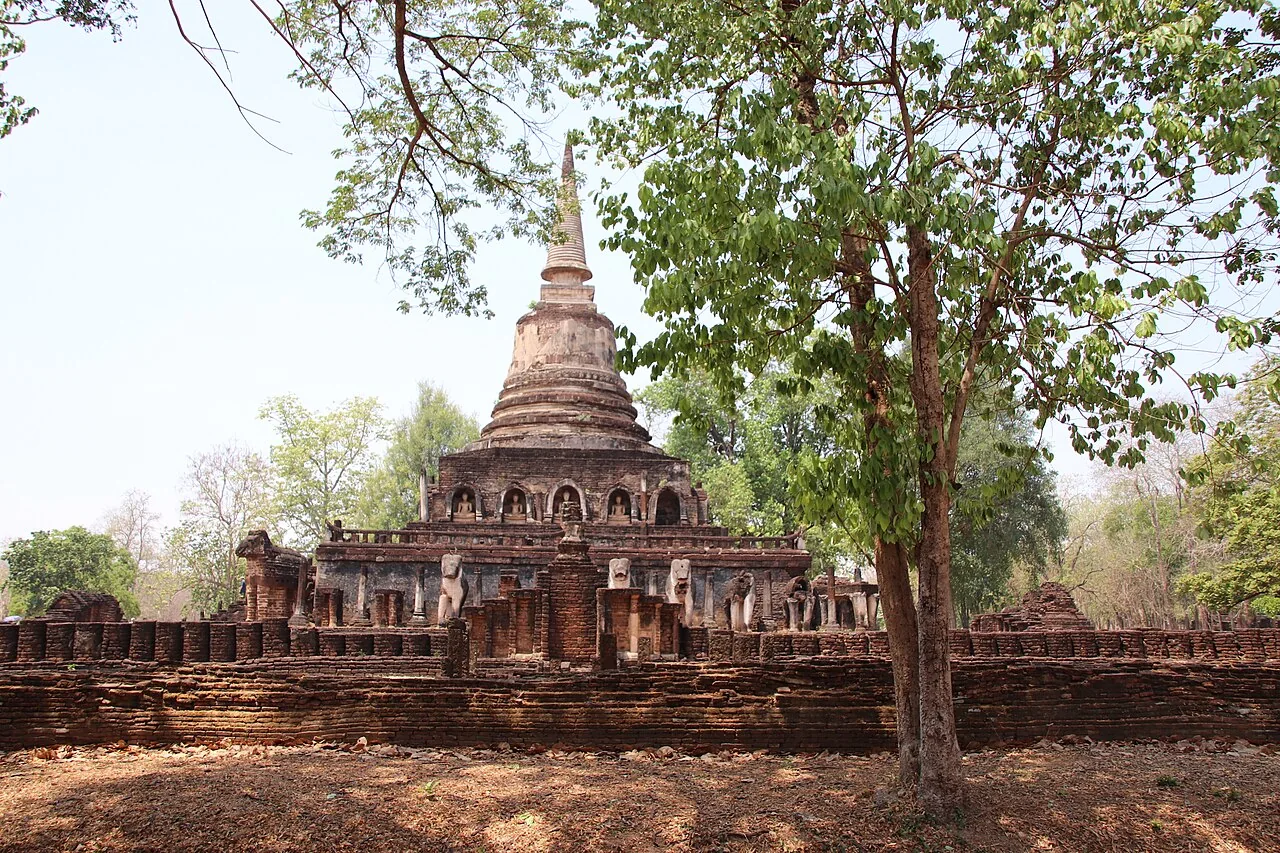
At Wat Chang Lom, the elephant figures encourage the eye to travel around the lower part of the monument before following the chedi upward. Resist the instinct to take only a centred photograph and move on. The relationship between the figures, the platform and the upper structure is the subject.
From a permitted position, compare what remains of two neighbouring figures. Which parts are clear enough to read? Where is material missing? How does a corner differ from a straight run? You can describe these things without claiming to identify every repair or reconstruct the entire original appearance.
The Fine Arts Department's guide to the three historical parks discusses the monument and places Wat Chedi Chet Thaeo opposite it. That proximity creates a useful comparison: after examining one dominant structure and its surrounding figures, move to an ensemble in which several forms ask for attention.
Before leaving, make a small sketch in words. “Figures around a platform; a larger form above; gaps and surviving detail visible from the path” is a workable beginning. Add an interpretation only when a sign or guide supports it. This habit keeps observation open rather than forcing everything you see into a symbolic explanation found online.
Photographs help most when they preserve the relationship between whole and detail. Take one frame that shows the monument's form, then a closer image from a permitted position. Keep the temple name with both. Later, the detailed image will still make sense because you can place it within the larger building.
Do not climb a sculpture or use an ancient surface as a support for your camera. It is possible to appreciate the craftsmanship without reaching every detail. If access to an upper area is restricted, the lower view remains a legitimate way to understand the monument. Your route should follow current management, not a photograph showing where someone once stood.
For children, make the activity comparative rather than competitive: find two features that are alike and one that differs. There is no need to turn fragile sculptures into a counting game that encourages running around their bases.
Wat Chedi Chet Thaeo: compare a group, not a number
Wat Chedi Chet Thaeo offers a different kind of attention. Instead of letting one silhouette stand for the whole visit, choose two structures and compare their shape, scale and placement. Ask how the space between them changes the way you move or look through the ensemble.
A useful first comparison has three parts: the base, the rising body and the upper profile. You do not have to name every architectural element correctly on arrival. Describe what you can see, then check the terminology on site. A rounded profile and a more angular one give you something concrete to discuss without immediately assigning each to a distant artistic tradition.
The temple's familiar translated name can lead to an unhelpful shortcut: assuming that the task is simply to find seven objects. Do not let a name replace the site's plan or a current explanation. The experience is richer when you pay attention to the group as a designed and altered place, including the spaces that connect its surviving parts.
Look for where your eye is drawn from the path. Does one feature sit behind another? Does a change in position reveal a form that was hidden? These are accessible questions even for someone new to Buddhist architecture. They also produce better photographs than repeatedly standing as close as possible to every structure.
If a guide identifies an artistic influence, ask what visible feature supports that reading. A useful answer connects a claim to something you can recognise. Keep the explanation in your notes with its source rather than turning it into a general rule for every similar building elsewhere in Thailand.
After a few careful comparisons, stop. A heritage day does not improve indefinitely as you add more structures. If you can explain how this group differs from Wat Chang Lom, the visit has already gained depth. That is a better point to move toward the next subject than waiting until the forms have become indistinguishable through fatigue.
Wat Nang Phaya: a wall can hold the detail
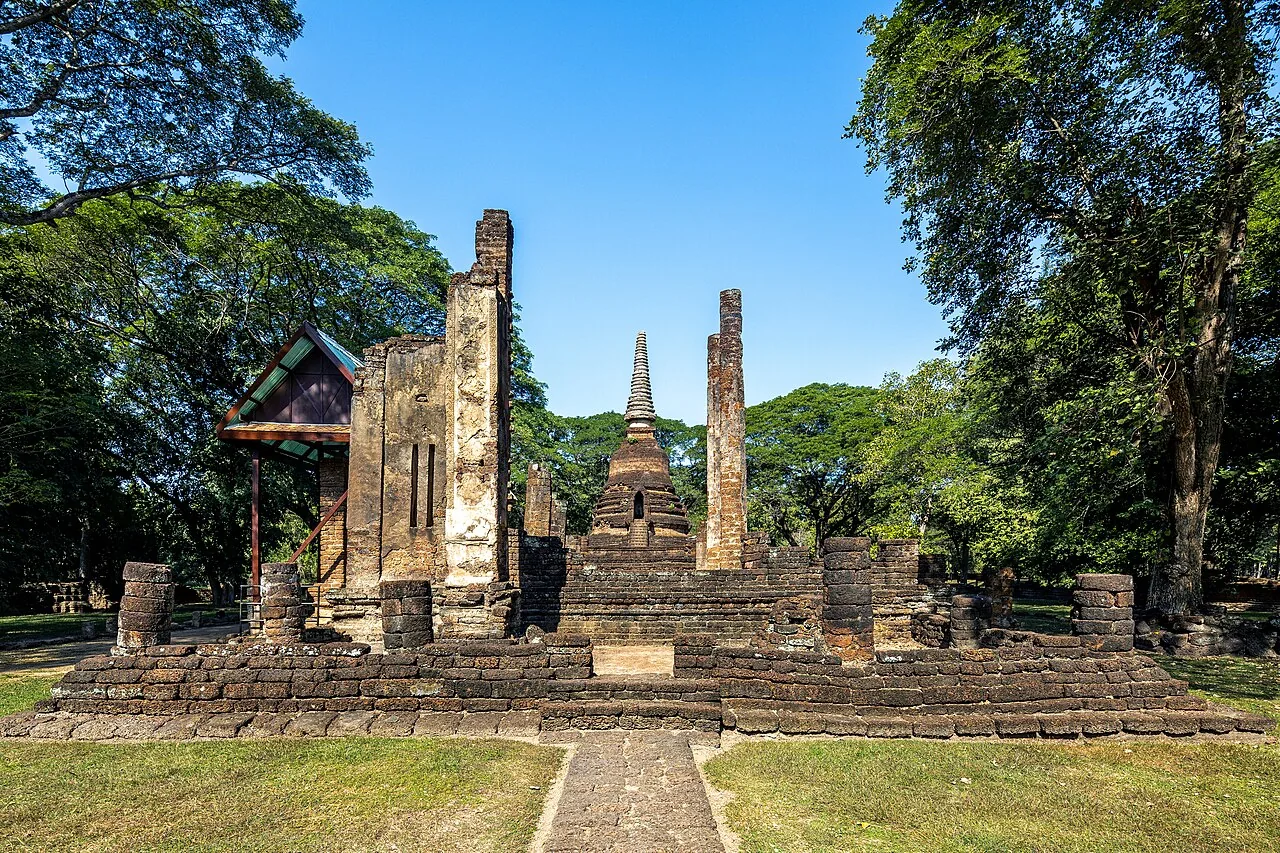
At Wat Nang Phaya, give the surviving decorative surface time. A large building can register immediately, while a smaller stretch of ornament asks you to slow down and decide what you are looking at. Start with its position on the wall, then examine how individual motifs repeat or join.
Fine Arts Department material identifies floral stucco decoration at the temple's vihara. Stucco and the structure supporting it are different parts of the building. That distinction matters when you look at a damaged edge: the loss of a surface treatment can leave a very different appearance from the intended finished wall.
Try a simple visual exercise. Choose a small area you can see without touching or leaning over a barrier. Identify a repeating shape, the space around it and a place where the pattern changes or breaks. Then step back and place that area within the wall. The detail becomes more meaningful when it remains connected to its architectural setting.
Conservation is part of the present scene. A shelter, a barrier or a visibly supported fragment may affect your photograph, but it also helps explain why there is still something to photograph. Do not treat protective arrangements as visual clutter that must be crossed or removed from the story.
If you want to read further, a conservation discussion in the SPAFA publication archive addresses ancient stucco, including Wat Nang Phaya. It is a specialist historical resource, not a statement of the temple's current access conditions. Its value for a visitor is the reminder that keeping a delicate surface visible involves knowledge and intervention.
Make the photograph with the available light, from the permitted route. Do not wet, brush or rub a surface to make its pattern clearer. A closer view is not worth changing the material you came to see. If the light is unhelpful, a labelled sketch or a note about the motif may be the more useful record.
The kilns: make space for production in the itinerary
The ceramic story deserves its own stop or reading session. Without it, a day at Si Satchanalai can leave the impression that historical importance consisted only of religious buildings. Kilns and production debris introduce decisions about materials, heat, stacking and the risk of losing a batch.
The Fine Arts Department's study of Sangkhalok production at Si Satchanalai distinguishes updraft, underground slab cross-draft and above-ground brick cross-draft kilns. For a first visit, you do not need to memorise every classification. The useful question is how the design guides heat through a load of objects.
When a display shows a kiln section or plan, identify the firing space and the path of heat before studying individual pots. A cutaway can explain relationships that are difficult to see in a surviving structure. Check which parts are excavated remains, which are reconstructed and which exist only in the interpretation drawing.
Then ask about the load. How were objects kept apart? How did a potter use the available space? What happened when pieces fused or firing did not go as intended? A display of imperfect material can be especially revealing because it makes production choices visible. Finished museum objects often hide the practical problems that had to be solved.
Access to a kiln-related display should be planned deliberately. Do not assume it is included simply because your driver says the historical park is on the itinerary. Confirm the place, opening arrangements and ticket coverage. If you have only a short visit, choose whether the ceramic subject is a priority before spending all your time in the central temple area.
Leave fragments where they are. An unremarkable-looking piece can be evidence when its context is recorded properly. The interest of ceramics is not an invitation to collect a souvenir from an archaeological site. If you want an object to take home, choose a clearly contemporary piece from a maker or retailer who can explain what it is.
A firing support is a surprisingly good place to start
Imagine arriving at a ceramics display and looking first at the least decorative object. A support used inside a kiln may have no painted scene and no elegant rim. Its purpose is practical, which is precisely why it can open the subject for someone who does not yet know how to read a finished vessel.
Singapore's National Heritage Board explains a tubular firing support associated with Si Satchanalai and Sukhothai production. The support helped potters fire vessels of different sizes more safely than earlier stacking methods, which could cause pieces to fuse. Circular marks on the bases of some bowls and dishes record contact with such supports.
That gives you a small but useful piece of detective work. When a museum allows the underside of an object to be seen, look for evidence of how it was supported. Read the label before deciding what a mark means. A firing trace, later damage and an alteration are not interchangeable, even when they all interrupt an otherwise smooth surface.
The Smithsonian's record for another tubular firing support identifies its material as stoneware, its place as Si Satchanalai and its period as the fifteenth–sixteenth century. The record also states that it is not on view. An online object is a reading resource; it should not become a promised stop in a travel itinerary.
Use this distinction whenever you research collections before travelling. A museum may own an object without displaying it, and a gallery's arrangement can change. If one particular item is central to your plans, check its current display status. Otherwise build your visit around the broader subject and let the objects actually available guide the experience.
For your notes, record function before aesthetic judgement. “This helped separate objects during firing” explains more than “an interesting old tube.” Once function is clear, questions about form, wear and manufacturing become easier to ask. A small tool can make a whole production landscape more intelligible.
Choose a route with one clear comparison
There are several sensible ways to organise the visit. The right one depends on your interest and available energy, not on completing every marked site. Choose a comparison that you want to be able to explain by the end of the day.
Temple form and surface
Give your main attention to Wat Chang Lom, Wat Chedi Chet Thaeo and Wat Nang Phaya. The contrast is between a strong monumental form, a group of structures and a decorative surface. This is a coherent introduction for someone who would like to understand architecture without adding a specialised ceramics visit.
Monument and manufacture
Choose one or two temples, then protect time for the kiln-related part of the outing. The question is how religious patronage and skilled production appear in different kinds of remains. Confirm the separate stop and its access arrangements before travelling. This is the approach at the centre of this guide.
A shorter visit with a longer reading trail
Choose one main temple and one specific feature to examine. Use the free collection records later to explore the ceramic subject online. This can suit a traveller who has limited walking time or who is combining the day with an onward journey. It is better to acknowledge a selective visit than to rush through several places and call the result comprehensive.
Check additional stops such as Chaliang or an excavation display as distinct places. Similar temple names occur elsewhere in Thailand; save the exact location you intend to visit. A broad place name in a booking message can lead to confusion even when both parties think the plan is clear.
Whichever route you choose, include a pause before attention runs out. A few notes made while sitting comfortably can help you connect the morning's details. The pause is part of understanding the site, not lost sightseeing time that must be recovered by hurrying at the next stop.
Religious heritage and present-day courtesy
A historical park contains archaeological remains, but its religious imagery does not become an unrestricted photographic prop. Treat Buddha images and sacred forms respectfully. Follow posted rules, keep off fragile structures and avoid poses that use an image as a joke or a background for physical stunts.
For visits that include active religious spaces, choose comfortable clothing covering shoulders and knees, and follow local instructions about shoes. Keep an easy-to-remove layer handy if your wider day involves different settings. There is no need to buy an imitation historical outfit to belong in the landscape; practical, considerate clothing serves the visit better.
Ask before photographing people, especially worshippers or anyone engaged in a ceremony. A public setting does not remove the value of consent. If a guide introduces a craftsperson, let the person explain whether photography is welcome and whether parts of the process or workspace should remain outside the frame.
Local craft can connect the old production story with the present, but the connection needs accurate wording. A contemporary maker may draw on historical forms while using different materials, equipment or designs. That does not make the work less interesting. Ask what the maker is doing now instead of demanding proof that nothing has changed for centuries.
When buying a contemporary ceramic, ask who made it, where it was made and what it is suitable for. A decorative object and a vessel intended for food use are different purchases. Do not assume that an antique-looking glaze establishes age, origin or suitability for serving food.
A few Thai words can help begin an interaction, but listening and patience do more than a long phrase list. Ask your guide to help you pronounce the place and maker's name correctly, and record the preferred spelling if you intend to write about the visit. A carefully credited name is a small contribution to a more human account of a destination.
For comparison, the Kampot guide follows another working landscape through the people and decisions behind a product. The materials and histories differ; the shared visitor habit is to ask about present work without turning it into a performance of an imagined past.
Plan for heat, rain and the attention you have
Use the weather forecast for your actual date, then design a route you can comfortably complete. A historical park can look shaded in photographs while still involving exposed movement between stops. The right amount of sightseeing depends on the conditions, your walking pace and how much time you want to spend standing and looking.
For a hot-season itinerary, including April, start within the confirmed opening period and give the most exposed part of the visit an earlier slot where practical. Carry water, use appropriate sun protection and plan a pause. A later start is not automatically a problem, but it may call for a shorter route and more attention to comfort.
After rain, ask about the current paths and any areas that require extra care. Wet surfaces can change how manageable steps and uneven ground feel. Choose footwear for the route rather than for the photograph, and be willing to skip an optional climb. A ground-level view can still explain the form and placement of a monument.
If air quality is a concern during your travel period, check the current local information before committing to prolonged outdoor activity. Do not infer conditions from the season alone. Travellers with relevant health needs should follow their own medical advice and adapt the outing rather than treating an itinerary as an obligation.
Photography introduces a separate timing choice. Lower light may make surface detail easier to see, but the site must actually be open and the route permitted. Do not assume a sunrise image establishes access before official hours. Confirm special openings through the managing authority, and keep ordinary travel plans within the published visitor arrangements.
Finally, account for attention as well as weather. If you spent the previous day studying Sukhothai in detail, choose a different emphasis at Si Satchanalai. The kiln story or a single decorative surface may be more rewarding than another full inventory of monuments. A change of question can refresh a heritage trip more effectively than adding another stop.
Getting there: settle the return before the first stop
Si Satchanalai needs a deliberate transport plan when you are staying in the Sukhothai area. Check your accommodation's actual location and the historical park you mean; modern town services and historic areas should not be treated as interchangeable points on a map.
The Tourism Authority of Thailand's Japan office listing describes a drive of roughly an hour from Sukhothai town and mentions a public bus from the market area. This is a broad orientation, not a current bus timetable or a guaranteed door-to-door journey. Confirm the present departure point, last return and any final transfer before choosing public transport.
With a hired driver, agree on the route by named stops. Include the central monuments, any kiln or excavation visit, waiting time and the return to your accommodation. If interpretation matters, check whether it is included. Transport alone may get you to every location while leaving the historical questions unanswered.
If you plan to cycle within the area, ask about current rental availability, the condition of the bicycle, where it may be used and where it must be returned. Test the brakes and fit before setting off. Treat cycling between visitor stops and riding a longer public-road approach as different decisions, with different demands on confidence and route knowledge.
The map below provides orientation around Wat Chang Lom in the historical park. Use the current entrance and ticketing arrangements when you arrive; the pin is not a promise that a vehicle can reach every point along your chosen route. Save the driver's meeting position separately so it remains clear even if you finish at a different monument.
For mobility planning, ask about the distance between the vehicle and the feature you most want to see, the surface, steps and available seating. A general statement that a park is accessible is less useful than a description of your specific route. If a tram or other visitor transport is operating, confirm boarding arrangements and whether it serves the stops you need.
Tickets: match the price to the places included
Check the ticket's scope before comparing prices. A central-zone visit and a day including archaeological or kiln displays are not necessarily the same purchase. Rental, guiding and transport may also be charged separately from admission.
When checked for this guide, the TAT Japan listing displayed daily hours of 08:00–17:00. It listed 150 baht per person for each of three principal areas—the central remains, Chom Chuen excavation and Sangkhalok kiln sites—and 220 baht for a combined ticket, plus a 20-baht tram fare. Treat these as the tourism office's published figures and confirm current eligibility, inclusions and operations with the park before paying.
The calculator uses Thai baht and lets you enter the actual admission amount you confirm. This avoids assuming that every traveller wants the same areas or qualifies for the same ticket. Add a whole-party transport quote, any separate guide fee and your food allowance. Include accommodation only if you want the wider trip cost rather than the outing's additional cost.
For a purely illustrative example, two travellers entering admission of 220 baht each, shared transport of 1,200 baht and food of 200 baht each would total 2,040 baht. The transport and food figures are invented planning allowances, not quotes or recommended market rates. A separately charged guide, bicycle or other service would need to be added rather than quietly assumed to be included.
Before booking a package, compare its total against the same list of components. A package that includes interpretation, several admissions and a return journey cannot be compared fairly with a vehicle-only price. Conversely, a long description of attractions does not establish that every entrance fee is included.
Keep a small note of what you paid and for what. That makes the budget useful to you later and prevents an old receipt from becoming an oversimplified price claim in a travel story. Conditions, eligibility and services can change; a dated amount with clear inclusions is more informative than a bare number presented as universal.
Book for the questions, not the attraction count
A useful guide should help connect what you see with the question that brought you here. If you are interested in ceramics, ask about that subject before booking rather than hoping every general historical tour covers it in depth.
Describe your preferred day in one short message: the central temples, a kiln-related stop if open, time for photographs, a manageable walking pace and the return destination. Add the language you need and any accessibility concerns. Ask which parts the provider can explain and which may require a separate local specialist or display visit.
For a group tour, check how much time is actually spent at each location. A brief stop can be enough for an overview, but it will not support a slow comparison of architectural forms. If your main interest is detailed looking, a smaller number of stops may be worth more than a broader itinerary.
Ask what happens when a display is closed or weather changes the route. A good alternative should still serve your interests. Replacing a kiln visit with an unrelated shopping stop is not automatically equivalent simply because both fill the same amount of time.
Accommodation should support the next day's journey. If you are choosing between staying in the Sukhothai area and closer to Si Satchanalai, compare transport arrangements, room facilities and the services you will need in the evening. An atmospheric location is only helpful if the rest of the plan works from it.
The accommodation link below is an ordinary search link, and the heritage-information link is not a ticket vendor. Neither is a claim of personal inspection or a guarantee of availability. Use them to narrow the practical questions, then confirm the actual service before paying.
A day bag for temples, displays and changing weather
Pack for the route you chose. A short central-zone walk, a cycling outing and a day including several displays do not require exactly the same bag. Begin with water, suitable clothing and footwear, sun or rain protection for the forecast, and your meeting and return details.
A light shirt with shoulder coverage and trousers or a skirt that comfortably cover the knees are a practical base when religious spaces are included. Choose clothing you can walk and sit in without constant adjustment. Keep footwear secure on uneven surfaces while making it manageable to remove where an active religious space requires that.
In hot conditions, a hat, sunglasses and appropriate sunscreen belong beside a plan for shade and breaks. Follow WHO's sun-protection guidance: use protective clothing and shade, with broad-spectrum sunscreen of at least SPF 30 on uncovered skin. Protection is not an invitation to stay outside longer than is comfortable.
For rain, protect your phone and any paper notes. A compact rain layer can be easier to manage than an umbrella when you need both hands free, but choose what works for your route. Keep equipment away from fragile surfaces; a convenient dry ledge on a monument is not a luggage shelf.
A small notebook has a particular use here. Give each stop a name, one visible feature and one question. For a ceramic display, record the object number if available, its stated origin and the function described on the label. Those notes are more useful than dozens of photographs whose subjects become uncertain later.
If you buy contemporary pottery, ask for packaging suitable for your onward journey and check what weight and space you can reasonably carry. Do not let the excitement of buying a large object make the rest of the trip awkward. A small well-documented piece can be a better reminder of a maker's work than a fragile purchase made without a transport plan.
A shelf for architecture, history and everyday context
The most directly relevant selection is Dawn F. Rooney's Ancient Sukhothai: Thailand's Cultural Heritage. Check the contents and edition before buying, and use it as background to the wider historical landscape rather than as a current source for tickets or transport.
Chris Baker and Pasuk Phongpaichit's A History of Thailand offers a broader political, economic and social frame. The fourth edition provides a different scale of reading from a monument guide. It can help place a heritage visit within a longer history, while the details of a particular structure still need a site-specific source.
Thailand — Culture Smart!, in the edition by Joe Rotheray, is selected for everyday social context. Earlier editions and listings may name a different author, so compare the book you are actually buying. A cultural guide is preparation for paying attention, not a set of assumptions to impose on every person you meet.
These are selections based on bibliographic and publisher information, not full-book reviews or claims of personal reading. The Amazon buttons search the specified title and author. Check format, condition, edition and delivery before purchase; an ordinary search result may mix several versions of the same work.
There is also useful free reading. The Fine Arts Department's ceramic study supports a deeper look at production, and museum object records provide examples you can examine from home. Keep the context visible: an object in a foreign collection is not necessarily on display, and a historical research document does not establish today's visitor arrangements in Thailand.
Choose one question to follow after the trip. It might concern how a decorative surface survives, how kiln design changed or how a particular vessel was supported during firing. A specific question makes the reading more rewarding than treating every book as something to finish before you are qualified to enjoy the place.
Before you commit a day to Si Satchanalai
Should I visit both Sukhothai and Si Satchanalai?
Choose both if you have the time and an interest that benefits from comparison. Give each day a different emphasis so the second does not repeat the first. Si Satchanalai's temples-and-production approach can work well for someone interested in architecture and ceramics. If time is limited, a selective visit is more useful than an exhausting attempt to cover everything.
Can I do the whole visit without cycling?
Plan the stops with a driver or ask the park about current visitor transport and walking distances. Confirm the route you need rather than assuming every part is connected by one service. Your choice should reflect comfort and access, not an idea that there is only one correct way to experience a historical park.
Are the kiln sites included in the main ticket?
Check the current ticket options and their exact coverage. The tourism listing describes both separate areas and a combined ticket, but you should confirm what is operating on your date. Tell your provider that the ceramic subject is a priority so it is not omitted from the route.
Can I buy old pottery as a souvenir?
Choose clearly contemporary work for an uncomplicated craft purchase. Do not collect fragments from the site. If an object is represented as an antiquity, do not assume a seller's receipt resolves ownership or export requirements; seek the relevant official guidance before considering such a purchase.
What would make a return visit worthwhile?
A new question. On a first trip you might compare temple forms; on another, study decoration or arrange more time with the ceramic displays. The place does not need a newly invented secret to justify attention. Its different kinds of evidence already give you more than one way to understand it.
A closer look.
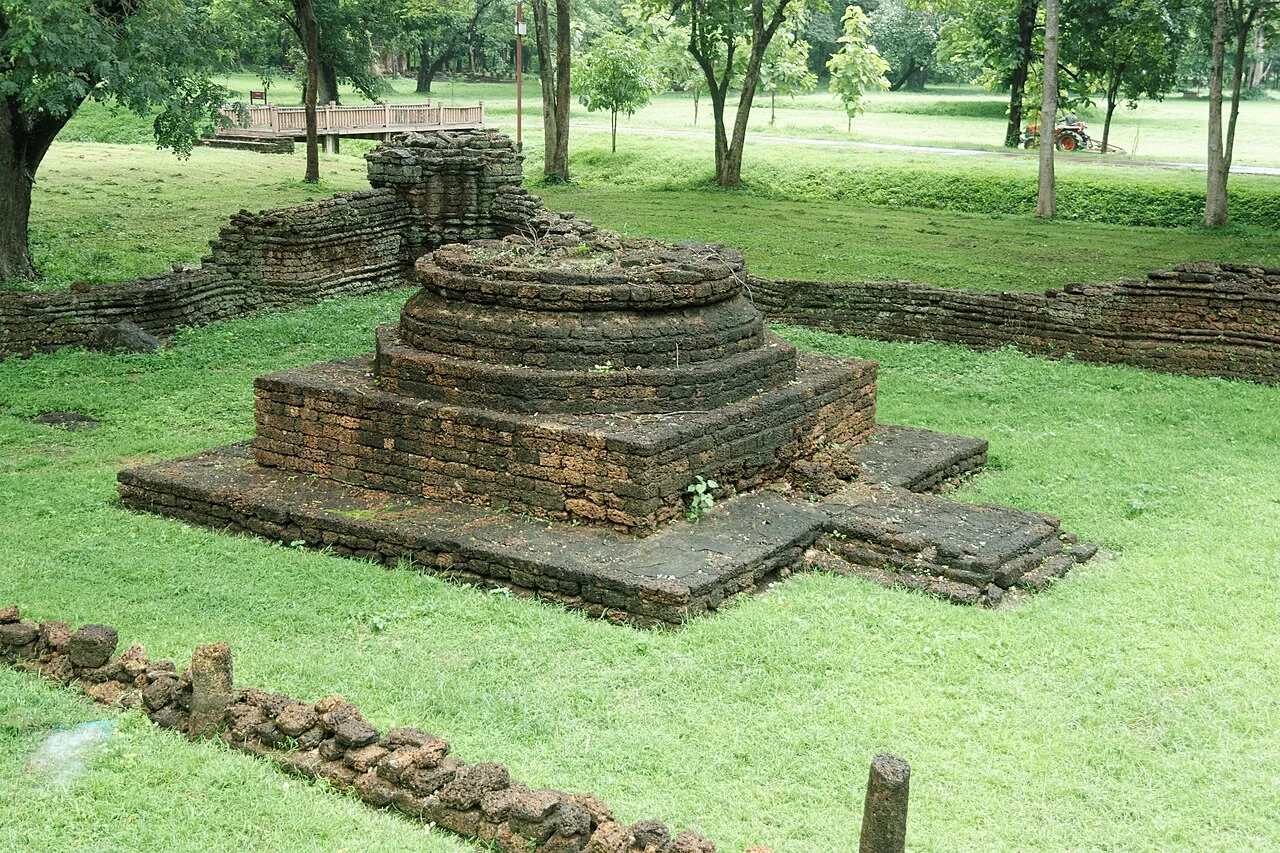
Four documentary photographs, dated 2016, 2019 and 2023. They show temple form and surviving remains, not current access conditions or a team visit.

Sok Heng Oeun
Sok Heng Oeun is the owner and editor of Hidden Corners. The Hidden Corners Editorial Team supports image preparation and editorial checks under his direction.
Sok Heng Oeun on Facebook ↗Research and AI-assisted editorial preparation. Publication authorized by Sok Heng Oeun; an individual owner reading review is not recorded. This guide does not claim a firsthand team visit.
Sources & image credits
Sources supporting this guide. Dated prices and access reports can change; confirm with the responsible authority before travelling.
- UNESCO's Historic Town of Sukhothai and Associated Historic Towns ↗
- Fine Arts Department's guide to the three historical parks ↗
- floral stucco decoration at the temple's vihara ↗
- conservation discussion in the SPAFA publication archive ↗
- study of Sangkhalok production at Si Satchanalai ↗
- Tubular firing support ↗
- Smithsonian's record for another tubular firing support ↗
- Check the tourism-office listing ↗
- WHO's sun-protection guidance ↗
- Ancient Sukhothai: Thailand’s Cultural Heritage — Dawn F. Rooney ↗
- A History of Thailand — Chris Baker & Pasuk Phongpaichit ↗
Photograph credits
- Si Chang Lom · Gary Todd · 2019-04-19 · Public domain, released by author. Uses publisher-provided resized photograph, converted to WebP; display may crop. No generative alteration. These adaptations remain available under their respective licences.
- Si Elephants · Gary Todd · 2019-04-19 · Public domain, released by author. Uses publisher-provided resized photograph, converted to WebP; display may crop. No generative alteration. These adaptations remain available under their respective licences.
- Si Nang Phaya · Supanut Arunoprayote · 2023-12-26 · CC BY 4.0. Uses publisher-provided resized photograph, converted to WebP; display may crop. No generative alteration. These adaptations remain available under their respective licences.
- Si Base · Ahoerstemeier · 2016-07-21 · CC BY 4.0. Uses publisher-provided resized photograph, converted to WebP; display may crop. No generative alteration. These adaptations remain available under their respective licences.
Packing and outfit graphics: AI-generated editorial illustrations. Portrait: supplied by Sok Heng Oeun.