
A monastery whose first day is not recorded
The precise foundation date is unknown. UNESCO's account describes an early religious settlement rather than providing a documented opening year, and identifies both the monastery and the more remote hermitage as part of the property's significance. Skellig Michael entered the World Heritage List in 1996. Those are firmer starting points than a confident claim that one named saint built everything in one particular year. UNESCO's property record
For a visitor, the most useful historical question is often smaller than “How did anyone live here?” Look at the relationship between a dwelling, a place of prayer and the ground that supports them. A monastery is an arrangement of daily needs and religious commitments. Its buildings make more sense together than as a collection of unusual roofs.
OPW places a possible foundation as early as the sixth century, while distinguishing that possibility from the first recorded reference to monks in the eighth century. Its history connects the community's later move to Ballinskelligs with both worsening conditions and changes in the Irish Church. The movement ashore did not immediately end the island's religious significance; pilgrimage continued long after the monastic community had left. OPW historical outline, pages 14–15
A visit also benefits from resisting the idea of an entirely self-contained island. Consider supplies, knowledge, religious relationships and the people who moved between island and mainland. These questions make a richer conversation with a guide than asking only how many monks lived in a cell. Where an answer is uncertain, uncertainty is part of the history rather than a reason to invent a more dramatic story.
For comparison, our Angkor Wat guide looks at a much larger sacred complex through its relationship with the surrounding landscape. The places are profoundly different; the useful shared habit is to look beyond the most photographed building.
Cells, rainwater and a church that breaks the pattern
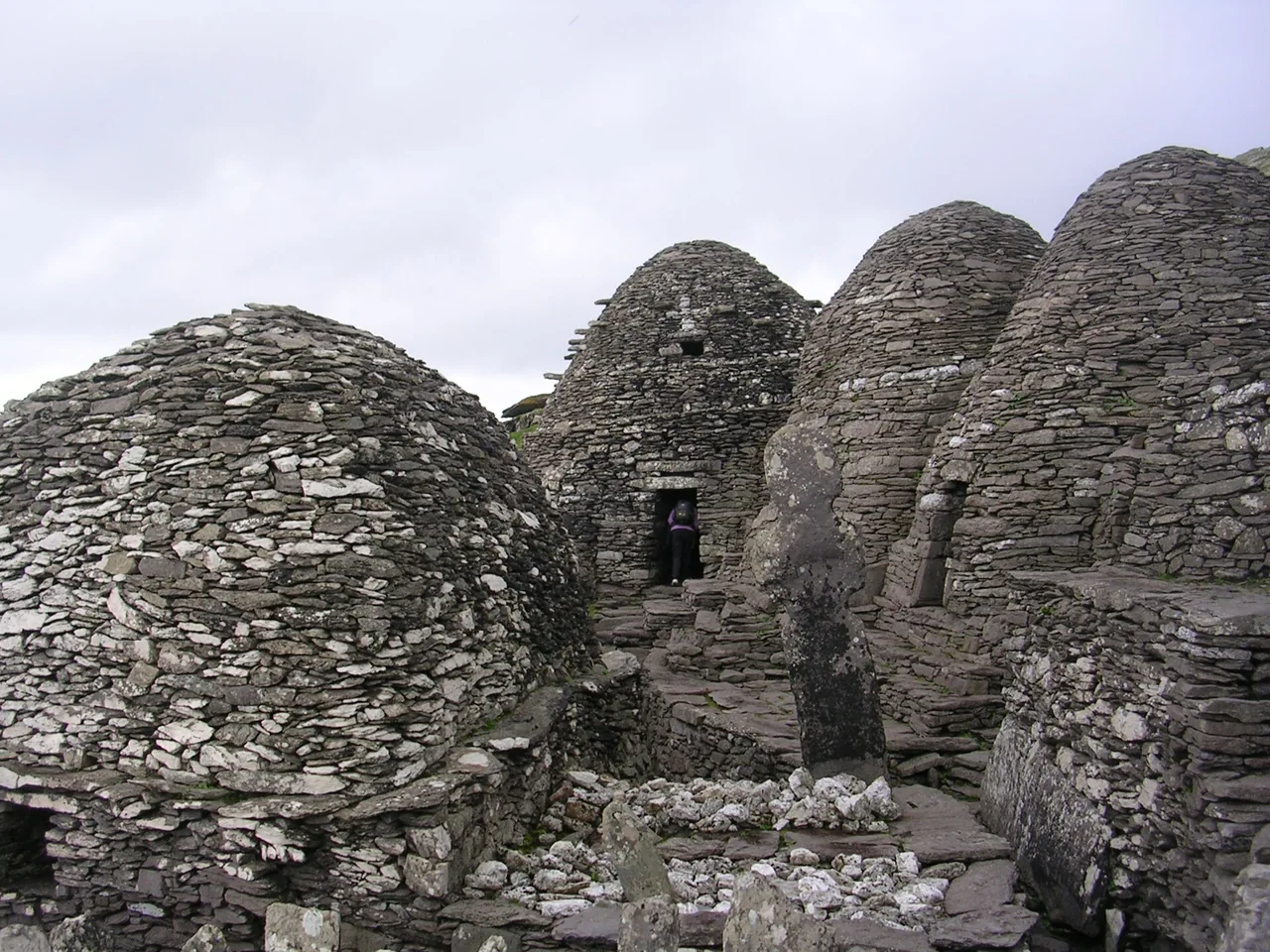
The monastery becomes easier to read when you look for three different jobs: shelter, water storage and worship. Its familiar rounded cells are only one part of that system. The official plan on pages 12–13 of the visitor guide labels the cells, oratories, graveyard, gardens and cisterns. Save that plan before travelling, then use the island guide's explanation to connect it with what is open on the day. OPW monastery plan and building descriptions, pages 12–13
Cell A is the largest of the main cells. OPW suggests it may have served a communal purpose, while Cells B–F were probably living spaces. Those qualifications matter: the plan gives a useful interpretation of the arrangement without pretending that a room's original occupants left a label. Compare the larger space with its neighbours and notice how a small community could divide individual and shared activities.
Water storage is less immediately eye-catching than the roofs, but just as revealing. Two cisterns lie beneath the platform supporting the cells; the guide identifies a third west of Cell A. They collected rainwater for use on the island. This detail changes the question from how people endured a remote place to how they made daily life work there. The spaces between buildings, their levels and their supporting structures deserve attention too.
St Michael's Church introduces a visible difference: OPW identifies it as the monastery's only mortared building, probably erected in the eleventh century and altered in the twelfth. The cells themselves belong to different periods. What survives is therefore a settlement that developed over time, with changes in construction and religious use, rather than a single building project frozen on its first day.
The lower garden contains evidence of older wall collapses, and excavations have revealed earlier entrances. Even the entrance used today was opened in the nineteenth century. These changes help explain why “untouched” is an unhelpful description. Survival here has involved rebuilding, investigation and conservation; a visitor follows an arrangement shaped by several periods of work.
Look for the smaller Oratory Terrace in the interpretation, but follow the access boundary: the guide allows it to be viewed while excluding direct access because its structures are fragile. You can understand a feature without entering it. A useful pair of questions for the island guide is which surviving detail is oldest and which part required the most conservation. Those answers can make a few minutes of looking much more memorable than trying to identify every stone.
Two lights made the island a signal
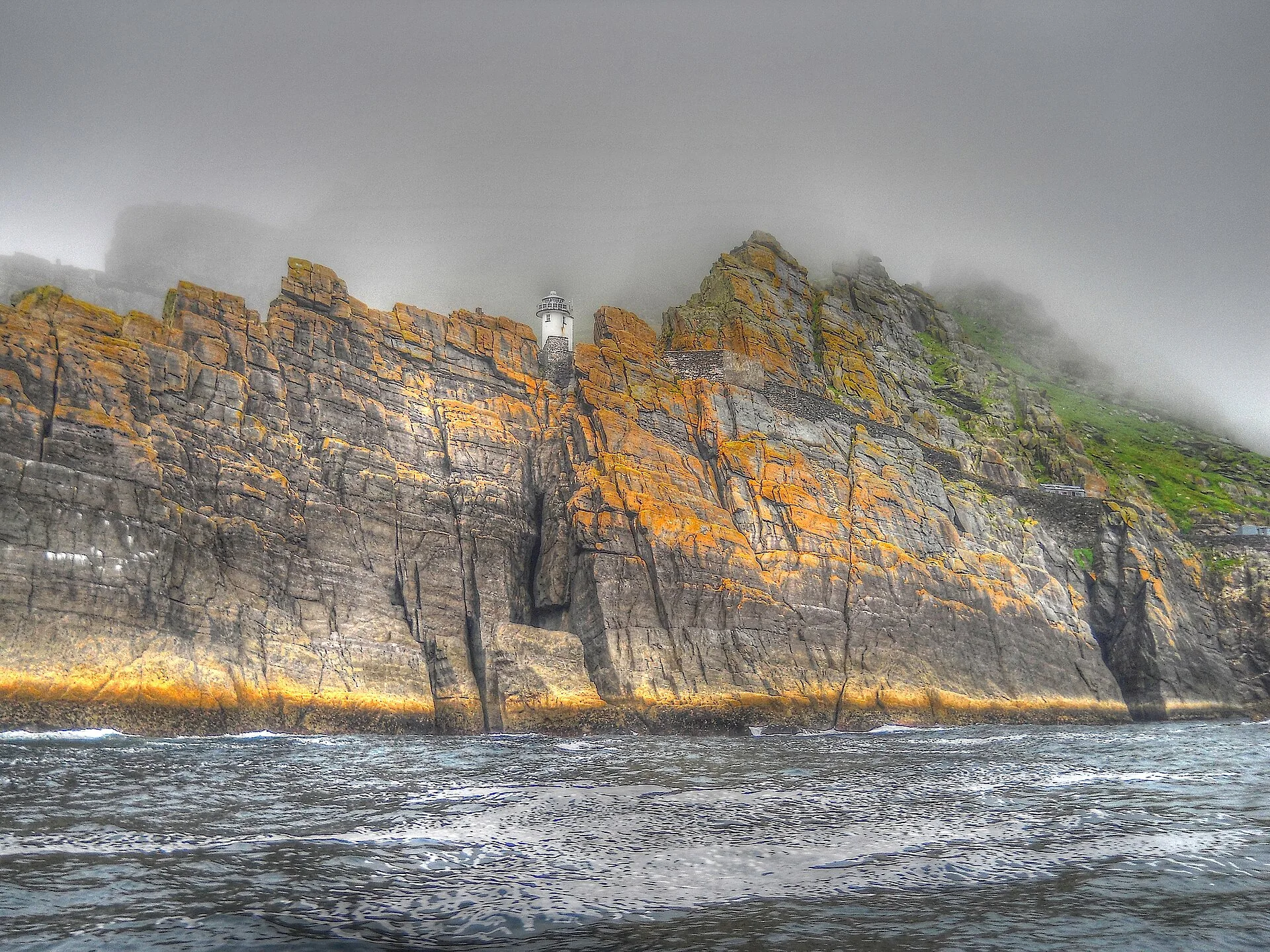
On 4 December 1826, two lights began operating on Skellig Michael. Irish Lights explains their purpose through the surrounding navigation system: the pair helped distinguish Skellig from other coastal lights. In 1870 the upper light was discontinued when the new Inishtearaght light entered service. The island's lighthouse story is therefore about a network at sea as well as one striking building. Irish Lights: the history of Skelligs Rock
Keepers and their families also had lives ashore. Irish Lights records new accommodation at Knightstown on Valentia Island, occupied in 1901, with reliefs operating from Valentia Harbour. Automation eventually ended permanent staffing in April 1987; solar power followed in October 2001. These dates trace changes in work, supplies and communication across the water.
The lighthouse road remains part of the visitor's approach to the monastery steps. It connects the island's religious remains with its later maritime engineering, although the onward road towards the working lighthouse is closed to the public. From the allowed route, notice how construction found a line around the rock. The monastery's high terraces and the lighthouse's coastal position answer different needs in the same difficult terrain.
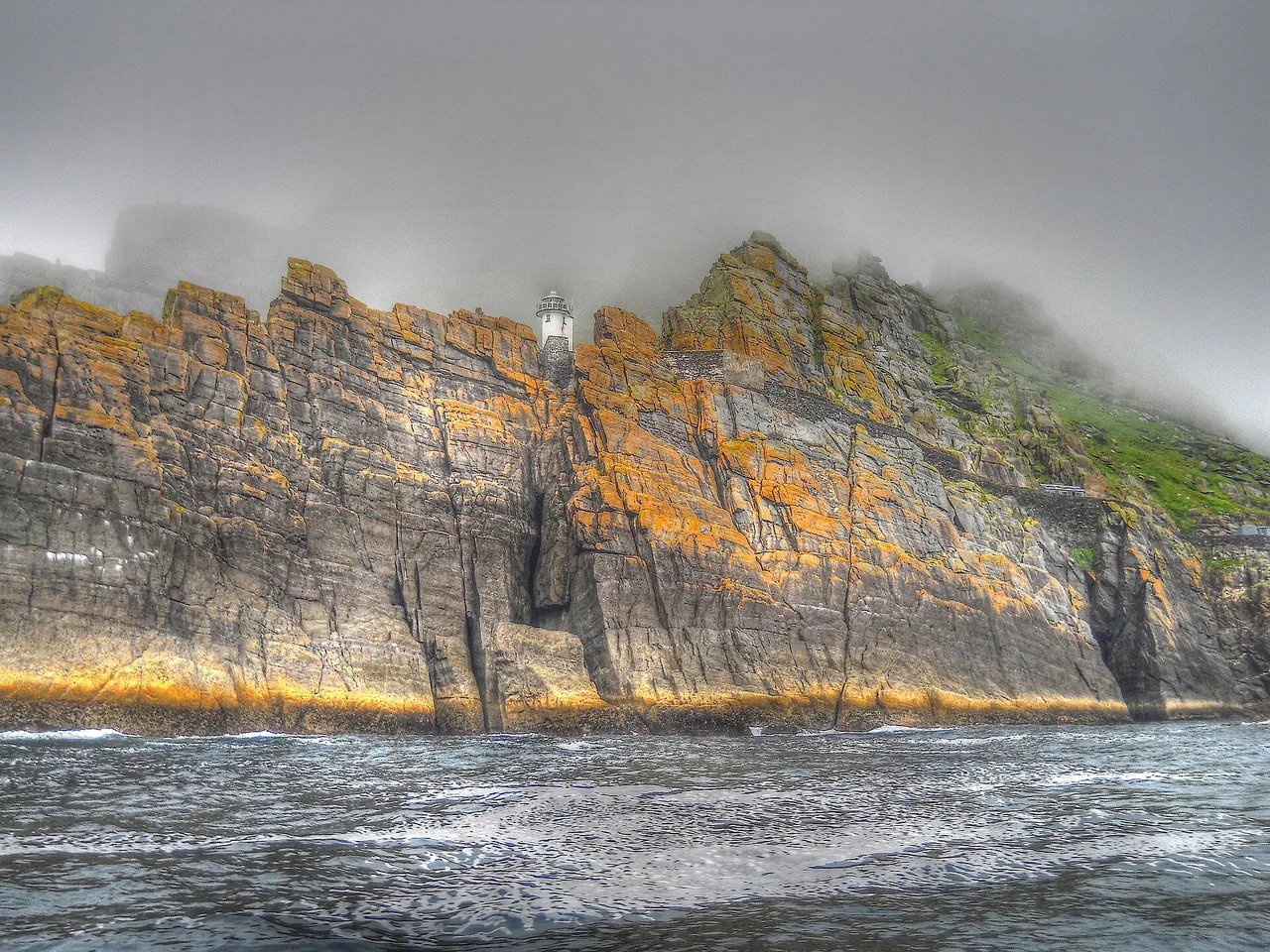
The white tower is especially useful to look for from the boat, where the relation between building, cliff and sea is easier to grasp. It is a working navigation feature, so seeing it does not mean your landing excursion includes entry. If maritime history is a particular interest, prepare one question about the keepers or the relief service for the mainland visitor centre, rather than expecting the monastery tour to cover every period equally.
The Skellig Experience exhibitions include lighthouse history alongside the monastery and wildlife. That gives a cancelled sailing a purposeful alternative: follow how people worked on an exposed island and how that work changed. It also makes a good introduction before a successful crossing. The sight of a road or landing place means more when you have thought about the materials and supplies that had to pass along it.
Choose a wildlife interest, not a guaranteed sighting
Many visitors arrive hoping to see puffins. Others are drawn by the larger shape of a seabird colony or by the way birds use cliffs and open water. Decide what you would enjoy observing before selecting a trip. A close photograph of one species and a broad view from a moving boat call for different expectations.
The Skellig Experience describes puffins as seasonal breeding visitors, generally present from late spring into July. Treat that as a broad guide to planning, not a promise for a particular departure. A bird photograph dated June does not establish what will be visible during your September holiday. Visitor centre's seabird introduction
Avoid judging wildlife value solely by how close an animal comes. Use binoculars if you own them and can carry them comfortably. On a moving boat, follow the crew's instructions about remaining seated and handling equipment. A stable view from an appropriate position is more useful than a rushed attempt to copy an image taken with a specialist lens.
There is also a difference between noticing a bird and interpreting a population. A busy cliff on one afternoon does not tell you whether a species is increasing. Counts may use pairs, individual birds or occupied nesting sites, and surveys may change methods. If you want that deeper story, read a dated monitoring report rather than converting the number of birds in view into a conservation conclusion.
For the visit itself, keep the task simple: follow the permitted route, give wildlife space, keep food secured and obey instructions about stopping. Do not try to lure a bird into a better position. A close encounter should remain the animal's choice, and a photograph is never a reason to step into habitat or obstruct other visitors.
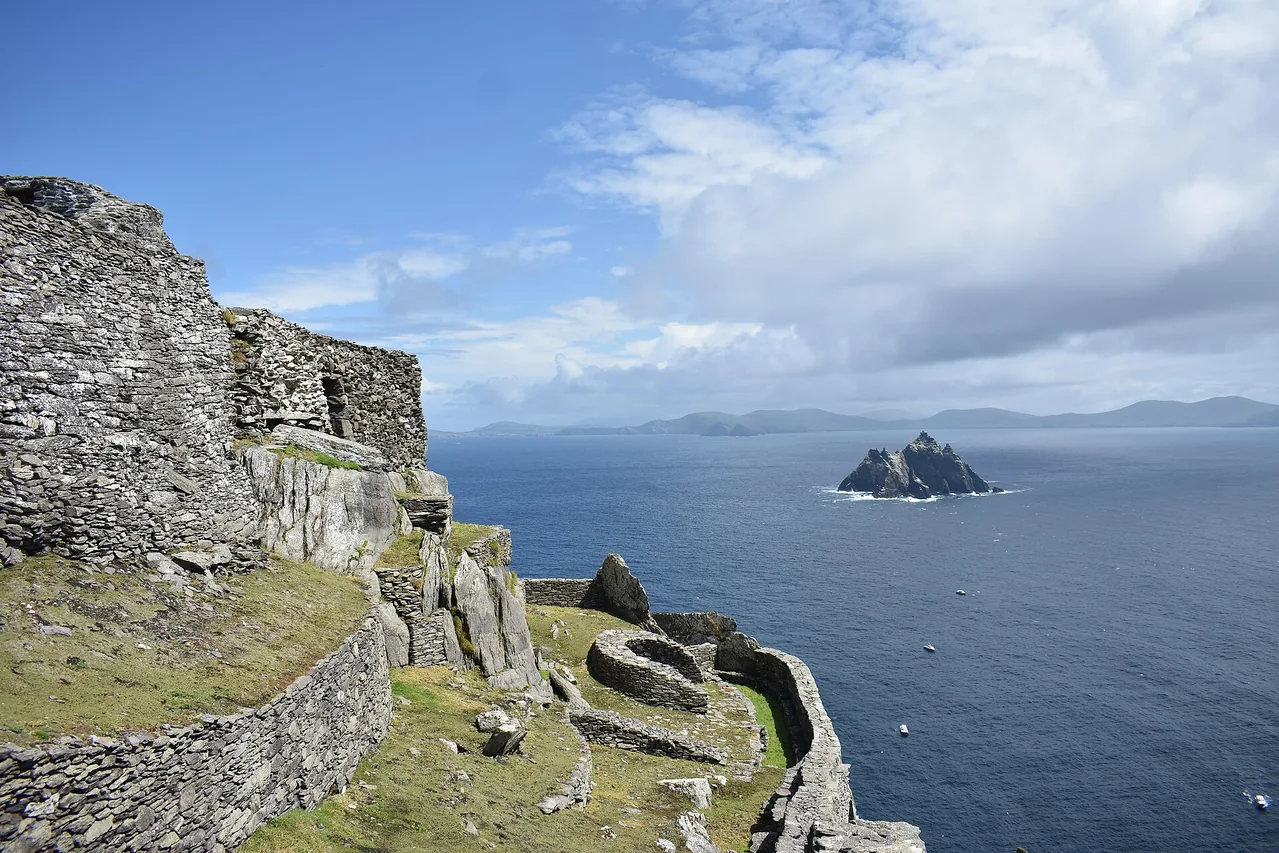
Let the story include the water between the islands. Looking continuously for one desired species can make the crossing feel like time lost before the “real” visit. A boat journey offers a changing perspective on the coast, the scale of the rock and the separation between islands. Even when a particular bird is absent, those relationships remain worth seeing.
Landing, boat-only or mainland: pick the visit that fits
As checked on 19 September 2026, Heritage Ireland lists a season beginning on 12 May and extending into September, subject to change and weather. Arrange a landing within the managed opening period and follow the current OPW access notice. Access for a landing is through permitted boat operators. The official page lists those operators for the current season, so start there rather than assuming a marketplace result establishes permission. Current access and operator list
The same page describes 618 steep, uneven steps and about 180 metres of ascent to the monastery. Children under 12 are not permitted. Consider those requirements before paying. A landing is not simply a boat excursion with an optional short staircase at the end.
For a mixed group, discuss suitability individually. One person's confidence with exposure does not establish another person's comfort, and agreeing to a holiday together does not mean everyone must choose the same excursion. Ask the operator about the actual arrangements for anyone who does not plan to climb; do not assume a safe, supervised waiting programme is included.
A boat-only circuit avoids the monastery ascent, but it still involves boarding and travelling at sea. Ask about the vessel, seating, duration and boarding arrangements that matter to your party. “No climb” is a useful description of an itinerary; it is not an accessibility certification for every visitor or every boat.
The mainland option is a deliberate alternative. It may suit a family with younger children, someone uncomfortable with the ascent, or a traveller whose limited time leaves no flexibility for cancellations. You can choose the visitor centre and coastal context without treating the decision as a lesser achievement.
There is no need to defend a sensible choice by saying you will come back and complete the “proper” version. The right visit is the one whose actual conditions match your interests and abilities. An article, including this one, cannot assess those for you. Use the official information, ask specific questions and allow yourself to decline a trip that does not fit.
Build a weather plan before you choose the day
Think about two calendars. The first is the site's operating season. The second is your own travel schedule: arrival, accommodation, onward transport and commitments that cannot move. A date that falls inside the season can still be a poor choice if a cancelled crossing would leave you with no alternative and an expensive chain of missed arrangements.
Our planning suggestion is to stay close to your departure point the preceding night when practical, and keep the remainder of the excursion day relatively open. This is an itinerary choice, not an operator requirement. It reduces the number of things that depend on a fast drive before departure or a precisely timed return.
If you can spend more than one day nearby, ask how the operator handles rebooking before assuming that a spare day provides another place. Available space and the terms of your booking still matter. Do not reserve overlapping seats speculatively without understanding cancellation conditions and the effect on a limited-capacity service.
For a single-day stop, choose a mainland plan you can enjoy at short notice. A museum or interpretation visit is useful because it continues the same subject. Save its opening information and travel route in advance. The worst moment to build that alternative is after a cancellation, when everyone in the group is disappointed and looking at different search results.
Use Met Éireann for official Irish weather information and the operator for the sailing decision. A favourable general forecast is not a personal assessment of the landing. Keep your phone reachable for practical updates and check the meeting instructions again the evening before.
Photography preferences belong below access and logistics in the decision. Clear light, dramatic clouds and a particular bird season may influence your preferred month, but none should become a promise that the trip will produce a specific image. Choose a period you would enjoy on the mainland too. It is a better foundation for the trip than trying to schedule the Atlantic around a photograph.
Where to stay, and which harbour your booking actually uses
Begin with the departure point written on your booking, not the island pin on a map. Skellig Michael is the destination offshore; the place where you leave your car, meet a crew and board the boat is a separate location. Confusing the two produces an itinerary that looks simple on a screen but does not tell you where to be in the morning.
Use the current OPW list of permitted operators when arranging a landing. Ask the operator to supply the exact meeting point, check-in time, departure harbour and a contact number for the day. Save these together. A map search for a company name may point to an office rather than the boarding place.
Portmagee is a useful base to investigate because of its relationship with the Skellig visitor experience and nearby Valentia Island. It is not a promise that every service leaves from the same pier. Choose accommodation after confirming the practical arrangements, especially if you will depend on a taxi or another person to get you to the boat.
If travelling without a car, work backwards from the requested check-in time. Find out whether local transport can deliver you there early enough and whether a return can be arranged after an uncertain arrival time. A town being reachable by public transport does not establish that the complete connection to your particular sailing works.
For drivers, check where parking is permitted and how long the space allows you to stay. Allow time to walk from the parking place, use mainland facilities and find the crew. Avoid a plan that depends on finding an unverified space immediately beside the pier. Keep valuables out of sight and bring only what you need onto the boat.
The map below locates the island for orientation. It is not a marine route, a walking route or an instruction to approach independently. Access arrangements and the operator's meeting pin should take priority over an automatically suggested route. If those instructions differ from something in an older travel article, resolve the difference with the operator before departure.
The monastery is free to enter; reaching it is not
Heritage Ireland lists admission to Sceilg Mhichíl as free. That does not make a visit free: the crossing is provided by boat operators who charge separately. Keeping those two facts beside each other prevents one of the easiest misunderstandings in planning this trip. A price shown by a tour company is not automatically an OPW admission fee.
Request a current quote for the exact type of excursion and your party. A boat-only cruise and a landing trip should not be compared as interchangeable products. Ask what is included, where the trip departs, how long you should allow and what happens if the skipper cannot land. The cheapest headline price can describe a different day from the one you have in mind.
There is another distinction worth making before payment: cancellation before sailing and an unsuccessful landing after sailing may be treated differently. Read the terms for both situations. Also separate an operator cancellation from a change you make because your travel plans have altered. Record the terms that apply to your booking rather than assuming a general statement on a travel forum covers it.
Build the remaining budget from quantities. Boat charges quoted per person must be multiplied by the number of paying travellers. A taxi quote for the vehicle should be entered once for the party. A room rate is multiplied by rooms and nights, not automatically by people. These small distinctions matter more than an impressive-looking daily total.
The calculator below uses euros. Its boat field is a whole-party amount, so first multiply any per-person quote by the relevant number of passengers. Blank fields represent allowances you have not entered; they are not evidence that transport, meals or accommodation will cost nothing. If a booking already includes a service, avoid adding the same charge twice.
For example, two travellers sharing one room for two nights enter one room and two nights. They enter the combined boat quote in the boat field and the combined transfer quote in transport. Food is an allowance per person for the excursion. This is a calculation example, not a claim about the price of a Kerry hotel, boat or meal.
Finally, consider the cost of flexibility. An extra night may make a weather-dependent trip easier to manage, but it also costs money and does not guarantee a replacement seat. Decide whether that flexibility is valuable within your whole itinerary. The correct budget is one you can afford even if the island landing does not happen.
Seven questions that make a boat listing easier to judge
Start by asking whether the product includes a landing. Do not infer it from a photograph of the monastery, the words “Skellig experience” or a route description that says the boat visits the islands. Then ask whether the operator is on the current permitted list for landing trips. These are two separate checks: the experience promised and the permission relevant to it.
Next, confirm the departure point and the time you must arrive, including check-in. Ask about the expected total duration and how the crew will communicate changes. A listing's estimated duration helps with planning, but the sea and the actual operation of the trip may affect timing. Avoid an onward connection that depends on an exact return.
Your fourth question concerns restrictions. Explain relevant needs directly and ask what the actual boarding, crossing and landing involve. The official under-12 restriction applies to the island visit. Do not assume that a boat-only service has identical rules, or that it is automatically suitable for every child or traveller; check the particular service.
Fifth, ask what happens if landing becomes impossible. Sixth, ask what facilities are available on the boat and how personal belongings should be carried. Seventh, establish the cancellation and refund terms in writing. These questions give you something concrete to compare across listings rather than relying on star ratings or promotional adjectives.
A guide to booking should leave room for saying no. If an operator's answer does not resolve a practical concern, ask again before paying. If a product does not match your needs, choose another experience. Scarcity of seats is not a reason to buy an unsuitable trip or to overlook the conditions attached to it.
The official link below helps you find current visitor information and the permitted-operator list. It is not a checkout or a promise of availability. The accommodation link is an ordinary convenience link without affiliate tracking. We do not describe an operator as personally tested when the editorial team has not travelled with it.
Pack for a boat crossing and stone steps on the same day
The most useful packing decision is how to keep your hands available. The official visitor guide, pages 4–5 recommends a backpack and sturdy footwear with grip. Use a small bag that closes properly and sits securely. Carrying a drink, camera and loose jacket separately makes movement more awkward precisely where you want less distraction.
Footwear deserves attention before accessories. Choose sturdy shoes or boots with soles in good condition, suitable for uneven stone and the conditions you expect. The official guidance does not permit sandals or flip-flops. A new pair that causes discomfort on an ordinary walk is a poor choice for a day when changing shoes may not be practical.
For a cool or showery day, start with a comfortable layer, add an insulating layer and carry a waterproof outer layer. Check that you can reach the outer layer without emptying the bag. A hat and light gloves may be useful in colder conditions. These are practical categories, not a forecast that every summer crossing will be cold.
For a brighter, warmer day, the bag still needs weather protection. Bring suitable sunscreen and sunglasses, and choose headwear you can secure. Apply products as their instructions direct. Do not mistake a cool breeze for the absence of sun exposure, or leave your water behind because the island visit sounds short.
Bring drinking water and food for the outing in closed containers, as the official guidance recommends. Keep food packed away when you are not eating and do not feed wildlife. Carry a small bag for your own waste and return it to the mainland. Plan around what you need rather than assuming refreshments will be available on the island.
A dry pouch can protect a phone and booking details from rain or spray. Save important instructions before leaving reliable connectivity. A phone should not become a task that occupies your hands on the steps: stop in an appropriate place before taking it out. Keep camera straps controlled so equipment does not swing or interfere with another visitor.
If you are prone to motion sickness, discuss appropriate preparation with a pharmacist or clinician before travel and follow their advice. This guide does not recommend a particular medicine or dose. Tell the operator about practical needs that affect your trip; avoid discovering at boarding that your assumptions about seats or facilities were wrong.
The illustration below separates the shared essentials from the items most useful in wind and showers. It is an AI-created packing aid, not a photograph of equipment supplied by an operator. You do not need to buy everything pictured, and no pictured item guarantees that an unsuitable excursion becomes suitable.
Give the mainland people a place in the island story
It is easy to describe Skellig Michael entirely through remoteness. Yet a visitor reaches it through the work of people onshore and at sea: crews, accommodation hosts, guides, conservation staff and others who help make the day possible. Let the story include that work instead of treating the mainland as a service corridor to a photograph.
Use the place names with attention. Sceilg Mhichíl and Skellig Michael refer to the same island in the official visitor information. You may encounter Irish and English names in interpretation and conversation. If you want help pronouncing a name, ask politely rather than presenting an improvised pronunciation as an authentic local phrase.
A useful conversation is specific and modest. Ask a guide which detail visitors often overlook, or ask a host what they would recommend nearby if a crossing is cancelled. Avoid assuming that everyone working in tourism can pause for an extended interview. A person who is loading a boat or managing a queue has an immediate job to do.
Ask permission before making a recognisable person the subject of a photograph, and accept a refusal without negotiation. The same courtesy applies to filming a guide's explanation. A public place is not a reason to turn someone else's working day into background material for your own story.
At the monastery, approach the remains as a religious and historic place. Keep movement and conversation considerate of other visitors, and follow the staff's directions about access. You do not need to invent a ceremonial dress code: for this visit, practical clothing, appropriate footwear and respectful behaviour are the useful priorities.
If you buy a book, meal or local service, choose it because you value what is offered. Do not claim that a purchase “saves” a community or automatically makes the trip sustainable. Fair treatment, clear agreements and attention to other people's time are more concrete contributions than a slogan about travelling authentically.
A landing day, a boat-only day and a mainland day
For a landing day, prepare the evening before: confirm the meeting instructions, check messages from the operator and pack the small bag. On the morning, allow time for check-in and mainland facilities. Listen to the crew's instructions, then to the island staff's briefing. The sequence matters more than trying to reproduce another traveller's minute-by-minute schedule.
Once ashore, give the ascent the attention it requires. The official information describes approximately two and a half hours on the island, excluding the crossing; treat the crew's actual instructions as controlling your return. Do not spend that allowance mentally before arriving by assigning a fixed number of photographs or a long list of stops.
At the monastery, choose a few things to look at carefully: the relationship between cells and shared spaces, the terraces and the broader setting. Ask a question where interpretation is available. Leave enough time to return without hurrying. A demanding descent is a poor place to recover time lost while arranging a photograph.
For a boat-only day, reset the expectation before boarding. You are choosing a view from the water, not a failed attempt at a monastery visit. Ask about the route and what can reasonably be seen from it. Bring suitable layers and protect equipment, but leave room to look with your own eyes rather than spending the entire trip trying to stabilise a zoomed phone image.
For a mainland day, the Skellig Experience visitor centre's exhibitions offer material on the monastery, lighthouse history and wildlife. Check its current opening arrangements and admission directly. Pair an indoor visit with a nearby outing that suits the actual weather, transport and interests of your group.
After any version of the day, a short note can make the visit last: one detail you noticed, one question you still have and the source that might answer it. This is particularly helpful if you plan to write or post about the trip. It separates what you saw from what you later learned, instead of merging both into a confident but unreliable memory.
Read one question further before you go
If you want a substantial introduction to the islands, start by considering The Book of the Skelligs, edited by John Crowley and John Sheehan. Its publisher describes an interdisciplinary treatment, which makes it a useful candidate for readers interested in more than one strand of the place. Check the contents and edition before buying.
For a personal island perspective, consider Des Lavelle's Island Boy. Read a memoir as one person's account with its own period and viewpoint, rather than as a current visitor manual. That distinction lets personal writing add depth without turning every remembered detail into present-day travel advice.
For the surrounding county, John Wesson's Kerry: The Beautiful Kingdom offers a broader visual frame. A regional book can help you decide what else interests you when planning the mainland part of the trip. It should not replace up-to-date transport, opening or access information.
You do not need three purchases to prepare well. Read the free official visitor guidance first, then choose a book that answers your own question. We selected these candidates from publisher information; this is not a claim that the editorial team has read and reviewed every page. Availability, formats and editions may differ across shops.
Questions worth settling before you book
Can children visit the monastery?
Current Heritage Ireland information says children under twelve are not permitted on the island. Check the official page again before booking. For a boat-only trip, ask the individual operator about its requirements and suitability rather than assuming that the island rule answers every question about a different service.
Are there toilets on Skellig Michael?
Toilets are listed in the current official visitor information. Older accounts that say there are none should not override that source. Ask about practical availability if this is important to your trip, and check facilities on your boat separately. The presence of a toilet does not imply a café, shop or a full visitor-centre service.
Does a landing ticket include a guided climb?
OPW provides interpretation at the monastery, but its guides do not escort visitors up or down the access route. A guide meets visitors at the start of the climb on the lighthouse road. This explains why the official site lists guided tours while the ascent remains unescorted. Ask your operator about any additional service included in your booking. OPW guide service, page 6
Can I use a drone or leave the visitor route?
OPW prohibits drones and leaving the designated visitor route. The rules protect people, fragile structures and nesting habitat. Follow signs and staff instructions for any temporary changes. OPW visitor rules, pages 6–7
Is it still worth coming if the boat is cancelled?
That depends on the trip you designed. If everything rests on one landing, a cancellation can overwhelm the day. If you have chosen mainland interests and accommodation you value independently, it becomes a change of plan. Build that alternative while booking, rather than asking the weather to justify the entire journey.
For another destination where the visitor experience depends on recognising the limits of access, read our Reynisfjara guide to the shore and wave risk. The hazards and rules differ. The shared planning lesson is to let current local instructions govern the visit, even when a famous photograph suggests a different experience.
A closer look.
Documentary photographs made in 2006, 2012 and 2023. They show buildings and landscape at those dates, not today's access or weather conditions.

Sok Heng Oeun
Sok Heng Oeun is the owner and editor of Hidden Corners. The Hidden Corners Editorial Team supports image preparation and editorial checks under his direction.
Sok Heng Oeun on Facebook ↗Research and AI-assisted editorial preparation. Publication authorized by Sok Heng Oeun; an individual owner reading review is not recorded. This guide does not claim a firsthand team visit.
Sources & image credits
Sources supporting this guide. Dated prices and access reports can change; confirm with the responsible authority before travelling.
- UNESCO's property record ↗
- OPW historical outline, pages 14–15 ↗
- OPW monastery plan and building descriptions, pages 12–13 ↗
- Irish Lights: the history of Skelligs Rock ↗
- Skellig Experience visitor centre's exhibitions ↗
- OPW visitor guidance and permitted operators ↗
- Met Éireann ↗
- official visitor guide, pages 4–5 ↗
- The Book of the Skelligs — Edited by John Crowley and John Sheehan ↗
- Island Boy — Des Lavelle ↗
- Kerry: The Beautiful Kingdom — John Wesson ↗
- OPW visitor rules, pages 6–7 ↗
Photograph credits
- Skellig Cells · Jibi44 · October 2006 · CC BY 2.5. Resized and converted to WebP; responsive display may crop. These adaptations remain available under their respective licences.
- Skellig Island · psyberartist · 7 September 2012 · CC BY 2.0. Resized and converted to WebP; responsive display may crop. These adaptations remain available under their respective licences.
- Skellig View · NoNameIsLeft · 16 July 2023 · CC BY-SA 4.0. Resized and converted to WebP; responsive display may crop. These adaptations remain available under their respective licences.
Packing and outfit graphics: AI-generated editorial illustrations. Portrait: supplied by Sok Heng Oeun.
_(2).jpg)

_04.jpg)