
A major error, not identified during peer review
"The radiocarbon dating was applied to soil samples that were not associated with any artifacts or features that could be reliably interpreted as anthropogenic or 'man-made.'"
That is the sentence. It sits in a retraction notice dated 18 March 2024, published by Wiley in the journal Archaeological Prospection under the identifier 10.1002/arp.1932, and it ends the formal life of a paper that had argued, five months earlier, that a terraced hill in West Java called Gunung Padang was the oldest pyramid on Earth. The notice draws its own conclusion in the next line: the interpretation that the site is an ancient pyramid built 9,000 or more years ago is incorrect, and the article must be retracted. It adds, in the neutral voice these documents use, that all of the authors disagree.
Most writing about Gunung Padang starts on the hill and works its way, eventually, to the controversy. This guide goes the other way. It treats the paper as the specimen: where it came from, what it claimed, why so many people found the claim plausible, which checks it should have failed and did not, how it was withdrawn, and what has happened since, because the story did not stop in 2024. Only then does it climb the stair, to a stepped sanctuary of volcanic stone that is roughly two thousand years old, still used for prayer, and in 2025 and 2026 the scene of a government restoration whose own public statements have reopened the question of age.
It is desk research. Nobody from Hidden Corners has been to West Java; the account is built from the retraction notice, the published critiques, Indonesian news reporting through 2026 and visitor information, with sources and check dates in the ledger. Where named people disagree, both sides are set out in their own terms. Nothing here alleges fraud, and nothing here is written to embarrass anyone who finds the older story moving.
The hill before the paper
A specimen needs a habitat, and Gunung Padang had one long before any journal was interested in it.
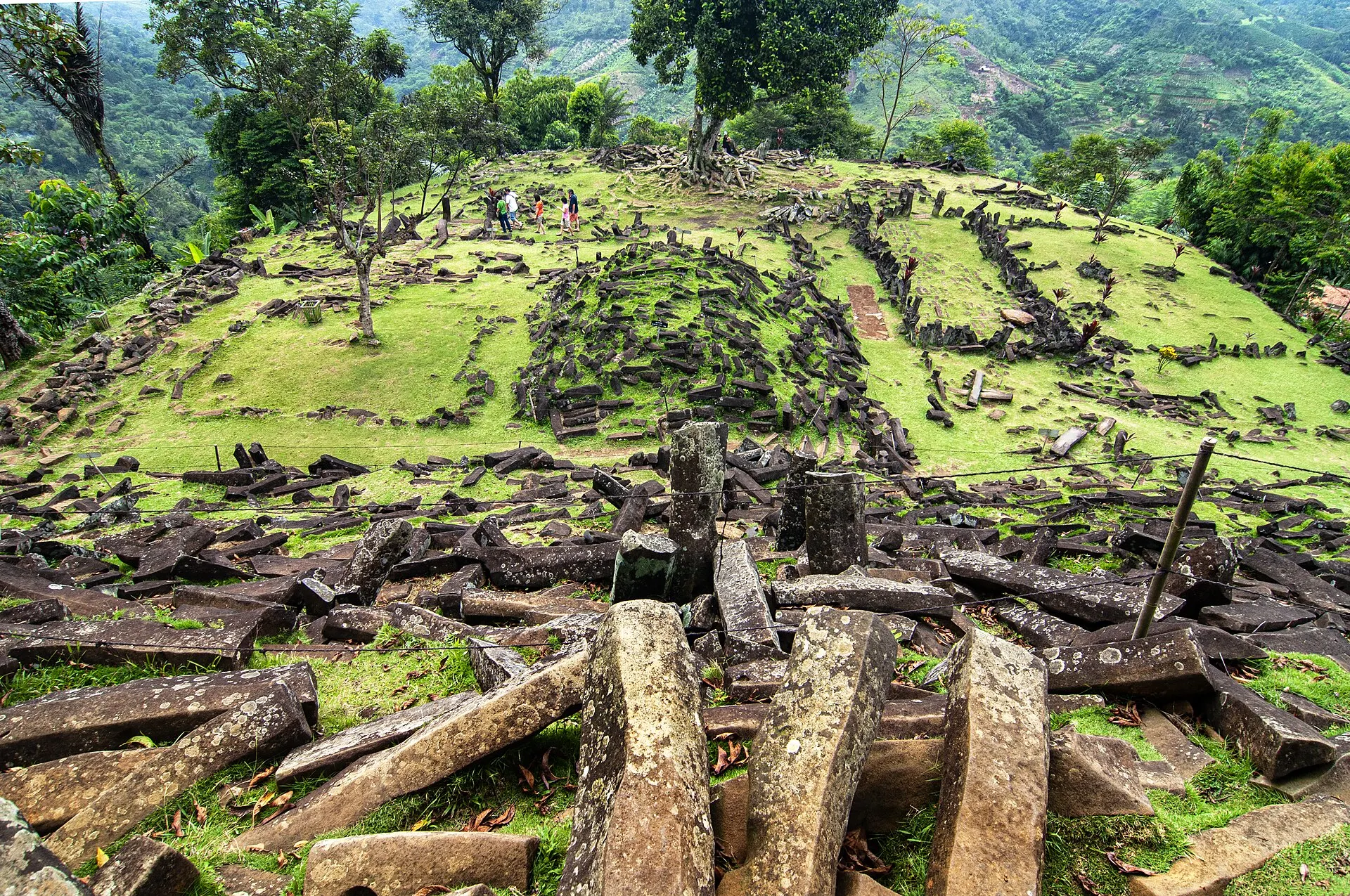
The site sits in Karyamukti village, Campaka district, in the regency of Cianjur, about fifty kilometres south-west of Cianjur town, on a hill of around 885 metres that was once part of a volcano. Local people knew it and used it well before it entered European paperwork. It acquired a written citation in 1891, when Rogier Verbeek recorded it, drawing on a visit made by M. De Corte the previous year. Verbeek was a geologist and natural scientist rather than a historian, and some popular summaries, including the English Wikipedia article on the site, call him the latter. His description was of a sequence of four terraces connected by rough stone steps, among columnar andesite. It is a modest entry, and it matters for a simple reason: the terraces, the stair and the stone were already there, visible and described, a century and a quarter before anyone argued about what lay underneath them.
The hill's formal protection came in two steps. It was declared a heritage site of local interest in 1998, and in June 2014 a National Site Area of 29 hectares.
The person who has worked there longest is Lutfi Yondri, an archaeologist now at Universitas Padjadjaran in Bandung, who excavated at Gunung Padang over roughly three decades. His most useful contribution, for anyone trying to understand the retraction, is methodological rather than dramatic. He recovered charcoal from beneath the retaining walls on several terraces and had it radiocarbon-dated. Charcoal under a wall was lying on the ground before the wall was built, so the wall has to be younger than the charcoal. Those samples, as reported in Archaeology magazine in 2024, cluster around 117 BCE and around 50 BCE. Yondri dates the earliest megalithic structures to about two thousand years ago, reads the terraces as the work of several generations rather than one, and interprets the site as religious: a place where people gathered on the terraces for rites honouring ancestors, with the highest terrace the most sacred.
That is the reference point for everything that follows, and it is worth noting what kind of evidence it is. The date is not the argument. The argument is the relationship between the sample and the structure. A piece of charcoal, taken from a known position beneath a known wall, can only have got there before the wall. Remove that relationship and the date becomes a number with nothing attached to it.
The mainstream picture is not perfectly tidy, and it should not be presented as if it were. Other summaries give different ranges: the Wikipedia article attributes to Yondri a construction estimate in the second to fifth centuries CE and to the archaeologist Harry Truman Simanjuntak a range in the sixth to eighth centuries CE, and reports pottery fragments dated to between 45 BCE and 22 CE. These are disagreements about which few centuries around the turn of the era the terraces belong to. None of them approaches the Ice Age, and the gap between them is small beside the gap that was about to open.
A hypothesis with a budget, 2012 to 2014
The retracted paper was published in 2023, but the idea inside it was more than a decade old, and it had already been tested in public once.
Its main author, Danny Hilman Natawidjaja, is a geologist. From around 2012 he and colleagues argued that geophysical surveys of Gunung Padang showed layers of construction deep beneath the visible terraces, far older than the terraces themselves. The claim moved quickly beyond academic circles. It drew attention from the presidency, and the then education and culture minister, Mohammad Nuh, pledged research money from ministry endowment funds, with a first disbursement reported by the Jakarta Post at around Rp 3 billion. Excavation followed.
So did objections. In September 2014 Desril Riva Shanti, then head of the Bandung Archaeological Centre, told the Jakarta Post that the excavation had not followed standard archaeological methods. Work of that kind, she said, should proceed in stages, slowly, using tools smaller than a hoe. She objected in particular that military personnel had used hoes on the eastern and western sections of the site, exposing its interior improperly. The English Wikipedia article also reports a petition against the approach signed by Indonesian archaeologists and geologists; the news reporting checked for this guide names individual critics only, so no count is given here.
Two features of this first episode carry forward into the paper's life. One is that the hypothesis had state enthusiasm behind it before it had peer review, which gave it a status in public that ordinary research questions do not have. The other is that the people who objected most sharply were archaeologists, and what they objected to was method: how the ground was opened, and what that did to the evidence. That is the same seam along which the 2023 paper would later split.
Also in the record from these years is a book by Ali Akbar, an archaeologist at Universitas Indonesia, titled Situs Gunung Padang: Misteri dan Arkeologi, and a research report of his covering 2012 and 2013. His name returns later in this story, in a different role.
The claim, October 2023
In October 2023 Archaeological Prospection published "Geo-archaeological prospecting of Gunung Padang buried prehistoric pyramid in West Java, Indonesia", with Natawidjaja as lead author and a group of Indonesian co-authors, under the identifier 10.1002/arp.1912.
The journal is a specialist one. It publishes work on prospection: the geophysical methods, such as ground-penetrating radar, electrical resistivity and seismic survey, that archaeologists use to see beneath the surface before, or instead of, digging. The paper combined survey of that kind with drilled cores and radiocarbon dates from material in those cores. From them it built a sequence of construction phases stretching far back beneath the visible terraces, and it placed the earliest human activity somewhere between about 25,000 and 14,000 BCE. Those dates would radically change the accepted chronology of monumental construction if they could be connected to something people built. The age of sampled material alone does not demonstrate that connection. Reported summaries at the time described it as the world's oldest pyramid.
The detailed phase-by-phase account in the paper could not be retrieved for this guide, because Wiley's pages block automated access, so its individual construction units are not listed here. What matters for the anatomy is the chain of reasoning, which the retraction notice later summarised: radiocarbon dates obtained from soil, read as the ages of phases of human construction.
One further detail was widely reported at the time of the retraction: the paper's acknowledgements thanked the writer and broadcaster Graham Hancock for proofreading the manuscript. That is a disclosed courtesy, not an impropriety, and it is included for one reason only. Hancock had presented Gunung Padang the year before as the opening episode of his Netflix series Ancient Apocalypse. The scientific claim and the popular one were already close together before the paper appeared, and after it appeared they became difficult to separate.
Why it was easy to believe
It would be convenient to explain the paper's reception as credulity. It would also be wrong. The claim landed in soil that had been carefully prepared, some of it by genuine science.
The drowned continent is real. During glacial periods the shallow Sunda Shelf was dry land, joining Sumatra, Java, Borneo and the Malay Peninsula into a single landmass now called Sundaland, of roughly 1.8 million square kilometres. At the Last Glacial Maximum the sea stood about 120 metres lower than it does today and the whole shelf was exposed. It flooded progressively, from around 18,000 years ago to about 5000 BCE. People lived there. Most of what they left is under the sea, and it has not been systematically surveyed. Anyone who says there is a large gap in the archaeological record of this region is correct.
A popular theory filled the gap. Stephen Oppenheimer's Eden in the East argued that Sundaland was a homeland from which peoples and ideas dispersed as the water rose. On the question of Austronesian origins it is an extreme minority position; the large majority of archaeologists, linguists and geneticists working on the subject favour a dispersal out of Taiwan. But the idea that something important was drowned off Indonesia, and that its traces might survive on high ground, had been in circulation for a long time.
Television arrived first. Ancient Apocalypse, released on Netflix in 2022, opened with Gunung Padang and presented it as evidence of an advanced civilisation lost at the end of the Ice Age. The series reached an audience that no journal ever will, a year before the paper existed. When the paper came out, it did not introduce the idea to the public. It appeared to confirm something the public had already been told.
National pride had a stake. A claim that Indonesia holds the oldest monumental architecture on Earth is not a neutral proposition for Indonesians, and it should not be expected to be. It had already attracted ministerial funding once, in 2014, and it would attract ministerial support again. Wanting a thing to be true is not the same as believing it without evidence, but it does change what counts as enough evidence, in any country.
And it came with a journal's name on it. Peer review is the mechanism the public relies on to tell a hypothesis from a finding. A paper in a Wiley journal looks like a finding.
Notice the shape of the chain. A well-established fact about sea level becomes a premise; the premise needs a civilisation; the civilisation needs a monument; a real archaeological site is recruited to be the monument; and a published paper appears to certify the recruitment. Each link is weaker than the one before, but the first is solid, and a solid first link is what lends the rest its weight. Nothing about Sundaland's genuinely unexplored archaeology requires Gunung Padang to be twenty thousand years old.
What the reviewers should have caught
The retraction notice is unusually direct about where the process failed. It describes "a major error" and adds that this error "was not identified during peer review". Three specific problems, raised afterwards by archaeologists, explain what that error was and why it is the kind reviewers are meant to catch.
Dating the dirt, not the deed
Radiocarbon measures the time since an organism died. It works on charcoal, wood, bone, shell, seeds and the organic carbon in soil. It cannot date stone, and it cannot date an act of building. To date construction with it, you need an intermediate step: a sample whose position proves it was deposited at, or just before, the moment of building, like Yondri's charcoal under the walls, or which is bound up with something people made, such as a hearth, a tool or a burial.
Soil taken from depth inside a hill has no such relationship by default. Hillsides accumulate organic material over geological time; drill into almost any old landform and you will retrieve carbon that is thousands or tens of thousands of years old. The laboratory result can be perfectly accurate. It simply tells you when that carbon stopped exchanging with the atmosphere, which is a fact about the soil. To make it a fact about a building, you must show that the soil sits in a layer people created or disturbed. On the retraction notice's account, that is what was missing: the samples were not associated with artefacts or features that could be reliably interpreted as man-made.
The archaeologist Andre Costopoulos put the same point more bluntly a week after the retraction: without associated cultural material, the soil samples date only the natural materials.
No comparison with the neighbours
Costopoulos also noted something a reviewer could have asked for without leaving a desk. The paper described the internal structure of Gunung Padang without comparing it to the surrounding hills, which are volcanic too. If a hill is to be interpreted as partly artificial, the first step is to show it is anomalous: that its layers, cavities and densities differ from those of the landforms around it in ways geology does not explain. Without that comparison there is no baseline, and every feature detected inside the hill is equally consistent with a hill.
This matters especially for geophysics. Radar, resistivity and seismic surveys detect contrasts: changes in density, moisture or material beneath the ground. Inside an extinct volcano those contrasts are everywhere and mostly natural. Lava flows, weathered horizons, columnar jointing and voids in fractured rock all produce them. A contrast is a place where the signal changes. Calling it a chamber or a construction phase is an interpretation that needs support from somewhere else, and the obvious somewhere else is excavation and datable cultural material.
Who judged it
The third problem is structural rather than technical, and it generalises well beyond Java. Archaeological Prospection is a journal for survey methods. Reviewers well qualified to assess a resistivity profile or a seismic model are not necessarily the right people to judge whether a radiocarbon sample sits in a cultural layer, and the paper's central claim was archaeological: who built what, and when. Costopoulos added that the paper effectively reversed the burden of proof, inviting critics to disprove a construction rather than demonstrating one.
The person with the deepest first-hand knowledge of the site's stratigraphy was outside the process. When a detailed public critique was assembled in early 2024, by the archaeologist Flint Dibble of Cardiff University working with the Indonesian archaeologists Lutfi Yondri and Harry Sofian, Yondri noted that he had not been consulted, despite having excavated at the site for decades and published dates from it.
None of these three checks is exotic. Each is the sort of question a specialist asks on a first read. That is why the notice's phrase, "not identified during peer review", is the most consequential in it. The retraction was not only a verdict on a paper. It was an admission about the review that let it through.
The afterlife: 2025 and 2026
Retraction closed the paper. It did not close the question in Indonesia, where the hill's age has become a matter of public policy again.
February 2025. The culture minister, Fadli Zon, who had visited the site the previous month, called for renewed research. Exact data on when the civilisation emerged, he told the Jakarta Post, was information that needed completing, and he expressed confidence that the site housed one of the world's oldest civilisations.
July 2025. Fadli Zon announced that study of the site would continue that year and be followed by phased restoration, carried out in cooperation with BRIN, the national research and innovation agency, and possibly funded through a public–private partnership. In the same remarks, as reported by ANTARA, he described Gunung Padang as clearly a cultural site, comparable to others in West Java though potentially among the most important. On 28 July ANTARA reported that the work would be led by the archaeologist Ali Akbar of Universitas Indonesia, with a core of ten specialists and around a hundred Indonesian researchers, and that its stated questions included the suspected presence of chambers beneath the structures, the age of the lowest structure, and the disappearance of an advanced civilisation. The same report gave dating figures in the team's name: surface structures around 500 CE, structures about four metres down around 500 BCE, and deeper layers around 5,200 BCE.
August to October 2025. Kompas reported that restoration began in August, then that it was postponed at the start of September in response to social and political unrest, and in October that it had resumed, with visitors able to watch the work.
30 November 2025. ANTARA and CNN Indonesia reported the team's statement that the site had been built around 6,000 BCE, based on laboratory tests of carbon taken from the fifth terrace at a depth of four metres, alongside a foundation of rounded stones found at the same depth. Neither report named a laboratory or a publication, and no peer-reviewed paper setting out these results had been found by the time this guide was revised.
December 2025. Ali Akbar told ANTARA that the restoration's first priority was to extend the site's life, stabilising the terrace sides against landslides and collapse, and that several cultural layers lay beneath the surface. On 15 December Kompas reported that the governor of West Java, Dedi Mulyadi, had asked for the site to be closed temporarily during the work. Three days later detik reported the team's answer: the site would stay open, because work was limited to the fifth terrace and the foundation of the eastern wall, and visitors could watch but not approach or interfere.
January 2026. The head of West Java's provincial tourism and culture office, Iendra Sofyan, told IDN Times that no pyramid had been found. What exists, in his words, is a stepped terrace, a punden berundak; the stones did not extend deep, at most about one to one and a half metres; and the site's theme is ritual, not a kingdom. He put the restoration's timetable at two to three years.
February to April 2026. ANTARA and detik reported that a second phase would run from late March to December 2026, restoring the terraces in sequence from the fourth towards the first, and aiming to excavate more than twenty metres down in search of older layers. In these reports the fifth terrace, restored in 2025, was described as dating to around 500 BCE.
Laid side by side, the public statements do not agree with one another. The same team's reported figures for the four-metre level include 500 BCE in July 2025 and February 2026 and 6,000 BCE in November 2025; a separate deeper figure of 5,200 BCE appears in July; and the provincial culture office says the stonework reached no deeper than about a metre and a half. None of this is published in a form that allows anyone else to check it, and it would be unfair to treat press statements made during fieldwork as a final position. It is also true that none of the reported figures approaches the retracted paper's 25,000 to 14,000 BCE.
The useful thing a reader can take from the retraction is a question, and it applies to any date that emerges from the new work, including dates much younger than 6,000 BCE: what was the carbon next to? If it came from beneath a wall, from a hearth, or from a layer packed with pottery, it can date the people. If it came from soil with no demonstrated connection to human activity, it dates the soil. The reports so far do not say which, and the published excavation report, when it appears, will be the place to look.
What the hill actually is
Strip away the paper and its afterlife and a clear object remains. It is not a smaller version of the pyramid claim. It is a different kind of thing.
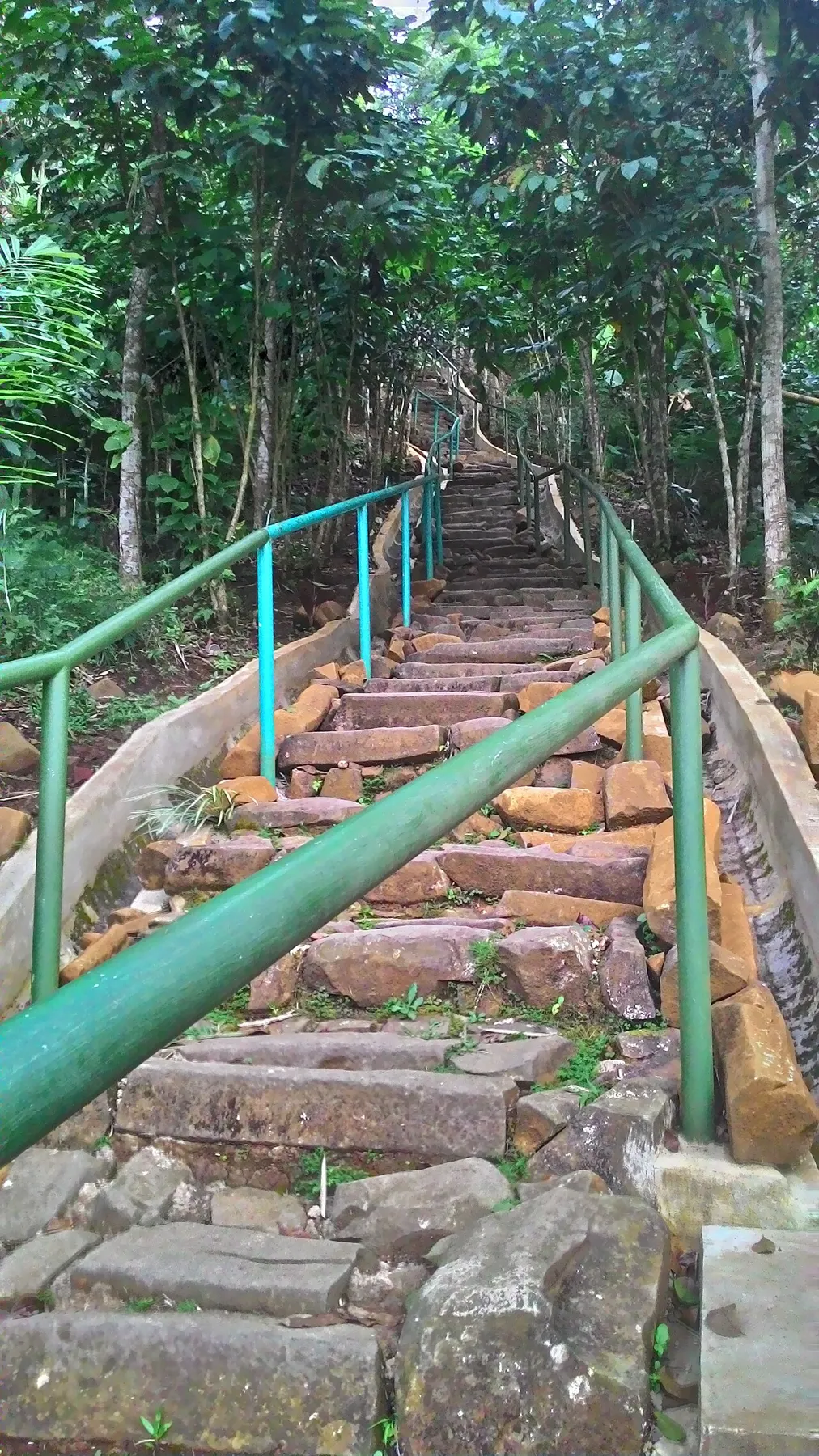
A punden berundak. The term means a stepped terrace sanctuary: a hill or rise shaped into ascending levels, with the sacred concentrated at the top. It is an old and widespread form in the Indonesian archipelago, predating Hindu and Buddhist influence, and its logic of ascent runs through much more famous monuments; Borobudur, for example, is built as a sequence of terraces rather than as a pyramid in the Egyptian sense. At Gunung Padang there are five terraces, one rectangular and four trapezoidal, arranged along a north-west to south-east axis and bordered by retaining walls. A steep entry stair, described as about 370 steps in the Archaeological Institute of America’s site report, reaches Terrace 1, the lowest and largest of the five. Terrace 5 is the highest and smallest; follow the currently permitted route rather than assuming every level is accessible.
The difference between this and a pyramid is not pedantry. A pyramid is a built mass: material placed where there was none. A punden berundak is a modification of a landform that already rises, and usually one that was already significant. The second needs far less labour, a different kind of social organisation and a different relationship with the land. The two readings of Gunung Padang, then, are not long and short versions of one story. One says farming communities faced and terraced a hill for ancestral rites around two thousand years ago. The other says the hill is itself a construction with engineered spaces inside. They describe different objects.
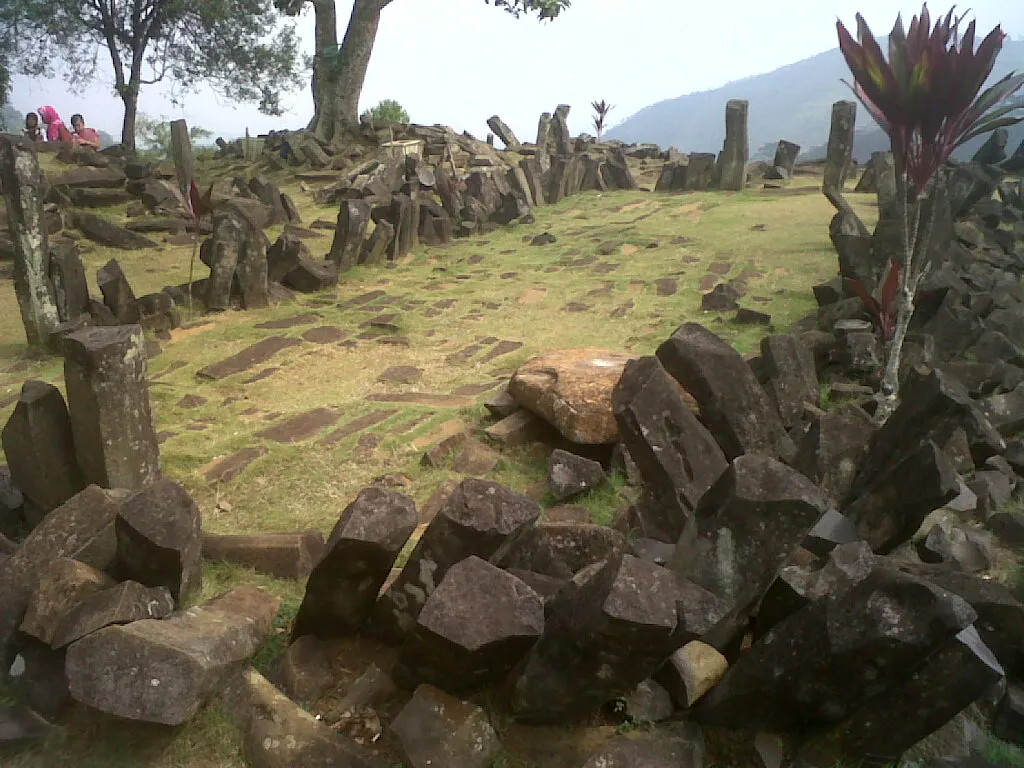
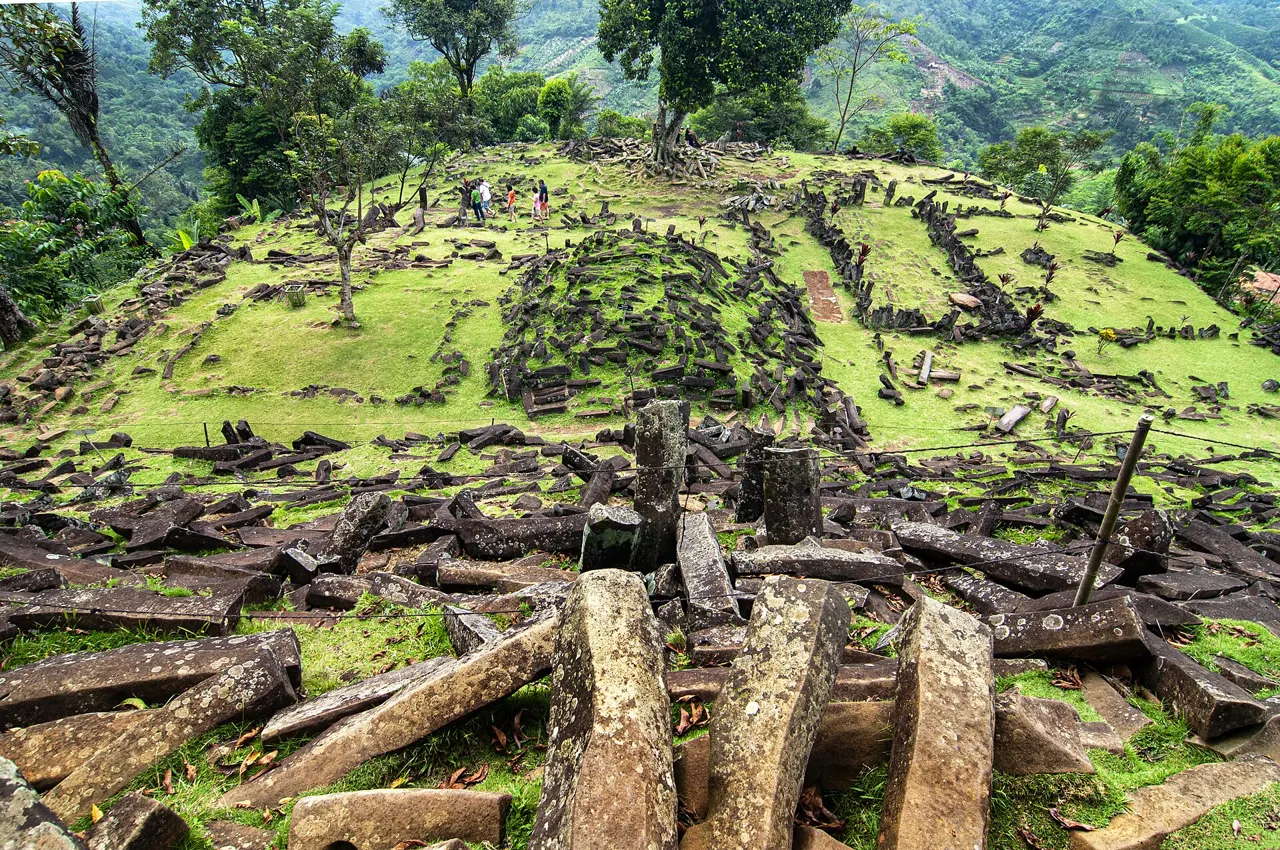
Columns the volcano made. The stone of the walls, and the stone scattered across the terraces, is andesite formed into long prisms, typically six-sided in section and around one to three metres long. The shape is not carved. It is columnar jointing: as a thick body of lava cools, it contracts and cracks into polygonal columns, the same process that produces basalt formations around the world. What is human at Gunung Padang is the recognition, selection, carrying and stacking of columns the landscape had already produced. That is arguably a more interesting achievement than carving, and it also explains why the geophysics was so easy to misread: the hill beneath the terraces is made of the same jointed volcanic rock as the walls on top of it.
Old by any ordinary measure. Charcoal beneath retaining walls has yielded dates around 117 and 50 BCE, as reported in the account of Yondri's excavations. Those dates belong to the sampled material, not directly to construction of the walls. Yondri places the earliest megalithic structures at about two thousand years ago; the distinction between a sample and a structure matters here too. That puts Gunung Padang among the major megalithic sites of Java. It was never necessary to make it older than agriculture for it to be worth knowing.
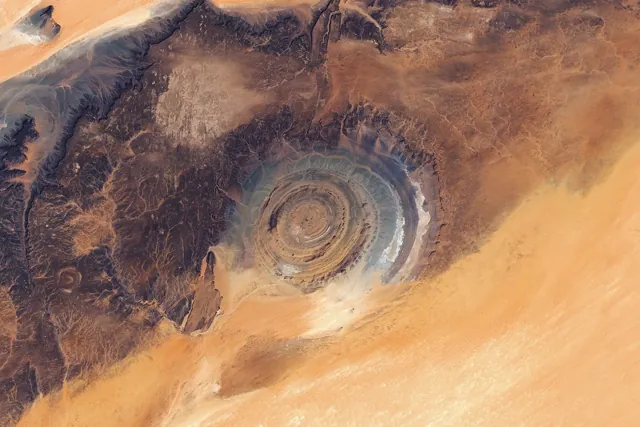
The same distinction between a striking shape and proof of a human structure matters at the Richat Structure.
A place people still climb to pray
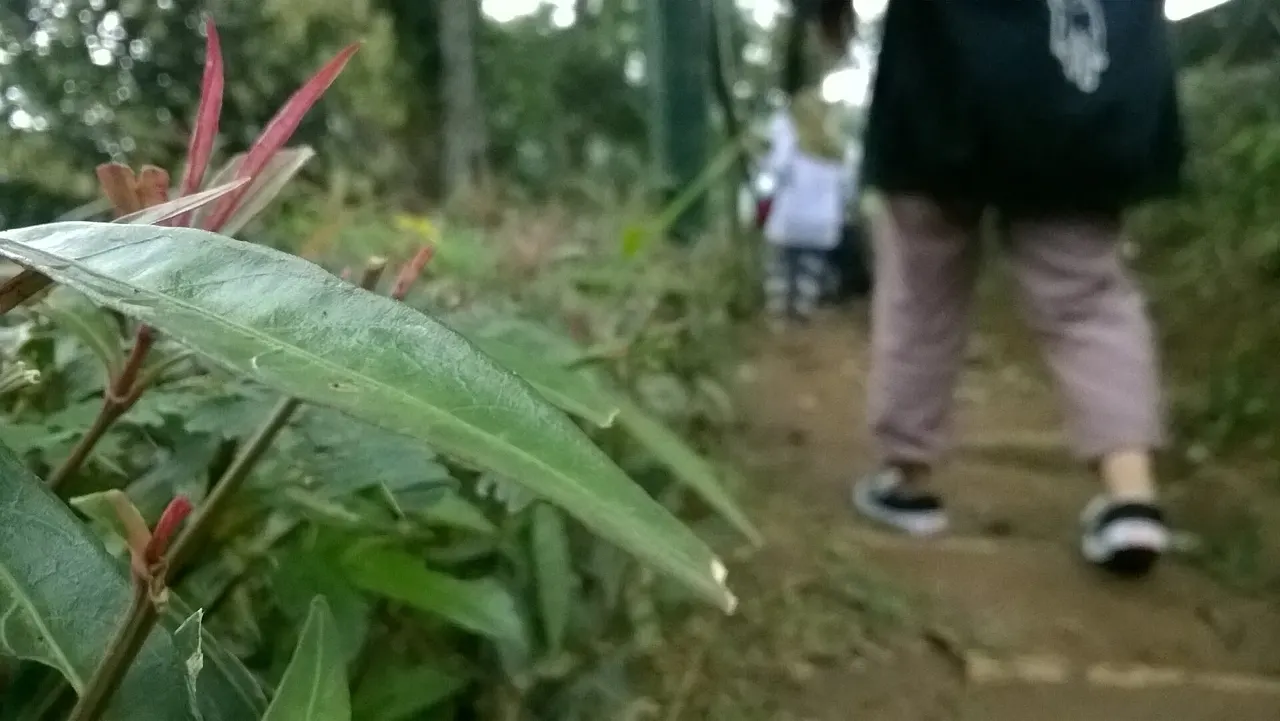
The terraces were built for ritual, and they have not stopped being used that way. People come to Gunung Padang to pray and meditate, and many treat the hill as sacred. The facilities at the entrance, which include a mosque or prayer room, toilets and food stalls, say something about who visits: mostly Indonesians, often at weekends and in groups, for whom the site is a place of devotion, heritage or national interest before it is an archaeological puzzle.
This has two consequences for a visitor.
The first is conduct. Behave as you would at a place of worship, because for some people present that is what it is. Keep clear of anyone praying or meditating, ask before photographing people, dress modestly, and follow any direction from site staff or the restoration team about where to walk and sit. Do not move, stack or rearrange the andesite columns. They are the archaeological record, their positions are data, and in 2025 and 2026 a restoration team has been working to return displaced stones to their original places.
The second is tact. The pyramid claim has been bound up with national pride and has had support from ministers of more than one government. A foreign visitor who arrives intending to correct people is neither kind nor useful. This guide takes a clear position on a retracted paper. It takes no position on anyone's attachment to a hill, and a guide or pilgrim who tells you the site is older than Egypt is repeating something a minister has said on the record, not inventing it.
What to look at on the terraces
The argument of this guide can be checked on the ground, which is unusual, and it makes a visit more rewarding than the forty-minute climb-and-photograph that many people settle for.
A column end-on. Find a loose or broken column and look at its cross-section. Count the sides. The regular polygon is the volcano's work; nobody cut it.
A retaining wall. The walls edging each terrace are the context in which the site's reliable dates were found. When you look at the base of a wall, you are looking at the kind of place where charcoal lay before the stones were set on top of it.
The order of the terraces. The site is arranged as an ascent, with each level more enclosed than the one below and the highest, on Yondri's reading, the most sacred. The layout is the clearest statement the builders left of what the place was for.
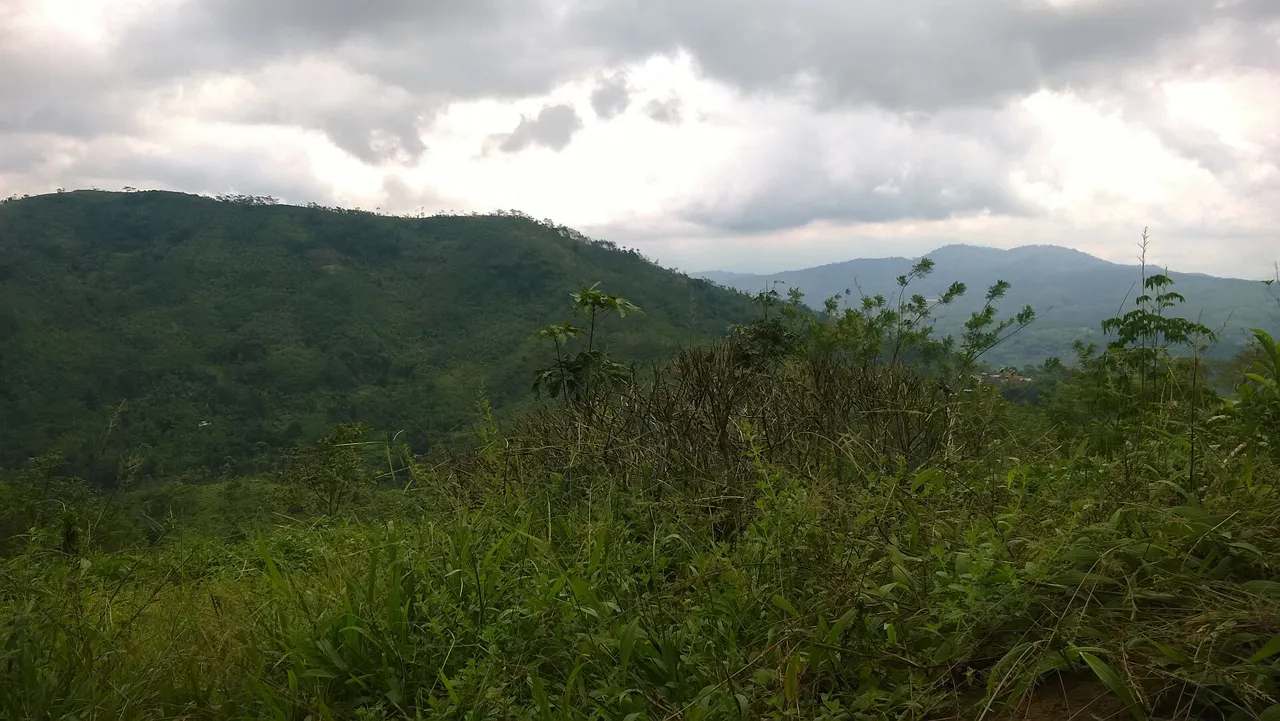
The neighbouring hills. From the upper terraces, look outward. This is the comparison Costopoulos said the paper never made, and you can make an informal version of it yourself: do the hills around this one have a similar profile, and if so, what would you need to see before calling this one artificial?
The restoration. If work is under way, the fenced area is the most current archaeology on the hill. Watch from where you are permitted to stand. The published results of that work, when they appear, will be the next document in this story.
What to be wary of. Signs, guides and online accounts may give the Ice Age dates or newer ones announced to the press. Nobody is being dishonest. It is a live dispute in which one side has official enthusiasm and the other has the retraction notice.
When to go
West Java has a tropical monsoon climate. At Gunung Padang the variable that matters is not heat but the stair.
Roughly May to September, the drier months, are the straightforward window. Steep, worn andesite steps are less slippery when dry, and clearer air gives the view across the neighbouring hills that the site invites you to use.
Roughly October to April, the wet season, brings heavy afternoon rain, slick stone and mud on the approach. Do not assume access continues during bad weather. Check with site staff; wet steps create a slip risk and a storm is a reason to postpone the climb. If you go in these months, leave room to shorten the visit when conditions deteriorate; rain is not confined to the afternoon.
Time of day. Morning is cooler for the climb, clearer for the view and quieter. At about 885 metres it can be cool and misty at first light, noticeably more so than the coast or Jakarta.
Day of week. Weekends, school holidays and Indonesian public holidays bring many more domestic visitors and groups. One older Indonesian listing gives a later Friday opening, which fits the pattern of Friday midday prayers; see the hours conflict under access below.
During restoration. The 2026 phase was announced for late March to December. Work on a terrace may change which parts you can walk on, whatever the season.
Getting there, and what may be fenced
Where. Karyamukti village, Campaka district, Cianjur regency, West Java, about fifty kilometres south-west of Cianjur town. The usual approach is by road from Cianjur, which itself sits on the route between Bogor and Bandung and is reachable from Jakarta.
The access road. The final approach is on minor rural roads through the hills. They have a history of trouble: in 2016 ANTARA reported that a thirty-metre section of the main access road, at Kampung Puncak Salak Baru in Cibokor village, Campaka, had subsided and become impassable, and that after repair it was temporarily limited to vehicles under eight tonnes. That was a decade ago and the road has presumably been maintained since, but it is a reminder that hill roads here can be cut by slips in heavy rain. A driver who has made the trip before is worth more than a map pin.
By car with a driver is the practical method, and the one this guide suggests. Public transport reaches the area but involves several changes and leaves you some way from the entrance.
On arrival. There is a ticket point, parking, a prayer room, toilets and food stalls. Ask site staff about current guiding requirements, availability and restricted areas before starting.
The climb. Around 370 steps at roughly 45 degrees to the first terrace, then further ascent through the five levels. Ask staff whether an alternative route is open and suitable for you; its availability was not independently confirmed. Anyone with knee, heart or mobility concerns should plan around the stair rather than discover it.
Opening hours, with a conflict. A travel listing updated in 2026 gives 08:00 to 16:30 daily. A Tirto article from December 2022 gives 08:00 to 17:00, with a later opening, from 13:00, on Fridays. No official current timetable was found. A non-Friday morning fits both published versions, but neither confirms today's access; check before travelling.
Restoration work. After the governor asked in December 2025 for a temporary closure, the restoration team said the site would stay open, with work areas off limits. The 2026 phase was announced to run from late March to December, moving from the fourth terrace towards the first. Expect fenced sections; treat any restriction as absolute; and check locally before a long drive, because the status could not be confirmed for September 2026.
The map on this page marks the site for orientation. It is not a route.
What it costs
Entry is cheap; transport is the real cost.
- Admission: sources disagree. A travel listing updated in 2026 gives Rp 10,000 per person; Tirto in December 2022 gave Rp 5,000 for domestic visitors. No official current price was found. Budget for the higher figure and bring small notes.
- Parking: a separate small charge is normal at Indonesian sites of this kind; the current amount was not confirmed.
- Guide: fees are negotiated rather than published. Agree the amount before you start climbing.
- Transport: a car with driver for the day from Cianjur, or a longer day from Bandung, Bogor or Jakarta. This is a per-party cost and larger than everything else combined, which makes it the item worth sharing.
- Food: warungs at the entrance.
The budget tool does not preset an admission price: neither reported amount is a verified current official rate. Enter the gate quote you obtain, then add your actual transport, guide, parking, food and accommodation allowances. A blank or zero field is a calculation input, not evidence that entry is free.
Arranging a visit
There is no booking system and no advance ticket. What is worth arranging ahead is the car.
- Agree the driver's waiting time. The site needs two to three hours to see properly, plus the drive in each direction.
- Ask whether the driver knows the final rural roads to Karyamukti; that is the stretch that goes wrong.
- Ask the driver or your accommodation whether restoration work is closing any terraces that week.
- If you want a guide, settle the fee at the entrance rather than halfway up.
- Make the site the anchor of a day, not a detour squeezed into a transfer between Bandung and Jakarta. The rural roads and the climb both take longer than people expect.
Hidden Corners has no commercial relationship with any operator for this destination, has tested none, and names none.
Packing for the stair
A short list, set almost entirely by the steps and the altitude.
Footwear with grip is the one item that matters. Worn andesite steps at 45 degrees, wet or dry, are unforgiving of smooth soles.
Water, more than the climb looks as if it needs. The stalls are at the bottom, not on the terraces.
Sun protection: hat, sunglasses, sunscreen. The terraces are open and the equatorial sun is strong at 885 metres, even when the air feels cool.
A rain layer in any month, and especially from October to April, when afternoon rain is normal rather than unlucky.
A warm layer for early mornings, which can be cool and misty.
Modest clothing, with shoulders and knees covered, as a courtesy at a place used for prayer.
Small cash in rupiah for admission, parking, a guide and the warungs.
Not needed: any intention of moving stones. The loose columns are archaeology, not props.
A morning on the terraces
Two to three hours on site is enough to see Gunung Padang properly. What follows assumes an early start and a car waiting.
Around 08:00, at the entrance. Before climbing, spend a few minutes looking at the surrounding hills from the bottom. Their shapes are the baseline the site should be measured against.
The old stair. Take it slowly. Around 370 steps at roughly 45 degrees is a real climb. If the stair is unsuitable for you, ask staff about permitted alternatives or decline the climb. An alternative route is not a guarantee of safe passage after rain.
The lower terraces. Work upward level by level rather than heading straight for the top. Find a broken column and look at its cross-section. Find the foot of a retaining wall and remember what was found beneath walls like it.
The restoration zone. If work is under way, watch from the permitted distance. It is the most current archaeology on the hill.
The top terrace. Sit for a while and look out across the neighbouring hills. If people are praying or meditating, keep your distance and your voice low.
Plan the descent before climbing. Ask staff which routes are currently permitted. If rain makes the surface slippery, do not press on just to complete the itinerary; follow their instructions.
What to decline. Any offer to be shown the entrance to a hidden chamber. No chamber has been demonstrated, and the loose stones should not be disturbed by anyone looking for one.
Afterwards. Cianjur sits between Bogor and Bandung, and the site works as the anchor of a day out from either. It does not combine well with a long transfer on the same day.
Further reading
The primary material on this dispute is unusually easy to reach, which is itself part of the lesson.
- The retraction notice, Archaeological Prospection, Wiley, dated 18 March 2024. Short, public and the most useful document about the site: it states the error, says the error was missed in peer review, and records that the authors disagree. Read the notice, alongside the retracted paper, which remains online and flagged.
- Lutfi Yondri, Situs Gunung Padang: Kebudayaan, Manusia, dan Lingkungan. The long-term excavator's book on the site, in Indonesian, covering its culture, people and environment. It is the scholarship the popular argument talks over. A copy is on the Internet Archive.
- Archaeology magazine, "Java's Megalithic Mountain", July/August 2024. An accessible English-language feature that sets out the mainstream evidence, including the charcoal dates from beneath the walls.
Free and useful: Retraction Watch's report, which includes the authors' response, and Andre Costopoulos's post on why he opposed retraction while rejecting the claim.
For another landscape where a refuted claim outlived its refutation, see the Richat Structure. For a place where a widely repeated date turned out to have no document behind it, see Darvaza.
Questions travellers ask
Is Gunung Padang the world's oldest pyramid?
No. The paper making that case was retracted by its journal in a notice dated 18 March 2024, because its radiocarbon dates came from soil with no demonstrated connection to human activity. The notice states that interpreting the site as a pyramid built 9,000 or more years ago is incorrect.
So how old is it?
Charcoal from beneath the retaining walls has been dated to around 117 BCE and around 50 BCE, and the site's longest-serving excavator dates the earliest megalithic structures to about two thousand years ago. Other summaries place construction a few centuries later. The team restoring the site since 2025 has given the press older figures, including 6,000 BCE, which have not been published for checking.
Was the retracted paper fraudulent?
No. The notice alleges no fabrication or manipulation. It identifies an error of inference: the dated material could not be linked to anything people made. All the authors disagree with the retraction.
Is there a chamber inside the hill?
Geophysical surveys found subsurface contrasts, which are expected and usually natural inside an old volcano. No excavation has demonstrated an engineered chamber. The 2025–2026 restoration team has named the question of chambers among its aims.
Is the site open during the restoration?
The restoration team said in December 2025 that it would stay open, with work areas off limits. The 2026 phase was announced for late March to December. Check locally before a long drive.
Is it worth visiting?
Yes, for what it is: a large stepped sanctuary built from naturally hexagonal volcanic columns, still used for prayer, with a view of the hills it should be compared with.
Why do people still say it is 25,000 years old?
Because the claim reached a very large audience through a Netflix series in 2022, a year before the paper and two before its withdrawal, and because some officials have promoted ages older than the mainstream account. Those statements do not verify the retracted paper's proposed dates.
What the specimen leaves behind
Followed from start to finish, the paper's life has a clear shape. A real site with a reliable date. A hypothesis that found state money before it found peer review. A paper that dated soil and read the result as construction. A public already primed by television and by a genuine drowned landscape to accept it. Three checks, all of them ordinary, that review did not make. A withdrawal that the authors still reject, and that even some critics of the claim thought was the wrong tool. Then a second life in a government restoration whose early statements have reopened the age question without yet publishing the evidence.
What survives all of it is the hill, and one question that anyone can carry up its stair and use anywhere else: what was the sample next to? Charcoal sealed beneath an undisturbed wall can set an older bound for its construction; it does not directly date the wall. Soil elsewhere in a hillside cannot establish a monument's age without archaeological context. Everything else about Gunung Padang, the terraces, the columns, the prayers at the top, is easier to see once that has been settled.
Sources
- Retraction notice, Archaeological Prospection, Wiley, dated 18 March 2024 — doi 10.1002/arp.1932; the retracted paper, October 2023 — doi 10.1002/arp.1912 (Wiley blocks automated access; wording taken from Retraction Watch and Southeast Asian Archaeology)
- Retraction Watch, full notice text and the authors' response, 20 March 2024 — retractionwatch.com
- Southeast Asian Archaeology, notice dated 18 March 2024, 19 March 2024 — southeastasianarchaeology.com; Noel Hidalgo Tan, "Lessons from the Gunung Padang retraction", 25 March 2024 — substack
- thePipeLine, the 25,000–14,000 BCE claim, the Hancock acknowledgement and the Dibble–Yondri–Sofian critique, 19 March 2024 — thepipeline.info
- Andre Costopoulos, 26 March 2024 — archeothoughts.wordpress.com
- D. H. Natawidjaja, "The Unjust Retraction of Groundbreaking Research: A Call for Academic Integrity" — grahamhancock.com
- "Retraction and Reflection: The Gunung Padang Controversy and the Challenges of Peer Review in Archaeological Prospection", ArcheoSciences 49-1 (2025), p. 607 ff. — cairn.info (listing only; text not accessed)
- Archaeology magazine, "Java's Megalithic Mountain", July/August 2024 — archaeology.org
- The Jakarta Post, archaeologists criticise the excavation, 24 September 2014 — thejakartapost.com
- The Jakarta Post, culture minister urges renewed study, 13 February 2025 — thejakartapost.com
- ANTARA (English), government to restore the site, 29 July 2025 — en.antaranews.com; ANTARA, Ministry of Culture continues research, 28 July 2025 — antaranews.com
- Kompas, restoration begins (19 August 2025), postponed (1 September 2025), resumed (7 October 2025), governor requests closure (15 December 2025) — 19 Aug, 1 Sep, 7 Oct, 15 Dec (headlines and dates from search results; Kompas blocks automated reading)
- ANTARA, team states 6,000 BCE, 30 November 2025 — antaranews.com; CNN Indonesia, same date — cnnindonesia.com
- ANTARA, restoration prioritises extending the site's life, 15 December 2025 — antaranews.com; detik, site stays open during restoration, 18 December 2025 — detik.com
- IDN Times Jabar, West Java culture office: not a pyramid, 3 January 2026 — idntimes.com
- ANTARA, 2026 phase, 20 February 2026 — antaranews.com; detik, restoration continues at terrace 4 — detik.com; detikTravel, 1 April 2026 — travel.detik.com
- ANTARA, access road at Cibokor reopened, 2016 — antaranews.com
- Lutfi Yondri, Situs Gunung Padang: Kebudayaan, Manusia, dan Lingkungan — archive.org
- Site description, terraces, steps, Verbeek 1891, heritage designations, alternative date ranges — en.wikipedia.org; Rogier Verbeek as geologist — en.wikipedia.org; Sundaland — en.wikipedia.org
- Visitor information: travelspromo.com (2026) — travelspromo.com; Tirto, December 2022 — tirto.id
Photograph credits
- Gunung Padang Documentary 1 · RaiyaniM · 2014-07-05 13:10:47 · CC BY-SA 4.0. Resized and converted to WebP; the hero may be cropped by the layout. These adaptations remain available under their respective licences.
- Gunung Padang Documentary 2 · Gilangsmntr · 2017-06-08 · CC BY-SA 4.0. Resized and converted to WebP; the hero may be cropped by the layout. These adaptations remain available under their respective licences.
- Gunung Padang Documentary 3 · Beeyan · 06-02-2015 · CC BY-SA 3.0. Resized and converted to WebP; the hero may be cropped by the layout. These adaptations remain available under their respective licences.
- Gunung Padang Documentary 4 · Gilangsmntr · 2017-06-08 · CC BY-SA 4.0. Resized and converted to WebP; the hero may be cropped by the layout. These adaptations remain available under their respective licences.
- Gunung Padang Documentary 5 · Mohammad Fadli · 2011-09-01 · CC BY-SA 3.0. Resized and converted to WebP; the hero may be cropped by the layout. These adaptations remain available under their respective licences.
Packing graphics: AI-generated editorial illustrations. Portrait supplied by Sok Heng Oeun.
A closer look.
The place, its details and its setting in dated photographs. Historical views do not establish today’s access or visitor conditions.

Sok Heng Oeun
Sok Heng Oeun is the owner and editor of Hidden Corners. The Hidden Corners Editorial Team supports image preparation and editorial checks under his direction.
Sok Heng Oeun on Facebook ↗AI-assisted preparation · Editorial review by Sok Heng Oeun, 19 October 2026. This article does not claim a firsthand team visit.