
A brick and a crater
Two things at My Son sit side by side that seem to belong to different centuries. One is a fired brick, laid against another with joints so fine that they are hard to see, part of a tower raised by builders of the kingdom of Champa more than a thousand years ago. The other is a round hollow in the ground, grassed over now, left by a bomb dropped during the war in Vietnam in the late 1960s. Both are evidence. Together they explain what a visitor sees at My Son today: a sacred valley built across many centuries for the worship of Shiva, and the fragments of it that survived both time and twentieth-century violence.
My Son, written Mỹ Sơn in Vietnamese, lies in a green bowl of hills inland from Hoi An in central Vietnam. It was inscribed as a UNESCO World Heritage Site in 1999, recognised as the most important religious centre of Champa, a civilisation that flourished along the coast of present-day central and southern Vietnam from roughly the second century CE into the second millennium. The Cham were not Khmer and not Vietnamese. They spoke an Austronesian language related to Malay and the languages of island Southeast Asia, practised forms of Hinduism and Buddhism and, later in some communities, Islam, and built their temples primarily in brick. Their descendants, the Cham people of Vietnam and Cambodia, live today in communities that continue their own traditions.
This guide reads My Son as a Cham place on its own terms. It explains how the sanctuary began, how Cham builders worked with brick, why the towers are grouped and labelled with letters, what the war did, what restoration has achieved and argued over, and how living Cham communities relate to a site far from where most Cham now live. It shows how to read brick, sandstone and repair without touching them, and how a modern dance programme differs from the evidence for medieval ritual. It ends with practical guidance for reaching My Son from Hoi An or Da Nang, coping with heat and the central Vietnamese rainy season, and planning an unhurried visit. It is based on published research and official heritage information rather than a site visit by the author, and it marks the details that should be confirmed before you go.
Champa, not Angkor
Visitors arriving from Cambodia sometimes see My Son as a smaller cousin of Angkor. The resemblance is superficial and misleading. Champa was a separate civilisation, more accurately a series of Cham polities, strung along the narrow coastal plains of central Vietnam between the mountains and the sea, with ports that traded across the South China Sea and into the Indian Ocean. Its rulers adopted Sanskrit, Indian religious ideas and royal titles, as did the Khmer, but they developed distinct architecture, sculpture, scripts and political traditions. Historians increasingly describe Champa not as a single centralised kingdom but as a shifting set of regions, each centred on a river valley and port, sometimes united under one ruler and sometimes not.
The relationship between Champa and its neighbours was long and complicated. At times Cham forces fought the Khmer; in the late twelfth century a Cham attack sacked Angkor, an event depicted, in the reading of many scholars, on the reliefs of the Bayon, and the Khmer under Jayavarman VII later occupied parts of Champa. To the north, Champa had a centuries-long relationship with the Vietnamese state of Dai Viet, involving war, trade, marriage alliances and diplomacy. Dai Viet expanded southward over the course of centuries. The northern Cham regions, including the area around My Son, came under Vietnamese control by the late fifteenth century, and the remaining Cham principalities further south were gradually incorporated until the nineteenth century.
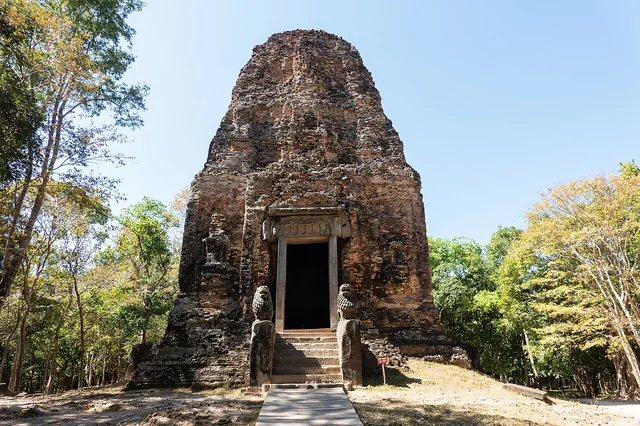
Two corrections follow for a visitor. First, the towers here are not Khmer prasats and should not be described as such. Cham temple towers are usually called kalan, a Cham term widely used in the literature. Second, the name "My Son" is Vietnamese, generally translated as "beautiful mountain", and was given to the valley in later centuries; Cham inscriptions refer to the sanctuary and its god by other names. Using the Cham terms where they are known is a small way of respecting whose place this was.
It is also worth correcting the common assumption that Champa disappeared. The polity ended; the people did not. The Cham language, scripts, religious traditions and temple ceremonies continue today, mainly in south-central Vietnam and in Cambodia. My Son is the oldest and most important ruined sanctuary of a culture that is still alive.
Bhadreshvara: the god at the centre
The oldest written evidence from My Son comes from Sanskrit inscriptions, the earliest attributed to a king named Bhadravarman and usually dated to around the late fourth or fifth century CE. It records the dedication of the valley to Shiva in the form of a linga called Bhadreshvara, a name joining the king's own name with Ishvara, "lord", an epithet of Shiva. The first sanctuary is believed to have been built of wood, which leaves little archaeological trace.
A later inscription records that this wooden temple burned, and that a king named Shambhuvarman rebuilt it in the late sixth or seventh century, re-establishing the god under a name joining his own with Bhadreshvara. From around this period, successive kings added temples in brick, and the valley became the principal royal religious centre of the northern Cham region. It was associated with a Cham capital in the coastal plain to the east, generally identified with the site of Tra Kieu, known in inscriptions as Simhapura, "the lion city". The distance between capital and sanctuary, a day's journey or more up the Thu Bon river valley, separated the political centre from the sacred one. My Son was a place of kings' devotion and ancestral cult, not a city.
The joining of king and god in Bhadreshvara is important. Like their Khmer neighbours, Cham rulers linked their authority to the god, and building or restoring a sanctuary was a way of affirming legitimacy. My Son's long sequence of construction, from roughly the seventh to the thirteenth century, reflects this: rulers returned to the ancestral sanctuary to found new towers, restore old ones and record donations of land, slaves, gold and ritual objects in inscriptions. The inscriptions at My Son are among the most important historical sources for Champa, and many are now held in museums, including the Museum of Cham Sculpture in Da Nang.
The valley's sacred quality was not only in the god installed there. My Son is enclosed by hills, with a mountain to the south that rises above the others, and a stream runs through the sanctuary area. In Indian-derived religious thought, mountains and water are sacred features; the setting itself, rather than any single building, may be the reason the valley was chosen.
The art of brick
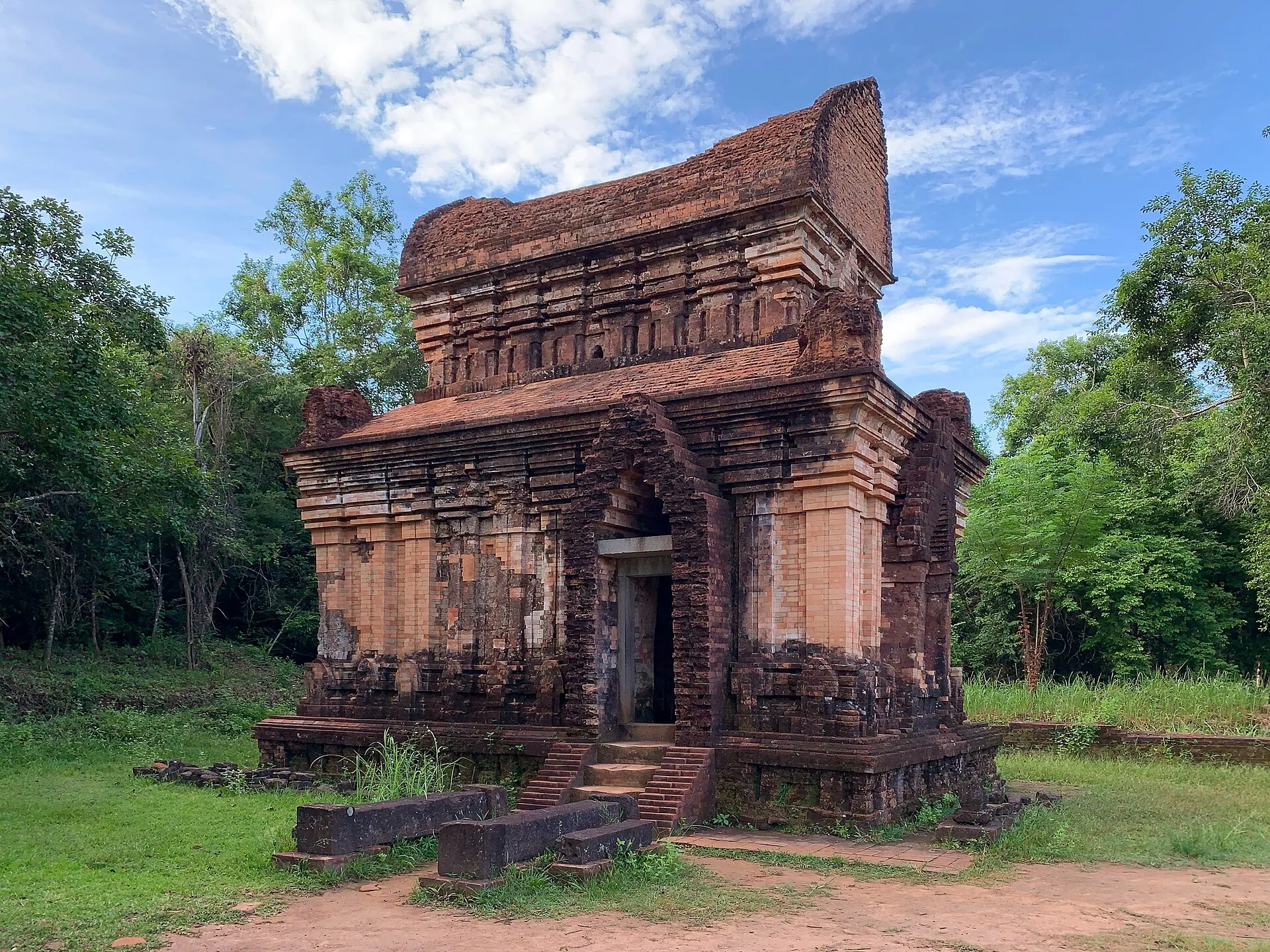
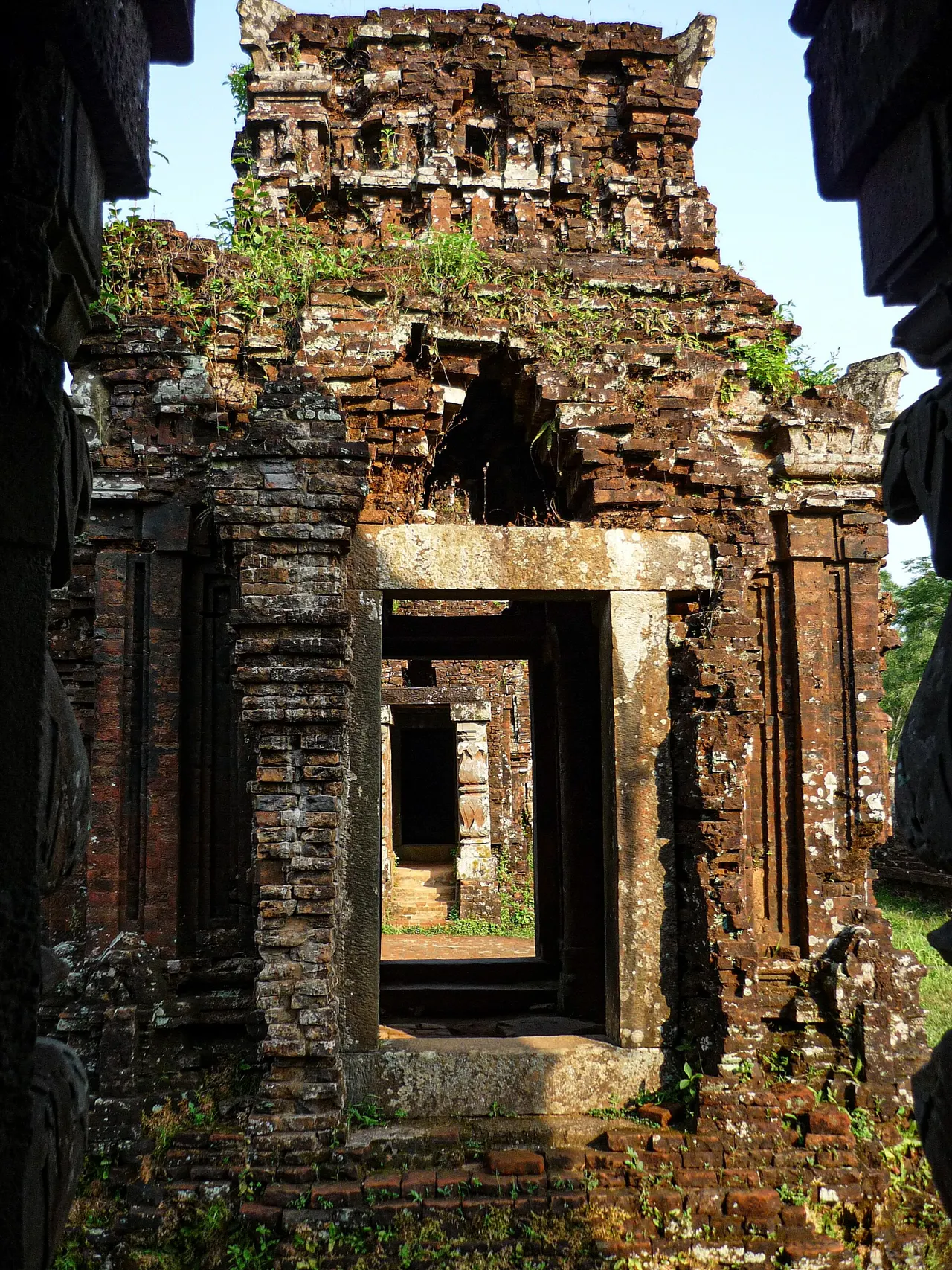
The Cham were extraordinary brick builders. At My Son and other sites, walls are made of fired bricks laid with very fine joints, and much of the decoration, pilasters, false doors, foliage scrolls, flying figures, small niches with deities, was carved directly into the brick after the walls were built, rather than moulded or pre-cut. Sandstone was used for particular elements: door frames, lintels, pedestals, altar pieces and freestanding sculpture.
The fineness of the joints is the detail most guides dwell on, and it is often presented as a lost secret. That framing is more dramatic than useful. Cham walls were built by skilled workshops over many centuries using fired brick, closely fitted courses and very thin bonding layers, and the brick surfaces were dressed and carved after laying. Popular accounts attach many specific recipes to the joints; this guide does not repeat them, because it has not checked the laboratory work behind any particular claim, and practice probably varied between periods and sites. What a visitor can see for certain is the result: courses so tight that, on a well-preserved wall, the eye reads the surface almost as one block, which is what made carving into it possible.
Brick weathers differently from stone. It absorbs water, can be split by roots and damaged by salts carried in moisture, and once a wall's integrity is disturbed it can collapse rapidly. In a wet tropical climate with dense vegetation, that vulnerability meant many towers at My Son had already fallen or been overgrown by the time French researchers documented them around the turn of the twentieth century. It also means that conservation of Cham brick is a specialised discipline: replacement bricks, mortars and protective roofing all have to be compatible with ancient material.
Art historians have defined a sequence of Cham styles, often named after sites where examples were first studied, such as the My Son E1 style and the Dong Duong style. The sequence is used to date buildings and sculpture where inscriptions are missing. Some of the finest sculpture from My Son, including the altar from tower E1 with scenes of ascetics, is displayed in the Da Nang museum rather than on site.
Groups and letters: the map Parmentier made
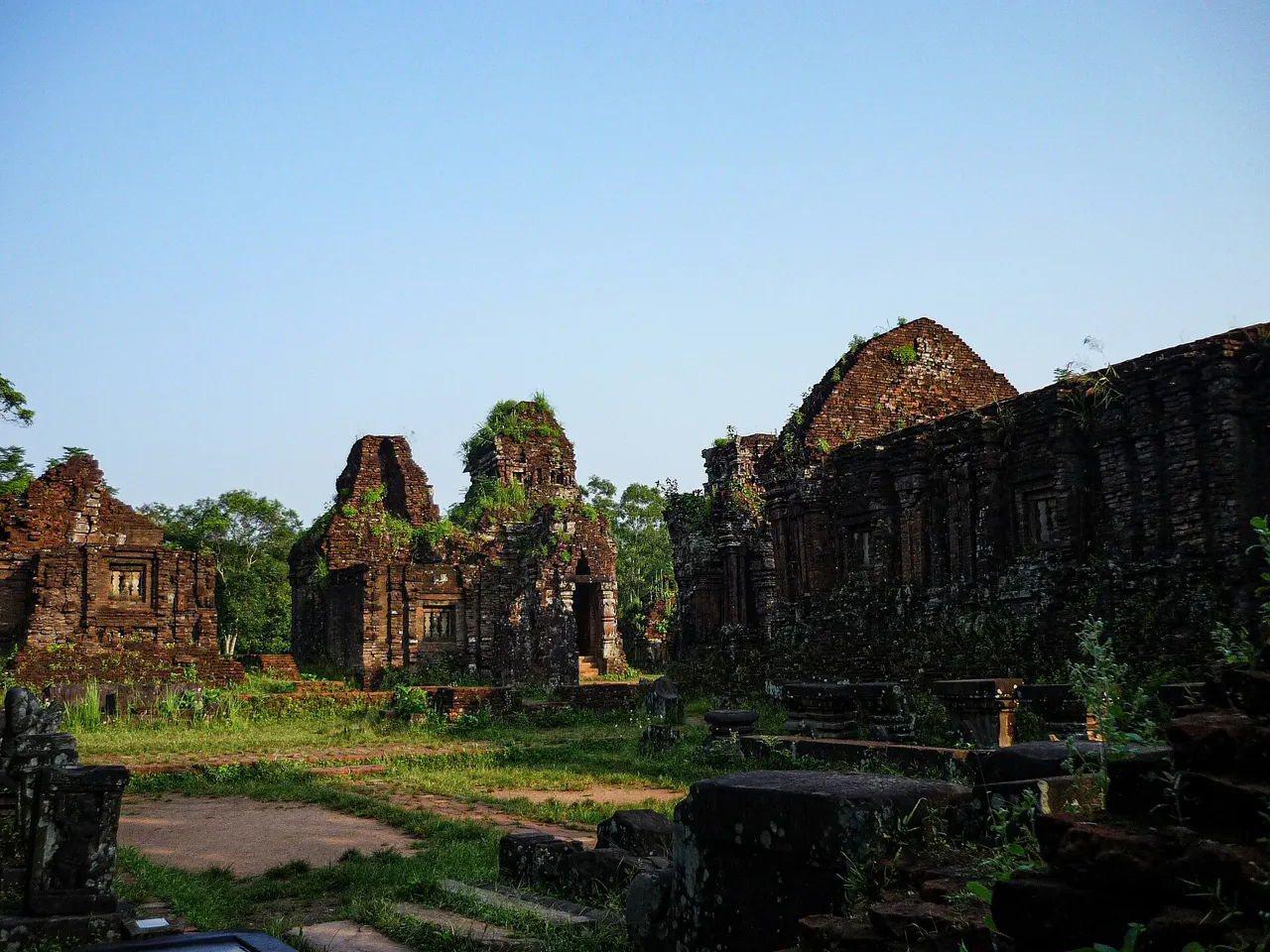
Between the end of the nineteenth century and the early twentieth, scholars of the École française d'Extrême-Orient (EFEO) surveyed the valley. The architect Henri Parmentier recorded the monuments in great detail, dividing them into groups and labelling them with letters, A, B, C, D, E, F, G, H and more, and numbering individual buildings within each group, such as A1, B5 or C1. Those labels are still used on site signs and maps.
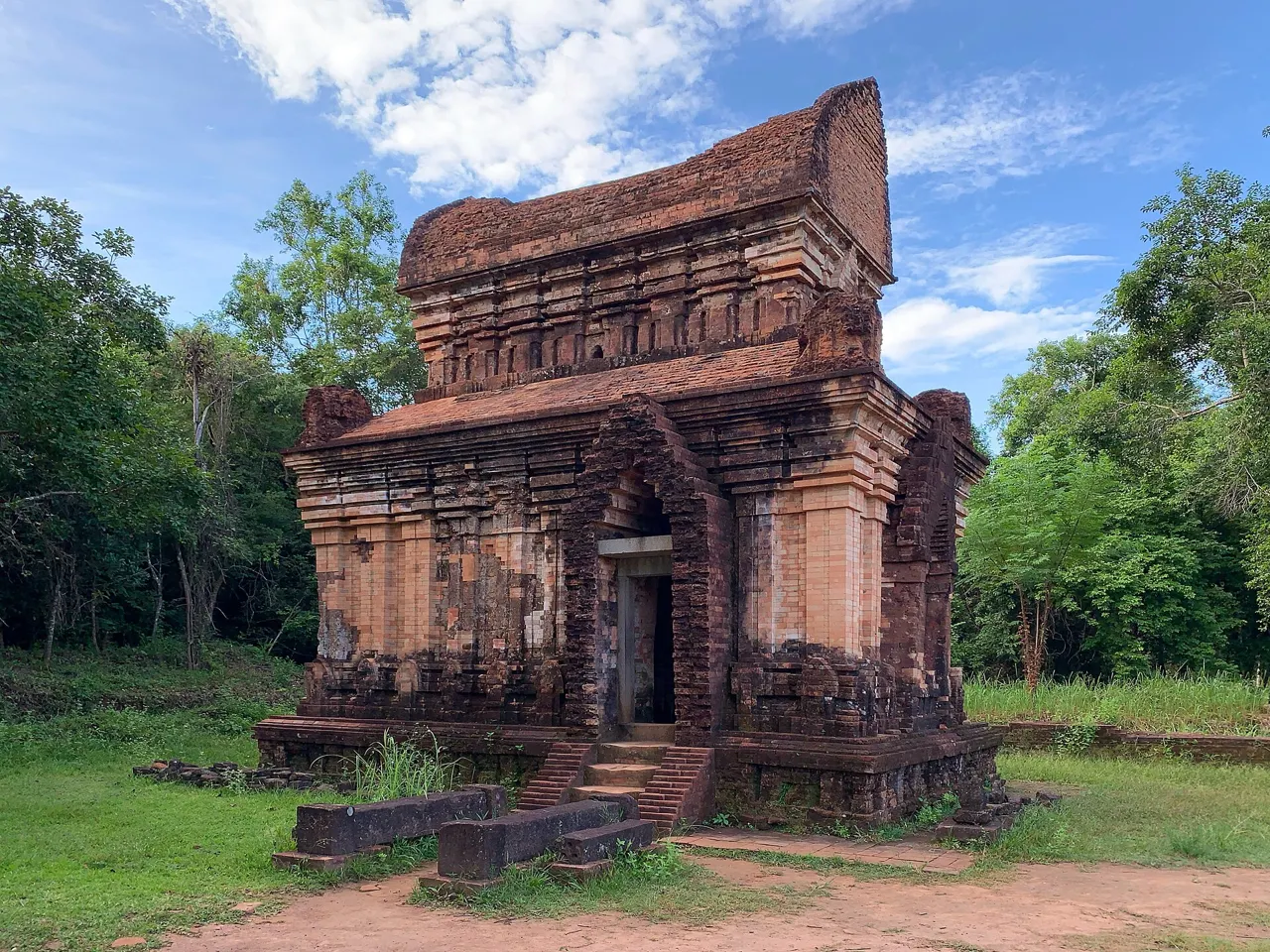
A typical group centres on a main tower, the kalan, which housed the linga or principal image. Around it stand smaller buildings: a gate tower (gopura); a long hall (mandapa) in front of the main tower for ritual gatherings; small shrines for subsidiary deities; and a building often called a repository, sometimes with a distinctive curved, boat-shaped roof, thought to have stored sacred objects or offerings. Enclosure walls frame the group. The arrangement is spatially meaningful: the main tower usually faces east, and visitors approach through gate and hall towards the sanctum.
Parmentier and his colleagues documented around seventy structures across the valley. Their photographs, drawings and plans, held in EFEO archives, are an invaluable record because many of the buildings they recorded no longer stand. The surveys were also part of a colonial project of knowledge, and the removal of sculpture to museums in that period, including what became the Da Nang museum, shaped how Cham art was seen. Both things are true: the survey preserved knowledge that would otherwise have been lost, and it was produced within a colonial framework that decided what counted as heritage.
When you arrive, the groups are not arranged in a single line. Paths link them across the valley floor and low rises. Groups B, C and D, near each other, are often the core of a visit, with the most complete standing structures and a set of display buildings. Group A, once the most spectacular, is reached by a separate path. Groups G and E, F, H and others are scattered. Signage and route availability change with restoration work.
1969: what the war destroyed
During the war in Vietnam, the My Son valley lay in a contested area. In 1969, US bombing destroyed or severely damaged many monuments. The great tower A1, which Parmentier had described as one of the finest achievements of Cham architecture, was reduced to rubble. Other groups were also badly hit. Bomb craters remain visible in parts of the valley. The surrounding hills were also affected by the war, and unexploded ordnance and mines were present in the area.
After the war, Vietnamese authorities, with international support, worked on ordnance clearance and on stabilising what remained. The war's legacy is not entirely over. UNESCO's management text for the property identifies unexploded ordnance as an issue in parts of the buffer area around the sanctuary (UNESCO World Heritage Centre, My Son Sanctuary). The practical rule is simple and has no exceptions: stay on the authorised visitor route and the marked paths. Do not follow a side track to a ruin glimpsed in the trees, do not pick up metal objects, and take warning signs seriously. Forest ruins outside the visitor route are not places for independent exploration, however inviting a photograph of them looks.
The war's effects are now part of the site's history and are acknowledged in its interpretation. A ruined foundation surrounded by heaped brick is not only a sign of loss but also evidence of a specific moment in the twentieth century. Some visitors find it the most affecting part of the visit. Treat it as you would any place of loss: with care, and without making it a backdrop for casual photographs.
It is also worth remembering that the war's effects on people in the region were far greater than its effects on monuments. Many villages around My Son and across the Quảng Nam region were destroyed or their people displaced. The heritage story and the human story overlap here.
Restoration and its debates
Restoration at My Son has involved Vietnamese authorities working with several international partners. From the early 1980s, Polish architect Kazimierz Kwiatkowski worked on Cham monuments in central Vietnam, including My Son, and is commemorated in Hoi An for his role in heritage conservation there. In the 2000s, Italian teams undertook conservation and research projects in the valley. In more recent years, the Archaeological Survey of India has carried out conservation of several groups under an India–Vietnam agreement, with archaeological finds including sculptures and pedestals. UNESCO and other organisations have supported documentation, training and planning.
Restoring brick ruins raises difficult questions. How much should be rebuilt? Should new bricks match the old exactly or be distinguishable? Should a collapsed tower be reconstructed from its own fallen bricks, rebuilt from drawings, or consolidated and left as a ruin? International charters generally favour minimal intervention and clear distinction between old and new, but practice varies. Different projects at My Son have made different choices. Visitors may notice walls where new brick is clearly different in colour or texture, consolidated ruins left incomplete, metal supports, and lightweight roofs over fragile structures to keep rain off.
Some reconstructions in the past were criticised for using incompatible materials or for rebuilding more than the evidence supported. Later work has aimed to correct or avoid this. It is reasonable to look at a wall and ask: is this original, reset original, or new?
Reading brick, sandstone and repair without touching
Most of what is worth seeing at My Son can be read from a step away. The site's fabric is fragile in ways that are not obvious: fired brick that has stood in a humid valley for a thousand years can lose its surface to a hand rubbed across it, and carved detail on a soft face can crumble under a fingertip. The method below uses only eyes and patience.
Read the courses. Stand square to a wall and follow one horizontal row of bricks along its length. On an original, well-preserved stretch, the rows are fine and the joints between them are thin enough that the wall reads as a continuous surface. Then look for the places where that changes: a patch where rows are slightly wavy, where joints are thicker and lighter in colour, or where bricks are more uniform in size and tone. Those are often where collapsed or missing sections have been reset or replaced. You do not need to be certain which is which. The habit of asking is the point.
Read the colour. Old brick at My Son varies in tone from brick to brick, weathered by centuries of rain, sun and biological growth. Newer brick tends to be more even and often brighter. Some conservation projects deliberately make new work distinguishable from old, following the international principle that a repair should be honest about being a repair, so a visible contrast is not necessarily a mistake. A wall that looks too perfect is worth a second look.
Read the stone. Sandstone was used where brick would not do: door frames, thresholds, lintels, pedestals, and some freestanding images. Notice where stone meets brick and how the two materials frame an opening. A threshold marks the crossing from outside into a sanctum, and in a Shaiva temple that crossing mattered. Do not stand, sit or lean on carved stone, including thresholds and pedestals; worn stone loses detail from contact, and some of these objects remain sacred to Cham people today.
Read the carving. Where decoration survives on brick, notice that it is cut into the wall rather than applied to it: pilasters, foliage, small figures in niches, false doors. Low, raking light in the early morning shows relief that disappears under a midday sun. A zoom lens or binoculars help with carving high on a tower, and they let you see detail without leaning in.
Read the damage. Humidity is the slow threat. Look for green and dark staining where water runs or stands, roots and seedlings in joints, white crusts where salts have crystallised on the surface, and flaking where those crusts have pushed the face away. UNESCO's record describes humidity, flooding and vegetation, alongside war damage, as part of the property's conservation story. Lightweight roofs, drainage channels, metal ties and propping are conservation responses to those threats; they are part of what you are looking at, not intrusions on it.
Read the absence. Low mounds of brick, foundations without walls and grassed hollows are evidence too. Parmentier's records show many buildings that no longer stand. A plinth can tell you where a tower stood and which way it faced even when nothing rises above knee height.
None of this requires leaving the path, and none of it requires touching. A good visit leaves no mark on the fabric and takes away a much clearer sense of what is original, what has been repaired and why.
What to notice on the paths
Brick joints. On undamaged original walls, the joints are almost invisible. Compare this with newer brickwork, where joints may be thicker.
Carved brick. Look for decoration carved into brick surfaces: foliage, pilasters, small figures in niches, and false doors. The carving shows that sculptors worked on finished walls.
Sandstone elements. Door frames, pedestals and lintels in sandstone, sometimes with inscriptions, contrast with the warm brick.
Linga and yoni pedestals. Inside or near towers, you may see square stone pedestals with a spout on one side. These are bases for the linga-yoni form of Shiva; the spout drained water poured over the linga in ritual. Do not touch, sit on or climb them.
Orientation. Most main towers face east. Stand at a gate and look through the hall to the tower to see the intended approach.
Bomb craters. Round hollows, now grassed or water-filled.
Restoration traces. Uniform new brick, modern mortar, metal supports and roofs.
The valley. Notice how hills enclose the sanctuary and the stream runs through. The setting is part of the sacred design.
The Cham today
The Cham are one of Vietnam's officially recognised ethnic groups. Most Cham in Vietnam live in the south-central coastal region, around the areas formerly organised as Ninh Thuận and Bình Thuận provinces, which the 2025 reorganisation merged into enlarged Khánh Hòa and Lâm Đồng provinces respectively, and in the Mekong Delta, especially An Giang, itself now enlarged by the merger with Kiên Giang. There are also large Cham communities in Cambodia. Religious life varies. Some Cham follow a tradition often called Balamon (from "Brahman"), rooted in the Hindu practices of Champa; others follow Bani, a localised tradition of Islam; and many, particularly in the Mekong Delta and Cambodia, follow Sunni Islam. These communities have their own priests, calendars and festivals.
My Son is far from the main Cham communities today. The most important Cham temples still in active ritual use, such as Po Klong Garai and Po Rome, are in the south-central region. The Kate festival, the major annual festival of Balamon Cham communities, is celebrated at those temples and in villages, not at My Son. This distance matters: My Son is a heritage site of Cham origin, managed by Vietnamese authorities, but it is not the living ritual heart of Cham religion today.
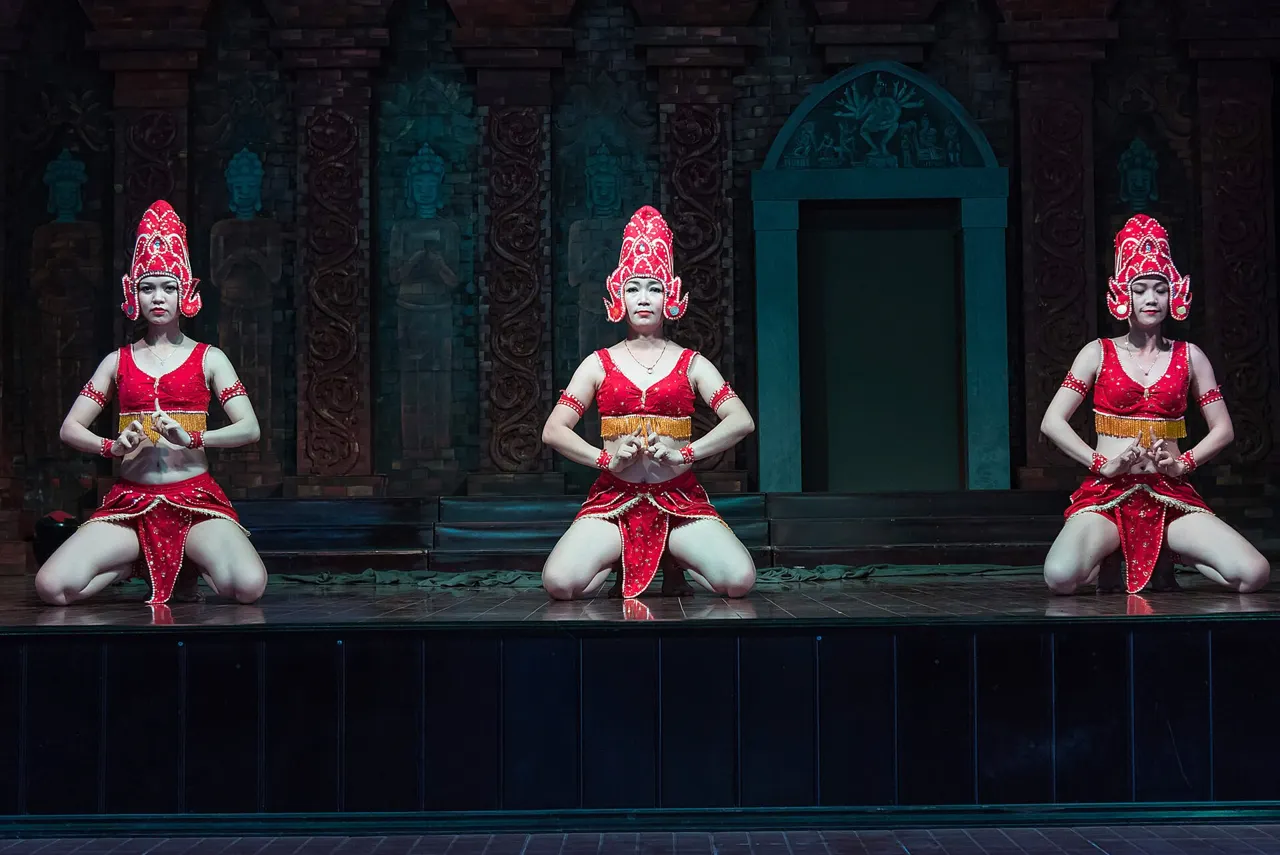
At My Son, visitors may see a staged performance of Cham-inspired dance and music, sometimes at scheduled times near the entrance area. These are cultural performances presented for visitors, not religious ceremonies. Enjoy them as performances, and if you want to learn about Cham religion as practised, look to sources from Cham communities and scholars, and to temples where ceremonies are actually held.
A respectful visitor can do a few simple things. Use "Cham" rather than "Khmer" or vague "ancient" labels. Treat the linga pedestals and altar remains as sacred objects, because to some Cham they still are. If visiting Cham temples in the south, follow the guidance of temple custodians on dress and photography.
Dance on a stage, ritual in the record
Many visitors leave My Son with a strong image of Cham culture drawn from a dance programme near the entrance. That programme is worth watching, but it is worth being clear about what it is, because it is easily mistaken for a window onto the sanctuary's past.
A modern programme is choreographed for an audience. It may draw on dance and music traditions maintained by Cham communities today, on stage conventions developed for heritage performance, and on imagery from Cham sculpture. Who designed the current programme, whether the performers are Cham, and which traditions it draws on were not established for this guide. Those are fair questions to ask a guide or the site staff, and the answers will tell you more than the costumes do.
The evidence for what happened at My Son between roughly the seventh and thirteenth centuries is of a different kind, and most of it is silent about movement. Sanskrit and Cham inscriptions record foundations, the installation of gods, restorations and gifts of land, people and treasure to the sanctuary. Architecture records how space was organised: gates, halls before the sanctum, a main tower housing the linga, pedestals with spouts to drain water poured in worship. Sculpture records how Cham artists imagined deities, ascetics, musicians and dancers, and some of those carvings are now in the Museum of Cham Sculpture in Da Nang. Together, these tell you that the sanctuary was a royal Shaiva centre where kings founded and restored shrines and where offerings were made. They do not give you a choreography.
That gap is the honest place to stand. A carved dancer shows that dance belonged to the imagined world of the gods and perhaps to temple life, but it does not show steps, music, costume colour or who performed. A staged programme can be beautiful and can support performers and Cham cultural continuity; it cannot fill the evidentiary gap, and visitors should not read it as a recreation of a specific medieval rite. Enjoying it as a performance, and reading the inscriptions and carvings as evidence, keeps the two from blurring.
The same distinction applies further afield. The Kate festival and other ceremonies at Cham temples in the south, such as Po Klong Garai, are living religious events held by Cham communities. They are not reconstructions of My Son, and they are not performances for visitors, even when visitors are present. If you go to one, follow the custodians' guidance on dress and photography, and keep in mind that you are a guest at someone else's observance.
When to go: dry heat and flood season
Central Vietnam has a climate distinct from both north and south. Its rainy season comes later in the year, roughly from September to December, often bringing heavy rain, flooding and typhoons. The hottest months are roughly May to August. The cooler and generally more comfortable period is roughly January to April, though early months can bring drizzle.
January to April. Generally the most comfortable for walking. Some rain early in the year; skies clear as spring advances.
May to August. Hot and humid, with high temperatures by midday. The valley is enclosed and can feel airless. Start at opening time.
September to December. Heavy rain, flooding and storms are common across central Vietnam. Roads can flood, and the site may close during severe weather. Paths become muddy. Check forecasts and local announcements, and keep a flexible schedule. Hoi An itself floods in some years.
Location and access
My Son lies inland, roughly forty kilometres south-west of Hoi An and around seventy kilometres from Da Nang by road. Under National Assembly Resolution 202/2025/QH15, adopted on 12 June 2025, Quảng Nam province and Đà Nẵng city were combined into a new city that keeps the name Đà Nẵng (Đại biểu Nhân dân, text of Resolution 202/2025/QH15). Older maps, books and signs still say Quảng Nam, and the name remains useful as a regional and historical label; this guide uses it that way. The boundary change does not alter the road: My Son is no closer to central Da Nang than before, and travel times should not be inferred from the fact that both now sit within one city.
Most visitors come by road from Hoi An or Da Nang, by tour bus, private car, taxi or motorbike. The drive from Hoi An typically takes around an hour, depending on traffic and route. Some tours return by boat along the Thu Bon River for part of the way, which shows the river valley that linked the sanctuary with the coast.
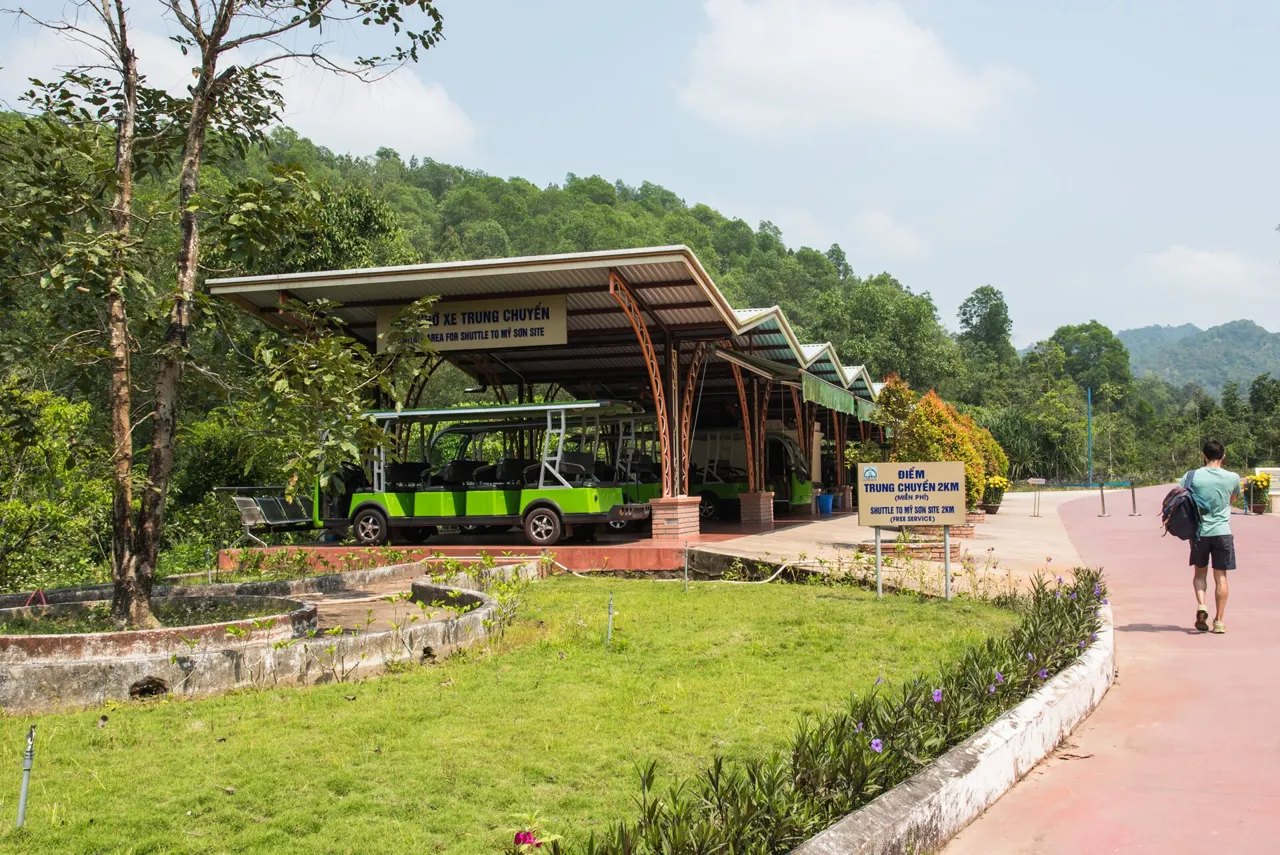
At the site, visitors usually buy tickets at the entrance area, where there is an exhibition building. From there, electric vehicles commonly carry visitors along a road to a drop-off point near the temple groups, followed by walking on paths between groups. Paths are mostly level but include uneven ground, steps and possibly mud. Visitors with limited mobility should ask about the vehicle service and the walking distances.
A map pin shows orientation only. Check current arrangements locally.
Budget: per person, per vehicle
Admission to My Son is charged per person; Vietnamese and foreign visitors may pay different rates. This guide does not state a current price because none could be verified. Enter the rate posted at the site or published by the management board.
- Transport from Hoi An or Da Nang is per seat on a tour bus or per vehicle for a private car.
- Tours may include admission, transport, a guide and sometimes a boat trip or meal. Check what is included.
- Guides may be available at the site.
- Food and drinks are available near the entrance.
Booking: choosing how to go
Tickets for an independent visit are usually bought at the entrance on the day. If you choose a tour from Hoi An or Da Nang, compare:
- Timing. An early departure means cooler walking and fewer people; a sunset tour gives softer light but check closing times.
- Group size. Small groups move more flexibly between temple groups.
- Admission. Is it included?
- Guiding language and depth. Can the guide explain Cham history and the restoration, or only give a general overview?
- Boat return. Some tours return by boat; this adds time but shows the river.
The accommodation link here is an ordinary search, not an affiliate link and not an endorsement.
Packing for an enclosed, humid valley
- Wide-brimmed hat. The valley floor is open in places, and heat builds quickly.
- Light long sleeves and sunscreen. Together, for sun protection.
- Clothing covering shoulders and knees. The site is a sacred place.
- Water. Plenty, especially May to August.
- Shoes with grip. Paths can be muddy and uneven.
- Rain layer September to December. Heavy rain is common.
- Insect repellent. The valley is green and humid.
- Small cash in dong. For admission, drinks and tips.
- Zoom lens or binoculars. For carvings high on walls.
- Dry bag for a boat return. If your tour includes the river.
A slow morning at My Son, and what to do if the weather turns
My Son's labelled groups invite a checklist approach: walk to every letter on the map. In practice that produces a hot, hurried circuit in which every ruin looks the same by the fourth group. A slower route through fewer groups, with time to read the fabric, is usually the better visit.
Early. Arrive at opening time from Hoi An. Spend a few minutes in the exhibition building near the entrance to see the plan of the groups and any current notices about which paths are open.
First hour. Take the vehicle to the temple area and walk to groups B, C and D, which usually hold the most complete standing structures. Choose one group and give it real time: read the courses on one wall, find a sandstone threshold, look for carved brick in raking light, and compare original and repaired work. Then move to the next.
Second hour. If paths are open and the heat allows, walk to Group A, where the ruins of the great tower A1 carry the history of 1969. Treat it as a place of loss rather than a backdrop. Further groups are optional; leaving them out is a reasonable choice, not a missed opportunity.
Late morning. Return to the entrance before the worst heat. If a performance is scheduled, watch it as a performance.
Afternoon. Visit the Museum of Cham Sculpture in Da Nang, where many of My Son's finest sculptures and inscriptions are displayed. Seeing the carved pedestals and images that once stood in the valley completes the morning's reading of empty sanctums.
Heat alternative. From roughly May to August, shorten the walk to one cluster, carry more water than seems necessary, and use shaded rest points. If you feel unwell, stop and return; the towers are not going anywhere.
Rain alternative. From roughly September to December, check before leaving whether the site is open and whether roads are affected. If heavy rain or flood warnings are in force, do not drive into the valley; spend the morning at the Da Nang museum instead and keep My Son for another day. If you do go in light rain, expect mud, slippery steps and more limited views, and accept that some paths may be closed.
A second visit. If you have time, a second, shorter visit at a different hour shows the brick in different light and lets you see a group you skipped without exhausting yourself on the first day.
The broader Cambodian comparison continues at Angkor Wat, where the materials, patronage and later religious use form a different history.
Reading before and after
The UNESCO World Heritage Centre's page and documents for My Son Sanctuary are the best free starting point. For deeper reading, Champa and the Archaeology of Mỹ Sơn (Vietnam), edited by Andrew Hardy, Mauro Cucarzi and Patrizia Zolese, collects research on the site, including from the Italian projects. Emmanuel Guillon's Cham Art is an illustrated introduction to Cham sculpture, much of it in the Da Nang museum. Recommendations are based on publisher descriptions.
For a comparison with another brick sanctuary from a different civilisation, see Sambor Prei Kuk, the Khmer brick temples before Angkor. The comparison is useful precisely because the traditions are different. Koh Ker is another site where war ordnance shaped heritage management.
Questions that come up
Is My Son Khmer? No. It is Cham, built by Champa, a separate civilisation.
Is it the "Angkor of Vietnam"? The comparison is common in promotion but misleading. It is a Cham sanctuary with its own history.
Is it safe from unexploded ordnance? Visitors use an authorised, maintained route. UNESCO notes ordnance issues in parts of the buffer area, so stay on the marked paths and never explore the forest ruins independently.
Are Cham ceremonies held at My Son? Staged performances are held for visitors; major Cham religious festivals take place at temples further south.
How long do I need? Two to three hours on site, plus travel.
The brick and the crater again
A fine brick joint and a bomb crater are both things the Cham did not intend to leave for us. One is the trace of a workshop skill refined enough that the wall could be carved like a single surface. The other is the trace of a war in which the valley was a battlefield. Between them lies the story of a sanctuary built by kings for Shiva, extended over six centuries, absorbed into another state's territory, surveyed by colonial scholars, broken in war and patiently repaired. To visit My Son well is to see all of that in one valley, and to remember that the people who built it still have descendants who speak its language.
Sources and confirmation routes
The first draft of this guide was written without live web access. Sources below were checked on 17 October 2026 during correction, by the site's director or by this writer as noted; other claims are from prior research and are marked where uncertain.
- UNESCO World Heritage Centre — My Son Sanctuary: Cham sanctuary developed over centuries; fired brick with sandstone; war damage, humidity and flooding; unexploded-ordnance issues in buffer areas (director's check; the page returned an access error to this writer).
- Đại biểu Nhân dân — text of National Assembly Resolution 202/2025/QH15: Quảng Nam and Đà Nẵng combined as Đà Nẵng city; Ninh Thuận into Khánh Hòa; Bình Thuận into Lâm Đồng; Kiên Giang into An Giang.
- Not verified for this correction: admission price and hours, performance schedule, which groups are open, inscription dates, restoration-project details, road distances. Confirm with the My Son management board and the Museum of Cham Sculpture, Da Nang.
Photograph credits
- My Son Documentary 1 · Chainwit. · 2024-08-02 07:00:47 · CC BY 4.0. Resized and converted to WebP; the hero may be cropped by the layout. These adaptations remain available under their respective licences.
- My Son Documentary 2 · Philip Nalangan · 2009-04-23 · CC BY 4.0. Resized and converted to WebP; the hero may be cropped by the layout. These adaptations remain available under their respective licences.
- My Son Documentary 3 · Philip Nalangan · 2009-04-23 · CC BY 4.0. Resized and converted to WebP; the hero may be cropped by the layout. These adaptations remain available under their respective licences.
- My Son Documentary 4 · Sznyr · 2019-03-04 14:19:13 · CC BY-SA 4.0. Resized and converted to WebP; the hero may be cropped by the layout. These adaptations remain available under their respective licences.
- My Son Documentary 5 · Sznyr · 2019-03-04 12:47:23 · CC BY-SA 4.0. Resized and converted to WebP; the hero may be cropped by the layout. These adaptations remain available under their respective licences.
Packing graphics: AI-generated editorial illustrations. Portrait supplied by Sok Heng Oeun.
A closer look.
The place, its details and its setting in dated photographs. Historical views do not establish today’s access or visitor conditions.

Sok Heng Oeun
Sok Heng Oeun is the owner and editor of Hidden Corners. The Hidden Corners Editorial Team supports image preparation and editorial checks under his direction.
Sok Heng Oeun on Facebook ↗AI-assisted preparation · Editorial review by Sok Heng Oeun, 19 October 2026. This article does not claim a firsthand team visit.