
A working monastery, through the day and year
Wat Phra Mahathat Woramahawihan in Nakhon Si Thammarat is a working monastery, not a closed monument. Its public heritage dossier describes continuing religious traditions, but we found no site-specific daily timetable. The morning-to-afternoon sequence in this guide follows spaces and practices; it is not a promise that a ceremony happens at a particular hour. On 25 July 2026 the World Heritage Committee, meeting in Busan, inscribed it.
That makes it Thailand's ninth World Heritage property, its sixth cultural one and the first in the south. The comparison is with the ruined Wat Mahathat temples at Ayutthaya and Sukhothai: here the monastery continues its daily worship. That does not mean religious activity has disappeared from those wider historic towns or parks. The Committee listed the monastery under criterion (ii), for the exchange of influences its architecture records, and criterion (vi), for its association with living traditions — the Nora dance drama and the local chronicles are named in the decision — and the second criterion rests on traditions that continue there.
This guide follows the site as a visitor might over a day, then its annual observances, festival by festival. The sequence connects its spaces with the practices described in the heritage record. Only at the end does it turn to the listing, the newest thing here and, so far, the least consequential.
It is written from a desk. Nobody from Hidden Corners has been to Nakhon Si Thammarat; what follows comes from the nomination dossier and the Committee's decision, Thai academic and press sources, and published history, checked in September 2026. Where the published figures disagree — and on the size of the chedi and the weight of its gold they disagree a great deal — the disagreement is reported rather than settled.
The first hours: chanting, alms and merit
Everything a visitor sees later in the day rests on an exchange that happens before most visitors are awake. The standard account of a Thai monk's day, as BuddhaNet sets it out, runs roughly like this: rise at four, meditate, chant; walk the alms round at six; return around eight to eat together and give a blessing; take a light meal before noon, which is the last solid food until the next morning; study in the afternoon; meditate and chant again in the early evening. Use that general account to understand the relationship between the monastery and the town. Confirm local arrangements if you hope to observe an alms round.
The lay side of that exchange is merit-making — tham bun — and at a relic temple it has more outlets than at an ordinary one. Food goes to the monks. Flowers, incense, candles and small squares of gold leaf are bought at the temple and offered at the images and the reliquary. None of this is priced as admission, and none of it is a ticket. It is the economy that has maintained the building for centuries, and it is worth understanding before you see the gold on the spire, because the gold is its accumulated result.
The early hours are the monastery's hours, not the visitor's. What goes on inside at that time is worship, and this guide's photography advice — follow posted rules, ask before photographing people and leave worship undisturbed — matters most then.
The etiquette around monks is specific. BuddhaNet's account records the rule that a woman offering an object to a monk passes it through a third medium, such as a cloth, rather than hand to hand. More generally: do not stand over monks who are seated, do not point your feet at them or at images, and let them pass first in a narrow space.
It is the difference between visiting a monument and visiting a household that owns one. The Committee's decision describes the property as protected under two laws at once: the Act on Ancient Monuments, which governs the fabric, and the Sangha Act, which governs the monastic community. Management runs through the province, the Fine Arts Department and the Sangha Supreme Council together. At a ruin the Sangha would have nothing to do.
The launch programme for the post-inscription tourism campaign included alms-giving ceremonies. Nothing in the sources suggests the daily alms round has been arranged for visitors.
The relic on the sand ridge
By mid-morning the obvious question is: why here? The monastery's answer is a story; the dossier's is geology. They agree.
The story is the founding legend, recorded in the local chronicles. Two royal siblings, Princess Hemachala and Prince Thanakuman, carried a tooth relic of the Buddha away from danger by sea and buried it on a beach — Hat Sai Kaew, the "beach of crystal sand". The chronicle, as the nomination quotes it, has an arahant prophesy that "on this beach surrounded by the sea there will in the future be a ruler named Phraya Si Thammasokkaracha who will found a great city and erect a great reliquary." Thai PBS, summarising the tradition, dates the burial to B.E. 854, which is the early fourth century CE. It is a claim about sanctity, not stratigraphy.
The geology is plainer. The nomination describes the city as sitting on an ancient beach ridge, roughly two to five metres high and one to five kilometres wide — a long raised line of old shoreline, higher and drier than the low coast around it. The temple precinct is a rectangle about 130 metres wide and 400 long on top of it. A "beach of crystal sand" is a fair description of a sand ridge, and the name survives on site: the Lan Sai Kaew, the sand courtyard, is one of the open spaces the TAT campaign singled out for its opening events.
What the Committee's decision adds is the layer underneath. It describes Wat Phra Mahathat as a Theravada monastery founded in the eighth century on a site previously occupied by a Hindu shrine, and one of its eight recommendations asks Thailand to design a research plan to study that underlying Hindu site. A Brahmanical sanctuary, a Buddhist foundation, a Sri Lankan-style reliquary, in one spot and never abandoned: that is what criterion (ii) means by the influence of Brahmanism, Hinduism and both Mahayana and Theravada Buddhism.
Much of the physical evidence for the early phases is dated by thermoluminescence, a laboratory method that estimates when fired brick or clay was last heated. The results overturn the assumption that a working temple is a young one. Brick from the Pho Langka vihara returns ranges running from the early eighth to the tenth century. The Thap Kaset — the gallery that runs round the base of the great chedi — is placed in the late eighth to early tenth. Some of the oldest fabric is in the parts people walk through every day.
None of that dates the relic, and nothing can. The belief that a tooth of the Buddha lies under the chedi is a belief, and it is reported here as one. It is also the reason for everything else. A relic makes a place somewhere pilgrims must come; pilgrims make it worth a ruler's patronage; patronage turns a small shrine into a great one. The rest of the morning is spent walking round the result.
Clockwise, three times, round the Great Reliquary
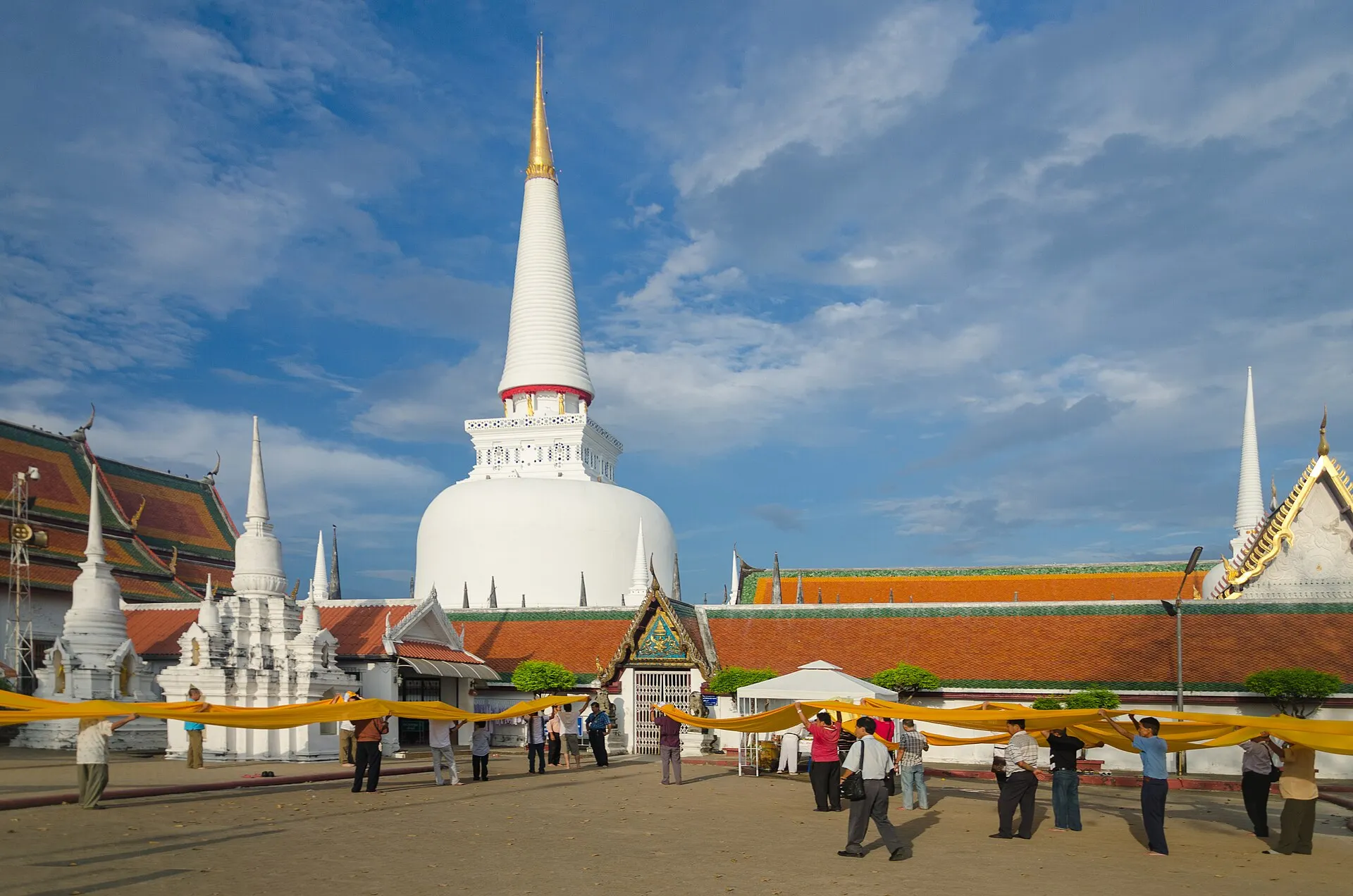
The central act at any relic stupa is circumambulation: walking round it clockwise, keeping it on your right. The festival procession, as the Sirindhorn Anthropology Centre describes it, goes round three times. At Wat Phra Mahathat the route is built in. The Thap Kaset gallery encloses the base of the Phra Borommathat Chedi.
What you are walking round is, first of all, a shape with an argument in it. The bell-shaped dome on a square base, rising through a throne-like platform to a ringed spire, is the Sri Lankan stupa form, not the Khmer tower and not the Javanese terraced mountain. The standard history places its present form in the early thirteenth century under a ruler remembered as Si Thammasokarat — the name the prophecy was waiting for — and connects the city from the late thirteenth century with the spread of Sri Lankan Theravada into Sukhothai and beyond. The Committee's decision says its style had "a profound influence on subsequent religious buildings in Thailand, Malaysia and beyond".
The measurements are where the published sources part company. English-language references commonly give the chedi as about 78 metres tall, with the bell recorded in the traditional Thai unit as 28 wa high by 14 wide. The nomination dossier gives its dimensions component by component instead: a square base 29.2 metres on each side and 5 metres high; a circular base 3.1 metres high and 21.98 metres across; a dome 9.8 metres high; a square platform 5.3 metres high; a spire 20.7 metres high; and a gold-covered finial 12.09 metres high. Those components add up to about 56 metres. Thai press coverage at the inscription, in MGR Online, gives the height as 55.78 metres. The dossier's figures do not support 78, and we did not find the 28-by-14 wa figure in the documents we could read. This guide uses the dossier's figures.
The gold is the same story in a different metal. The spire is widely reported, in English sources and some Thai guides, as carrying around 600 kilograms of gold leaf. The nomination says the finial is decorated "with real gold sheets and jewels" and that "the total real gold sheets currently weigh 197.45 kilograms". A Thai PBS feature from January 2025 gives a third figure, about 142 kilograms. The dossier's figure is the most authoritative, and less than a third of the popular one.
What the dossier adds, and the popular figure hides, is a record of how the gold got there. It lists years in which the finial was embellished with gold and jewellery during the Ayutthaya period — 1612, 1649, 1670, 1686, 1687, 1688, 1692, 1699 and 1734 — and says donations continued through the Thonburi and Bangkok periods into the present. It shows the finish on the spire as a series of dated acts of devotion, three in consecutive years, rather than one spectacular object.
The spire carries 52 rings, a figure the Thai sources agree on. Sculpted elephants surround the base; Thai PBS counts 22. The dossier describes 120 smaller satellite stupas standing round the base in three square layers. Older English references give 158 minor chedis and describe them as holding the remains of devotees; that count, like the height, does not match the dossier, and we could not confirm what the smaller stupas contain. Treat them with the care due to a shrine or a grave.
The one part of the reliquary most visitors do not reach is the upper terrace. The route up, for the festival cloth at least, runs through the Wihan Phra Song Ma, which the dossier dates to the late Ayutthaya period, between 1688 and 1767. According to the Sirindhorn Anthropology Centre's database of Thai rituals, not everybody is allowed up, because the area above is believed to be where the relics are enshrined.
Midday in the Wihan Luang and the galleries
By late morning the monastic day turns inward. On the standard routine, monks take the last meal of the day before noon. For a visitor, the halls of the complex are the obvious place to be: out of the sun, and full of the building history the courtyard hides.
The largest of them is the Wihan Luang, the great assembly hall. Older English references put it in the fifteenth or sixteenth century. The dossier's thermoluminescence dates for its walls fall in the fifteenth century, with ranges of 1409–1416, 1424–1474 and 1433–1483, which fits the lower end of that range. It is still where monks and lay people meet for sermons and ceremonies, fullest on holy days.
The Wihan Luang is one of a family of halls, and the dossier's dating makes them a timeline in brick:
- Pho Langka vihara — ranges from the early eighth to the tenth century, the oldest of the dated halls. Its name recalls Lanka, and the Committee specifically asks for a structural analysis of it and restoration of its statues.
- Wihan Kien — thirteenth century, from ranges of 1193–1270. Now the core of the museum, and the subject of the afternoon.
- Phra Dan vihara — fourteenth to early fifteenth century.
- Thamma Sala vihara — fifteenth century, ranges of 1422–1478. The name means, roughly, hall of the dharma.
- Wihan Luang — fifteenth-century walls.
- Wihan Phra Song Ma — the stairway hall, late Ayutthaya, 1688–1767.
Read as a list, those dates dismantle the idea of an "original" temple under later additions. The complex has been rebuilt in pieces for over a thousand years, each hall renewed while the others stayed in use — the condition that makes conservation here harder than at a ruin. The Committee's recommendations ask for analysis of the structural systems of the circumambulatory paths and the Thap Kaset roof supports, and for a long-term conservation strategy for the religious buildings — the working rooms, not only the monument.
The nomination describes a further practice tied to these halls: the chanting of the local chronicles on special religious days. It is one of the reasons criterion (vi) names the chronicles alongside Nora. A chronicle here is not a document in a vitrine but a text recited in the place it describes.
For the visitor the practical point is modest: a hall in use is not a hall to walk into. If a sermon or ceremony is under way, the chedi gallery and the courtyards remain; come back to the hall later.
Afternoon in the Wihan Kien: a museum made of offerings
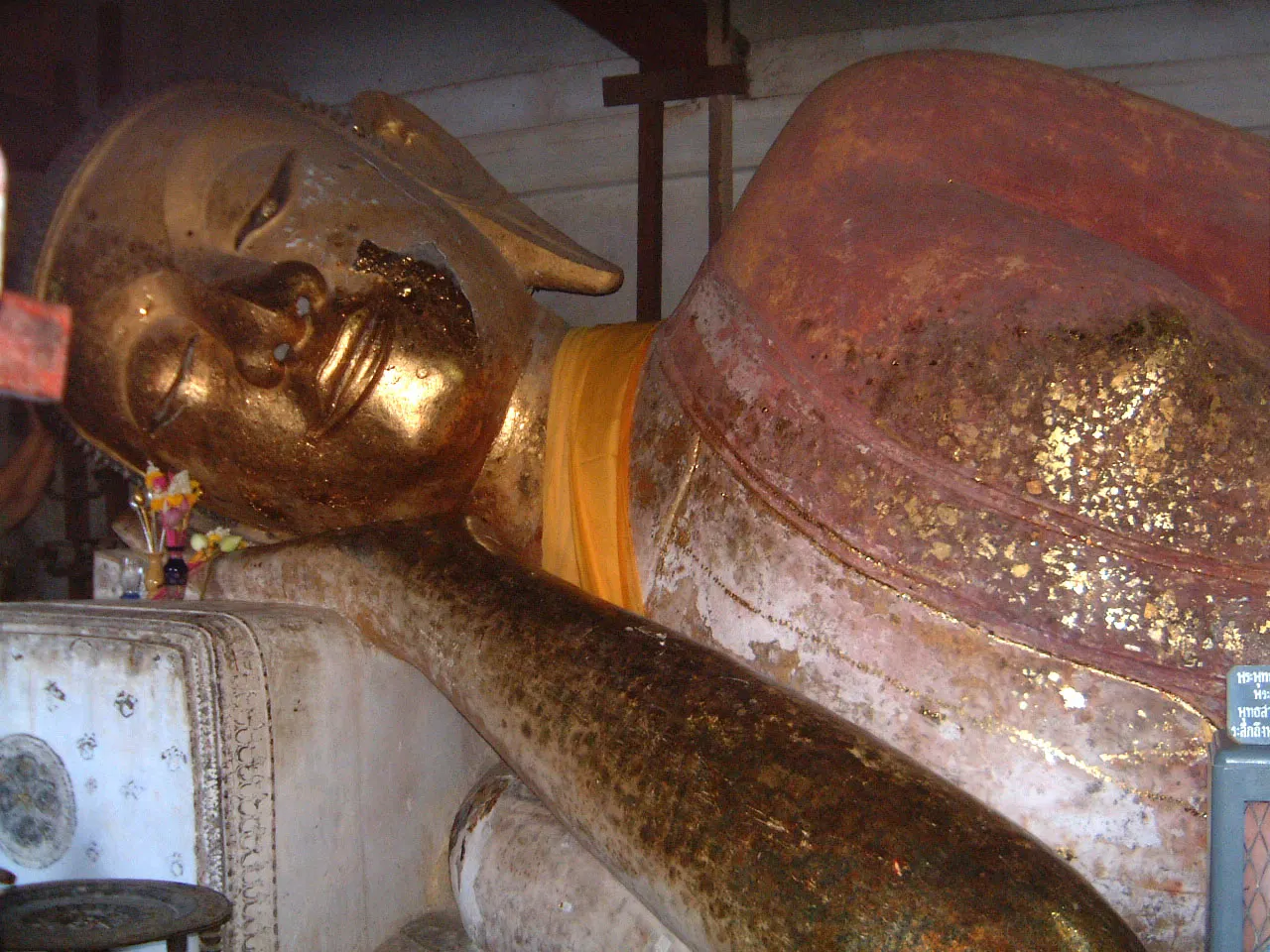
The afternoon is for the museum, the most direct evidence of how the monastery has been kept going. It occupies the Wihan Kien and neighbouring halls, including the Pho Langka vihara. The nomination dossier describes it as safeguarding 32,656 artefacts and artworks, "most of them offerings from laypeople", with 84 registered as national treasures. A national museum collects from excavations and purchases. This one is made of donations, kept by the institution they were given to. It is the lay side of the morning's merit-making, preserved.
The same dossier states that the museum is open to the public free of charge. Newly listed sites sometimes introduce charges, so treat that as the documented position, not a guarantee.
Hours are the other thing to check. Travelfish, in a profile written before the inscription, gives the museum as roughly 08:30 to 16:00, with the wider complex closing shortly after. A Thai visitor guide reviewed in July 2026 gives daily hours of 08:30 to 16:30. We found no official post-inscription timetable. The safe reading is to arrive by early afternoon and not to count on anything after four.
The Committee's recommendations reach the museum too. They ask Thailand to continue digitising the buildings, archives and collections, and ICOMOS's interim report asked for a consolidated, indexed inventory of the property's attributes. Cataloguing more than thirty thousand devotional gifts is a large undertaking for a monastery museum.
Separately, the Fine Arts Department opened a permanent exhibition on the World Heritage property at the time of the inscription. Khaosod English's report of it does not say where it is housed, what it costs or when it is open, and we could not establish those details. Ask locally rather than assuming it is inside the temple.
Closing time on Ratchadamnoen Road
Published visitor guides differ on late-afternoon closing time, and we found no official post-inscription schedule. Check current access before travelling; evening chanting is a monastic practice, not a guaranteed visitor event. The visitor's day ends outside, on Ratchadamnoen Road, the old city's long north–south axis.
Nakhon Si Thammarat is usually treated as a provincial capital with a famous temple. Its historical importance extends beyond that modern description. The region is associated with Tambralinga, but identifying medieval place-names in overseas accounts requires care; they should not simply be treated as interchangeable names for one kingdom. The clearer connection for a visitor is the monastery’s place in maritime exchange. UNESCO’s account describes religious and architectural influences arriving through transoceanic networks, including traditions from India, Java, Sri Lanka and the Mon region of southern Myanmar. Look at the combination of forms and continuing practices, rather than expecting a single origin to explain the whole complex.
The Ramkhamhaeng stele of 1283 lists the city as Sukhothai's southernmost tributary, though the relationship seems to have been personal rather than institutional. Later chronicles make it the head of twelve naksat cities stretching down the peninsula as far as Kelantan and Kedah — a scheme for which, the historians note, there is no evidence of actual control. By the sixteenth century European sources list it as tributary to Ayutthaya, and under King Naresuan it became a first-class province, governed by a local dynasty that behaved in practice like a hereditary one.
That last detail connects directly to the temple. The Sirindhorn Anthropology Centre records that the Phraya Nakhon — the city's governors — and their heirs led the annual cloth offering to the relic, with devotees carrying food and requisites for the monks, and that the tradition carried on through the change from absolute to constitutional monarchy in 1932. The governors went; the offering stayed. The kingdom became a province; the relic temple went on being a relic temple.
The nomination's own boundary expresses the relationship in planning terms. The inscribed property is 5.356 hectares. The buffer zone around it is 113.136 hectares, more than twenty times larger, and Thailand has begun revising the city's general town plan to extend it further, with building-height controls within a kilometre of the Great Reliquary. ICOMOS asked specifically for the view lines to the chedi to be protected. The plan's purpose is a skyline in which one structure stays the tallest thing in sight.
The modern city carries its own living traditions that sit beside the temple's — shadow puppetry, nielloware, a strong local food culture — and almost none of it has been written up for foreign visitors. That is the gap the tourism campaign intends to close.
Magha Puja and the cloth that came ashore
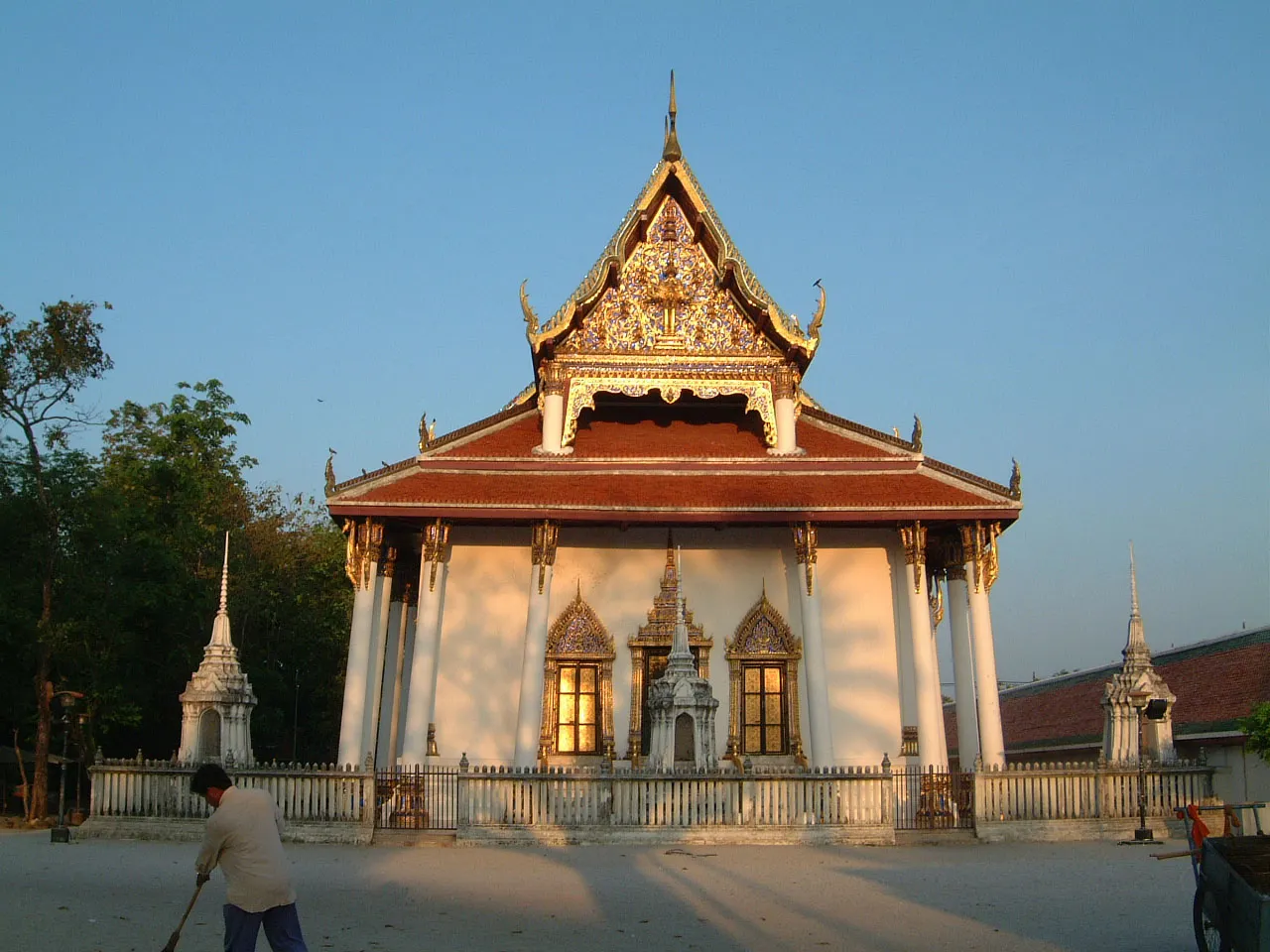
A day at the monastery repeats. A year does not, and the year begins, for most visitors' purposes, at the full moon of the third lunar month — Magha Puja, usually in February, sometimes in March when the lunar calendar inserts an extra month. That is when Nakhon Si Thammarat carries a cloth to the relic.
The festival is Hae Pha Khuen That, "carrying the cloth up to the reliquary". Its origin story is told in more than one version. In the one given by the Thai history magazine Silpa Wattanatham, a group of Buddhist devotees from Hongsawadi — Pegu, in Lower Burma — were sailing to Sri Lanka to offer a long painted cloth, a phra bot showing the life of the Buddha, to the Tooth Relic there. Their ship foundered; of roughly a hundred people aboard, about ten survived. The cloth washed ashore at Pak Phanang, on the province's coast. The survivors brought it to the king, who had it offered to the local relic instead, and the procession began. A second version, from the Encyclopedia of Southern Thai Culture as Silpa reports it, makes the devotees come from Inthapat, in the Khmer lands, rather than from Pegu.
The details differ; the shape agrees, as Silpa notes. A cloth meant for the Tooth Relic in Lanka ended up on a relic stupa built in the Lankan style, on a peninsula that received its Buddhism by the same sea route the cloth was travelling. It is almost too apt, and should be read as a story. The Sirindhorn Anthropology Centre's English entry is blunt about the history: "There is no evidence as to when this time-honored religious tradition was originated."
The practice itself is well documented. According to the Centre, the cloth is sewn together from many pieces until it is long enough to be draped round the base of the chedi. Participants carry it above their heads, because it is sacred, forming a line as long as the cloth, and walk three times clockwise round the stupa. Then representatives go up through the Wihan Phra Song Ma with temple officers to drape it; the crowd does not. Red, white and yellow are the favoured colours. The finest cloths carry hand-drawn or printed scenes from the Buddha's life, especially the Vessantara story, though the Centre notes that most people now prefer a plain length.
The ritual has a documented royal history too. Silpa quotes King Chulalongkorn's diary from his southern tour of 1905: wanting to wrap the chedi, his party could find no red cloth, because the whole town had bought it for welcome banners, and so they used pink.
The nomination makes a larger claim for it. The dossier describes the annual cloth-wrapping as "a remnant of the ancient influence from Sri Lanka" that "has surpassed that of Sri Lanka in terms of scale". It is the clearest reason the monastery could be inscribed under criterion (vi): the living tradition is not an idea about the past but a city carrying a cloth.
It is also the moment the monastery is most crowded. ICOMOS's interim report of December 2025 observed that during the festival period "the number of visitors appears to exceed" the site's established carrying capacity, and asked what specific measures were planned. For a visitor, the festival is the most remarkable time to be here and the hardest to be here well. Go as an observer at the edges; the cloth needs carriers who belong to it more than it needs photographs.
Visakha Puja, the older date
The February procession is the famous one, but it is not the original date. The Sirindhorn Anthropology Centre records that under King Rama II, in the early nineteenth century, the cloth ceremony was performed on Visakha Puja, the full moon of the sixth lunar month, usually in May. In the reign of Rama IV it was observed once more each year, on Magha Puja, so that devotees living further away could take part. Both dates remain in use, and Silpa Wattanatham gives the same pair.
That double date is a small piece of evidence about how the monastery's year works. Its calendar is not fixed by the building but negotiated by the people who use it — adjusted, in this case, to widen access for the province's more distant villages. The second festival was added for the congregation, not for visitors.
By May the dry months are ending. This coast's heavy rain does not come until late in the year, though, so through the middle months it stays less affected than the Andaman side, which is why Nakhon Si Thammarat works as a mid-year stop for travellers already in the south.
For a visitor, Visakha Puja means the same thing as Magha Puja at a smaller scale: large numbers of Thai worshippers, a monastery in full ceremonial use, and every reason to be unobtrusive. The Centre notes that devotees can offer a cloth on any day; most choose the holy days. The festival is the collective form of something people also do alone.
The rains retreat and the tenth month
In July the monastic year turns inward. The day after the full moon of Asalha, the rains retreat — vassa, or phansa in Thai — begins: roughly three lunar months, running usually from July into October, during which monks remain in one monastery rather than travelling. It ends with the ceremony of Pavarana and is followed by Kathina, when lay people offer new robes. The custom predates Buddhism, in the ascetic practice of not travelling during the rains.
The listing arrived in the season when the retreat begins: the campaign to bring people in started at the point in the year when the monks themselves stop moving.
The biggest civic event of the monastery's year falls inside the retreat. Sat Duean Sip, the festival of the tenth lunar month, usually in September or October, is when families make merit on behalf of their dead and of the pret, the hungry ghosts believed to be released at this time. Its visible centrepiece is the procession of mrap — elaborate trays of offerings, desserts, flowers and candles — carried through the city, with Wat Phra Mahathat as the religious destination and the fairground, city hall and parks as the other venues.
This is the festival for which the only published visitor figure for the monastery exists. In the supplementary information Thailand sent ICOMOS, the State Party reported that the site received about 60,000 visitors over the 2025 Sat Duean Sip, held from 12 to 26 September, and also gave a roughly 3,000-a-day average. Those figures do not reconcile over the stated 15-day period, so neither yields a dependable daily attendance rate. The same document describes how the monastery managed it: a designated entry through the Yaowarat Gate and exit through a separate gate; a main car park for 80 cars and six buses, with overflow at three neighbouring temples; 77 toilets kept clean through the period; staff and trained volunteers posted to manage the flow; and ten numbered points marking the route.
The numbers are the State Party's, and the crowds they count are the province's own families, not tourists.
Nora, the southern Thai dance drama, is the other living tradition the Committee named — alongside the chronicles — in calling the monastery "the heart of living religious traditions", and the nomination notes its separate recognition by UNESCO as intangible heritage. The opening celebrations for the listing, according to The Nation, included Nora and khon performances alongside chanting, meditation and ordinations. We found no regular public performance schedule at the temple.
October to February: the monsoon, then the dry months
When the rains retreat ends, this coast does the opposite of what most visitors to Thailand expect. Nakhon Si Thammarat sits on the Gulf of Thailand side of the peninsula, and its heavy rain comes with the north-east monsoon, roughly October to December — the months when Bangkok and the Andaman coast are drying out. On 20 November 2025 the Thai Meteorological Department's twelfth warning of the season named Nakhon Si Thammarat among the east-coast provinces facing "heavy to very heavy rain" over most of their area under "a strong northeasterly monsoon covering the Gulf of Thailand", with warnings of flash floods and run-off in foothills, river channels and lowlands. Provincial flooding in these months is recurrent rather than exceptional.
ICOMOS asked Thailand for a revised risk-management plan covering "natural disasters and human activities beyond tourism impact", and the Committee's decision records management plans for 2026–2030 that include disaster-risk strategy. The State Party's supplementary information mentions twice-yearly earthquake and fire drills. The sand ridge the monastery stands on is only a few metres high.
For travellers, the season breaks down like this:
- October to December — the wet season here. Visits are possible, but flooding can cut roads and rail, and open courtyards are miserable in heavy rain. Avoid unless you have a specific reason, and check TMD warnings before travelling.
- January to about April — the drier, more comfortable window, and the one containing Magha Puja and the cloth procession. Late in the stretch it becomes very hot, and the stone underfoot in the open courtyards heats quickly.
- May to September — hot, with intermittent rain, but much less affected than the Andaman coast at the same time. Visakha Puja falls near the start; Sat Duean Sip near the end.
- Any month, early — the hours before about 09:00 are cooler and quieter, and are when the complex most clearly reads as a monastery rather than an attraction.
Then the year closes back on itself. The monsoon eases in January, the courtyards dry, and at the February full moon the cloth goes up again. Every visit falls somewhere in that cycle; the useful question is not "when is it open?" but "what will the monastery be doing when I am there?"
The listing arrives in the middle of the year
Into that cycle, in late July 2026, came the inscription — and two days later a campaign.
On 27 July the Tourism Authority of Thailand launched a year-long programme under the name "12 Auspicious Mysteries of the World Heritage City", with the invitation to "travel through 12 months, visit the World Heritage stupa: decode 12 auspicious mysteries and experience living heritage." TAT's governor, Thapanee Kiatphaibool, presented the temple as living heritage and set the aim of making Nakhon Si Thammarat an international destination for cultural and faith-based tourism. Launch events included photo booths near the Bodhi tree. In effect, a tourist calendar laid over a monastic one.
The Fine Arts Department's director-general, Phanombut Chandrachoti, said the department would work with local authorities and that any new construction, "including shops and other facilities", must be planned so as not to diminish the site's cultural value. The department expected a surge of visitors; nobody published its likely size.
What exists is a planning estimate. In its supplementary information, Thailand calculated a physical carrying capacity of 46,480 visitors, using a standard of ten square metres per visitor across the 56,000 square metres open to visitors, multiplied by operating hours. The same submission gives conflicting festival attendance figures, while ICOMOS observed that festival numbers "appear to exceed" established capacity. The model appears to describe daily throughput, not how many people may safely gather in one space at once. The documents we read do not reconcile those measures, so this figure is not a visitor target or a guarantee of comfort.
What exists as a warning is Si Thep. When the ancient town of Si Thep in Phetchabun was inscribed on 19 September 2023, the response was immediate. Time reported on 28 September that around 20,000 people arrived the following weekend, more than park authorities expected, and that visitors had climbed Khao Klang Nok, a 20-metre monument. The Bangkok Post reported that daily visitors had gone from about 300 to about 7,000, that parking, toilets, food and accommodation were all inadequate, and that the Fine Arts Department announced a temporary closure of Khao Klang Nok to protect it.
Wat Phra Mahathat differs from Si Thep in two ways that cut in opposite directions. It is in a city, with a car park, 77 toilets, trained volunteers and experience of 60,000-person festivals; it is far better prepared to absorb a surge than a rural archaeological park. But the cost of a crowd falls differently. At Si Thep, crowding threatened brick. Here it falls on a congregation trying to use its own temple — the component criterion (vi) protects, and the one most easily displaced by the attention the criterion attracts. The last of the Committee's eight recommendations asks Thailand to develop protection measures for the intangible heritage practices. Its report is due by 1 December 2029.
Three Mahathats, and only one still has a congregation
The name explains why this listing is different, because Phra Mahathat is less a proper name than a job title. It comes from Pali and means, roughly, the great and noble relic — the stupa that holds it. A wat phra mahathat is a city's relic temple, and old Thai royal centres tended to have one, because holding a relic was part of what made a city a proper city.
Three of them now sit inside World Heritage properties.
Sukhothai's Wat Mahathat is the central monument of the historical park: a field of chedis, standing brick columns and a seated Buddha under open sky, at the heart of a capital whose power moved south.
Ayutthaya's Wat Mahathat is the one nearly everyone has seen a photograph of — the sandstone Buddha head held in the roots of a fig tree. It is famous because it is an image of a temple that came apart: the city was destroyed in 1767, and the tree grew through the wreckage.
Nakhon Si Thammarat's Wat Phra Mahathat is the same class of building doing the same job, and the gold on its finial was being added to within living memory.
The difference between the three is not architectural. It is political: two of those cities lost, and one did not. Nakhon Si Thammarat was absorbed into the Thai state as a province and carried on being a city, so its relic temple carried on being a relic temple. The head in the fig roots shows a mahathat where the story stopped; this one shows it continuing. Neither is the better site; they answer different questions, and only one of them has a congregation with a stake in what happens next.
For another Buddhist heritage property in the region — one inscribed even though UNESCO's advisers had recommended deferring it — see Yên Tử and the Trúc Lâm complex in Viet Nam.
Thailand's list, and the missing south
Laid out by date, Thailand's nine World Heritage properties tell a story of their own.
- 1991 — Historic Town of Sukhothai and Associated Historic Towns (cultural); Historic City of Ayutthaya (cultural); Thungyai–Huai Kha Khaeng Wildlife Sanctuaries (natural).
- 1992 — Ban Chiang Archaeological Site (cultural).
- 2005 — Dong Phayayen–Khao Yai Forest Complex (natural).
- 2021 — Kaeng Krachan Forest Complex (natural).
- 2023 — The Ancient Town of Si Thep and its Associated Dvaravati Monuments (cultural).
- 2024 — Phu Phrabat, a testimony to the Sīma stone tradition of the Dvaravati period (cultural).
- 2026 — Wat Phra Mahathat Woramahawihan, Nakhon Si Thammarat (cultural).
A thirty-one-year gap, then a rush. After Ban Chiang in 1992, Thailand added no cultural property until Si Thep in 2023 — only forests in between. Then came three cultural inscriptions in four years. We found no published explanation for either. The effect is plain: the country's heritage map is being redrawn in places off the standard circuit — Phetchabun, Udon Thani, and now the southern Gulf coast.
The south had nothing. Before July 2026 every Thai cultural World Heritage property lay in the centre, the north or the north-east. The peninsula — the ports, the maritime trade, the Sri Lankan connection — was absent from what the list said about Thailand. This inscription closes that gap, and its argument is the one the building makes: Thailand's Buddhism did not only arrive overland; a substantial part of it came by sea, through here.
The wait was long. The monastery was on Thailand's tentative list from 2012, according to The Nation; Khaosod English dates the preparatory work to 2009, seventeen years before inscription. We found no published reason for the length of the wait, and do not guess at one.
For another place where the question of how many visitors a site can take is being settled by infrastructure before the visitors arrive, see Choquequirao.
Conditions of entry, stated plainly
At a ruin, etiquette is courtesy. At a working monastery it is the condition on which you are admitted, and the monastery sets it.
Dress. Shoulders, midriff and legs above the knee covered, for everyone. This is enforced at entry. One Thai visitor guide reports sarongs for hire near the entrance; bring your own covering rather than relying on it.
Shoes. Off before entering any hall. Slip-on footwear makes the day much easier.
Direction. Walk round the chedi clockwise, keeping it on your right.
Photography. Follow the monastery's posted rules. Ask before photographing people and never interrupt worship. Do not fly a drone without permission or use the chedi as a backdrop for posed pictures.
Monks and images. Do not point your feet at monks or Buddha images, do not stand over seated monks, and do not climb on any structure. Women should not hand objects directly to monks.
Restricted areas. The upper terrace of the reliquary is not open to everyone. Where access is limited, it is limited for religious reasons, and it is not negotiable.
Holy days. On Magha Puja, Visakha Puja and during Sat Duean Sip the monastery is at full ceremonial use. Go if you want to see that, but go as the least important person there.
A visit to the living monastery offers a useful contrast with the archaeological setting of Si Satchanalai; the two places call for different expectations about worship and visitor access.
Getting to Ratchadamnoen Road
The city. Nakhon Si Thammarat is on the Gulf coast of southern Thailand, with domestic flights to Bangkok and a station on the southern railway line; the overnight train from Bangkok is a long but straightforward way to arrive.
The temple. The monastery stands on Ratchadamnoen Road (often written Rajdamnern), the old city's main north–south axis, about four kilometres south of the railway station according to Travelfish. Blue songthaews run along the road for a few baht, and taxis and motorcycle taxis are easy to find.
Entry and parking. The State Party's documents describe a main car park for 80 cars and six buses, with overflow at neighbouring temples during festivals, and a designated entry through the Yaowarat Gate at busy times.
Accessibility. The courtyards are largely flat. The halls have steps and raised thresholds, shoes must be removed, and the upper terrace is not generally accessible.
Combining. The Ratchadamnoen axis holds other temples and the city's museums, and the shadow-puppet and nielloware workshops make a full day sensible. The map on this page is for orientation only: the pin says nothing about hours or conduct.
What it costs: almost nothing, and why
Published visitor accounts report free temple entry; confirm the current arrangements. Travel and accommodation may make up most of the budget.
- Temple entry: no fee, per Travelfish and a Thai visitor guide reviewed in July 2026.
- Museum: free, per the nomination dossier. That is the documented position; re-check, since newly listed sites sometimes introduce charges.
- Offerings: flowers, incense, candles and gold leaf are sold at the temple for small sums. They are optional offerings, separate from admission; ask before participating and do not treat a purchase as a requirement to worship.
- Local transport: songthaews along Ratchadamnoen cost a few baht.
- Getting to the city: the real cost — a domestic flight or the southern-line train from Bangkok. We have not quoted fares, which change with date and class.
- Accommodation: provincial-city prices, except around the festivals, when rooms fill.
The budget tool has no preset admission charge, following the cited free-entry accounts. Use it for your transport, food, accommodation and any optional offerings or donation. Recheck entry arrangements before travelling; a voluntary donation is separate from admission.
What to arrange, since nothing is booked
There is no ticket, no timed entry and no permit for the temple. What needs planning is everything around it.
- Festival dates. Magha Puja, Visakha Puja and Sat Duean Sip all move with the lunar calendar. Confirm the specific year's dates before booking. For 2026, a Thai travel-trade source citing TAT's calendar lists the Sat Duean Sip programme as 28 September to 12 October — a dated 2026 programme, not a promise of the same dates in another year.
- Accommodation at festival time. Book well ahead for February and for the tenth-month festival.
- Trains. Southern-line sleepers from Bangkok are worth booking in advance.
- A local guide. Useful less for the architecture than for the etiquette and for what is happening in front of you on a given day. Ask through your accommodation or the provincial tourism office.
- The monsoon. From October to December, keep plans flexible and check Thai Meteorological Department warnings.
Nothing on this page is sponsored: no affiliate links, no commercial arrangements, and no operator is named.
Packing for a dress code and a monsoon coast
The list is short and follows from two facts: entry depends on covering up, and the courtyards are open to tropical sun and monsoon rain.
Covering layers. Long trousers or a long skirt, and a top that covers shoulders and midriff, in light natural fabric for the humidity. A large scarf or sarong doubles as a wrap.
Slip-on shoes, because they come off at every hall, and socks if you would rather not cross hot stone barefoot.
Sun protection for the courtyards: hat, sunglasses, sunscreen. The hat comes off indoors.
Water, more than the distances suggest.
A rain layer in any month, and a serious one from October to December.
Small notes and coins for offerings, songthaews and the market.
Leave behind: drones, and tripods for use among worshippers.
Fitting your hours to the monastery's
The day described above is the monastery's. A visitor's version of it needs only a few decisions.
Arrive when the published hours begin, at 08:30. The courtyards are cooler then, the stone is not yet hot underfoot, and the day's visitors have not yet arrived.
Walk the Thap Kaset gallery once without a camera, clockwise, to see the scale, the elephants and the satellite stupas and to watch how people use the space. Then go back for photographs of the architecture.
Take the halls around midday, when the sun is highest. Skip any hall in use.
Do the museum by early afternoon, since the published closing times vary between 16:00 and 16:30.
End on Ratchadamnoen Road as the gates close, with the rest of the old city, its markets and its craft workshops.
With only two hours: the chedi gallery, one hall and the museum. Skip the museum before you rush the gallery.
Further reading
English-language material on this monastery is thin, which is part of the reason to write about it. These are the best starting points we found.
- The UNESCO nomination documents — the nomination text, executive summary, ICOMOS interim report, the State Party's supplementary information and the Committee's decision 48 COM 8B.23. They are the primary source for the dimensions, the gold figure, the dating and the carrying capacity used here, and they are free. Documents page.
- Stuart Munro-Hay, Nakhon Sri Thammarat: The Archaeology, History and Legends of a Southern Thai Town (White Lotus Press). The standard English-language monograph on the city and its temple, recommended from its publisher description and scholarly reputation; the publisher catalogue identifies a 2001 edition. This recommendation is based on its catalogue description, not a claim to have read the complete book.
- The Sirindhorn Anthropology Centre's database of local rituals — its entry on Hae Pha Khuen That, in English and Thai, is the most careful account of the cloth ceremony we found, and it is open about what is not known. rituals.sac.or.th.
Scholarly translations of medieval Chinese trade accounts offer another historical perspective. Read their place-name identifications alongside archaeological and regional historical studies; a modern equivalence proposed for one name should not be transferred automatically to another entry.
Compare how religious use changes over time in our Angkor Wat guide, without treating Cambodian and southern Thai traditions as one story.
Questions travellers ask
When did it become a World Heritage site?
On 25 July 2026, at the 48th session of the World Heritage Committee in Busan, under criteria (ii) and (vi). It had been on Thailand's tentative list since 2012.
Is there an entrance fee?
No. The temple is free, and the nomination dossier describes the museum as free too. Re-check before you go, since new charges sometimes follow a listing.
What are the opening hours?
Published hours vary: Travelfish gives the museum as about 08:30 to 16:00; a Thai guide reviewed in July 2026 gives 08:30 to 16:30 daily. We found no official post-inscription timetable.
How tall is the chedi?
About 56 metres, on the nomination dossier's component measurements and a Thai press figure of 55.78 metres. The 78 metres often quoted in English is not supported by the dossier.
How much gold is on the spire?
The nomination gives 197.45 kilograms of gold sheet on the finial. The widely repeated 600 kilograms is not supported by the dossier.
What should I wear?
Shoulders, midriff and knees covered, for all visitors. This is enforced. Shoes come off inside the halls.
When is the cloth festival?
Hae Pha Khuen That is held on Magha Puja, usually in February, and also on Visakha Puja, usually in May. Both dates follow the lunar calendar and change every year.
How is this different from Ayutthaya or Sukhothai?
The Wat Mahathat temples discussed here at Ayutthaya and Sukhothai survive as ruins. Other parts of those historic towns still have places of active worship. This is a working monastery with daily worship — Thailand's first World Heritage property in the south, and a religious site still in use.
Is it crowded now that it is listed?
No post-inscription visitor figures had been published when we checked. The only official figure is for the 2025 Sat Duean Sip festival: about 60,000 visitors over two weeks.
Three more years of the same year
The Committee has asked Thailand to report on its progress by 1 December 2029: the buffer zone, the conservation guidelines, the digitised collection, the structural studies, the research into the Hindu site underneath, and measures to protect the practices that got the monastery listed.
The monastery's calendar will continue alongside that reporting process: cloth offerings, rains retreats, tenth-month observances and daily worship. These are recurring practices, not a countdown supplied by UNESCO. Visitors can make room for them without expecting a particular rite on demand. The listing asks how that living rhythm can endure while the buildings, collections and visitor arrangements receive greater attention.
What the inscription changes is who else is watching. For a monastery that has absorbed a Hindu shrine, a Sri Lankan reliquary, the Ayutthaya court, the Bangkok court and a king's pink cloth without breaking its own calendar, a tourism campaign is one more thing arriving by the usual route. The test is whether it fits the year, or tries to replace it.
Sources
- UNESCO World Heritage Centre, Wat Phra Mahathat Woramahawihan, Nakhon Si Thammarat — property page and documents
- UNESCO, nomination text (chedi dimensions, gold sheet weight and embellishment years, satellite stupas, thermoluminescence dates, museum collection and free admission, founding chronicle, cloth-wrapping comparison with Sri Lanka) — whc.unesco.org/document/219634
- UNESCO, nomination executive summary (property and buffer-zone areas, precinct dimensions, beach ridge, management bodies) — whc.unesco.org/document/219635
- ICOMOS interim report, 19 December 2025 (buffer zone and view lines, risk management, festival crowding) — whc.unesco.org/document/224494
- State Party supplementary information (carrying capacity, 2025 Sat Duean Sip visitor figures, festival crowd management, buffer-zone revision, drills) — whc.unesco.org/document/224441
- World Heritage Committee decision 48 COM 8B.23 (brief synthesis, criteria, protection, eight recommendations, 2029 reporting deadline) — whc.unesco.org/en/decisions/9177
- UNESCO State Party page for Thailand, used for the list in Thailand's list — whc.unesco.org
- The Nation Thailand, inscription and tentative-list date, 25 July 2026 — nationthailand.com
- The Nation Thailand, TAT campaign, launch events and Thapanee Kiatphaibool, 27 July 2026 — nationthailand.com
- Khaosod English, Fine Arts Department exhibition and construction controls, 26 July 2026 — khaosodenglish.com
- Khaosod English, "Wat Phra Mahathat: 1,500 years of heritage", 28 July 2026 — khaosodenglish.com
- MGR Online, chedi height of 55.78 metres, 26 July 2026 (Thai) — mgronline.com
- Thai PBS, gold weight, 52 rings, 22 elephants and founding tradition, 29 January 2025 (Thai) — thaipbs.or.th
- Sirindhorn Anthropology Centre, Hae Pha Khuen That — English entry and Thai entry
- Silpa Wattanatham, the Hae Pha Khuen That legend and King Chulalongkorn's pink cloth, 24 February 2024 (Thai) — silpa-mag.com
- BuddhaNet, the daily life of a Thai monk — buddhanet.net
- Rains retreat (vassa), Pavarana and Kathina — en.wikipedia.org
- TAGTHAi, the Festival of the Tenth Lunar Month (Sat Duean Sip) — tagthai.com
- Explera, Sart Duean Sip 2026 dates and venues, citing TAT's calendar, 3 September 2026 — explera.co.th
- The Nation Thailand, Thai Meteorological Department monsoon warning, 20 November 2025 — nationthailand.com
- Time, Si Thep visitor surge, 28 September 2023 — time.com
- Bangkok Post, "Phetchabun 'unprepared' for sudden visitor spike", September 2023 — bangkokpost.com
- Temple description, the 78-metre and 600-kilogram figures reported here as unsupported, and the older minor-chedi count — en.wikipedia.org
- Nakhon Si Thammarat Kingdom and Tambralinga, including the Lingwai Daida, Zhu Fan Zhi and Ramkhamhaeng stele — en.wikipedia.org
- The meaning of Phra Mahathat — en.wikipedia.org; Wat Mahathat, Ayutthaya — en.wikipedia.org
- Visitor practicalities before the inscription: hours, free entry, dress code, songthaew access — travelfish.org
- Visitor practicalities reviewed July 2026: daily hours, sarong hire — thaiholidayguide.com
Photograph credits
- Wat Phra Mahathat Documentary 1 · Preecha.MJ · 2013-04-11 07:15:20 · CC BY-SA 4.0. Resized and converted to WebP; the hero may be cropped by the layout. These adaptations remain available under their respective licences.
- Wat Phra Mahathat Documentary 2 · Matthew Laird Acred http://www.asisbiz.com/Thailand.html Acred99 ( talk ) · 2001-04 · CC BY-SA 3.0. Resized and converted to WebP; the hero may be cropped by the layout. These adaptations remain available under their respective licences.
- Wat Phra Mahathat Documentary 4 · Media lib · 2008-08 · CC BY-SA 3.0. Resized and converted to WebP; the hero may be cropped by the layout. These adaptations remain available under their respective licences.
- Wat Phra Mahathat Documentary 5 · Matthew Laird Acred http://www.asisbiz.com/Thailand.html / Acred99 ( talk ) · 2001-04 · CC BY-SA 3.0. Resized and converted to WebP; the hero may be cropped by the layout. These adaptations remain available under their respective licences.
Packing graphics: AI-generated editorial illustrations. Portrait supplied by Sok Heng Oeun.
A closer look.
The place, its details and its setting in dated photographs. Historical views do not establish today’s access or visitor conditions.

Sok Heng Oeun
Sok Heng Oeun is the owner and editor of Hidden Corners. The Hidden Corners Editorial Team supports image preparation and editorial checks under his direction.
Sok Heng Oeun on Facebook ↗AI-assisted preparation · Editorial review by Sok Heng Oeun, 19 October 2026. This article does not claim a firsthand team visit.