
Yên Tử: one word struck through, another written in
The document is two pages long and dated 10 July 2025. It is a draft decision of the World Heritage Committee, and near the top of its operative text a single verb has a line through it. Defers the examination of the nomination of — struck out. In its place: Inscribes.
That edit is the whole story of how Viet Nam's Yên Tử–Vĩnh Nghiêm–Côn Sơn, Kiếp Bạc Complex of Monuments and Landscapes became a World Heritage site. The advisory body that evaluates cultural nominations, ICOMOS, had read the dossier and recommended deferral: not a refusal, but a statement that the case was not yet made. Ten of the Committee's member states put their names to an amendment that reversed the verb. The Committee adopted it, and the decision went into the record as 47 COM 8B.22 — criteria (iii) and (vi), twelve components, 525.75 hectares, three provinces, Viet Nam's ninth World Heritage property.
The Committee is a body of twenty-one elected states and is entitled to overrule its advisers. It does so regularly, and heritage specialists have argued about the practice in public for years. Nothing about this is irregular. What makes it worth a traveller's attention is that the paperwork on either side of that strikethrough is free to read, and it describes the place more candidly than anything written to promote it: which buildings are old and which were rebuilt in 2002, which components were cut and why the advisers were unconvinced, what the Committee asked Viet Nam to fix, and the date by which it has to say what it has done. That date is 1 December 2026.
So this guide is built in two halves. The first follows the file in the order it was written, from a tentative list in 2021 to a report that is not yet public. The second walks up the mountain in the order a pilgrim would, from the emperor who founded a Zen school here to the bronze pagoda on the summit. Nobody from Hidden Corners has been to Yên Tử; this is desk research from UNESCO's documents, Vietnamese government and press sources and the cable-car operator's own price list, with check dates shown.
Twenty components on the tentative list
Every World Heritage nomination begins on a State Party's tentative list, a public inventory of places a country intends to put forward. According to the ICOMOS evaluation, Viet Nam entered this complex on its list on 1 February 2021.
What reached the Committee's advisers was large. The nomination proposed twenty component parts. The evaluation numbers them one to twenty, and read in order they show how broadly the case was drawn. There were royal sites of the Trần dynasty: an imperial ancestral shrine (Thái Miếu), a temple at An Sinh, the Thái Lăng mausoleum. There was Kiếp Bạc, the temple of the general who beat the Mongols. There were seven pagodas and pagoda clusters on and around the Yên Tử range, among them Chùa Lân, the Hoa Yên cluster and the Ngọa Vân hermitage. There were the lowland pagodas of Vĩnh Nghiêm, Thanh Mai, Côn Sơn, Bổ Đà and Nhẫm Dương. There was a limestone cave full of inscriptions, Kính Chủ. And there were three stake-yards — fields of hardwood piles that once lay under the Bạch Đằng river, where the Trần navy destroyed a Yuan fleet in 1288.
That last group is the clearest sign of the argument being made. Wooden stakes in a riverbed are not Buddhist monuments. They were in the nomination because the dossier's thesis was not only about a Zen school; it was about a dynasty whose kings won a war, abdicated, took robes and made a religion part of the state. The UNESCO statement of Outstanding Universal Value, as finally adopted, keeps that idea: it describes Trúc Lâm Buddhism as a syncretic system that combined Mahayana Buddhism with Confucian ethics, Taoist cosmology and local Vietnamese belief, and it presents the property as an alliance of state, religion and people.
The evaluation also gives the one visitor figure in the file. "The twenty component parts of the nominated property attract more than one million visitors annually." That sentence describes the nomination before it was cut, and before inscription. It is a baseline, not a forecast.
It is also the number that explains most of what followed. A property that already receives a million people a year is not a remote ruin waiting to be discovered. It is a working pilgrimage landscape under heavy use, with roads, car parks, cable cars and new pagodas already built. Everything ICOMOS later asked for — a tourism plan, impact assessments, data — follows from that sentence.
February 2025: eight names come off
Serial nominations are judged partly on whether every piece is needed. If a component adds nothing the others do not already say, it weakens the whole. During the evaluation, in February 2025, the State Party proposed a reduced selection of twelve component parts, dropping eight.
Decision 47 COM 8B.22 lists the eight that were excluded, by name and original number. In the decision's own English spelling they are: An Sinh Temple (2), Thai Lang Mausoleum (3), Bi Thuong Pagoda (5), Suoi Tam Pagoda (6), Cam Thuc Pagoda (7), Ho Thien Pagoda (11), and the Dong Van Muoi (19) and Dong Ma Ngua (20) stake-yards.
The pattern is legible. Two of the three Trần royal sites went. Four smaller pagodas went. Two of the three Bạch Đằng stake-yards went, leaving one to stand for the battle. The file does not give a reason for each exclusion, and this guide will not invent one, but the evaluation does record a fact about one of them: most of Bí Thượng hill, component 5, was levelled a few decades ago.
What remains is twelve, and they sit in three provinces under their current names:
- Quảng Ninh (five): Thái Miếu, the Trần imperial ancestral shrine; Chùa Lân; the Hoa Yên pagoda relic cluster, which runs up the mountain to the summit; the Ngọa Vân hermitage-pagoda; and the Yên Giang stake-yard.
- Bắc Ninh (two): Vĩnh Nghiêm pagoda and Bổ Đà pagoda.
- Hải Phòng (five): Kiếp Bạc temple, Côn Sơn pagoda, Thanh Mai pagoda, Kính Chủ cave and Nhẫm Dương pagoda.
That list is assembled from three records that agree with each other: the ICOMOS evaluation's numbering of the original twenty, the decision's list of the eight excluded, and Vietnamese reporting from VnExpress and the national news agency that places the survivors by province. The An Sinh temple and the Thái Lăng mausoleum were among the eight removed, so neither belongs on a map of the inscribed property.
The practical consequence is simple. If you are on the Yên Tử road and pass a well-kept Trần-era site that is not on this list, it is not part of the World Heritage property. That does not make it minor. It means a selection was made, argued and tested, and the twelve are what survived the argument.
What ICOMOS actually wrote
The evaluation is the most informative document ever published about this landscape, and very little travel writing cites it. It is worth reading for three things: why ICOMOS said wait, what it found on the ground, and what it said about cable cars.
Why it said wait. ICOMOS accepted that the property's distinctive feature lies in the historical significance of Trúc Lâm Buddhism. Its difficulty was with the case built around that. It described the nomination as underpinned by a heritage narrative that was too inclusive, and it found a lack of information and analysis about the physical expressions of Trúc Lâm — the question of what, on the ground, actually carries the history. The nomination had argued three criteria, (iii), (v) and (vi); ICOMOS considered that none had been demonstrated at that stage. ICOMOS also recognised the potential for criteria (iii) and (vi) to be justified by a more coherent Trúc Lâm narrative. Its assessment was of the case presented at that stage, not a denial of the landscape's significance. The Committee eventually inscribed under two criteria, dropping (v).
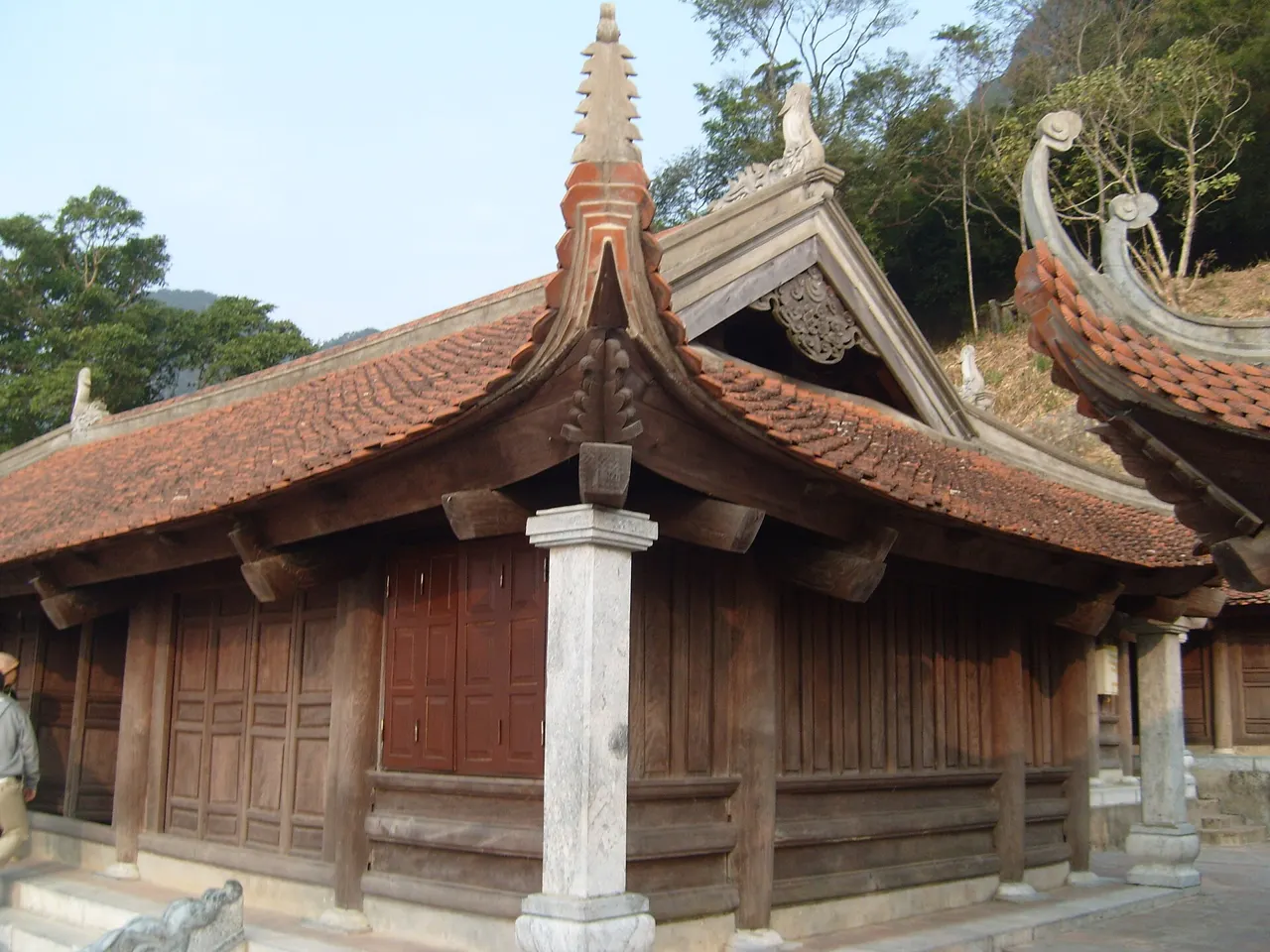
What it found on the ground. This is the part a visitor most needs. The evaluation records, component by component, how much of what stands is recent. The Giải Oan pagoda near the foot of the mountain was rebuilt in 1994. A new Hoa Yên pagoda was built in 2002. The present Một Mái pagoda dates from 1853. The Vân Tiêu pagoda was renewed in 2003. Chùa Đồng, the bronze pagoda on the summit, was reconstructed in concrete in 1930 and rebuilt again in 2007. A new Chùa Lân was built in 2002 on the old foundation. The hermitage at Ngọa Vân was rebuilt in 2012. ICOMOS's general judgement is that most standing Buddhist monuments of the Trần dynasty have been damaged, heavily modified or rebuilt.
That is not an accusation. Wooden pagodas in a monsoon climate are rebuilt; that is how they survive, and the adopted decision notes that reconstruction followed national regulations and traditional materials on original sites. But it changes what you are looking at. The authenticity of Yên Tử lies mainly in its sites, its routes, its archaeology and its unbroken use, not in the age of its timber.
What it said about cable cars. An earlier version of this guide paraphrased the evaluation as positive about the lifts. The actual wording is more balanced, and deserves quoting in full. On the negative side: "Cable car systems for tourists at some of the monuments have an aesthetic impact on the landscape, but are located far from the monuments themselves." On the positive side, two sentences: "The access provided by cable cars helps to protect the ancient pilgrimage routes, especially the passage from the Giai Oan Pagoda through the red pine pilgrimage route to the Hon Ngoc and Hue Quang stupa gardens, and to the Hoa Yen Pagoda (component part 9)." And: "The Hoa Yen Pagoda Relic Cluster and Ngoa Van Pagoda (component parts 9 and 10) have cable car systems to transport large numbers of people with minimal environmental impacts."
So the finding is two-sided: a visual cost to the landscape, set against protection for the old stair and low environmental impact. For a mountain where the lift is still a live argument, compare the Choquequirao cable car in Peru, which has been promised for years and not built.
What it asked for. Beyond the deferral, the evaluation pressed for a formal tourism management plan, Heritage Impact Assessments before new projects, and monitoring that produces reliable data. Those requests passed almost intact into the decision the Committee adopted.
Ten delegations and a strikethrough
The amended draft decision is the document the rest of this guide is named after, and its cover sheet adds detail the press coverage left out. It is dated 10 July 2025. The amendment was submitted by India, with nine co-authors: Bulgaria, Japan, Kazakhstan, Kenya, the Republic of Korea, Rwanda, Senegal, Türkiye and Zambia. Ten states out of twenty-one signed the text that changed Defers to Inscribes.
The Committee adopted it during the 47th session, which met in Paris from 6 to 16 July 2025. UNESCO's online decision record, reference WHC/25/47.COM/17, gives the session but prints no day. Vietnamese press, led by VnExpress, reports the gavel at 13:02 Paris time on 12 July 2025, announced by the Committee chair, Nikolay Nenov of Bulgaria. That date is consistent with everything else in the file, but it comes from journalism, not from UNESCO's own record.
Look at what the amendment did and did not change. It changed the verb, and the adopted decision carries a full Statement of Outstanding Universal Value. It did not remove ICOMOS's concerns; it turned them into obligations. The adopted decision carries thirteen recommendations, lettered (a) to (m). The grouped summary below selects their principal themes; it does not reproduce every clause. Read it alongside the complete decision to see what remained unresolved:
- better interpretation of Trúc Lâm's development, and further research on intangible heritage;
- extending the boundaries to take in more of the sacred Yên Tử landscape;
- urgent, systematic conservation on minimal-intervention principles, and archaeological mapping of the Yên Tử area;
- better security and safety, especially for the woodblocks;
- monitoring indicators with reliable, accessible data;
- a formal tourism management plan, given projected increases in visitors;
- real consultation with, and participation by, local people;
- controls on village growth, transport infrastructure, wastewater and agricultural runoff;
- preventing sand mining upstream and illegal coal mining, including by offering other livelihoods;
- Heritage Impact Assessment for every relevant project in the property and its buffer zone.
Coal is the item most visitors would not guess. The decision names illegal coal mining as a threat, and asks for it to be tackled partly by offering people other livelihoods rather than by prohibition alone. Boundary extension is the other surprise: the Committee is asking for a bigger property than the one it inscribed.
For another Southeast Asian site where the paperwork tells a different story from the brochure, see Gunung Padang.
Two provinces that no longer exist
The dossier was written for a property in three provinces: Quảng Ninh, Bắc Giang and Hải Dương. That is how the ICOMOS evaluation describes it, and how the Vĩnh Nghiêm woodblocks are still named in the evaluation's reference to the Memory of the World register — "Bac Giang Province".
On 1 July 2025 Viet Nam's reorganisation of its provinces took effect. Bắc Giang was merged into Bắc Ninh. Hải Dương was merged into the city of Hải Phòng. Quảng Ninh was unchanged. The Committee voted eleven days later, on a file whose provincial names had just gone out of use.
Vietnamese government and press material now describes the property as spanning Quảng Ninh, Bắc Ninh and Hải Phòng. Same ground, new names. Local names changed below province level too: the Hải Phòng components are now described by wards named after historical figures — Trần Hưng Đạo ward for Côn Sơn and Kiếp Bạc, Trần Nhân Tông ward for Thanh Mai, Phạm Sư Mạnh ward for Kính Chủ, Nhị Chiểu ward for Nhẫm Dương.
This matters in three practical ways. First, any guidebook, map layer or tourist-board page from before mid-2025 uses names that are now wrong. Second, "Hải Phòng" in a search engine returns the port city, a long way from the pine hills at Côn Sơn. Third, the governance matters for the file: the decision records that the property falls under three provincial People's Committees, and two of those committees took over new territory days before the vote. The report due in December is the first that will be written entirely under the new map.
When you arrange transport, give the component's own name — Côn Sơn, Kiếp Bạc, Vĩnh Nghiêm, Yên Tử — rather than a province.
The report due on 1 December 2026
The last paragraph of the decision reads: the Committee "Requests the State Party to submit to the World Heritage Centre, by 1 December 2026, a report on the implementation of the above-mentioned recommendations, for review by the World Heritage Committee at its 49th session."
The research check recorded on 30 September 2026 found no implementation report on the property page. The fixed submission deadline is 1 December 2026, with review requested for the Committee's 49th session. Absence before that deadline is not evidence of non-compliance. Readers should check the current UNESCO document record for later submissions and assessments; this article does not claim a fresh finding after that recorded check.
What is visible in the meantime is what the provinces have done publicly, and it can be set against the list of recommendations.
A certificate and a brand. UNESCO reports that the inscription certificate was formally presented at a ceremony on the evening of 20 December 2025. In September 2026, at the opening of the Côn Sơn–Kiếp Bạc autumn festival, a shared brand identity for the three-province property was unveiled. Neither answers a recommendation directly, but a shared identity is at least evidence of three provinces acting as one site.
Free entry. On 5 February 2026 Quảng Ninh's Provincial People's Council passed a resolution making the Yên Tử relic and scenic area free to visit from then until 31 December 2028, according to Dân Trí and other national outlets. The previous fee was 40,000 dong for adults and 20,000 for children. Vietnamese press also reports free parking and free visitor insurance for 2026.
Counting. The same coverage describes AI-based systems tracking entry and exit at Yên Tử. Set against recommendation (g), on monitoring with reliable data, that is a quick and concrete response. Whether the numbers feed a tourism management plan, recommendation (h), is what the report should show.
The numbers so far. Over the nine-day Tết holiday, 14 to 22 February 2026, Yên Tử received about 171,000 visitors — a figure given both by the provincial report carried on vietnam.vn and by the national daily Tiền Phong. Tiền Phong puts ordinary holiday days at 10,000 to 20,000 people and the peak, on the fourth day of Tết, at about 35,000, with queues at the cable-car stations. The two sources disagree on the comparison: Tiền Phong says 2.2 times the same period of 2025, while the English version of the provincial report says 2.2 times 2015. We report both rather than choose.
Free entry and a surge of visitors, with a tourism plan still to come: that combination is exactly the pressure recommendation (h) anticipates. When the report is published, it will be the most useful document about this site since the evaluation, and it will be free to read on the property page.
Trần Nhân Tông and the Bamboo Grove
The mountain half starts with the reason all twelve components belong together, which is one man's biography.
Trần Nhân Tông was born in Thăng Long, now Hanoi, in December 1258, and took the throne in 1278 at twenty. The Mongol Yuan empire, which had already conquered China, invaded Đại Việt twice in his reign. In 1285 the Trần armies broke the advance. In March 1288, at the Bạch Đằng river, they destroyed a Yuan fleet using a tactic that is the reason one of the twelve components is a field of wooden stakes.
That component is the Yên Giang stake-yard in Quảng Ninh. The evaluation describes it as one of three stake-yards on the ancient Bạch Đằng battlefield, and notes that many of the stakes are in good condition because they are made of very hard wood and have been fully immersed in water. It is the only part of the property that is a battlefield, and it was kept when its two sister yards were cut. The dossier's logic needs it: without the war, the abdication that follows is just a king retiring.
In March 1293, having beaten the largest land empire of the age twice before he was thirty, Trần Nhân Tông abdicated in favour of his son. In 1295 he took monastic ordination. He went to Yên Tử and founded Trúc Lâm — the Bamboo Grove school — which UNESCO's citation calls a uniquely Vietnamese Zen tradition. He died on the mountain, at Ngọa Vân, in December 1308, aged fifty.
What Trúc Lâm proposed is why it mattered to the state as well as to monks. A school founded by a king who had given up his throne was never going to treat the world as something to flee; it tied practice to ordinary duty and to government. The adopted statement of value puts this in heritage terms: a religion drawn from several sources that shaped secular society from its spiritual homeland at Yên Tử. Two successors completed the lineage. Pháp Loa, the second patriarch, is associated with Vĩnh Nghiêm and Thanh Mai; Huyền Quang was the third. All three stand as statues in the bronze pagoda on the summit, beside Shakyamuni.
The dynasty's own ground is represented by Thái Miếu, the imperial ancestral shrine in Quảng Ninh, which the evaluation describes as fully excavated, investigated and then backfilled. It notes plans for a building and an outdoor museum to present what is considered the earliest and most complete royal ancestral shrine in Viet Nam. For now, the site's importance lies mostly underground.
Vĩnh Nghiêm and its 3,050 woodblocks
If Yên Tử is where the school was founded, Vĩnh Nghiêm is where it was run. The evaluation associates the pagoda with Pháp Loa, the second patriarch, and places it in the institutionalisation stage of the tradition — the point at which a mountain hermit's teaching became an organisation that trained, ordained and published.
Publishing is the key. The pagoda holds 3,050 woodblocks, carved in Hán or Nôm script, used to print Buddhist sutras and texts on the development and thought of Trúc Lâm. Viet Nam's government portal gives the physical details. They were carved from thị wood grown in the pagoda's own garden, which is soft, smooth, durable and resistant to warping. The largest block is over a metre long and 40 to 50 centimetres wide; the smallest measures 15 by 20 centimetres. Their surfaces are black and shiny from centuries of printing ink. They were carved in different periods by craftsmen from what were then Bắc Giang, Bắc Ninh and Hải Dương. These workshop locations should not be confused with the boundaries of the later World Heritage nomination.
The woodblocks were recognised by UNESCO before the buildings. On 17 May 2012, at the fifth meeting of the Memory of the World Committee for Asia and the Pacific in Bangkok, they were added to what the ICOMOS evaluation calls UNESCO's Asia-Pacific Memory of the World regional register. The pagoda around them became part of a World Heritage property thirteen years later. It is an unusual case of one institution recognised twice, under two separate UNESCO programmes: first for its documents, then for its place.
The evaluation records that the blocks are kept in specially designed preservation chambers and display cabinets. The Committee's decision still singles them out: recommendation (f) asks for improved security and safety, "especially for woodblocks". That is the only object named in the recommendations. For a visitor it means expecting to see them behind glass, if at all, and understanding why.
Bổ Đà, the second Bắc Ninh component, belongs to what the evaluation calls the revival period of Trúc Lâm. It too holds woodblocks, named a National Treasure in 2017 and stored in the same way. Together the two pagodas explain why a Zen school, a tradition that talks about going beyond words, is recognised here partly through its printing blocks. Trúc Lâm lasted because someone kept printing it.
Côn Sơn and Kiếp Bạc: the general and the poet
The five Hải Phòng components, in what used to be Hải Dương province, place Trúc Lâm inside the political and literary life of the country.
Côn Sơn pagoda was founded in the tenth or eleventh century and, according to Vietnam News Agency coverage of the inscription, became one of the three great centres of Trúc Lâm under the Trần; all three patriarchs taught there. It is also bound up with Nguyễn Trãi, the fifteenth-century strategist and poet, author of the Bình Ngô đại cáo, who retired to Côn Sơn. VOV reports sixteen late-fourteenth-century steles here recognised as national treasures in 2015, with a further twelve from the Lê and Nguyễn periods.
Kiếp Bạc temple is dedicated to Trần Quốc Tuấn — Trần Hưng Đạo — who commanded against the Mongols, kept a military base here and died in 1300. The news agency describes the temple as a synthesis of Daoist, Buddhist, Confucian and indigenous belief, which is the adopted statement of value in miniature.
The other three are less known outside Viet Nam. Thanh Mai pagoda, founded under the Trần and expanded in 1329, is connected with Pháp Loa; excavations in 2021 found three architectural layers spanning the Trần, later Lê and Nguyễn periods. Kính Chủ cave, in Dương Nham mountain, holds more than fifty stone inscriptions. Nhẫm Dương pagoda dates from the Trần period, with archaeological finds pointing to occupation from prehistory onward.
A note on scale that avoids a common confusion. VOV describes the Côn Sơn–Kiếp Bạc national relic area as more than 8,000 hectares across eight communes. The entire World Heritage property, all twelve components in three provinces, is 525.75 hectares. The national designation and the World Heritage boundary are different things, drawn for different purposes.
The 2026 autumn festival programme. The Côn Sơn–Kiếp Bạc autumn festival opened on 26 September 2026 and runs for nine days to 4 October, according to the government portal. It marks the 726th anniversary of Trần Hưng Đạo's death and includes a seal-opening rite, incense offerings at Kiếp Bạc and Côn Sơn, processions and lantern-floating on the Lục Đầu river. It is the first autumn festival since inscription, and Deputy Prime Minister Lê Tiến Châu attended the opening. The cluster also holds a spring festival, so this half of the property is busy at both ends of the year.
The stair from Giải Oan
Now the mountain itself, from the bottom.
The Yên Tử approach is from the Uông Bí side in Quảng Ninh. In the evaluation's numbering the mountain's components begin with Chùa Lân, component 8, which the evaluation associates with Trần Nhân Tông and the birth of Trúc Lâm. What stands there now is new: a pagoda built in 2002 on the old foundation.
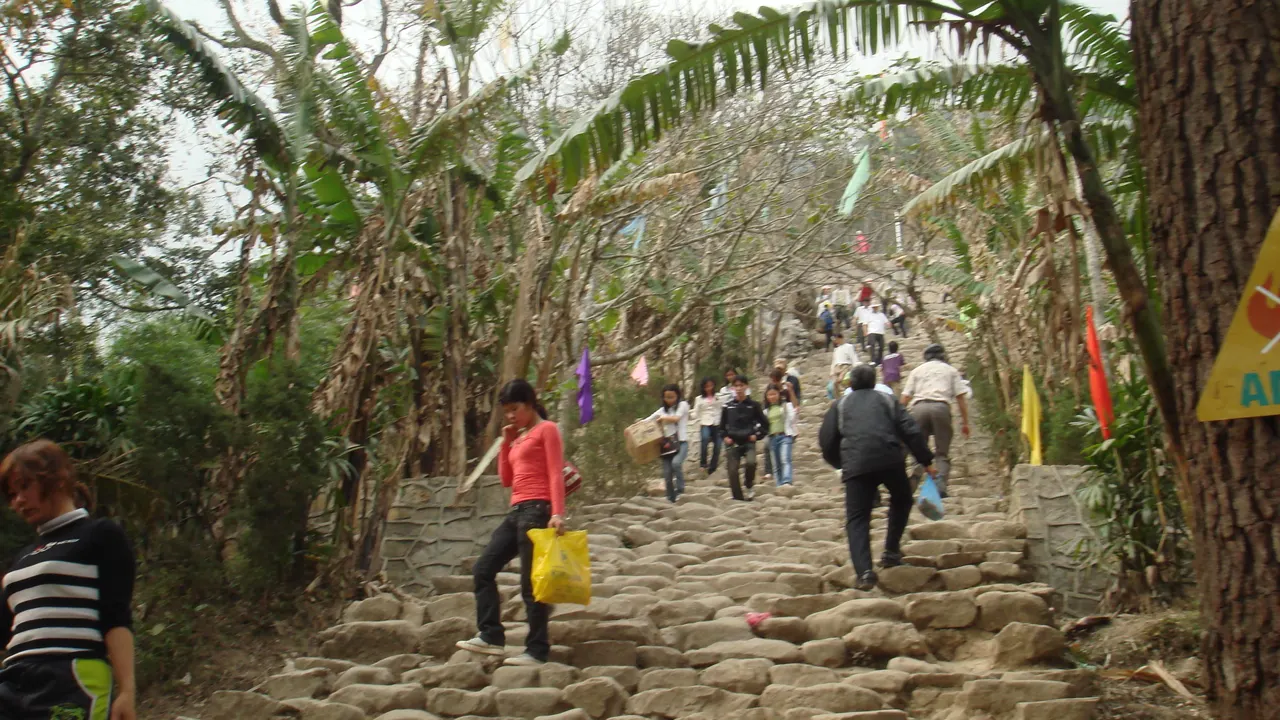
The climb proper runs through the Hoa Yên relic cluster, component 9, which is not one building but the whole upper route. The evaluation's own description of its lower stretch is the best map there is: from the Giải Oan pagoda, rebuilt in 1994, along the red-pine pilgrimage route to the Hòn Ngọc and Huệ Quang stupa gardens, and on to Hoa Yên. The Huệ Quang stupa — the operator calls it Huệ Quang Kim Tháp, or Tháp Tổ, the Patriarch's Tower — stands in a stupa garden, where the remains of monks are enshrined, and marks roughly the halfway point of the mountain.
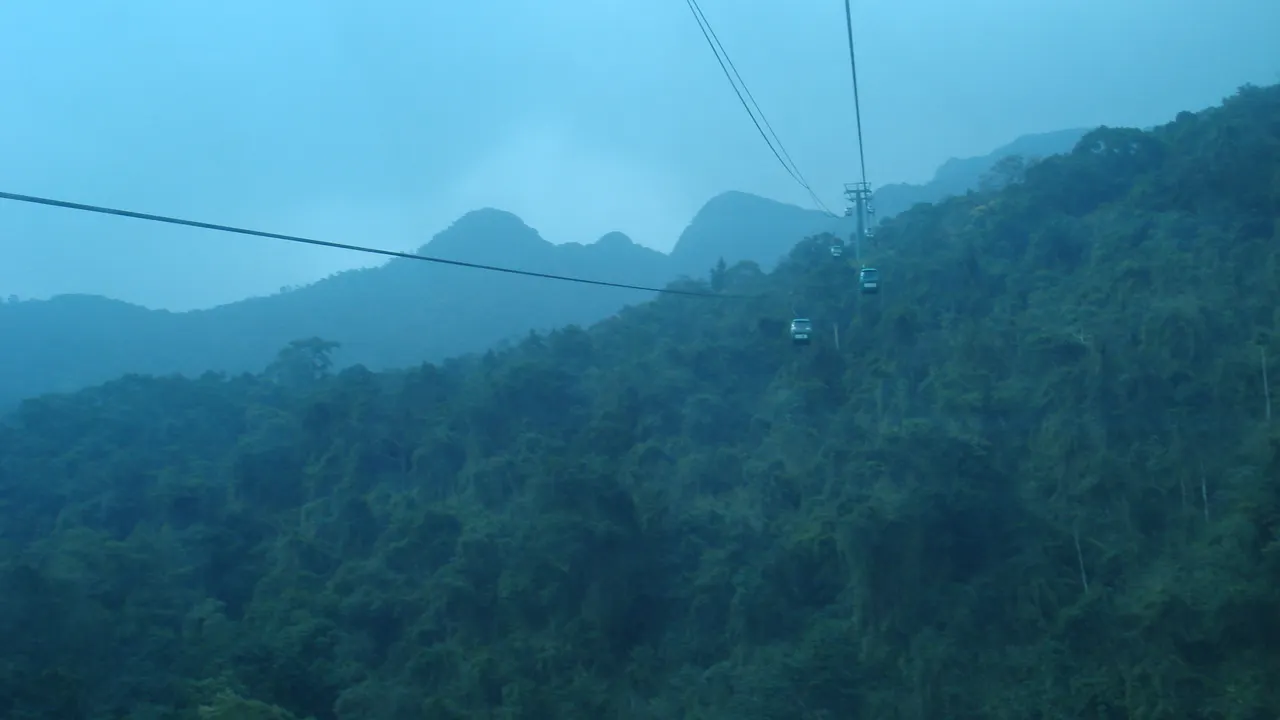
This is the stretch the cable cars were built to spare. The operator, Tùng Lâm Development JSC, runs two lines. The first, which it calls Hoàng Long, opened in 2001 and runs about 1,200 metres from the Giải Oan area to the foot of the Patriarch's Tower. The ICOMOS sentence about cable cars protecting "the passage from the Giai Oan Pagoda through the red pine pilgrimage route" is about exactly this line. Every passenger in a cabin is one fewer pair of feet on the old stones.
How long is the stair on foot? The operator's own page says the full walk to the summit is four to five hours and more than 6,000 steps, against about two hours using both lifts. Those are the operator's figures, from a company that sells cable-car tickets; no independent count was found.
The point is that the pilgrimage is the route, not only the buildings along it. The evaluation's argument for authenticity at Yên Tử rests on the sacred mountain venerated for centuries, on the old paths and on the archaeology, far more than on the age of any structure. Walking some of the stair, even a short section above or below a cable-car station, is the closest a visitor can come to the thing that was inscribed.
Hoa Yên, halfway up
Hoa Yên is the principal pagoda of the mountain and the working centre of the upper route. The building is new — the evaluation dates it to 2002 — but the site is the one the tradition remembers.
Two other pagodas in the same cluster show how mixed in age the mountain is. Một Mái, the one-roofed pagoda, dates in its present form from 1853, the oldest of the dated buildings the evaluation lists for the cluster. Vân Tiêu was renewed in 2003. The same cluster holds the An Kỳ Sinh statue, which ICOMOS lists among exposed artefacts on the mountain that need better protection.
From just east of Hoa Yên the operator's second line, Bạch Long, opened in 2008, climbs about 879 metres to the area near the An Kỳ Sinh statue and the statue of Trần Nhân Tông. From its top station the summit is still a climb on foot. No lift reaches the bronze pagoda.
Hoa Yên is the place to decide what kind of visit this is. The cable car makes it reachable for people who could not manage the lower stair, which is a real gain in access. If your time or legs allow only part of the mountain, spend it here rather than rushing to the summit: the Hoa Yên cluster is the component that holds most of the Yên Tử route, and the summit, as the next sections show, is both further and newer than people expect.
Ngọa Vân, on the far flank
In the story, Ngọa Vân comes before the summit: it is where Trần Nhân Tông spent his last years and where he died in 1308. On the map it is somewhere else. Ngọa Vân — the name means lying in the clouds — is reached from Đông Triều, on the western side of the range, not from the Uông Bí stair. It is its own component, number 10, with its own cable car, and it takes a separate trip.
For understanding the property it may matter more than the summit. The Bronze Pagoda is where the patriarchs are shown; Ngọa Vân is where the founder ended his life as a monk. The evaluation records that the hermitage was rebuilt in 2012, so again the site, not the building, is what carries the history.
The strongest physical evidence from Ngọa Vân is tiny. On 21 June 2012 a small lotus-shaped gold box was found in the Đông Triều area, according to Thể thao & Văn hóa: 4.2 centimetres high, with a lid of four layers of petals made up of eighty-seven pieces, dated by style to the thirteenth or fourteenth century. Quảng Ninh put it forward as a National Treasure in 2018, and the ICOMOS evaluation, written later, records the Ngọa Vân gold box as recognised by law as a National Treasure.
Ngọa Vân is one of the two components ICOMOS names as served by a cable car moving large numbers "with minimal environmental impacts". We could not find a published fare for this line; the Tùng Lâm price list covers the Yên Tử lines only.
A practical note that follows from the geography: Ngọa Vân is not an afternoon extension of the Yên Tử climb. Treat it as a separate half-day by road, or leave it for another visit.
Chùa Đồng at 1,068 metres
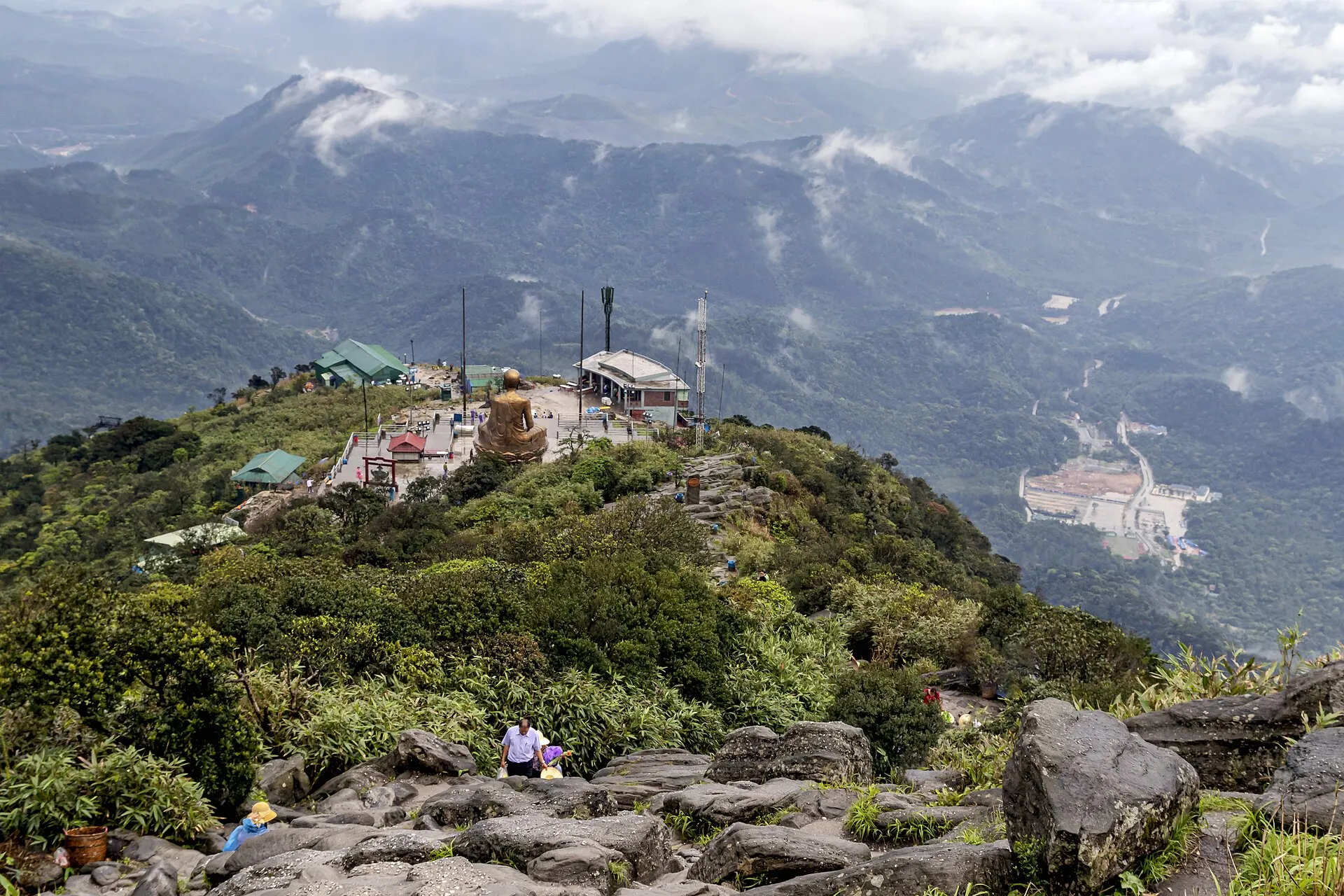
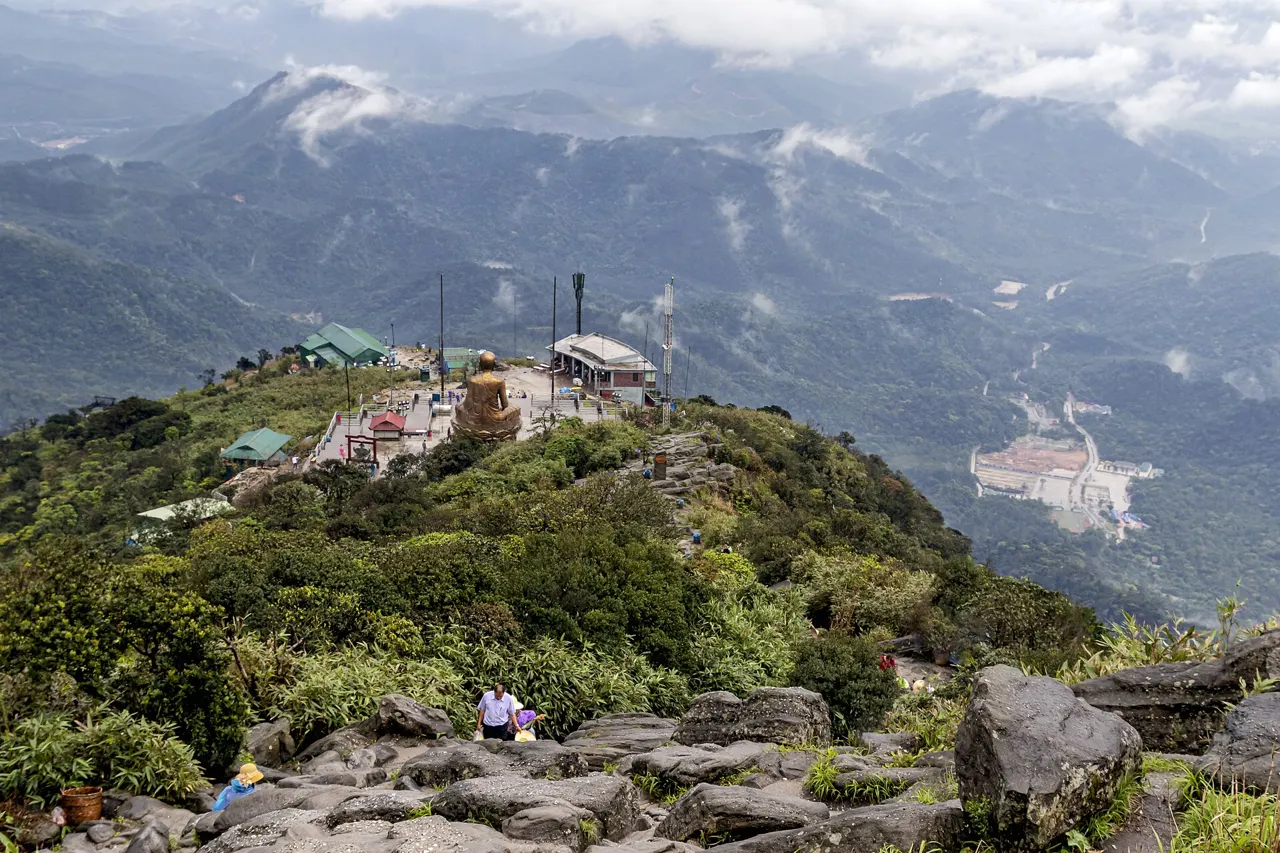
The top of Yên Tử is 1,068 metres, and on it stands Chùa Đồng, the Bronze Pagoda. It is small. It is built entirely of bronze, weighing around seventy tonnes, and it houses statues of Shakyamuni and the three Trúc Lâm patriarchs — Trần Nhân Tông, Pháp Loa and Huyền Quang.
It is also new, which almost no visitor material says. The ICOMOS evaluation records that the summit pagoda was reconstructed in concrete in 1930 and rebuilt again in 2007. The present bronze building is not quite twenty years old. What is ancient is the idea of a shrine on the summit, and the act of climbing to it.
That distinction is the most useful thing to take up the mountain. The Committee did not inscribe Yên Tử for a bronze building; if it had, the evaluation's dates would have been fatal. It inscribed a landscape whose meaning comes from continued use — rituals, festivals, scripture and pilgrimage, as the statement of value under criterion (vi) puts it. The summit pagoda is the latest version of a very old gesture, and the destination of a pilgrimage that, by the evaluation's count, brought more than a million people a year to the property before it was inscribed.
On the ground that means expectations. The summit is exposed and often in cloud, and in the spring festival the summit is likely to be crowded. A clear view is a matter of luck. The reward is not a monument but arriving, as pilgrims have for seven centuries, at the highest point of a mountain an emperor chose.
From here the file and the mountain meet. Everything below the summit — the rebuilt pagodas, the stair the cable cars protect, the woodblocks in their cabinets, the stake-yard in the river — is what the December report has to account for.
Manners for a working mountain
These are places of worship first. Most people on the stair are pilgrims, and in festival season many have travelled far. Behave as you would in a church during a service.
Dress respectfully, with shoulders and knees covered as a considerate starting point for visiting places of worship. Follow each venue's posted dress and shoe instructions rather than assuming one property-wide rule.
Watch what people do before you look at the architecture. Given how much of the building stock is recent, the offerings, the order of stops and the prayers at each station tell you more about what the place is for than any roof line.
Photography. Check signs and staff instructions before photographing an interior, object or ceremony. Ask people for consent; avoid interrupting worship. Do not launch a drone without confirming the applicable legal and site permissions. This guide has not verified a single rule covering all twelve components.
The woodblocks and steles are national treasures. The Committee has formally asked for better security for the woodblocks. Do not touch the steles at Côn Sơn, do not take rubbings, and accept display conditions at Vĩnh Nghiêm and Bổ Đà as they are.
Take nothing away — no stones, no leaves from the old trees, no fragments. With a million-plus visitors a year, a souvenir habit becomes erosion.
When to go, by the lunar calendar
Northern Viet Nam has clear seasons, but two festival calendars matter more.
Spring festival, roughly February to April. The Yên Tử festival opens on the tenth day of the first lunar month — 26 February in 2026 — and traditionally runs to the end of the third lunar month. Festival periods make pilgrimage especially visible, although religious life continues throughout the year. They also bring pressure on access: Tết 2026 brought about 171,000 people in nine days and a peak of about 35,000 in one day. Choose this period if the festival matters to your visit, and allow for crowds, queues and changing weather.
Autumn, roughly September to November. The best general window for Yên Tử: cooler and drier than summer, with far fewer people on the mountain. But it is Côn Sơn–Kiếp Bạc's busy season. The autumn festival runs in the eighth lunar month — 26 September to 4 October in 2026 — so the two halves of the property peak at opposite ends of the year. For a quiet visit to Côn Sơn, go after the festival closes.
May to August. Hot, humid and wet, running into the storm season. The summit is often in cloud and the stone stair is slick.
December and January, before Tết. Cold, damp and quiet. At 1,068 metres the summit can be properly cold with no view. These months can be quieter, but low cloud may obscure the summit view and cold or wet conditions can limit a visit.
Time of day. Early. The cable cars carry most of the day's crowd from mid-morning. Because lunar dates move every year against the Gregorian calendar, check the current year's festival dates before booking anything.
For another living religious site inscribed recently and facing the same question of crowds, see Wat Phra Mahathat.
Getting between three provinces
This is three trips, not one. The most common planning error is to treat a serial listing as a single site. Yên Tử, Vĩnh Nghiêm and Côn Sơn–Kiếp Bạc are separate destinations in three provinces. The listing is an intellectual unity, not a logistical one.
Yên Tử (Quảng Ninh). Approached from Uông Bí, by road from Hanoi or Hạ Long. Vietnamese press reports free parking at the Hà Kiều bus station. From there, walk or use the two Tùng Lâm cable-car lines: Hoàng Long from the Giải Oan area to the Patriarch's Tower, then Bạch Long from beside Hoa Yên to near the An Kỳ Sinh statue. The final climb to the summit is on foot whichever you choose.
Ngọa Vân and Thái Miếu (Quảng Ninh). Both on the Đông Triều side of the range, reached separately by road.
Vĩnh Nghiêm and Bổ Đà (Bắc Ninh, formerly Bắc Giang). Lowland pagodas reached by road; not on a pilgrimage route that takes you there automatically.
Côn Sơn, Kiếp Bạc and the other Hải Phòng components (formerly Hải Dương). Côn Sơn and Kiếp Bạc are in the Chí Linh area and close enough to visit together; Thanh Mai, Kính Chủ and Nhẫm Dương are separate stops. This is not the port city of Hải Phòng.
Yên Giang stake-yard (Quảng Ninh). On the old Bạch Đằng battlefield. We found no visitor information for this component and give no access advice for it.
Accessibility. Limited at Yên Tử. The cable cars bring the mid-mountain within reach of people who could not manage the stair, but the stations, the connections and the summit approach involve steps and uneven stone. The lowland pagodas are much flatter.
The map on this page marks the Yên Tử approach for orientation only. A single pin cannot show a twelve-part property.
What it costs in 2026
The headline price is zero; the real costs are the lifts and the driving.
- Yên Tử entry: free until 31 December 2028, by a Quảng Ninh Provincial People's Council resolution of 5 February 2026. The previous fee was 40,000 dong for adults and 20,000 for children. Checked 30 September 2026.
- Cable cars (operator's list, valid 15 August to 31 December 2026): the first line alone, return, 320,000 dong; both lines, return, 390,000 dong. Children 0.81 to 1.19 metres and Vietnamese citizens over 70 pay half; children under 0.8 metres ride free. A combined cable car and meal ticket is 520,000 dong. Not covered by the entry waiver. Prices after 2026 were not published at the time of checking.
- Ngọa Vân cable car: fare not found; check locally.
- Vĩnh Nghiêm, Bổ Đà and the Hải Phòng components: the waiver is a Quảng Ninh measure. Charging at these sites was not confirmed; assume small fees may apply.
- Parking and insurance: reported free at Yên Tử in 2026.
- Transport: the biggest cost, and a per-party one. Three clusters in three provinces realistically means a hired car and driver for at least two days.
- Offerings: incense, flowers and votive items are sold at every site for small sums. They are an act of participation, not an entry fee.
What to arrange before you go
There is no ticket to buy for Yên Tử and no permit needed for any component. What needs arranging is transport and timing.
- A car and driver for more than one cluster. Agree the whole route in advance and name each component; a driver who knows Uông Bí may not know Vĩnh Nghiêm.
- Festival accommodation near Yên Tử fills in the spring season, and near Chí Linh during the autumn festival. Check the lunar dates for the year.
- Cable-car tickets are sold by the operator; festival queues at the stations are long, so arrive early.
We have no affiliate links or commercial relationships for this destination. The cable-car operator is named only because its price list is the primary source for fares.
What to carry up
A mountain and a place of worship at once; the list has to satisfy both.
- Footwear with real grip. The stair is worn stone, slick in every season. This is the item that matters.
- Covering layers for shoulders and knees, light enough for humidity.
- A warm layer in any month. The summit is at 1,068 metres, windy and often in cloud.
- A rain shell, year-round.
- Socks that come off easily, for any shrine where posted instructions require shoe removal.
- More water than the cable car makes you think you need.
- Small dong notes for cable cars, offerings, stalls and sites outside the Quảng Ninh waiver.
- Leave behind: a drone, and any plan to photograph people at prayer.
Two days, honestly
One day covers Yên Tử. Seeing the property as the thing it was inscribed as takes at least two, and a third if you want Ngọa Vân.
Day one: Yên Tử, early. Reach the base before the mid-morning surge. Walk at least one section of the old stair between Giải Oan and the Patriarch's Tower, or take the Hoàng Long line and walk from there. Stop properly at Hoa Yên and find Một Mái. Take the Bạch Long line or climb on toward the summit, knowing that Chùa Đồng is small, rebuilt in 2007, and may be in cloud.
Day two: the lowlands. Vĩnh Nghiêm in the morning, for the woodblocks and for Trúc Lâm as an institution that trained monks and printed books. Côn Sơn and Kiếp Bạc in the afternoon, for the general and the poet, the steles, and the pine hills Nguyễn Trãi retired to.
A third half-day: Ngọa Vân from Đông Triều, where the founder died. It is on the other side of the range and does not fit into day one.
With only one day: Yên Tử alone, early, accepting that you have seen one cluster of a serial property. That is better than three rushed ones.
The documents, and three things to read
The best material on this site is official, free and almost never cited.
- The ICOMOS evaluation. The deferral, the reasoning, the twenty original components, the reconstruction dates and the cable-car wording. whc.unesco.org/document/222043. Free.
- The amended draft decision 47 COM 8B.22. The strikethrough itself, the ten sponsoring states, the thirteen recommendations and the 1 December 2026 deadline. whc.unesco.org/document/221830. Free.
- The UNESCO property page. The official description, maps and documents — and, when it appears, the State Party's report. whc.unesco.org/en/list/1732. Free.
- On Trần Nhân Tông and Trúc Lâm. English-language scholarship is thin. Cuong Tu Nguyen's Zen in Medieval Vietnam (University of Hawai'i Press) is the standard critical study of the Vietnamese Zen source texts; it is a scholarly work, not an introduction, and we could not verify its current print status. Edition unverified.
The interplay of worship, research and visitor interpretation also runs through Angkor Wat.
Continue with Kampot, before the salt turns white, for another place where the current season and the people using the landscape shape the visit.
Questions travellers ask
When was it inscribed?
At the 47th session of the World Heritage Committee in Paris, July 2025, as decision 47 COM 8B.22, under criteria (iii) and (vi). Vietnamese press gives 12 July 2025; UNESCO's online decision record does not print a day.
Did UNESCO's advisers really recommend against it?
ICOMOS recommended deferral, which means "not yet", not "no". Ten Committee members sponsored an amendment changing the draft to inscription, and the Committee adopted it. This is legitimate: the Committee is not bound by its advisers.
What are the twelve components?
In Quảng Ninh: Thái Miếu, Chùa Lân, the Hoa Yên cluster up to the summit, Ngọa Vân and the Yên Giang stake-yard. In Bắc Ninh: Vĩnh Nghiêm and Bổ Đà. In Hải Phòng: Kiếp Bạc, Côn Sơn, Thanh Mai, Kính Chủ cave and Nhẫm Dương.
How much does it cost?
Yên Tử entry is free until 31 December 2028. Cable cars are charged: 320,000 dong return for one line, 390,000 dong for both, on the operator's 2026 list. Fees at the other clusters were not confirmed.
Can the cable car take me to the top?
No. The two lines reach the area near the An Kỳ Sinh statue; the last climb to Chùa Đồng is on foot.
Is the Bronze Pagoda ancient?
No. The ICOMOS evaluation records a concrete reconstruction in 1930 and a rebuild in 2007. The summit shrine and the pilgrimage are old; the building is not.
Which province is it in?
Three: Quảng Ninh, Bắc Ninh and Hải Phòng. The Bắc Ninh components were in Bắc Giang, and the Hải Phòng ones in Hải Dương, until the provincial mergers of 1 July 2025.
Before the report comes back
An emperor who had twice beaten a Mongol army gave up his throne at thirty-four, climbed this mountain and spent the rest of his life working out how to be a Buddhist and a person with duties at once. Seven centuries later, more than a million people a year follow him up, most of them past buildings rebuilt within living memory, to a bronze pagoda younger than many of the pilgrims.
The file says the same thing in its own language. ICOMOS did not doubt the mountain. It doubted the case as written, and it listed what was not yet in place: a tourism plan, impact assessments, reliable numbers, protection for the woodblocks, room for the landscape to be larger than its boundary. Ten delegations changed one word, and the Committee turned the doubts into a deadline.
The decision sets 1 December 2026 as the reporting deadline. Later documentation may change what can be said about the response, so the deadline belongs to the historical record rather than to an evergreen countdown. Visit with that distinction in mind: the rebuilt pagodas and cable cars are part of a living pilgrimage landscape, and the inscription file records the questions raised about its management.
Sources
- UNESCO World Heritage Centre, Yen Tu-Vinh Nghiem-Con Son, Kiep Bac Complex of Monuments and Landscapes: area, buffer zone, twelve components, criteria — property page
- UNESCO World Heritage Centre, Decision 47 COM 8B.22 (WHC/25/47.COM/17): statement of Outstanding Universal Value, recommendations (a)–(m), reporting deadline, list of eight excluded component parts — whc.unesco.org/en/decisions/8956
- ICOMOS evaluation of nomination 1732: tentative list date, the original twenty components, the February 2025 reduction, the million-plus visitor figure, the deferral and its reasoning, reconstruction dates, the cable-car sentences, Thái Miếu, Yên Giang, Ngọa Vân and the woodblock registers — whc.unesco.org/document/222043
- Amended draft decision 47 COM 8B.22, dated 10 July 2025: "Defers" struck through and "Inscribes" substituted; submitted by India with nine co-authors; reporting paragraph — whc.unesco.org/document/221830
- UNESCO, inscription announcement and 20 December 2025 certificate ceremony — unesco.org
- VnExpress, decision time (13:02 Paris time, 12 July 2025) and component locations by province (Vietnamese) — vnexpress.net
- Vietnam News Agency, the five Hải Phòng components, their wards and histories (Vietnamese) — nvsk.vnanet.vn
- Viet Nam Government Portal, inscription and the first multi-province serial nomination — en.baochinhphu.vn
- Dân Trí, Quảng Ninh Provincial People's Council resolution of 5 February 2026: free entry to 31 December 2028, previous fees (Vietnamese) — dantri.com.vn
- Tiền Phong, Tết 2026 visitor figures, daily and peak numbers, AI tracking, free parking and insurance (Vietnamese) — tienphong.vn
- Yên Tử Spring Festival 2026: opening on 26 February, the 171,000 Tết visitors, the entrance-fee waiver, free parking and insurance, AI visitor tracking — vietnam.vn
- Tùng Lâm Development JSC, Yên Tử cable-car price list valid 15 August – 31 December 2026 (Vietnamese) — yentutunglam.com.vn
- Tùng Lâm Development JSC, the Hoàng Long and Bạch Long cable-car lines — yentutunglam.com.vn
- Viet Nam Government Portal, opening of the 2026 Côn Sơn–Kiếp Bạc autumn festival, 26 September – 4 October (Vietnamese) — baochinhphu.vn
- VietnamPlus, Deputy Prime Minister Lê Tiến Châu at the 2026 autumn festival (Vietnamese) — vietnamplus.vn
- Thể thao & Văn hóa, the Ngọa Vân gold box (Vietnamese) — thethaovanhoa.vn
- Viet Nam Government Portal, the Vĩnh Nghiêm woodblocks: 3,050 blocks, thị wood, dimensions, Memory of the World Asia-Pacific recognition on 17 May 2012 — en.baochinhphu.vn
- VOV, Côn Sơn–Kiếp Bạc: Trần Hưng Đạo, Nguyễn Trãi, the 8,000-hectare relic area, the national-treasure steles and the two festivals — english.vov.vn
- Trần Nhân Tông: reign, the 1285 and 1288 Mongol defeats, abdication 1293, ordination 1295, death 1308 — en.wikipedia.org
- Yên Tử mountain: 1,068 m summit, the bronze Chùa Đồng and the three patriarchs — en.wikipedia.org
- Viet Nam's 2025 provincial consolidation, effective 1 July 2025 — en.wikipedia.org
- Viet Nam's nine World Heritage properties — en.wikipedia.org
- Yên Tử festival season, tenth day of the first lunar month to the end of the third — vietnam.travel
Photograph credits
- Yen Tu Documentary 1 · Bùi Thụy Đào Nguyên · 2016-04-20 09:21:07 · CC BY-SA 4.0. Resized and converted to WebP; the hero may be cropped by the layout. These adaptations remain available under their respective licences.
- Yen Tu Documentary 2 · Thang Nguyen from Nottingham, United Kingdom · 2008-03-08 15:19 · CC BY-SA 2.0. Resized and converted to WebP; the hero may be cropped by the layout. These adaptations remain available under their respective licences.
- Yen Tu Documentary 3 · Thang Nguyen from Nottingham, United Kingdom · 2008-03-08 15:06 · CC BY-SA 2.0. Resized and converted to WebP; the hero may be cropped by the layout. These adaptations remain available under their respective licences.
- Yen Tu Documentary 4 · Liftold ( thảo luận ) · 2008-12-12 · CC BY-SA 3.0. Resized and converted to WebP; the hero may be cropped by the layout. These adaptations remain available under their respective licences.
- Yen Tu Documentary 5 · Bùi Thụy Đào Nguyên · 2010-05-17 · CC BY-SA 3.0. Resized and converted to WebP; the hero may be cropped by the layout. These adaptations remain available under their respective licences.
Packing graphics: AI-generated editorial illustrations. Portrait supplied by Sok Heng Oeun.
A closer look.
The place, its details and its setting in dated photographs. Historical views do not establish today’s access or visitor conditions.

Sok Heng Oeun
Sok Heng Oeun is the owner and editor of Hidden Corners. The Hidden Corners Editorial Team supports image preparation and editorial checks under his direction.
Sok Heng Oeun on Facebook ↗AI-assisted preparation · Editorial review by Sok Heng Oeun, 19 October 2026. This article does not claim a firsthand team visit.