
The door that faces the wrong way
Most of the great stone sanctuaries built under Khmer kings turn their main doors east, towards the sunrise and the direction that Hindu and Buddhist ritual treated as auspicious. The central sanctuary at Phimai, in Thailand's Nakhon Ratchasima province, does not. Its principal axis runs roughly south-south-east, and the long processional approach, the outer gateways and the town's own southern gate line up along that bearing. Stand at the main entrance and look back the way the axis points and you are, in a broad sense, looking down the road towards Angkor.
That single orientation is the best doorway into the site. It turns Phimai from a smaller copy of something Cambodian into a place with its own argument: a provincial ritual centre that was deliberately pointed at the capital it belonged to, built for a branch of Buddhism that is now rare in mainland Southeast Asia, restored in the twentieth century by Thai archaeologists working with French expertise, and still surrounded by a working Thai town whose shops, markets and river festival press up against the old walls. This guide reads the temple through those layers. It explains what the white sandstone tower was for, why the sculptures inside show the Buddha rather than Shiva, how the place was taken apart and put back together, and what a visitor can actually see from the paths that are open today.
It is written from published research and official site information rather than from a visit by the author, and it flags where a fact needs confirmation before you travel. Practical sections near the end cover season, access from Nakhon Ratchasima (Korat), budget units, booking, packing and a day plan that includes the town and the national museum, which holds many of the objects that once stood inside the walls.
Vimaya: a name carved into the doorframes
The modern Thai name Phimai is generally explained as a descendant of an older name recorded in Khmer inscriptions: Vimaya, or the town of Vimayapura. Inscriptions found on the doorframes of the central sanctuary refer to a deity called, in the formal language of Khmer religious dedication, Kamraten Jagat Vimaya, roughly "the lord of the world, Vimaya". The deity was not a local spirit with a stone house. Scholars who have worked on the Phimai texts read Vimaya as a Buddhist image, a form of the Buddha or a Buddhist protective deity installed as the sanctuary's principal object of worship.
A useful dated anchor is a sacred-image dedication recorded in 1108 CE. The Fine Arts Department’s account gives the names Kamrateng Chakata Vimaya and Kamrateng Chakata Senapati Trilokayavijaya. An image’s dedication is evidence for a particular event; it does not supply one construction date for every surviving building. Read the sanctuary as a complex that developed through more than one campaign, rather than assign the same age to every doorway and tower.
What the inscriptions do establish is that Phimai was not peripheral to the Khmer world in the sense of being forgotten. It was a place where officials of rank made merit, where Sanskrit and Old Khmer were carved in the same scripts used at Angkor, and where the deity at the centre had a name that later became the town's own. When you read a Thai road sign saying Phimai, you are reading, through nine centuries of sound change, the name of a god.
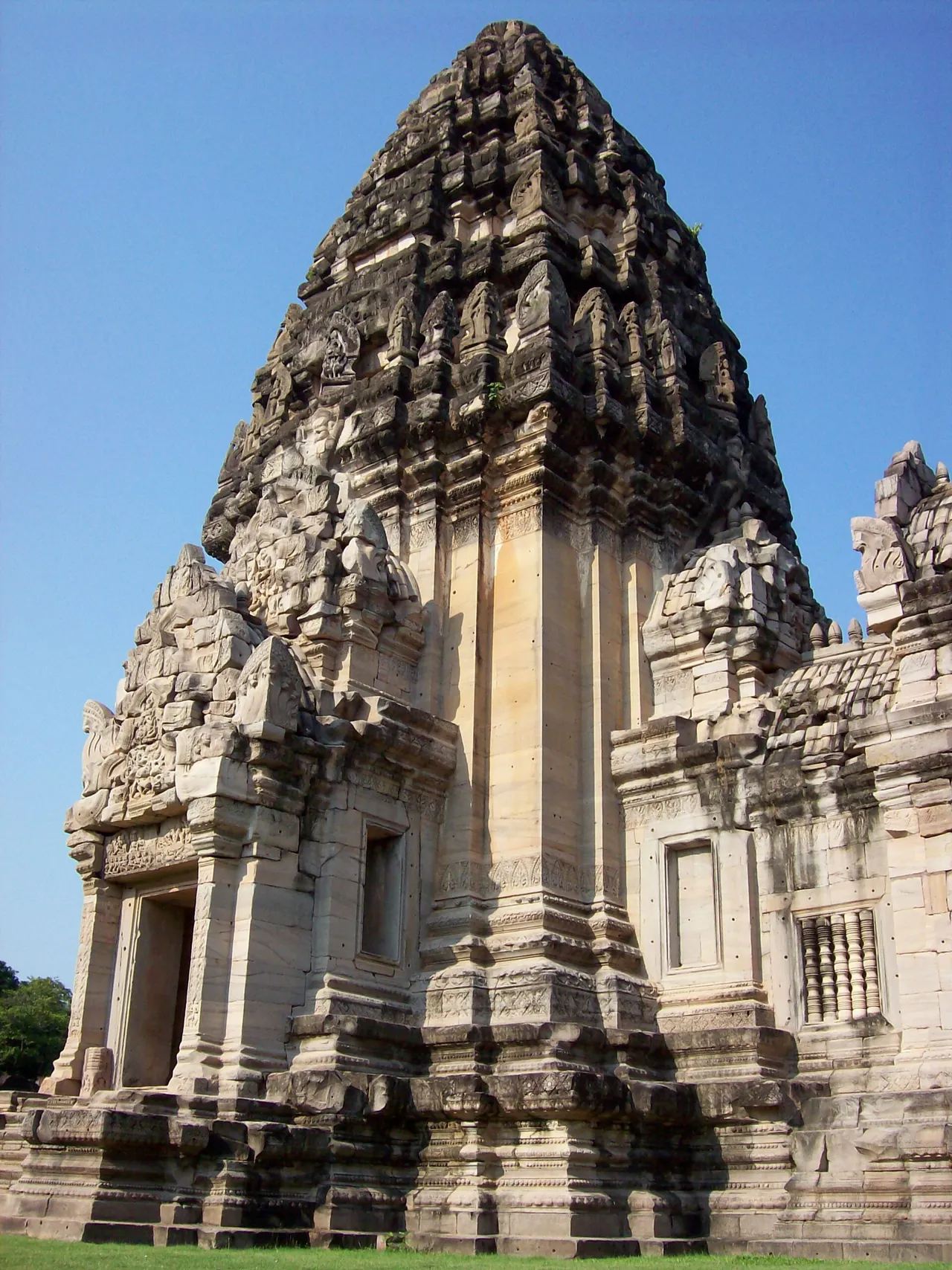
The dating of the central sanctuary is usually placed in the late eleventh to early twelfth century. That puts its main construction slightly before Angkor Wat, which was built under Suryavarman II in the first half of the twelfth century, and helps explain why visitors who know Angkor Wat often feel they are seeing a prototype. Art historians do point to features of the Phimai tower, particularly the curved, bud-like profile of the prang, that anticipate the towers of Angkor Wat. Whether Phimai directly influenced the Angkor builders or both drew on a shared regional development is a question the evidence cannot fully settle, and it is better treated as a family resemblance than as a lineage.
A Buddhist sanctuary in a Hindu template
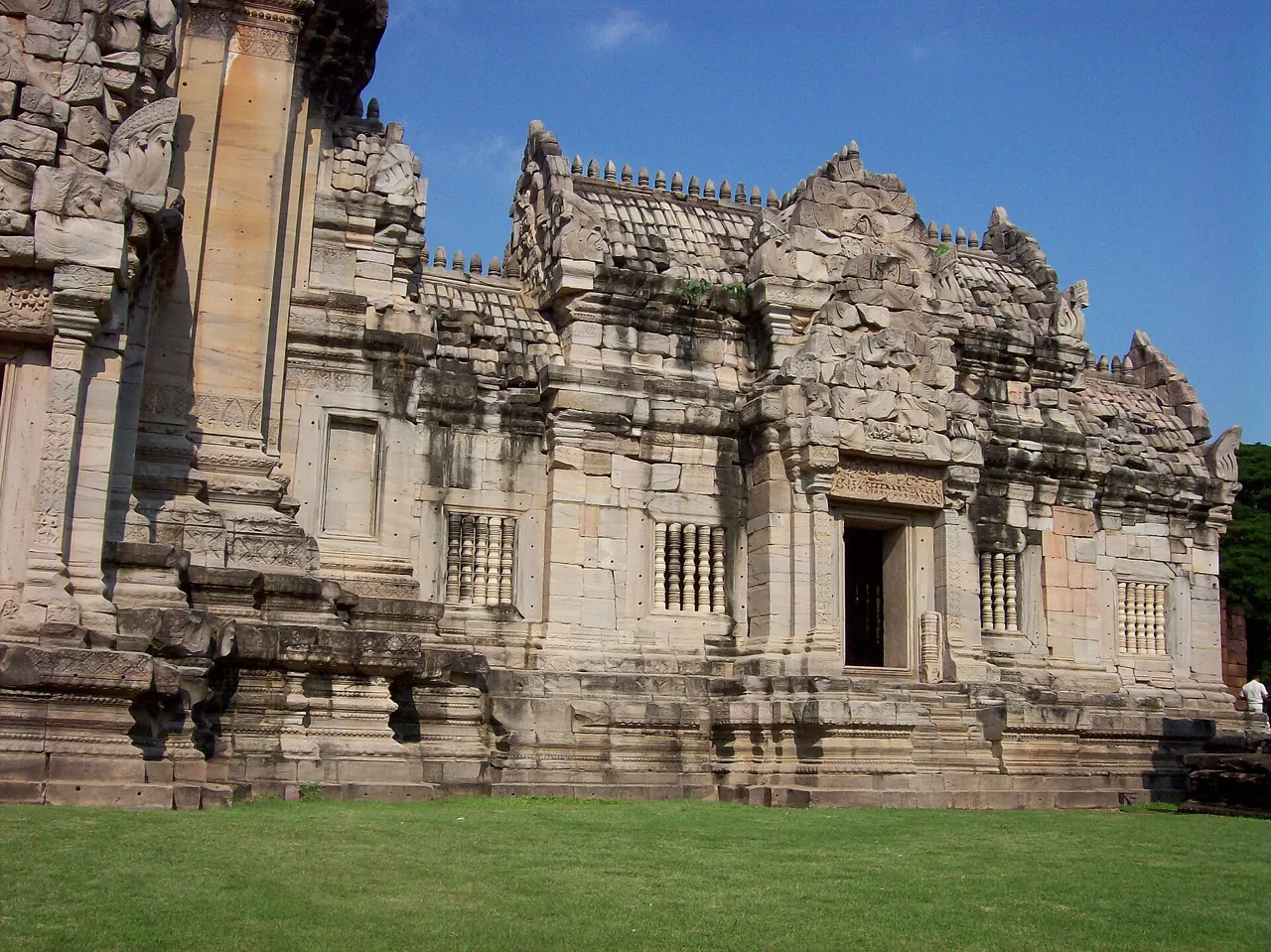
Khmer temple architecture developed largely around Hindu cosmology. The central tower stands for Mount Meru, the axis of the world; the enclosures stand for the mountain ranges around it; the moats and ponds stand for the oceans. Phimai uses all of this vocabulary. It has a central tower raised on a platform, a gallery enclosing it, gateways called gopura at the cardinal points, and an outer wall with ponds outside. A visitor familiar with the shape of a Khmer Hindu temple will recognise the template immediately.
What changes is the content. The lintels inside the central sanctuary, and many of the sculptures recovered from it, carry Buddhist subjects. The best-known is the image of the Buddha seated on the coils of the naga Mucalinda, the serpent king who, in the Buddhist story, rose up to shelter the meditating Buddha from a storm, spreading his hoods above the Buddha's head. The naga-protected Buddha became a strongly favoured image in the Khmer world, and Phimai is one of the places where you can see how central it was. Other carvings at the site show figures associated with tantric or esoteric Mahayana Buddhism, sometimes called Vajrayana, including multi-armed protective deities and dancing figures.
This matters because it complicates a simple story in which the Khmer empire was Hindu until Jayavarman VII made it Buddhist at the end of the twelfth century. Buddhism had been present in the Khmer world for centuries before that, and some rulers and officials patronised it strongly. Phimai is among the clearest built expressions of that earlier Buddhist strand. The temple's carvers took a sacred architecture whose grammar was shaped by the worship of Shiva and Vishnu and filled it with Buddhist meaning, while still keeping Hindu stories in places: the outer lintels and pediments include scenes from the Ramayana, the epic of Rama, and episodes involving Krishna.
The coexistence is not a contradiction to be solved. Khmer religious life combined traditions in ways that make modern categories look rigid. A general dedicating a Buddhist image could still use royal titles bound up with Hindu ideas of kingship, and sculptors could place a Ramayana battle on the outside of a Buddhist shrine because the epic belonged to the shared culture of the court. When you walk the outer gallery and then step towards the central tower, you are moving from the shared epic world towards a specifically Buddhist core.
The road to Angkor and the houses of fire
The southward orientation becomes more meaningful once you know that Phimai sat at one end of a major Khmer road. Archaeologists, using field survey and later satellite and aerial imagery, have traced routes linking Angkor with outlying centres across the region, and the road between Angkor and Phimai is one of the most studied. It ran for something over two hundred kilometres across what is now north-western Cambodia and north-eastern Thailand, crossing the Dangrek escarpment that now marks much of the border.
Along such roads the Khmer built structures that the inscriptions call by names translated as "houses of fire" or rest houses, and that Thai archaeology often labels dharmasala. Their exact function is still discussed. They may have sheltered a sacred flame carried along the route, served pilgrims and officials as resting points, or both. A stela of Jayavarman VII from Preah Khan in Angkor famously lists rest houses along the main roads of the empire. Several laterite and sandstone structures in north-east Thailand are identified as such stations. Near Phimai itself, there are remains of a structure of this type along the approach.
Jayavarman VII, who reigned from the late twelfth into the early thirteenth century, also built small chapels associated with hospitals, known in Thai as kuti rusi or arogayasala, across the empire. The Preah Khan and Ta Prohm inscriptions describe a network of more than a hundred such hospitals. Examples survive in the Phimai area and further afield in Isan. These later works show Phimai continuing to matter after its main sanctuary was finished. The town was still a node in the imperial network when the most ambitious builder of the Khmer kings was reorganising that network around his own Mahayana Buddhist programme.
The road also helps place Phimai within a wider Khmer landscape. Heritage proposals and promotional descriptions have grouped these monuments in different ways over time. Do not confuse that historical relationship with a current World Heritage inscription. UNESCO’s published Tentative List entry for the Ensemble of Phanom Rung, Muang Tam and Plai Bat Sanctuaries concerns that named ensemble. It is not a World Heritage inscription of Phimai. Check the exact property name when a tour or website uses the UNESCO label; a nearby monument’s status cannot be transferred to this one.
Taken apart and put back: the restoration
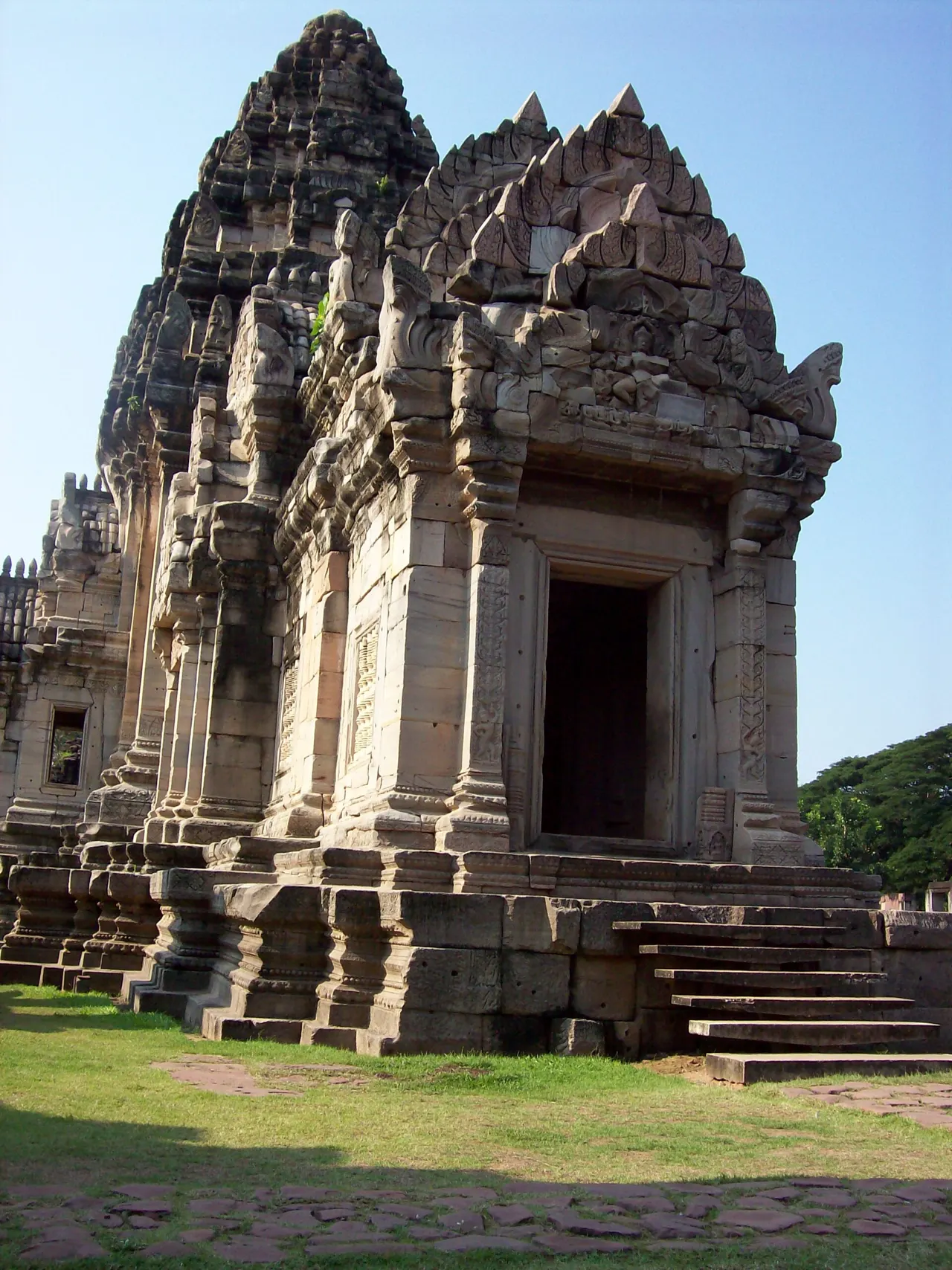
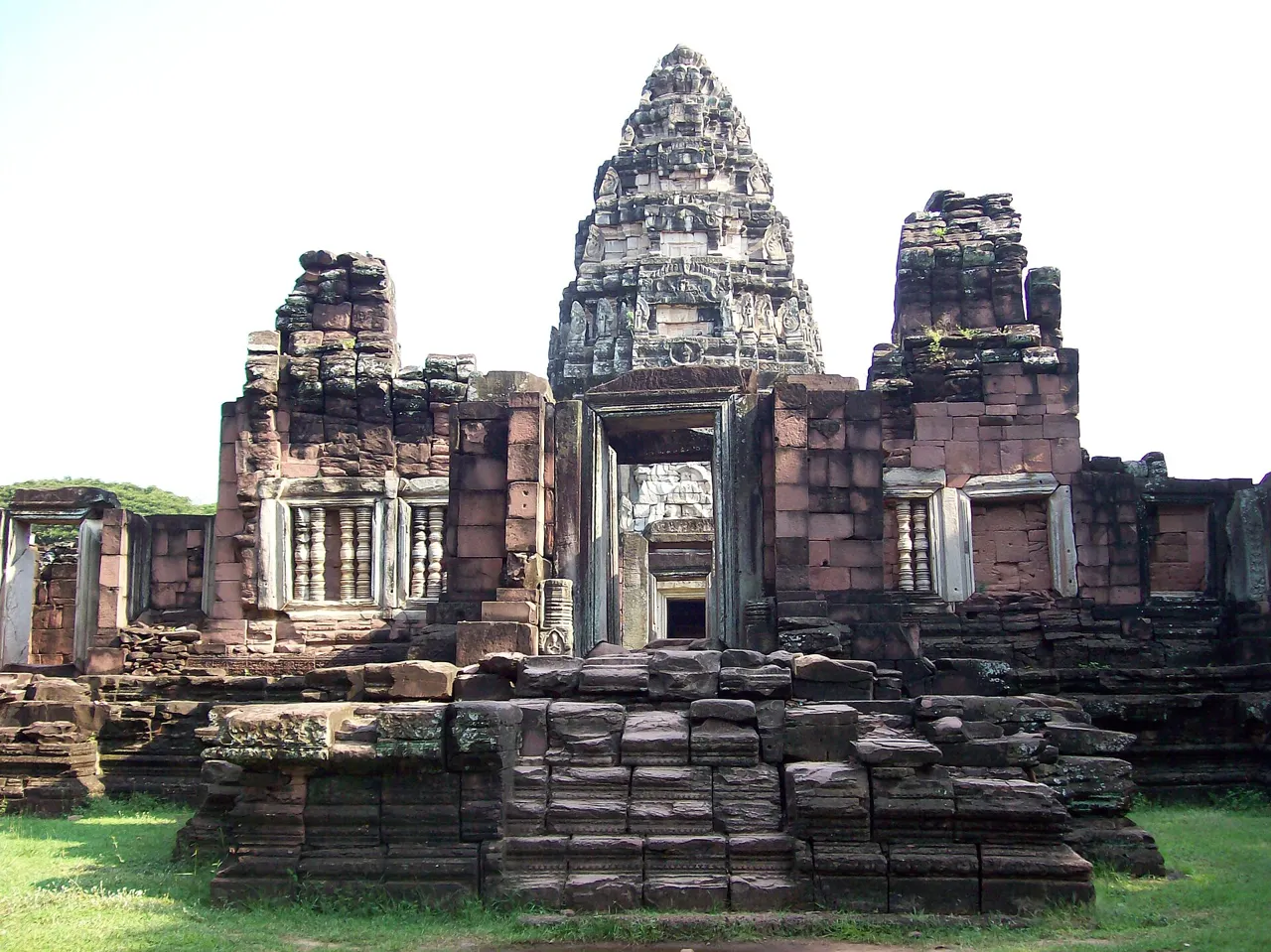
When Western and Thai observers recorded Phimai in the late nineteenth and early twentieth centuries, much of it was collapsed. Blocks lay where they had fallen, vegetation had grown through the enclosures, and the central tower was badly damaged. What you see today is substantially the result of a restoration carried out by Thailand's Fine Arts Department in the 1960s, with technical collaboration from French specialists who had developed the method of anastylosis at Angkor. Anastylosis means dismantling a structure, recording every block, consolidating the foundations, and then reassembling the original stones in their original positions, adding new material only where it is structurally necessary and, ideally, making that new material distinguishable.
The restoration of the central sanctuary was a major undertaking for Thai archaeology and became a reference point for later work at Phanom Rung and other Khmer sites in the country. Phimai was formally opened as a historical park in 1989, under the Fine Arts Department's system of protected historical parks. That status brought landscaped grounds, paths, a visitor information point and the separation of the monument from everyday traffic that a visitor encounters now.
Restoration also involved choices that shape what you can read in the stones. Where original blocks were missing, restorers inserted plain replacement blocks, and you will notice smooth uncarved surfaces in places where carving would once have continued. These gaps are honest; they show the limit of the evidence. Some of the finest sculptures were moved to the Phimai National Museum, just outside the park, both for protection and for display. The statue widely identified as Jayavarman VII, a seated figure with the calm, slightly smiling face associated with portraits of that king, was found at the laterite tower known as Prang Brahmadat. The original is kept in the museum; a replica is placed at the tower.
Thinking of Phimai as a restored site helps a visitor avoid two mistakes. One is to assume the tower is exactly as it was in the twelfth century, when in fact it is a careful twentieth-century reassembly of twelfth-century stones. The other is to dismiss it as reconstruction, when the method was designed precisely to put original material back where it belonged. Both the ancient building and the modern restoration are part of what makes the place legible.
Three towers, three materials
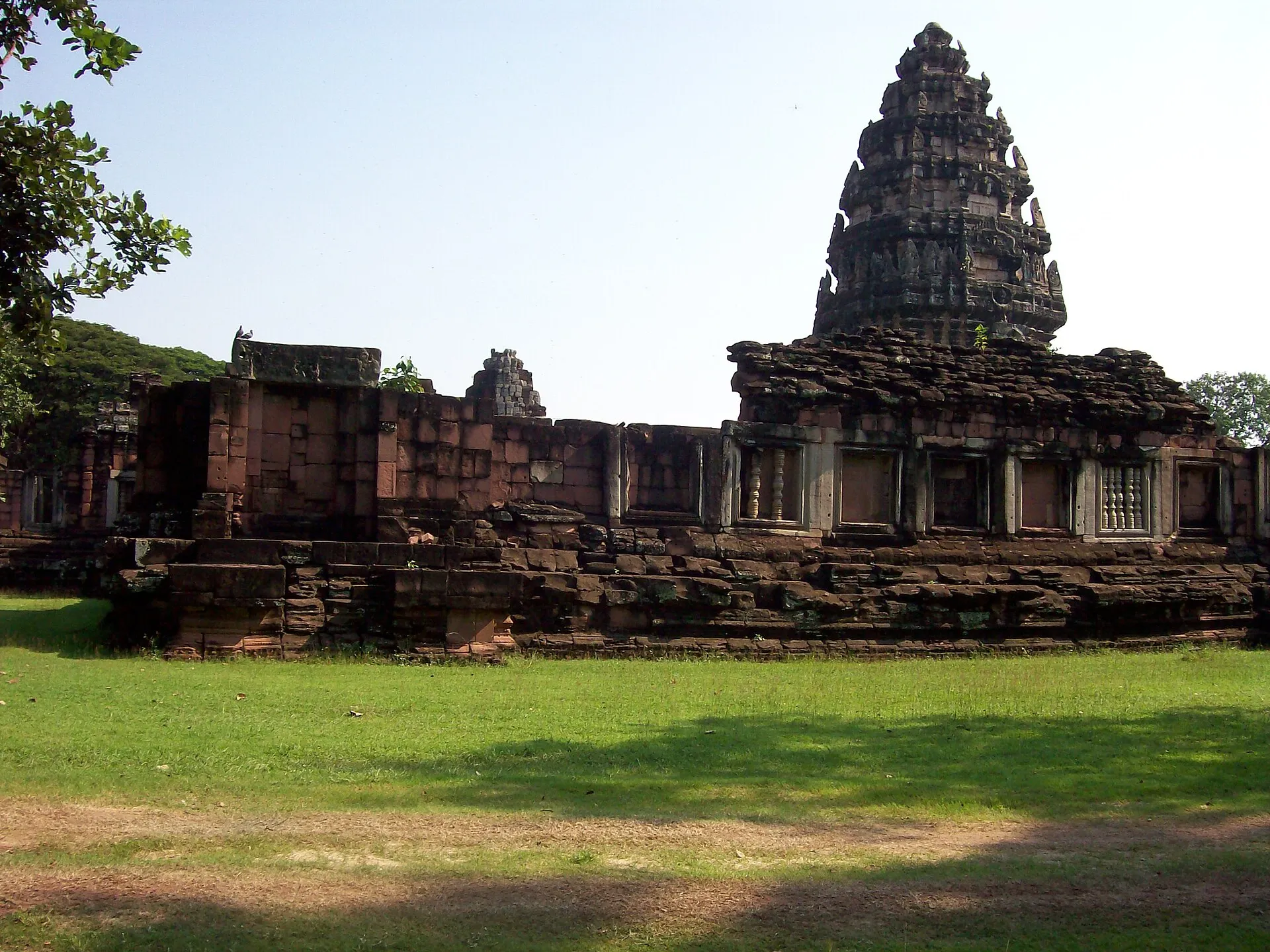
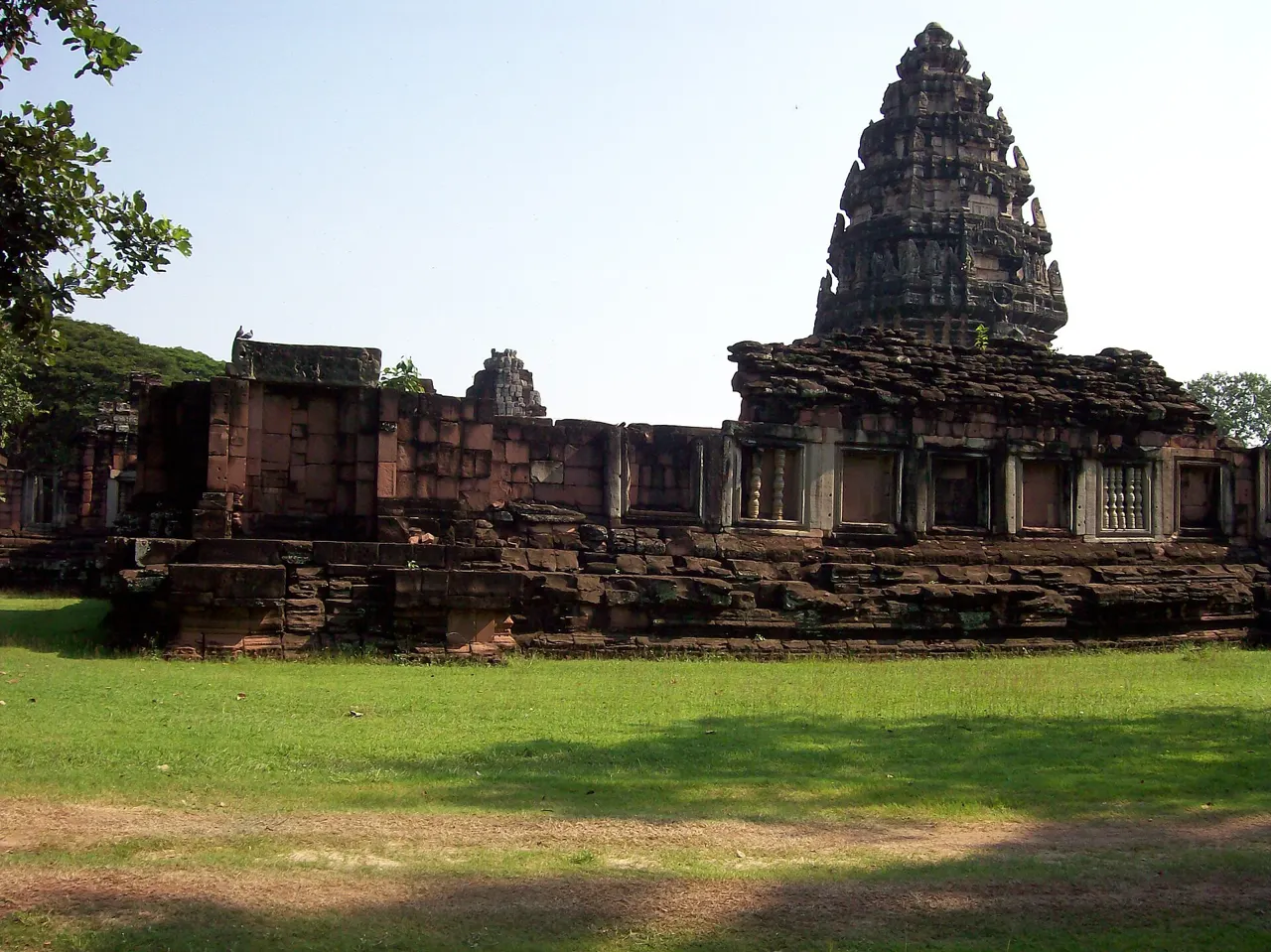
Inside the inner enclosure, the eye goes first to the tall central prang of pale sandstone. Next to it stand two smaller towers that are easy to overlook but tell much of the site's chronology. One, built of red sandstone, is usually called Prang Hin Daeng, "the red stone tower". The other, built largely of laterite, is Prang Brahmadat, named in Thai tradition after a legendary king, Brahmadat, from local storytelling. Thai folk narratives attach a whole cast of legendary figures to Phimai; these stories are part of the town's culture, but they are not the same thing as the inscriptional history.
The difference in materials is a clue. Laterite, a porous iron-rich stone that hardens when exposed to air, was widely used for foundations, walls and secondary structures in the Khmer world, and it became especially common in the period of Jayavarman VII. Red sandstone and pale grey-white sandstone came from different quarries and were used in different periods and for different purposes. Art historians combine the material evidence with decorative style and inscriptions to argue that the two smaller towers belong to a later phase than the central sanctuary, associated broadly with the late twelfth or early thirteenth century.
As you walk between them, look at how each stone weathers. Laterite has a pitted, sponge-like surface and rarely carries fine carving. Sandstone takes a crisp line and holds the folds of a garment, the scales of a naga or the tiny figures of a battle scene. The central tower's carvers chose a material that could carry narrative; the builders of the laterite tower chose a material that was quick and durable. Neither is a lesser building. They were made for different jobs at different moments, and their being side by side in one enclosure is a compressed timeline of how this sanctuary was used and added to.
What to notice on the open paths
Phimai rewards slow looking more than a quick circuit. These are details you can find from the normal visitor routes, without climbing on structures or touching carvings.
The naga bridge and the approach. Before the outer gateway, the processional way crosses a raised terrace whose balustrades are formed by the bodies of multi-headed serpents. In Khmer symbolism the naga balustrade marks a transition from the human world to the divine. Pay attention to the sequence: the terrace, the outer gate, the open court, the gallery, and only then the central tower. The architecture is choreography as much as shelter.
The lintels over the central sanctuary's inner doors. Look for the seated Buddha on the coiled naga with the serpent hoods spread behind the head. Then look at the outer lintels and pediments for scenes from the Ramayana, often crowded with monkeys and warriors. The shift from epic battle outside to meditative Buddha inside is the theme of the whole sanctuary.
Replacement blocks. Find a place where a frieze runs and then stops at a smooth block. That is where the restorers had no original stone. Once you start noticing these, you can read the restoration as a layer in its own right.
The bud-shaped tower profile. From a distance, compare the outline of the central prang with photographs of Angkor Wat's towers. The curving tiers that narrow towards a lotus-bud top are the feature most often cited when people say Phimai anticipates Angkor Wat.
The orientation. Use your phone's compass or a map to check the axis yourself. Then imagine the whole route south: the town's southern gate, the road, the escarpment, Angkor. This is the one observation that changes how the whole site reads.
The town walls and gates. Outside the park, sections of the old town walls and gates survive. The southern gate, often called Pratu Chai, the Victory Gate, lies on the main axis. Walking out to it is a good way to feel the scale of the ancient town, which was much larger than the walled sanctuary.
Respect the rules posted on site. Do not sit on carved surfaces, do not climb fallen blocks, and do not touch reliefs, whose surfaces are damaged by skin oils and repeated contact. Some areas may be roped off for conservation at any given time.
The museum holds the other half
A visit that skips the Phimai National Museum sees only part of the site. The museum, operated by the Fine Arts Department a short walk from the park towards the river, holds many of the lintels, statues and architectural fragments recovered at Phimai and from other sites in the lower north-east. Seeing the carvings at eye level, out of the glare and away from the height of a doorway, makes it much easier to read their subjects and the hand of individual sculptors.
The museum also gives Phimai a longer past than the Khmer period. North-east Thailand has a rich prehistory of rice-growing, pottery, bronze and iron-using communities, and sites in the wider Phimai area have produced burials and ceramics from many centuries before the temple was built. A distinctive black burnished pottery from the region, sometimes called Phimai black ware, is one of the markers archaeologists use for the late prehistoric period here. Displays on this deeper past help explain why the Khmer chose this place: it was already a long-settled, fertile landscape on a river system, not empty ground.
Check the museum's opening days separately from the historical park. Thai national museums commonly close on some weekdays and on certain public holidays, and the schedule can differ from the park's. The Fine Arts Department's website and the museum's official social media pages are the most reliable places to confirm this before you plan your day.
Rivers, banyans and the living town
Phimai sits on low ground where the Mun River, one of the great rivers of the Khorat Plateau, is joined by other channels. Water explains much about the town: its fields, its defences, its connection to trade, and its annual festival calendar. The Mun flows east across Isan to meet the Mekong near Ubon Ratchathani, and the plateau around it is a broad basin of farmland, salt flats and seasonal wetlands.
A few kilometres from the temple, on the river, is Sai Ngam, a park built around an enormous banyan tree, or more accurately a single banyan whose aerial roots have grown into a grove of trunks. It has been a destination for Thai visitors for generations and is listed in Thai tourism material as one of the area's attractions. It is a useful counterweight to the stone: a living, growing place where families picnic and buy snacks.
The town also holds an annual festival, commonly in November, that combines long-boat racing on the river with light-and-sound or historical performances at the historical park. Event dates, formats and ticketing vary year to year and are set locally, so check with the Tourism Authority of Thailand's regional office and local announcements rather than relying on a fixed date. If you prefer quiet, avoid the festival period; if you want to see the town at its liveliest, aim for it and book accommodation early.
Phimai's residents are, for the most part, speakers of Thai and the Korat dialect, and the town's religious life today is Theravada Buddhist, centred on its working temples. This is worth saying plainly because visitors sometimes assume that a Khmer-built monument implies a Khmer-speaking population today. Khmer-speaking communities do live in the lower north-east, especially in Surin, Buriram and Sisaket provinces, but the history of language and identity in Isan is complicated and should not be flattened. At Phimai, the ancient Khmer temple, the Thai town, and the Lao-influenced culture of the wider Isan region overlap without one cancelling the others.
The town's food is part of a Korat and Isan tradition. Phat mi Phimai, a stir-fried rice noodle dish associated with the town, is commonly sold near the historical park. Ordering it is a small way of spending money with local businesses rather than only at large hotels in Korat.
When to go: heat, rain and festival crowds
Phimai's climate follows the pattern of the Khorat Plateau: a cooler, drier period roughly from November to February, a hot period peaking around March to May, and a rainy season roughly from May or June to October. These are averages, not forecasts. The plateau can be surprisingly hot in April and pleasantly fresh on winter mornings, and rain can arrive early or late.
Cool, dry months. The most comfortable walking conditions, clear light and lower humidity. This is also the busiest period for domestic and international visitors and includes the November festival. Morning light from the south-east suits the temple's orientation.
Hot season. The temple grounds are largely open to the sun, with limited shade in the enclosures. If you visit between March and May, arrive at opening time, plan the museum for the middle of the day, and return to the park in the late afternoon if hours allow. Heat illness is a real risk for anyone walking stone courts at midday; build in water and rest.
Rainy season. Green fields, fewer visitors and frequent afternoon storms. Stone surfaces become slippery, and some paths can puddle. Carry a light rain layer and protect a phone or camera. Thunderstorms on open ground are a reason to shelter, not to wait under a tree.
Thai public holidays, including New Year, Songkran in April and long weekends, bring more domestic visitors. They can also bring free-entry days at some Fine Arts Department sites; check announcements, because these are set by the authorities rather than fixed for every year.
Location and access from Korat
Phimai lies in Nakhon Ratchasima province, in the south-west of Isan, roughly sixty kilometres north-east of the provincial capital, which most travellers know as Korat. The historical park is in the centre of Phimai town, so once you arrive the temple, museum, market and the southern gate are within walking or short cycling distance.
Getting to Korat. Korat is a major transport hub connected to Bangkok by highway, intercity bus and the State Railway of Thailand. The rail journey from Bangkok takes several hours depending on the train; buses are frequent. The road journey between Bangkok and Korat typically takes three to four hours by car depending on traffic, especially through the hills at Khao Yai.
From Korat to Phimai. Local buses run from Korat's bus terminal to Phimai, with a journey usually of around an hour to an hour and a half. Departures, terminal numbers and fares change, so confirm the current arrangement at the terminal or with your accommodation. A hired car or taxi gives more flexibility, especially if you want to combine Phimai with Phanom Rung and Muang Tam further south in Buriram province, which are well over an hour's drive away and are better treated as a separate day or a dedicated route.
Within Phimai. The town is compact. Bicycles are sometimes available to rent from guesthouses, which suits the flat terrain and lets you reach Sai Ngam and the town gates easily. Accessibility within the park varies: paths across the grounds are generally level, but the central sanctuary sits on a raised platform with steps, and some thresholds are high. Wheelchair users should contact the park in advance for current information about step-free routes.
A map pin shows orientation only. Check current road conditions and opening arrangements before travelling.
Budget: what you pay and what you don't
Admission to Fine Arts Department historical parks in Thailand is charged per person, with different rates for Thai nationals and foreign visitors. A separate charge commonly applies to the national museum. This guide does not state a current price because it could not verify the current official rate at the time of writing; enter the rate published by the Fine Arts Department or posted at the ticket office in the budget tool. Some parks also charge for bringing in a vehicle or bicycle.
The other costs are mostly per party or per night:
- Transport. A public bus from Korat is inexpensive. A private car or driver for a day is a per-vehicle cost and varies with distance and whether you add Phanom Rung or Muang Tam.
- Accommodation. Phimai has guesthouses and small hotels; Korat has a wider range. Staying in Phimai overnight lets you see the temple at opening time and in late-afternoon light.
- Food. Local restaurants and markets are generally affordable. Festival periods raise accommodation prices and reduce availability.
- Guides. Independent licensed guides can sometimes be arranged through the TAT regional office or accommodation; rates are negotiated rather than fixed.
Because admission is per person and transport is per vehicle, a solo traveller on the bus spends very differently from a family hiring a car. The budget tool lets you separate these units.
Booking: what actually needs planning
For an ordinary visit, you do not need to book Phimai Historical Park in advance; tickets are typically bought at the entrance. What needs planning is around the visit:
- Accommodation during the November festival. Rooms in Phimai fill quickly. If you want to be in town for the boat races or performances, book early and check cancellation terms.
- Museum days. Confirm the national museum is open on your day, as closure days may differ from the park.
- A driver for the wider route. If you want to combine Phimai with Phanom Rung and Muang Tam, arrange transport the day before. Ask whether the price includes waiting time and fuel, and agree the route clearly.
- Guiding. If you want a guide who can explain inscriptions and iconography, ask specifically about their experience with Khmer archaeology. A general tour of the town is a different service.
The accommodation link in this guide is an ordinary search, not an affiliate link and not an endorsement of any property.
Packing for open stone courts
The site is mostly exposed, flat and paved or grassed, with steps at the central platform. What you carry should match the season and the long periods in the sun.
- A wide-brimmed hat. The courts have limited shade, especially at midday.
- Sun protection layered with clothing. Light long sleeves and sunscreen together; sunscreen alone does not make midday exposure comfortable.
- Clothing that covers shoulders and knees. Phimai is an archaeological site, but nearby working temples and respect for a sacred place make modest dress sensible.
- Refillable water bottle. Drink before you feel thirsty, particularly March to May.
- Shoes with grip. Sandstone and laterite become slick after rain; steps at the platform can be uneven.
- Light rain layer in the wet season. Afternoon storms are common from roughly May to October.
- Small cash in baht. For admission, the museum, snacks and local transport.
- Binoculars or a phone with zoom. Lintels sit high above doorways; zoom lets you read the carvings without climbing.
- A compass or map app. To check the temple's southward orientation for yourself.
- Insect repellent for dusk. Riverside areas such as Sai Ngam can have mosquitoes in the evening.
A thoughtful day in Phimai
Early morning. Arrive at the historical park at opening time. Walk the approach slowly: naga terrace, outer gateway, court, inner gallery. Spend most of your attention on the central sanctuary's lintels while the light is low and the courts are cool.
Mid-morning. Visit the smaller towers, Prang Hin Daeng and Prang Brahmadat, and compare their materials. Find a few replacement blocks and think about the restoration as a layer.
Late morning to early afternoon. Move to the Phimai National Museum during the hottest part of the day. Look for the Jayavarman VII statue and the prehistoric material, which gives the Khmer period its deeper context.
Lunch. Try phat mi Phimai or another local dish near the park.
Afternoon. Walk or cycle to the southern gate on the temple's axis, then on to Sai Ngam on the river. Rest in the shade of the banyan.
Late afternoon. If park hours allow, return for a second look at the central tower in different light. Otherwise, wander the market.
Adjustments. In the hot season, shorten outdoor time and lengthen the museum visit. In heavy rain, prioritise the museum and return to the park when the storm passes. With limited mobility, focus on the level outer courts and the museum, which is generally easier to navigate than the raised platforms.
For a different Thai historical-park visit, see Si Satchanalai. Plan it as a separate journey rather than an extra stop on a Phimai day.
Reading before and after
The books listed with this guide are chosen by purpose rather than as a complete bibliography. Michael Freeman's guide to Khmer temples in Thailand and Laos is a practical field companion that places Phimai among its neighbours. Claude Jacques and Michael Freeman's work on ancient Angkor gives the imperial context that explains why a road ran south from Phimai. Smitthi Siribhadra and Elizabeth Moore's study of the Khmer palaces and temples of Thailand is a deeper art-historical treatment. These recommendations are based on publishers' and catalogue descriptions; editions and current availability should be checked.
The Fine Arts Department’s historical-park pages are useful primary reading. Use UNESCO’s current property records to check any World Heritage claim, and compare the exact site names rather than relying on a tour’s general description.
If you are travelling on to other Khmer sites, reading about Angkor Wat beyond its famous towers will help you trace the road from the other end, and Koh Ker shows how a different Khmer capital's sculptures were removed and returned.
The regional comparison becomes richer after reading about Angkor Wat’s architecture and changing religious use; comparison need not imply that every design travelled along one simple route.
Questions that come up
Phimai is not presented here as a World Heritage inscription. Its relationship to Angkor is historical and architectural; it does not depend on a UNESCO label. Check the current UNESCO records rather than older descriptions of proposed serial nominations.
Is it older than Angkor Wat? The central sanctuary is generally dated to the late eleventh or early twelfth century, which places it before or overlapping with the beginning of Angkor Wat's construction. The smaller towers are later.
Why does it face south? The common interpretation is that the axis points along the road towards Angkor, tying the sanctuary to the capital. It is an interpretation supported by the alignment of the town gates and the road, rather than an inscription that states the intention.
Is it Hindu or Buddhist? The principal sanctuary was Buddhist, associated with Mahayana and tantric strands. Hindu epic scenes also appear in its decoration.
Can I combine it with Phanom Rung in one day? It is possible with a car and an early start, but rushed. Phanom Rung and Muang Tam deserve their own day, ideally from a base nearer Buriram.
Do I need a guide? Not to enter. A knowledgeable guide or a good field guide book adds a great deal to reading the lintels.
Back at the southern door
Phimai's southern orientation is a small fact with large consequences. It tells you that this sanctuary was conceived as part of a network, facing a capital two hundred kilometres away; that its builders were confident enough to bend a convention for that reason; and that the town around it was built to the same axis. Add the Buddhist core inside a Hindu-shaped template, the later laterite and red sandstone towers, and the twentieth-century reassembly of the main tower, and the site becomes a layered document rather than a single monument. When you leave through the southern gate, you leave along the line its builders intended.
Sources and confirmation routes
The first draft was prepared without live web access. The director checked the specific official records cited in the revised text on 17 October 2026. Current fees, departures and unconfirmed details still require confirmation before publication.
- Fine Arts Department of Thailand — historical park and national museum information, admission and opening days.
- UNESCO: the distinct Phanom Rung, Muang Tam and Plai Bat tentative ensemble
- Tourism Authority of Thailand — festival dates and regional visitor information.
- State Railway of Thailand — train schedules Bangkok–Nakhon Ratchasima.
Photograph credits
- Phimai Documentary 1 · Philip Nalangan · 2006-01-06 · CC BY 4.0. Resized and converted to WebP; the hero may be cropped by the layout. These adaptations remain available under their respective licences.
- Phimai Documentary 2 · Philip Nalangan · 2006-01-06 · CC BY 4.0. Resized and converted to WebP; the hero may be cropped by the layout. These adaptations remain available under their respective licences.
- Phimai Documentary 3 · Philip Nalangan · 2006-01-06 · CC BY 4.0. Resized and converted to WebP; the hero may be cropped by the layout. These adaptations remain available under their respective licences.
- Phimai Documentary 4 · Philip Nalangan · 2006-01-06 · CC BY 4.0. Resized and converted to WebP; the hero may be cropped by the layout. These adaptations remain available under their respective licences.
- Phimai Documentary 5 · Philip Nalangan · 2006-01-06 · CC BY 4.0. Resized and converted to WebP; the hero may be cropped by the layout. These adaptations remain available under their respective licences.
Packing graphics: AI-generated editorial illustrations. Portrait supplied by Sok Heng Oeun.
A closer look.
The place, its details and its setting in dated photographs. Historical views do not establish today’s access or visitor conditions.

Sok Heng Oeun
Sok Heng Oeun is the owner and editor of Hidden Corners. The Hidden Corners Editorial Team supports image preparation and editorial checks under his direction.
Sok Heng Oeun on Facebook ↗AI-assisted preparation · Editorial review by Sok Heng Oeun, 19 October 2026. This article does not claim a firsthand team visit.