
A river that goes in one side of a mountain
In central Laos, in Khammouane province, a river called the Nam Hinboun reaches a wall of limestone and does not go around it. It goes through. For several kilometres the water runs inside the mountain in a single great passage before emerging on the far side into a valley of rice fields and villages. That passage is Kong Lor Cave, and the trip that has made it known is simple to describe: you sit in a narrow wooden motorboat with a driver and a helper, the boat enters the dark, and about an hour later you see daylight at the other end.
Simple to describe is not the same as simple to do. The journey involves getting wet, climbing in and out of the boat in shallow water, walking short sections over gravel in the dark, sharing a passage with other boats in a tunnel too large for headlamps to reveal, and depending on the skill of the boatmen who read the river by torchlight. It changes dramatically with the season. In the dry months the water is low and boats scrape over shallows; in the wet months the river can rise high enough that trips are curtailed or stopped.
This guide is for travellers deciding whether Kong Lor is right for them and how to do it well. It explains how a river cave of this size forms, what the boat trip involves stage by stage, how the community around the cave runs the boats, what the protected landscape around it contains, and how the road journey there, often done as part of the motorbike route known as the Thakhek Loop, fits in. It is written from published information rather than a visit by the author, and it does not describe or encourage exploration beyond the visitor route. Many caves in this karst are research sites or are dangerous; the boat trip through Kong Lor is the visitor experience, and that is what this guide covers.
How a river cuts a mountain
Kong Lor is a river cave formed in limestone, the kind of rock that dominates much of central Laos and gives the region its forests of towers, cliffs and sinkholes. Limestone is made mainly of calcium carbonate, which dissolves slowly in water that has picked up carbon dioxide from the air and soil and become weakly acidic. Over very long periods, water moving through cracks in the rock widens them into channels. Where a whole river is captured by such channels, it can enlarge a passage enormously, dissolving and eroding it at the same time.
The result at Kong Lor is a passage that, in places, is tens of metres wide and high. The river carries sand and gravel through it, depositing banks inside the cave and scouring the floor where the current is strong. The cave's shape reflects both dissolution of the rock and mechanical erosion by water and sediment, especially during floods. Geologists studying caves like this speak of time scales of hundreds of thousands to millions of years; the passage you travel through is far older than the human history of the valley, though no single age can be given without specific study.
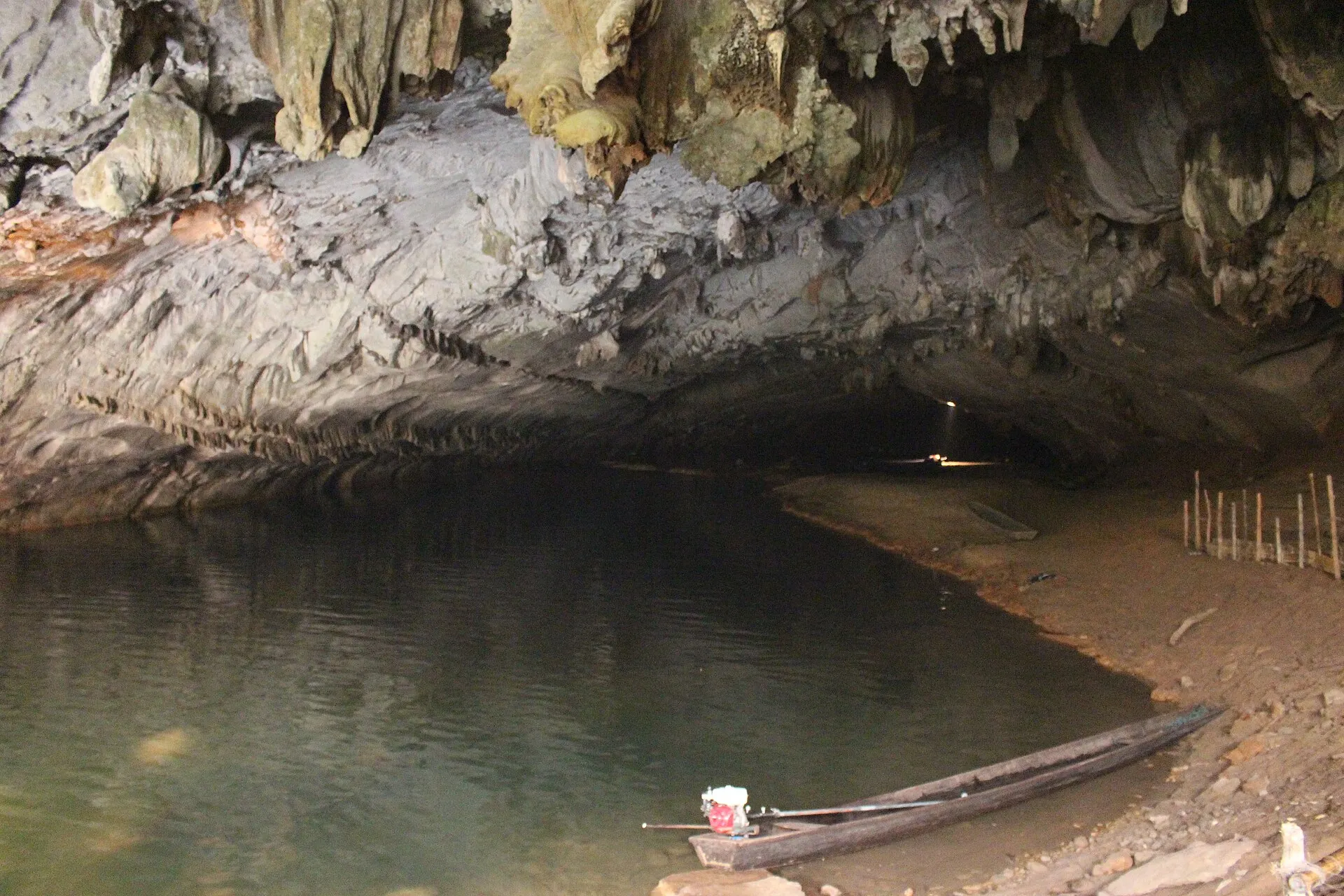
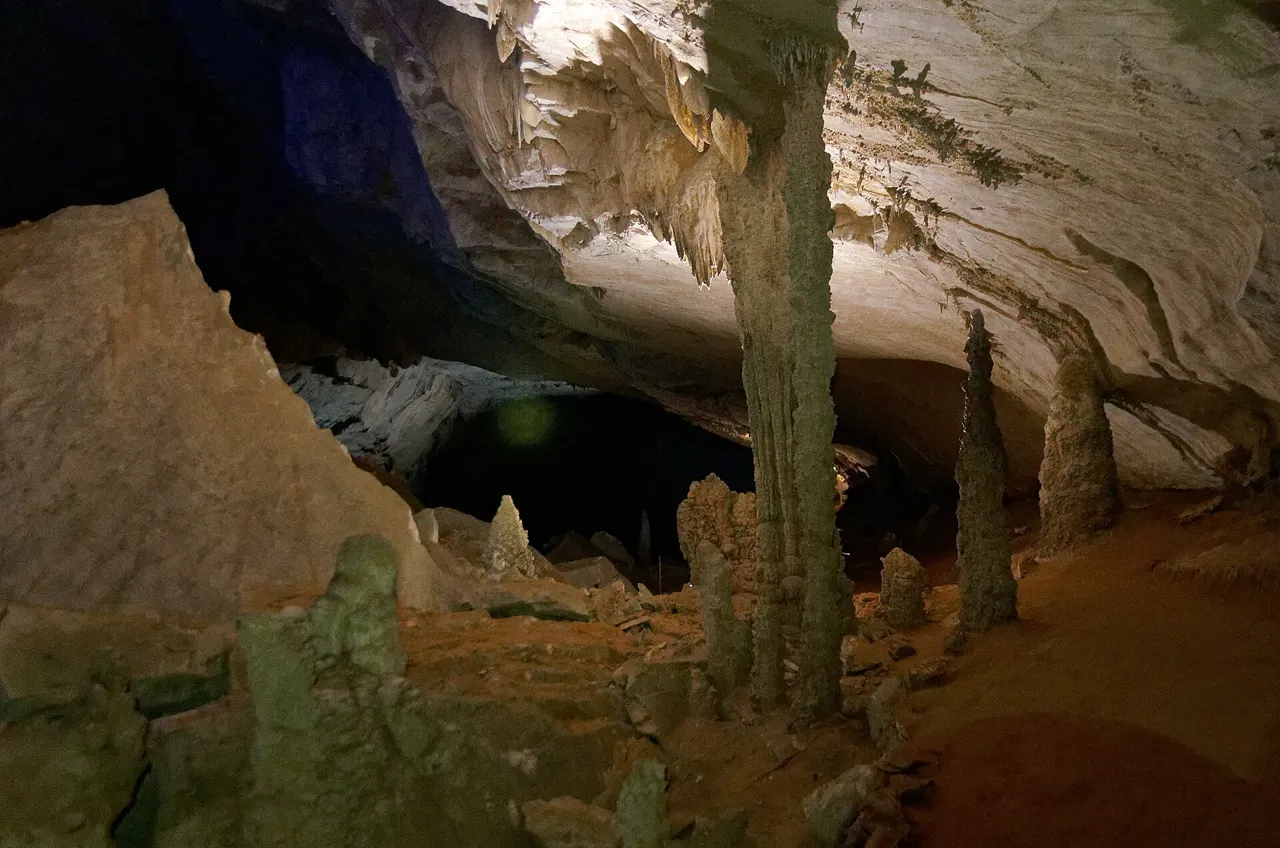
Inside, some areas have formations made by water dripping and seeping rather than flowing: stalactites hanging from the ceiling, stalagmites rising from the floor, flowstone sheets and columns. These grow where water saturated with dissolved limestone loses carbon dioxide into the cave air and deposits a thin film of calcite. They grow very slowly, which is one reason touching or breaking them is so damaging. The best-known formations at Kong Lor are in a side area on the visitor route, which has been fitted with electric lighting.
The same processes created the wider karst landscape around Kong Lor: tall cliffs, isolated towers, enclosed valleys and many other caves, some with rivers, some dry, some known only to researchers. The limestone region extends across a large part of Khammouane and neighbouring provinces and continues into Vietnam, where the karst of Phong Nha–Ke Bang lies on the other side of the Annamite mountains.
It helps to distinguish a managed visitor route from a cave shown only in an expedition report. Kong Lor is promoted as a boat journey by Laos’s national tourism information; that does not certify the equipment or conditions of a particular departure. Other caves may be research sites, places used by residents, or routes requiring specialist training. A survey map is not permission to enter. Ask the current operator about river conditions, equipment, staffing and the permitted route. A passage being open on an earlier visit does not establish that it can be entered today. Water conditions, darkness and difficult exit routes make independent exploration a different undertaking from the advertised crossing.
Kong Lor itself has a long history of local use and outside attention. Caving and survey teams have documented and mapped the river passage, and it is because the main passage is so continuous and navigable that it could become a visitor route at all. Most river caves in the region are not like this: they narrow, drop over cascades, or sump, meaning the passage dips below the water surface. The visitor trip is possible because Kong Lor is unusually open, not because caves in general are safe to enter by boat.
The trip, stage by stage
The details vary with water level and the boat crew, but the trip generally follows this sequence.
The ticket and the gear. At the entrance, confirm the current quote and whether it is per boat, passenger or group. Ask about passenger limits, the return journey, any walking sections and what equipment is included. Check that a suitable life jacket is available and fits before boarding, rather than relying on an old description of what is supplied. Ask how lighting is provided and test it with the crew. Bring a separate light only as the operator recommends; carrying one does not make leaving the managed route appropriate.
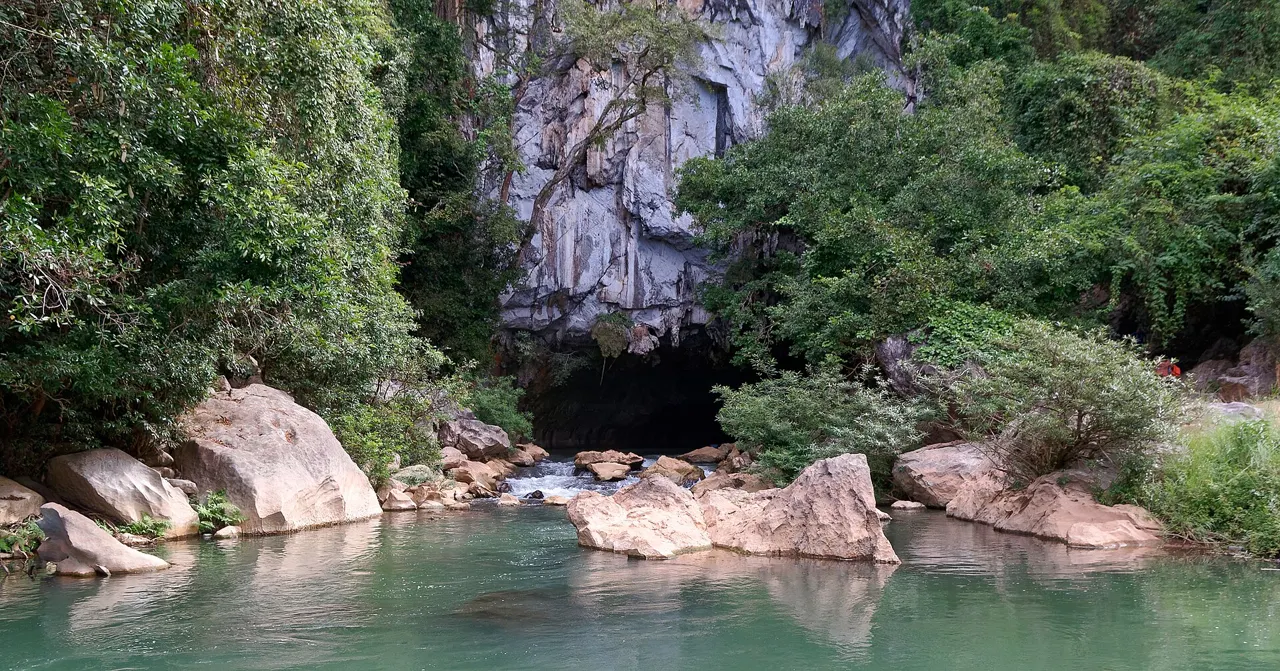
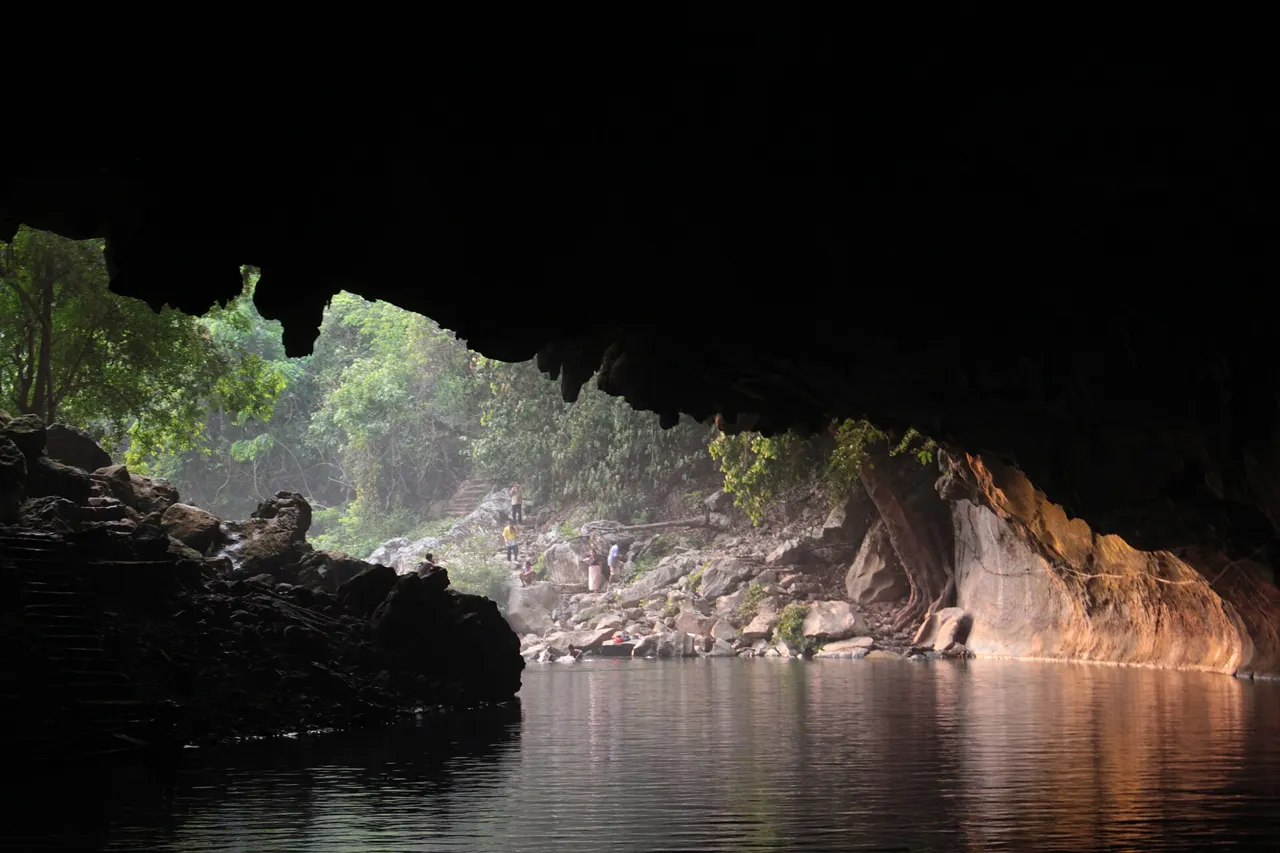
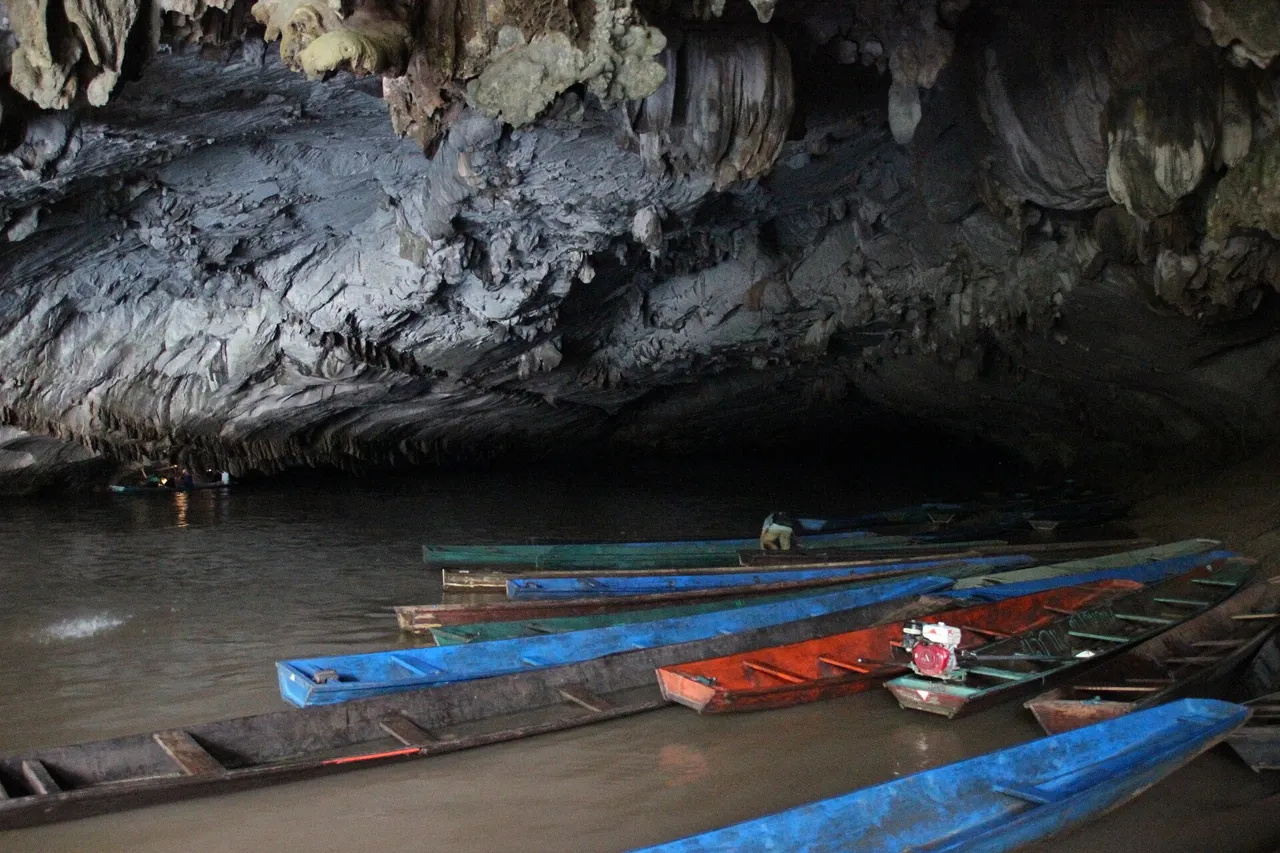
The entrance. A short walk leads from the ticket area to the river, where the water flows into a large dark opening in the cliff. You climb into a narrow motorised longboat. Each boat usually has a driver at the back and a helper at the front who watches for rocks and shallows.
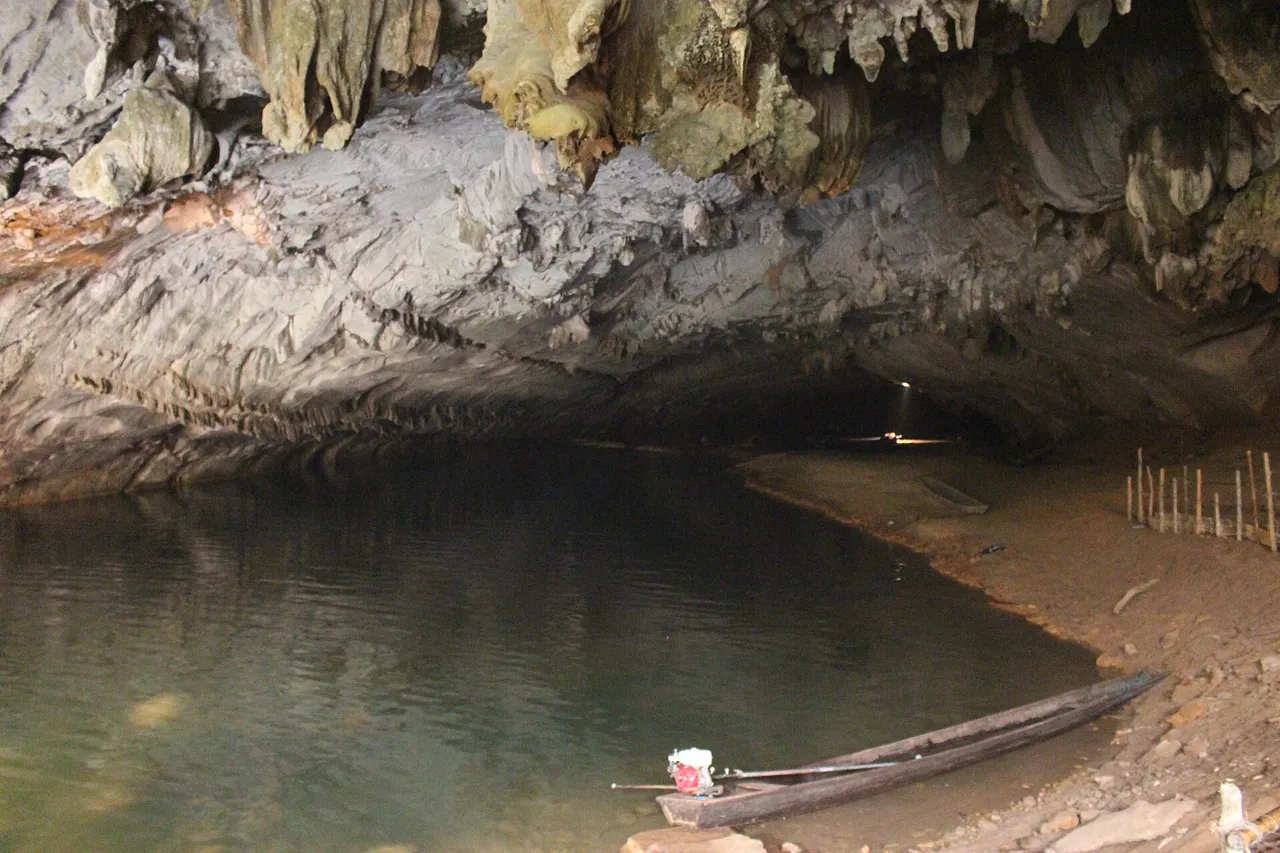
The dark. Once inside, daylight fades quickly. The cave passage is so large that a headlamp beam often does not reach the roof or the far wall. You hear the engine and water, and sometimes other boats. Passengers should stay seated and keep hands inside.
The illuminated section. Partway through, boats usually stop and passengers walk through an area of formations that has been lit with electric lights. This section is on land, with a path. Stay on the path; formations are fragile and some floors are wet.
The shallows. In low water, the crew may need passengers to get out while the boat crosses a shallow section. Ask before boarding whether walking or wading is expected that day, what surfaces are involved and whether your footwear and mobility suit it. An older account of shallow water cannot establish the depth or footing for your trip. Follow the crew’s instructions and explain a limitation before reaching a difficult transfer.
The other side. The boat emerges from the cave into daylight. A short distance downstream, often near Ban Natan, boats stop and passengers can rest, buy drinks and snacks, and walk briefly before returning.
The return. Most trips go back through the cave the same way. The return through the passage often feels different: you may notice details you missed and the river's direction changes how the boat moves.
The total time is usually around two to three hours for a return trip, but this varies.
The people who run the boats
A cave outing also involves the people arranging transport, boarding and the return. Ask who operates the boat and how the ticket is organised. The national tourism description links the cave with nearby village stays, but it does not establish today’s crew rotation or how each payment is distributed. Paying a local operator or host can support that particular service; it is not evidence that every family at both ends receives a share. Judge the actual arrangement by its clarity, the briefing and the equipment offered, rather than a broad community-benefit label.
Before tourism, the cave was a route between the valleys on either side of the mountain. People and goods moved through it by boat when water allowed. That history is part of why the villages exist where they do and why local people know the river so well. Road access to the Kong Lor valley was improved in the early twenty-first century, and tourism has grown since. Villages that were once remote now have guesthouses and restaurants.
Visitors are part of an economy on which people depend. Respect the crews' instructions, which are about safety. Tipping practices vary; a small tip for a careful crew is appreciated but should not be presented as obligatory unless locally indicated. Ask your guesthouse what is customary.
The local population is predominantly Lao, and village life follows the agricultural year and Buddhist calendar. Dress modestly in villages, ask before photographing people, and be aware that houses and gardens are private.
It is worth thinking about what the cave means to the people on the far side. For a village like Ban Natan, the cave was historically one of the shorter ways out of an enclosed valley, but only when the river allowed. In flood it closed; in very low water boats had to be dragged. A visitor experiences that as an adventure on a single morning. For residents, it shaped which markets they could reach, how goods arrived and how isolated the valley felt in the rainy months. Improved roads have changed that relationship, and tourism has given the river crossing a new economic role. A stop on the downstream side, where villagers sell drinks and snacks, is not an extra tourist attraction bolted onto the trip; it is the point where the cave delivers you into someone's home valley.
Homestay and guesthouse accommodation has developed in the villages near both ends. Staying overnight spreads spending more widely than a quick day trip and gives you the chance to take the boat at a quieter hour. Standards and facilities vary; expect simple rooms in many places, and treat a homestay as a family's home rather than a hotel, following house rules about shoes, meal times and quiet hours.
The protected landscape around the cave
Kong Lor lies within the Phou Hin Poun National Protected Area, a large area of karst, forest and river in Khammouane province. Protected areas in Laos are managed for conservation and also include villages and farmland; protection does not mean the absence of people. The karst supports forest on steep slopes, wildlife adapted to cliffs and caves, and rivers with fish important to local livelihoods.
Caves in the region host bats and invertebrates, some of them specialised to cave environments. Scientific surveys of karst in Laos continue to record species that are new to science or poorly known. This is one reason to stay on the visitor route: the deeper or less visited parts of caves can be home to sensitive species and are research areas, not tourist areas.
The river is also changing. Central Laos has seen major hydropower development, and some projects in Khammouane and neighbouring provinces divert or regulate water across river basins. Changes in flow, sediment and fish movement affect communities and ecosystems downstream. Specific impacts on Kong Lor itself are a subject for local and scientific information, but it is worth knowing that the river you travel on exists in a region where water management is actively debated.
Water levels and safety
Water level is the single biggest variable at Kong Lor. It depends on rainfall upstream, the season and possibly regulation by water infrastructure in the wider basin.
Low water. More walking in shallows, more stops while the crew guides the boat, but generally stable conditions. Wear footwear you can walk in through water.
Moderate water. Smoother passage, fewer walking sections.
High water. In the wet season, after heavy rain or when the river is in flood, the boat trip may be shortened, modified or stopped for safety. Floodwater in a cave is dangerous: currents become strong, the passage can fill with debris, and rescue is difficult. Never ask a crew to go when they say it is unsafe, and never try to enter the cave independently.
Why is a flooded cave so much more dangerous than a flooded river in the open? Outside, a river in spate spreads across its floodplain and slows. Inside a mountain it cannot spread; the same volume must pass through a fixed tunnel, so the water rises and speeds up. Floating debris such as logs and bamboo has nowhere to go but downstream through the passage. Light conditions make it hard to see hazards, and there are few places to get out of the water. Rain does not have to fall at the cave for the river to rise: storms in the catchment upstream can send a surge through hours later, under a clear sky. This is why crews make decisions based on the river's level and colour, not on whether it is raining at that moment, and why their judgement must be accepted.
At the other end of the year, low water brings its own minor risks: slipping on wet cobbles while stepping in and out of the boat, stubbing toes on submerged rocks, and cold feet in a long passage. These are the reason for secure water shoes and a steady approach, not for alarm.
Additional safety points:
- Check the fit and condition of the life jacket before boarding, and keep it on throughout the boat journey.
- Stay seated; sudden movement can unbalance a narrow boat.
- Carry a reliable light source, ideally a headlamp with spare batteries or charge.
- Keep valuables and electronics in a waterproof bag.
- If you have mobility limitations, ask about the walking sections before buying a ticket.
- Do not leave the visitor route, enter side passages or climb formations.
What to notice in the dark
The entrance light. As the boat enters, look back. The opening frames the outside world and shows how quickly daylight disappears.
The scale. Shine your light upward and outward. In many places the beam will not reach the walls or ceiling. That is the measure of the passage the river has made.
Sand and gravel banks. These show where the river drops sediment as it slows. After floods they shift.
Water lines and debris. On walls and formations you may see marks or debris left by higher water, evidence of how high the river can rise.
Formations in the lit area. Look for stalactites, stalagmites and columns. Notice how some are still wet, meaning they are actively growing.
The exit. As daylight appears ahead, the cave's end is often a dramatic contrast of green, light and sky.
The crew. Watch how the front helper reads the water and gestures to the driver. Their skill is what makes the trip possible.
The road there and the Thakhek Loop
Many travellers reach Kong Lor as part of a multi-day circuit from the Mekong town of Thakhek, widely called the Thakhek Loop. The route usually heads east from Thakhek through karst country, north towards the area of Lak Sao, and returns via the junction at Ban Na Hin and Route 13 along the Mekong, with a detour to Kong Lor. Many do it by rented motorbike; others use cars with drivers or public transport for parts.
The loop's appeal lies in its landscapes: limestone cliffs, caves, lakes created by reservoirs, rivers and villages. But it involves real road risks. Roads vary in condition, traffic can include trucks, animals and children, and weather changes surfaces quickly. Rented motorbikes may lack proper maintenance. Many travel insurance policies require a valid licence for the vehicle you ride. A helmet is legally and practically essential.
If you are not an experienced rider, a car with a driver or a public bus to Ban Na Hin with onward transport to Kong Lor are safer options. Kong Lor village is reached by a road branching from the area near Ban Na Hin, roughly forty kilometres long. Distances and road conditions should be confirmed locally.
The loop also shows, in a few days, how much this landscape has been reshaped in recent decades. Part of the route crosses the Nakai Plateau, where the reservoir of the Nam Theun 2 hydropower project flooded a large area of forest and farmland when it was filled in the late 2000s. Dead trees standing in the water have become one of the loop's most photographed sights. The project involved the resettlement of villages on the plateau and has been the subject of long international discussion about its social and environmental outcomes. Travellers who pass through are seeing a recent human transformation layered on top of a geological one: the karst took millions of years; the reservoir took a few seasons to fill.
Sections of the loop pass other caves that are signposted for visitors, swimming spots in rivers and pools, and viewpoints over the karst. Each has its own conditions, and some are informal, with no staff or safety measures. Treat any cave with water in it with the same caution as Kong Lor, and do not swim in caves or below cliffs after heavy rain. Ask at guesthouses or the tourist information office in Thakhek about current conditions rather than relying on older blog posts.
For many travellers, the most sensible approach is to treat Kong Lor as the anchor of the trip and plan the rest around it: arrive the afternoon before, stay near the cave, take an early boat, and keep a spare day in case of rain or high water. A tightly scheduled loop that leaves no slack is how people end up riding wet roads at dusk.
Settle the questions while you can still hear the answers
The most useful briefing happens before the engine starts. At the ticket point, ask the operator to describe the journey in order: where you board, whether you change boats or walk, where you turn around and how the return works. Then repeat the parts that matter to you. “Does the ticket include the full return?” and “Will I need to step into water?” are different questions. A price alone cannot answer either. Water conditions and current procedures can change the answer.
Describe any mobility limitation as the movement you need help with. Ask about the actual boarding edge, the size of a step into the boat, whether you must crouch, and the surface used for walking. Explain what you can comfortably manage before a ticket is issued. Check the return as well as the outward boarding: a crew offering help at the entrance does not answer how another landing or a shallow section will work. Agree on a shorter alternative or choose not to board if the route does not meet your needs.
If children are travelling, ask about suitable life jackets for their actual sizes and about the operator’s conditions for participation. An adult jacket is not interchangeable with a properly fitting child’s jacket. Do not assume that a child’s ability to swim answers the question. The same applies to an adult who is uneasy on water: tell the operator rather than expecting someone to infer it. If suitable equipment or a satisfactory explanation is unavailable, choosing not to board is a reasonable outcome.
Check how lighting is provided and what you are expected to carry. A phone torch uses the same battery you may need for communication and is awkward when your hands are needed for balance. A small light can be useful if the operator recommends it, but bringing one does not make independent exploration appropriate. Keep the trip within the managed route. Do not follow an interesting side passage or leave the group to improve a photograph.
Agree on the decision point for bad conditions. Ask what happens if the trip is cancelled before boarding or shortened after departure, whether a return transfer is included and how a change will be communicated. The answer should come from the operator handling your trip, not from a hotel that sells the excursion under a general description. Save the booking contact and the inclusions while there is still time to clarify them.
Kong Lor’s advertised scale needs one last translation into time. Laos’s tourism page describes a through-cave waterway of about 7.5 kilometres. That number is not the length of your visit: boarding, condition-dependent walking, stops and the return need separate allowances. Ask for the operator’s current estimate and keep your onward transfer flexible, rather than convert kilometres into a departure time on a map.
Leave room for the village as well as the cave
A cave crossing does not occupy the whole meaning of a Kong Lor stay. The national tourism description places homestay options in Kong Lor and Natan villages, which helps explain why travellers may choose to stay near the cave rather than treat it only as a road-loop checkpoint. A longer stay can make the logistics less hurried. It also creates choices about where money goes and how a visitor fits into an inhabited valley.
Ask a prospective host what the accommodation actually provides: sleeping arrangement, bathroom, meals, drinking water, electricity and the way to reach the cave. “Homestay” is a broad description, not a standard specification. A family house, a small guesthouse and an organised village programme may offer quite different experiences. Choose the one that suits your needs rather than assuming that the simplest room automatically provides the closest cultural connection.
If a meal is offered, agree on dietary needs early and ask whether the price is per person or for the group. Describe an allergy clearly; do not rely on a translated dish name to establish ingredients. A host may need time to obtain supplies. Paying for a meal or a room does not entitle a visitor to enter private rooms, photograph family members or expect an evening performance. Treat ordinary household routines as ordinary life.
A slow walk can be worthwhile without becoming an unofficial trek. Ask locally which lanes or paths are public and currently suitable. Fields, riverbanks and shortcuts may involve private land, work or conditions that are not obvious from a map. Stay away from unexploded ordnance and unfamiliar objects; follow established, locally confirmed routes. Do not create a new path around a muddy section simply because a navigation app draws a line there.
Build a weather alternative before committing your onward travel. If river conditions prevent the crossing, a rest day may be more useful than replacing it with another cave whose access you have not checked. Read about the karst, make a confirmed village visit or continue the journey under the current road advice. There is no obligation to rescue a cancelled cave day with a riskier excursion. Avoid a plan in which a non-refundable transfer leaves no room to accept a closure.
Keep the return arrangement clear if you plan time near the far entrance. Ask whether the same boat waits, which meeting point to use and how a change in river conditions will be communicated. A meal, a village walk and the cave crossing may involve different hosts or separate charges; confirm what is included instead of assuming that a boat ticket covers the whole afternoon. Keep the operator’s contact and leave enough time for your onward transfer. The cave’s advertised length is not a timetable for the journey back.
When to go: rain, rivers and fields
Central Laos has a monsoon climate with a dry season, roughly November to April, and a wet season, roughly May to October. The cooler period is around December to February; it becomes hot in March and April.
November to February. Comfortable temperatures and generally reliable boat trips. Water levels fall as the season goes on, so more walking may be needed later.
March to April. Hot outside, but the cave itself is cooler. Low water means more walking in shallows.
May to October. Green landscapes and fewer visitors. Heavy rain can raise the river and disrupt trips. Roads can be muddy or damaged. Check conditions daily and keep flexible plans.
Location and access
Kong Lor Cave is in Khammouane province in central Laos. The nearest main town on the Mekong is Thakhek. The access village is Ban Kong Lor, at the cave's upstream end.
From Vientiane. Buses travel south along Route 13 towards Thakhek and further south; some services or connections go via Ban Lao and Route 8 to Ban Na Hin. From there, local transport continues to Kong Lor. Journey times can be long.
From Thakhek. Some travellers take buses or vans to Ban Na Hin and then onward. Others join organised trips or rent a motorbike for the loop.
From Thailand. The Third Thai–Lao Friendship Bridge links Nakhon Phanom in Thailand with Thakhek.
A map pin shows orientation only. Transport schedules change and should be confirmed locally.
Budget: per boat, per person, per night
The main costs at Kong Lor are in different units:
- Protected area or site entry, if charged, is per person. Arrangements change.
- Boat hire is usually per boat, with a maximum passenger number. Sharing reduces cost per person.
- Headlamp rental is per item.
- Accommodation in Ban Kong Lor or Natan is per room per night.
- Transport varies widely: bus seats are per person; a car or motorbike rental is per vehicle per day.
This guide does not state current prices because none could be verified. Enter the posted boat price in the budget tool as an extra and divide by the number of people sharing.
Booking: what needs arranging
The boat trip is normally arranged on the spot at the cave entrance. What benefits from planning:
- Accommodation near the cave, especially in high season, so you can take an early or late trip without the long drive.
- Transport, including whether a driver waits.
- A motorbike rental, if you choose it: check the bike's condition, helmet quality, insurance and what happens if it breaks down.
- Weather and water checks on the day.
The accommodation link here is an ordinary search, not an affiliate link and not an endorsement.
Packing for a wet, dark river
- Headlamp with spare batteries or charge. Rentals exist, but your own is more reliable.
- Water shoes or secure sandals. You may walk through shallow water over gravel.
- Quick-drying clothes. Expect to get wet to the knees or more.
- Waterproof bag or pouch. For phone, money and documents.
- Light layer. The cave can feel cool when wet.
- Change of clothes. Leave dry clothes at your guesthouse or in a bag.
- Small cash in kip. For tickets, rentals, snacks and tips.
- Rain jacket in the wet season. For the road and village walks.
- Helmet and riding gear if travelling by motorbike.
- Insect repellent. For the villages and the valley at dusk.
A day at Kong Lor
Day before. Arrive at Ban Kong Lor and stay overnight. Check water conditions with your accommodation.
Morning. Take an early boat. You may share the passage with fewer boats.
Midday. Return to the village and rest. Walk through the rice fields or along the river.
Afternoon. If staying a second night, consider walking or cycling in the valley, or travel onward.
Adjustments. If water is high, wait a day. If you are uncomfortable with darkness, enclosed spaces or water, consider whether the trip is right for you.
Water also determines what a visitor can meaningfully see around Tonlé Sap; the Cambodian lake is a useful seasonal comparison, not a substitute itinerary in Laos.
Reading before and after
Good books on Lao caves for general readers are few. For context, Martin Stuart-Fox's history of Laos gives the background of the country. For karst landscapes, general geology texts on caves and karst explain the processes at work. Official Lao tourism and protected-area information, where available, is the best source for current access.
For other underground and karst stories, see Tsingy de Bemaraha and Makay.
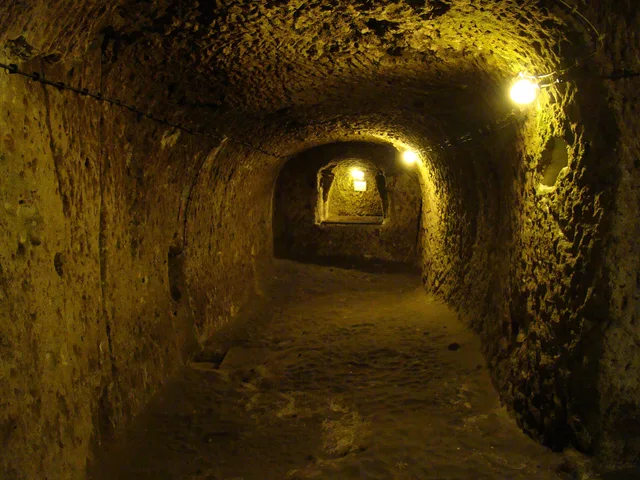
For a deliberately different cave story, read about Derinkuyu’s excavated underground spaces. A river-carved passage and a human-cut underground settlement need different explanations.
Questions that come up
How long is the cave? The passage is several kilometres, commonly cited around seven kilometres. Exact figures vary by source.
Do I get wet? Probably, at least feet and legs.
Is it suitable for children? Many families do it, but consider the darkness, water and walking.
Can I swim in the cave? No. Stay with the boat and crew.
Is it open in the wet season? Often, but trips can be stopped by high water.
Can I go without the boat, on foot or by kayak? No independent entry. The managed boat trip is the visitor route; kayaking or walking the passage on your own exposes you to flood risk and is not permitted as an ordinary visit.
Is it frightening? For most people it is exciting rather than frightening, but the darkness is complete outside the beams of lights and the boat is small. If you are claustrophobic or anxious in water, the very large passage helps; the shallows and stepping in and out are the hardest part for many.
Will my phone photos work? In most of the passage, only what your light reaches will appear. The lit formation area and the two entrances are where photographs work best. Keep the phone in a waterproof pouch between shots.
The river decides
Kong Lor is not a show cave with fixed paths and handrails. It is a river that happens to run through a mountain, and the trip depends on that river's mood. Knowing this changes how you plan: build in flexibility, respect the crews, carry your own light and accept that the water decides what you can do on a given day.
That acceptance is also the most useful way to understand the place. The passage exists because a river was patient enough to dissolve a mountain; the villages exist because people learned when the passage could be used; the visitor trip exists because those people now share their knowledge of the water with strangers for a fee. When the boat comes out into the green light of the far valley, you have travelled the route the river chose, at the pace the crew judged safe. That is a better thing to have experienced than any conquered cave.
Sources and confirmation routes
The first draft was prepared without live web access. The director checked the specific official records cited in the revised text on 17 October 2026. Current fees, departures and unconfirmed details still require confirmation before publication.
- Lao tourism information
- Khammouane provincial tourism office, Thakhek
Photograph credits
- Kong Lor Documentary 1 · Alexander Blecher, blecher.info , all 452 pictures , overview · 20 March 2015 · CC BY-SA 4.0. Resized and converted to WebP; the hero may be cropped by the layout. These adaptations remain available under their respective licences.
- Kong Lor Documentary 2 · Jakub Hałun · 2017-11-20 10:01:29 · CC BY-SA 4.0. Resized and converted to WebP; the hero may be cropped by the layout. These adaptations remain available under their respective licences.
- Kong Lor Documentary 3 · Alexander Blecher, blecher.info , all 452 pictures , overview · 20 March 2015 · CC BY-SA 4.0. Resized and converted to WebP; the hero may be cropped by the layout. These adaptations remain available under their respective licences.
- Kong Lor Documentary 4 · Jakub Hałun · 2017-11-20 08:25:19 · CC BY-SA 4.0. Resized and converted to WebP; the hero may be cropped by the layout. These adaptations remain available under their respective licences.
- Kong Lor Documentary 5 · Busy · 2013-07-21 12:25:21 · CC BY-SA 3.0. Resized and converted to WebP; the hero may be cropped by the layout. These adaptations remain available under their respective licences.
Packing graphics: AI-generated editorial illustrations. Portrait supplied by Sok Heng Oeun.
A closer look.
The place, its details and its setting in dated photographs. Historical views do not establish today’s access or visitor conditions.

Sok Heng Oeun
Sok Heng Oeun is the owner and editor of Hidden Corners. The Hidden Corners Editorial Team supports image preparation and editorial checks under his direction.
Sok Heng Oeun on Facebook ↗AI-assisted preparation · Editorial review by Sok Heng Oeun, 19 October 2026. This article does not claim a firsthand team visit.