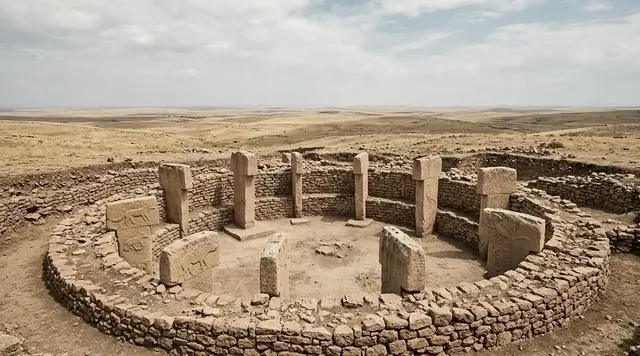
AI illustration
 Written and edited by
 The 2023 accounts of Kalaallit Airports Holding A/S set out a DKK 5,100m financing plan in which the Government of Greenland injects DKK 2,400m of equity and the Danish state DKK 700m. Greenland's contribution is 3.4 times Denmark's, and the figure is not a matter of interpretation: it is a line in a signed, audited set of accounts, and the Danish share was capped at DKK 0.7bn by a Greenlandic statute two months before Denmark agreed to pay it. By the 2025 accounts the plan has grown to DKK 5,266m, DKK 2,599m has been written off, and the company that owns the runways has negative equity.
Silence Index — D-174
Busy
Ranks 96 of 99 scored dossiers — quieter than 3% of the others we have scored. A low score is not a warning; it describes who else will be standing next to you.
How the total is weighted. These are the fixed weights of the four inputs, the same on every dossier — not this place’s scores. We do not publish per-input bars, because the per-input values were never recorded article by article and inventing four plausible numbers that sum to the total would be a fabrication dressed as a chart.
This dossier was scored before 2 September 2026, when the fourth input became night darkness. It keeps the input it was reasoned with until it is re-scored at its next source re-check; the methodology page records the change.
The index is a desk instrument scored by this publication, not a field measurement. How it is calculated, and where it fails.
What this dossier is built from
Nobody from this publication has been to Greenland. This is an audit of documents rather than of a place: four annual reports filed by the companies that own the runways, two Danish finance acts, one Greenlandic statute, the Nordic Investment Bank's loan record, a Danish Ministry of Finance announcement, Statistics Greenland's yearbook, three Visit Greenland statistical reports, the UNESCO record for the Ilulissat Icefjord, the operator's own press releases, and Air Greenland's published results. Every figure below is traced to one of those. Where two official sources give different numbers for the same quantity, both are printed and both are named.
The question is narrow and it has a filed answer. Two 2,200-metre runways have been built in Greenland, replacing a 950-metre strip at Nuuk and an 845-metre strip at Ilulissat. Somebody paid for them. The accounts say who, line by line, and the line items are not the ones that circulate.
The financing plan, as filed
Kalaallit Airports Holding A/S — since restructured and renamed Greenland Airports – Mittarfeqarfiit A/S — published a group financing plan in its 2023 annual report. Six lines, in millions of Danish kroner:
- Equity injection from Grønlands Selvstyre, the Government of Greenland — 2,400
- Equity injection from the Danish state — 700
- State re-lending via Danmarks Nationalbank — 1,050
- Loan from the Nordic Investment Bank — 450
- New commercial loan — 500
- Total financing — 5,100
The report's own sentence is flat: Grønlands Selvstyre indskyder 2,4 mia. kr. i Kalaallit Airports Holding A/S. Greenland's equity contribution is 3.4 times Denmark's. The same report puts group equity at 31 December 2023 at DKK 2,010.1m — share capital of DKK 2,391.0m less DKK 380.9m of accumulated losses — and records DKK 386m paid in by the Government of Greenland during that year alone. Ownership of the international-airports subsidiary is given as 66.66 per cent; the parent's 2024 report states the same split as two-thirds to the parent and one-third to the Danish state.
The plan was restated once before the big write-down. The international company's 2024 table drops the DKK 500m commercial loan, adds a new financing framework of DKK 1,100m, DKK 94m of subordinated loan capital and DKK 32m of debt arising on the purchase of the runways themselves, and totals DKK 4,826m. The accompanying note is candid about why: the construction sums for the two airports had been reassessed, with increased regulatory requirements and higher construction costs incorporated. That is filed language for an overrun, written a year before anyone announced one.
Drop one level, to the company that actually holds the two international runways, and the arithmetic gets cleaner still. Its 2023 plan reads: equity from the Greenlandic parent 1,400; equity from the Danish state 700; state re-lending 1,050; Nordic Investment Bank 450; new commercial loan 500; total 4,100. Fourteen hundred against seven hundred is exactly two to one. The ownership split is not a political gesture. It is the equity ratio.
What popular coverage gets wrong
The circulating version, which runs through general news coverage of the Arctic and is then inherited almost intact by travel writing, is that Denmark financed Greenland's airports — a geopolitical favour, framed either as Copenhagen displacing Chinese construction interest or as a response to Washington. In the travel register it compresses further, to a single sentence: Denmark has built Ilulissat a jet runway.
Three things are wrong with that.
First, the majority funder is Greenland. Denmark's DKK 700m of equity is 13.7 per cent of the DKK 5,100m plan and 13.3 per cent of the restated DKK 5,266m one. Greenland's DKK 2,400m is 47.1 per cent of the first. Denmark did not build these runways; it took a minority stake in the company that did.
Second, most of what Denmark did put in is a loan, and the finance act says so. Danish re-lending via Nationalbanken runs to DKK 1,050m plus a further DKK 1,140m authorised in 2025, against which the airport company pays the state a commission of 0.15 per cent of the nominal outstanding on the first DKK 450m and 1.30 per cent a year beyond it, and carries a risk premium set at 1.73 per cent annually. The Danish finance bill for 2026 is unambiguous about the end of the arrangement: Alle lån skal være tilbagebetalt i 2052. Denmark is a lender at a commission, not a donor.
Third, the ceiling on Denmark's equity was set in Nuuk, not Copenhagen. Inatsisartutlov nr. 4 af 22. november 2018 — the Greenlandic statute establishing the framework for the airports — provides at §5 that Grønlands Selvstyre secures the company share capital and subordinated loan capital of up to DKK 2.1bn, and at §6 that the state may subscribe up to DKK 0.7bn in the international-airports subsidiary. Greenland's parliament wrote the Danish number into Greenlandic law. The Danish finance bill then repeats it verbatim: Den danske stats bidrag udmøntes i et kapitalindskud på 700,0 mio. kr.
Seven hundred against four hundred and fifty
A DKK 450m figure attaches itself to Denmark's contribution in most retellings, and it is worth being exact about why. The Danish finance bill for 2020 sets out the 2018 package in one sentence: the Danish state's contribution is delivered as a capital injection of DKK 700m, a re-lending facility of DKK 450m and a state guarantee of DKK 450m to Kalaallit Airports International A/S.
So there are three separate DKK 450m items in the same package — a re-lending facility, a state guarantee, and, quite separately, the Nordic Investment Bank's own DKK 450m loan, signed on 31 May 2019 with a twenty-year maturity and recorded by the bank as EUR 63.3m. The 450 that circulates as Denmark's stake is a facility limit and a guarantee ceiling, not equity. Denmark's equity is 700, in the Greenlandic statute of November 2018, in the Danish finance bill for 2020, in the Danish finance bill for 2026, and in every set of company accounts from 2023 to 2025. We print both numbers because both are genuinely in the record; we do not treat them as competing versions of the same line, because they are not.
One further correction to the geography of the money. The Nordic Investment Bank is not a neutral third party in this. Denmark holds 21.1 per cent of NIB's authorised capital, EUR 1.76bn of EUR 8.37bn, behind Sweden's 34.6 per cent and Norway's 21.5 per cent. On our own arithmetic that is roughly DKK 95m of proportionate Danish exposure inside the NIB line — and the Danish state separately guarantees the whole DKK 450m under the 2018 package. The guarantee is not the loan, and neither is a gift.
The restatement, and a company that has lost its capital
The plan did not hold. Greenland Airports International A/S filed a new financing table for 2025 with eight lines and a total of DKK 5,266m: parent equity 1,400; Danish state equity 700; state re-lending 1,050; Nordic Investment Bank 450; new re-lending 1,140; a construction grant carrying no repayment obligation of 400; subordinated loan capital 94; and DKK 32m of other debt arising on the purchase of the runways at Nuuk and Ilulissat. The DKK 500m commercial loan that appeared in the 2023 plan is gone from the table without explanation.
The Danish Ministry of Finance announced the addition on 2 July 2025: approximately DKK 1.5bn, of which roughly DKK 1.1bn in further state loans and DKK 0.4bn as a construction grant, on the stated ground that anlægsprojektet i Ilulissat har vist sig dyrere end tidligere forventet. The Finance Minister, Nicolai Wammen, is quoted saying the state wishes to help the company finish the Ilulissat airport. The 2025 accounts record the re-lending framework at DKK 1,140m with DKK 800m drawn.
Then the write-down. The 2025 accounts impair the two airports by DKK 2,599m — DKK 806m at Nuuk and DKK 1,793m at Ilulissat — on the stated grounds that project costs have risen and that expected cash flows from the opening of Nuuk have not developed as expected. The two airports were tested as separate cash-generating units. The result for 2025 is a loss of DKK 2,424.8m. Equity falls from DKK 2,186.3m at the end of 2024 to minus DKK 238.5m, against share capital of DKK 943.7m and accumulated losses of DKK 1,182.2m. The report states plainly that the company has lost more than half its share capital and is therefore inside the Danish Companies Act's capital-loss rules, while noting that the matter concerns equity and not liquidity. The auditors, Grønlands Revision, signed with an emphasis of matter on valuation uncertainty at both airports.
Cost per passenger, and what the money bought
Two official series exist for international air passengers to Greenland in 2025 and they do not agree. Statistics Greenland's yearbook gives 114,431. Visit Greenland's Tourism Statistics Report 2025 gives 126,436, a rise of 20.1 per cent, with Nuuk at 93,753, Kangerlussuaq at 8,179, Narsarsuaq at 4,333 and Ilulissat at 3,242. We have not reconciled them and we do not average them.
On our own arithmetic across those two figures, the DKK 5,266m plan works out at between DKK 41,650 and DKK 46,020 of capital for each international air passenger the country received in 2025. For scale, Denmark's block grant to Greenland was DKK 4,323.7m in 2024, so the airport programme is roughly 1.2 times one year's block grant; Greenland's GDP was DKK 16,260m on the 2023 preliminary figure. Set against that, the Danish money that never has to come back — DKK 700m of equity plus the DKK 400m construction grant, DKK 1,100m in all — is 20.9 per cent of the programme, and about 4 per cent of the DKK 27.4bn Denmark committed to Arctic and North Atlantic defence over 2025–2033 in the sub-agreement of 10 October 2025.
What the money bought is visible in the traffic. Nuuk's own accounts record 181,172 departing passengers in 2025, against 10,192 passengers in the airport's first thirty-four days of operation in 2024. Visit Greenland's series shows the switch rather than growth: Kangerlussuaq's international passengers fell 88.2 per cent in 2025 while Nuuk's rose 729 per cent. Total overnight stays reached 396,846, up 14.6 per cent, split almost exactly evenly between residents and international visitors.
A runway with a rate limit
Nuuk opened on 28 November 2024. On 22 September 2025 the Danish civil aviation and railway authority imposed an immediate directive limiting the airport to a maximum of two arrivals, four departures and four total movements per hour, with at least five minutes between movements and twenty minutes between consecutive arrivals, and helicopters restricted to one local operation at a time within twenty nautical miles. Air Greenland's Chief Operating Officer, Line Frederiksen, stated that the airline had previously run up to eight movements an hour during transatlantic connections and that approximately 40 per cent of same-day connections between the coast and Nuuk could no longer be maintained.
The cause was not the runway. The operator's own account is that traffic in the lower airspace, below roughly six kilometres, had been managed by pilots separating themselves, and that a controlled terminal area was needed. That terminal area went live at 06:00 local time on 14 May 2026, operated by Naviair's flight information centre in Nuuk, with restrictions to be lifted gradually. A DKK 5.3bn programme delivered a runway that spent nearly eight months rate-limited for want of an air traffic control arrangement.
The airline's numbers show the cost of the transition. Air Greenland's first half of 2025 recorded regularity of 72.0 per cent against 83.9 per cent a year earlier, punctuality of 46.6 per cent against 71.1 per cent, and 59 cancellations against three. Feeder traffic fell by an average of 53 per cent as the Kangerlussuaq hub emptied, with remaining passengers flying routes about 54 per cent longer. The half-year loss before tax was DKK 87.4m. The full year closed at a pre-tax profit of DKK 3.3m.
Ilulissat: a jet runway and 432 rooms
Ilulissat's runway, terminal, service building and AFIS tower were all delivered during 2025, with defect rectification scheduled into 2026. Greenland Airports announced on 26 November 2025 that Qaqortoq would open on 16 April 2026 and Ilulissat in October 2026; Air Greenland announced on 24 February 2026 a direct Ilulissat–Copenhagen service from 29 October 2026, flown initially by a leased Boeing 737-800 of 180 seats until an A320neo arrives in spring 2027.
The constraint waiting at the other end is beds. Visit Greenland's capacity analysis for Ilulissat 2026–2031, prepared with Avannaata Kommunia and the local destination organisation, counts 432 rooms in the town in 2024, rising to 565 once Hotel Arctic's budget hotel opens, and 658 including the surrounding area. Against a projected increase in seat capacity from abroad of about 100 to 150 per cent between 2024 and 2026, it models a shortfall of 190 rooms in July and August 2026 in the higher scenario and 62 rooms in July in the lower one, rising by 2031 to a deficit of between 696 and 954 rooms on 15 per cent annual growth. More than two-thirds of the year's visitors arrive between June and September. Occupancy in the town already ran at 86.0 per cent in July 2023.
Ilulissat is a settlement of 5,150 people at 1 January 2026 sitting beside a UNESCO World Heritage property of 399,800 hectares with a 64,890-hectare buffer, inscribed in 2004 for the Sermeq Kujalleq glacier, which moves at around 40 metres a day and calves more than 46 cubic kilometres of ice a year — a tenth of all calf ice produced in Greenland. UNESCO's own record states that the management plan addresses rapidly increasing tourism and in particular pressure from cruise ships and helicopter traffic. That plan predates the runway.
Why the Silence Index is 36, and what the next accounts must say
Four inputs, weighted 30/30/20/20. Physical remoteness scores 68: this is west Greenland, on an island of 2,166,086 square kilometres of which 410,449 are ice-free, with a national population of 56,740. Access friction scores 12, and it is the input that sinks the whole score — the entire point of DKK 5.3bn was to abolish access friction, and it worked. There is no permit, no invitation letter and no closed zone; there is a scheduled jet, a terminal and a ticket. Visitor volume scores 14: 126,436 international air passengers in 2025 is a small number in absolute terms but they arrive through two doors and concentrate in four months. Unresolved questions score 46, because the out-turn cost of Ilulissat is not yet filed and DKK 2,599m has already been written off a project that is not finished. That gives 36.0. We have rounded to 36.
This is the lowest score we have awarded in some time, and deliberately so. An archive whose median sits at 78 needs to be able to say that a capital city with a 2,200-metre runway and a Copenhagen flight is not remote in the sense the index measures.
Three things are outstanding and all of them will appear in filings rather than in coverage. Whether the DKK 2,599m impairment is the end of it, or whether the 2026 accounts carry more once Ilulissat's final out-turn is known. Whether the capital-loss position is cured by a further injection, and from whom — the Greenlandic parent, the Danish state, or both in the ratio that fixes the ownership split. And whether the DKK 500m commercial loan that vanished between the 2023 and 2024 tables was ever sought.
The framing this dossier set out to correct will probably survive all of it, because the framing does not depend on the numbers. What the numbers show is narrower and duller than geopolitics. A small country borrowed heavily against its own balance sheet, took a minority partner for a fifth of the money, wrote off half the book value of the asset before the second runway opened, and now owns two-thirds of a company with negative equity and a jet runway at each end of its western coast. That is not a favour granted. It is a country buying its own front door on credit, and the invoice is filed under section 40.21.07 of the Danish finance act, where anyone can read it.
Corner Codex — D-174
- Subject
- Two 2,200 m runways: Nuuk (opened 28 November 2024) and Ilulissat (due late 2026)
- What they replace
- Nuuk's 950 m strip and Ilulissat's 845 m strip, per the Nordic Investment Bank
- Owner
- Greenland Airports International A/S, CVR 40 14 99 53, Qeqertanut 1, Nuussuaq
- Ownership
- Two-thirds Grønlands Selvstyre via the parent company, one-third the Danish state
- Greenland's equity
- DKK 2,400m into the group; DKK 1,400m of it into the international company
- Denmark's equity
- DKK 700m — fixed by Greenlandic statute in November 2018, not by Danish largesse
- Danish lending
- DKK 1,050m plus DKK 1,140m of re-lending via Nationalbanken, repayable by 2052
- The Danish budget line
- § 40.21.07, Genudlån til Greenland Airports International A/S
- Plan total
- DKK 5,100m in the 2023 accounts; DKK 5,266m in the 2025 accounts
- Written off in 2025
- DKK 2,599m — Nuuk DKK 806m, Ilulissat DKK 1,793m
- Equity at 31 Dec 2025
- Minus DKK 238.5m. The company is inside the capital-loss rules
- International air passengers
- 114,431 in 2025 (Statistics Greenland) or 126,436 (Visit Greenland)
- Silence Index
- 36 / 100
The Traveler's Panel · checked
Changing information. Prices, permits, seasons and road access change, sometimes at short notice. Everything here is a starting point for your own confirmation — not a quote, and not a guarantee. Verify with the operator and the relevant official body before you book.
| Who paid the most | Grønlands Selvstyre — DKK 2,400m of equity into the group |
| Denmark's equity | DKK 700m, capped by Greenlandic statute in November 2018 |
| Denmark's lending | DKK 1,050m plus DKK 1,140m via Nationalbanken, all repayable by 2052 |
| The budget line | § 40.21.07 of the Danish finance act |
| Runways | 2,200 m at Nuuk and at Ilulissat, replacing 950 m and 845 m |
| Open now | Nuuk since 28 November 2024; Qaqortoq since 16 April 2026 |
| Not open yet | Ilulissat — October 2026 on the operator's own announcement |
| Written off in 2025 | DKK 2,599m, leaving the airport company with negative equity |
Getting there — Copenhagen or Keflavik to Nuuk by scheduled jet; Ilulissat direct from Copenhagen from 29 October 2026
- This is one of the few dossiers in this archive where the practical answer is simply: buy a ticket. Nuuk has had a 2,200-metre runway and a scheduled Copenhagen jet since 28 November 2024. There is no permit, no invitation letter, no restricted zone and no ranger. Abolishing the friction was the entire purpose of the DKK 5.3bn, and on that narrow measure the money worked.
- Air Greenland flies Nuuk to Copenhagen at five to eight rotations a week in peak summer, and also connects Nuuk to Keflavik, Aalborg, Billund and, seasonally, Iqaluit. United ran Newark to Nuuk twice weekly in the summer of 2025. Kangerlussuaq retains a twice-weekly Copenhagen service. Those are the routes as published by Visit Greenland in March 2026; schedules in this market have changed every season since the airport opened and should be checked rather than assumed.
- Ilulissat is not yet reachable by direct international jet. Air Greenland has announced a direct Copenhagen service from 29 October 2026, flown at first by a leased 180-seat Boeing 737-800 until an A320neo arrives in spring 2027. Until then the route is via Nuuk or Kangerlussuaq on domestic aircraft, which is what almost every visitor to the Icefjord has always done.
- Expect the domestic legs to be the fragile part. Air Greenland's own half-year figures for 2025 recorded regularity of 72.0 per cent and punctuality of 46.6 per cent, with 59 cancellations against three a year earlier, and reported that roughly 40 per cent of same-day connections between the coast and Nuuk could not be maintained under the movement restrictions imposed in September 2025. Those restrictions were being lifted gradually from 14 May 2026. Build slack into any itinerary that depends on connecting the same day.
- Season matters more than anything else here. More than two-thirds of Ilulissat's visitors arrive between June and September, and occupancy in the town was already running at 86.0 per cent in July 2023, before the runway. If you are going in high summer, the accommodation is the booking that constrains everything else.
Indicative costs — verify before booking
| What it cost to build | DKK 5,266m on the 2025 financing plan, of which Greenland's parent company put in DKK 1,400m of equity and the Danish state DKK 700m |
| Capital per passenger | Between DKK 41,650 and DKK 46,020 for each international air passenger the country received in 2025, on our arithmetic across the two official series |
| What Denmark gets back | DKK 2,190m of re-lending, at a commission of 0.15 per cent to DKK 450m and 1.30 per cent a year beyond, repayable in full by 2052 |
| What nobody gets back | DKK 400m, the construction grant agreed on 2 July 2025, and DKK 2,599m, the 2025 impairment of the two airports |
| Airfares | We will not quote them. Every figure we found came from a seller, and this market has repriced every season since Nuuk opened. Check with the carriers |
| Beds in Ilulissat | 432 rooms in 2024, 565 once Hotel Arctic's budget hotel opens, 658 including the surrounding area — against a modelled shortfall of up to 190 rooms in July and August 2026 |
What to pack
- A tolerance for schedule failure. The domestic network is the weak link, not the international sectors, and the published regularity figures are the airline's own.
- Accommodation booked far ahead if you are travelling to Ilulissat between June and September. The capacity analysis models a room shortfall in exactly those months.
- Clothing for a coast rather than for an ice sheet. Nuuk sits at 5 metres and Ilulissat at sea level; the weather that cancels flights is fog, wind and icing, not cold.
- Cash discipline. Greenland's GDP was DKK 16,260m on the 2023 preliminary figure for a population of 56,740, and prices in the towns reflect a small, import-dependent economy.
- Realistic expectations about the airport itself. Nuuk is a working regional terminal with a long runway, not a monument, and the tower controlling its airspace only began operating in May 2026.
Where to stay
Accommodation is the binding constraint on this story, and the numbers are published. Visit Greenland's capacity analysis for Ilulissat counts 432 rooms in the town in 2024, rising to 565 once Hotel Arctic's budget hotel opens and 658 if the surrounding settlements are included, against a modelled increase in seat capacity from abroad of somewhere between 100 and 150 per cent across 2024 to 2026. In the higher scenario that is a shortfall of 190 rooms in July and August 2026; by 2031, on 15 per cent annual growth, the modelled deficit runs to between 696 and 954 rooms. Occupancy in the town was already 86.0 per cent in July 2023 and 85.1 per cent in August, before any of the new capacity arrived. Nuuk, with 20,304 residents at 1 January 2026, has more stock and a working business-travel market to absorb it, and Visit Greenland has published a separate capacity analysis for the capital covering 2025 to 2030. The practical advice is unglamorous: in high season, secure the room before the flight, because the flight can be rebooked and in Ilulissat in July the room cannot.
Safety & responsible travel
- Do not repeat the line that Denmark built these runways. The filed accounts put Greenland's equity at DKK 2,400m against Denmark's DKK 700m, and most of the Danish money is a loan repayable by 2052.
- Be careful with the Icefjord. UNESCO's own record says the management plan is written against rapidly increasing tourism and specifically against pressure from cruise ships and helicopter traffic. That plan predates the jet runway that is about to open eight kilometres away.
- Use the scheduled aircraft rather than chartering over the ice. Helicopter traffic is one of the two pressures UNESCO names.
- Spend in the towns rather than only through operators headquartered elsewhere. Tourism's direct contribution to Greenland's economy was DKK 1,152m in 2024, about 4.9 per cent of GDP and 1,824 jobs, and the point of the runways was to raise that figure rather than to move visitors past it.
- Do not treat Kangerlussuaq as abandoned. Its international traffic fell 88.2 per cent in 2025, but 381 people still live there, the Danish defence agreement of October 2025 records it as potentially more strategically relevant rather than less, and a twice-weekly Copenhagen service still runs.
Nearby, and quieter
The Ilulissat Icefjord is the reason the runway exists and it sits immediately south of the town: 399,800 hectares inscribed by UNESCO in 2004 under criteria (vii) and (viii), with a 64,890-hectare buffer zone, centred on Sermeq Kujalleq, which moves at roughly 40 metres a day and calves more than 46 cubic kilometres of ice a year — about a tenth of all the calf ice Greenland produces. Kangerlussuaq, 67 degrees north at the head of a 170-kilometre fjord, was until 2024 the country's international gateway and is now a settlement of 381 people whose international passenger count fell 88.2 per cent in a single year; it retains a twice-weekly Copenhagen service and, on the Danish defence agreement of October 2025, a military future. Qaqortoq in the south, population 3,081, received the third airport in the 2018 statute and opened on 16 April 2026, funded through the Regional company rather than the International one and written down by DKK 286m in the 2024 accounts before it carried a single passenger. Nuuk itself, at 20,304 people, is the smallest national capital in the world to have gained a 2,200-metre runway in living memory.
Getting there, in order
- 1Nuuk Airport
- 2Nuuk
- 3Ilulissat Airport
- 4Kangerlussuaq Airport
Each leg is a separate booking and a separate chance to be weathered out. Build spare days into the chain, not onto the end of it.
Where it is
Nuuk and Ilulissat international airports, west Greenland · 66.7000°N 51.3000°W · Open in Google Maps · OpenStreetMap
Key locations
- Nuuk Airport — the 2,200 m runway opened 28 November 2024; 181,172 departing passengers in 2025
64.1908°N 51.6781°W - Nuuk — capital, 20,304 residents at 1 January 2026 (Statistics Greenland)
64.1833°N 51.7214°W - Ilulissat Airport — gazetteer coordinate for the existing field; the new 2,200 m runway is adjacent
69.2406°N 51.0633°W - Ilulissat — 5,150 residents; 432 hotel rooms in 2024 rising to 565 in 2026
69.2197°N 51.0986°W - Ilulissat Icefjord — UNESCO property of 399,800 ha inscribed 2004; the coordinate UNESCO publishes
69.1333°N 49.5000°W - Kangerlussuaq Airport — the former hub; international passengers fell 88.2 per cent in 2025
67.0119°N 50.7137°W - Kangerlussuaq — settlement of 381 people, named in the Danish Arctic defence agreement of October 2025
67.0088°N 50.6894°W - Qaqortoq Airport — the third airport in the 2018 statute; opened 16 April 2026
60.7652°N 46.0647°W
Coordinates are for orientation and are accurate to roughly the width of the feature named, not to a doorway. Several of these points are inside protected areas or need a permit, a guide or a boat — read the access notes above before you plan a route to any of them.
Sources & further reading — checked
- Kalaallit Airports Holding A/S — Årsrapport 2023 (published May 2024). The group financing plan in mio. kr.: Greenland equity 2,400; Danish state equity 700; state re-lending via Nationalbanken 1,050; Nordic Investment Bank 450; new commercial loan 500; total 5,100. Group equity DKK 2,010.1m, share capital 2,391.0m, accumulated losses 380.9m; DKK 386m injected by Greenland during 2023; International A/S owned 66.66 per cent
- Kalaallit Airports International A/S — Årsrapport 2023. The subsidiary's own financing plan: equity from the Greenlandic holding company 1,400 and from the Danish state 700, re-lending 1,050, NIB 450, commercial loan 500, total 4,100. Share capital DKK 865m, equity DKK 1,950.3m, 2023 loss DKK 10.4m, balance sheet DKK 3,277.6m; two of six board members appointed by Denmark; Ilulissat runway completion moved to autumn 2026
- Greenland Airports International A/S — Årsrapport 2024. The restated plan totalling 4,826: parent equity 1,400, Danish state 700, re-lending 1,050, NIB 450, a new financing framework of 1,100, subordinated loan capital 94, other debt on the purchase of the runways 32. Equity DKK 2,186.3m, result +DKK 77.6m, balance sheet DKK 4,536.5m; 10,192 passengers used Nuuk from its opening on 28 November 2024
- Greenland Airports International A/S — Årsrapport 2025 (published June 2026). The eight-line plan totalling DKK 5,266m including new re-lending of 1,140 and a non-repayable construction grant of 400; impairments of DKK 2,599m split 806 at Nuuk and 1,793 at Ilulissat; result minus DKK 2,424.8m; equity minus DKK 238.5m against share capital DKK 943.7m; the capital-loss statement; 181,172 departing passengers at Nuuk; CVR 40 14 99 53
- Greenland Airports – Mittarfeqarfiit A/S — Årsrapport 2024. The parent owning two-thirds of Greenland Airports International A/S with the Danish state holding one-third, and 100 per cent of the Regional company. Group equity DKK 2,604.1m, share capital DKK 2,491.0m, revenue DKK 472.4m, loss DKK 208.5m, balance sheet DKK 5,022.7m; DKK 100m injected by Greenland in 2024; 13 airports and 46 heliports and about 471 employees
- Greenland Airports — press release on the 2024 annual reports (19 June 2025). The Regional company's 2024 operating deficit of DKK 296m, of which DKK 286m is an accounting write-down of the Qaqortoq project, and management's description of the group results as 'tilfredsstillende og forventelige' — satisfactory and expected
- Greenland Airports — 'A landmark year for Greenland Airports' (3 September 2025). The company's own account of 2024: the opening of Nuuk international airport on 28 November, the merger of the Construction company into the Regional company, and the statement that Ilulissat and Qaqortoq were expected to open in 2026, with the annual reports published separately
- Greenland Airports — 'Restrictions Challenge Air Greenland's Flight Schedule' (26 September 2025). The 2-2-4 model imposed by the Danish civil aviation and railway authority with effect from 22 September 2025 — two arrivals, four departures and four movements an hour, five minutes between movements, twenty between arrivals — and Line Frederiksen's statement that roughly 40 per cent of same-day coast connections could no longer be maintained
- Greenland Airports — 'Status of Restrictions at Nuuk Airport' (5 December 2025). The operator's explanation that the constraint is airspace management below roughly six kilometres rather than runway capacity, the terminal management area solution with Naviair, and the expectation that it would become operational in summer 2026
- Greenland Airports — 'New Air Traffic Control Solution Prepares Nuuk Airport for Increased Traffic' (13 May 2026). The terminal manoeuvring area becoming operational at 06:00 local time on 14 May 2026, staffed by Naviair's flight information centre in Nuuk with hours of 06:00 to 21:00, and the statement that the movement restrictions were expected to be lifted gradually
- Greenland Airports — 'Airport opening dates for Qaqortoq and Ilulissat airports' (26 November 2025). Qaqortoq confirmed for 16 April 2026 and Ilulissat for October 2026, with runways and buildings handed over and interiors, equipment and testing outstanding, quoting programme manager Anna Eva Villefrance
- Greenland Airports — 'Experienced CEO to lead Greenland Airports into its next phase' (20 July 2026). Jeppe Jensen appointed chief executive from 1 November 2026 with Jens Lauridsen leaving once Ilulissat opens, and the company's statement that its focus is shifting from construction to operations — confirming that Qaqortoq had opened and Ilulissat had not
- Greenland Airports — Our Organization. The merged entity's own description: infrastructure for air transport and cargo at 13 airports and 46 helipads from Qaanaaq to Nanortalik, three new airport projects at Nuuk, Ilulissat and Qaqortoq, and the current board and executive team
- Kalaallit Airports Gruppen — Om os (ownership and group structure). The holding company described as 100 per cent owned by Grønlands Selvstyre, owning the international company jointly with the Danish state at 66.7 and 33.3 per cent, Domestic at 100 per cent, and Mittarfeqarfiit A/S incorporated on 30 December 2022, with Denmark appointing two board members to the international company
- Nordic Investment Bank — loan record, Kalaallit Airports International A/S (22806). DKK 450m, equivalent to EUR 63.3m, at a twenty-year maturity, signed 31 May 2019; new 2,200 m runways at Nuuk replacing 950 m and at Ilulissat replacing 845 m, the latter converted to an access road; classified Category A, with expected annual increases of 11 tonnes of nitrogen and 5,000 tonnes of CO2
- Nordic Investment Bank — 'A new gateway to Greenland's future'. The lender's own account of the project: 2,200 m runways at both Nuuk and Ilulissat, a Copenhagen to Nuuk sector of four hours fifty minutes, the 28 November 2024 opening, Nuuk's 2023 traffic of 39,881 passengers up 18.8 per cent, and quotes from NIB's Harald Rokke and from Jens Lauridsen
- Nordic Investment Bank — Who we are / About. The bank's ownership: Sweden 34.6 per cent, Norway 21.5, Denmark 21.1 (EUR 1,763,074,493.79), Finland 17.7, Lithuania 2.0, Latvia 1.3, Iceland 0.9 and Estonia 0.9, of authorised capital of EUR 8,368,844,474.11 — the basis for this dossier's estimate of Danish exposure inside the NIB line
- Danish Ministry of Finance — 'Yderligere finansieringsbidrag til selskabet Greenland Airports International A/S' (2 July 2025). Approximately DKK 1.5bn of further Danish financing — about DKK 1.1bn in state loans and DKK 0.4bn as construction grants — on the stated ground that 'anlægsprojektet i Ilulissat har vist sig dyrere end tidligere forventet', with Nicolai Wammen quoted and Denmark described as a minority owner since 2019
- Danish Ministry of Finance — Forslag til finanslov for finansåret 2020, § 40. Genudlån mv.. The sentence that reconciles the competing figures: 'Den danske stats bidrag udmøntes i et kapitalindskud på 700 mio. kr., en genudlånsfacilitet på 450 mio. kr. og en statsgaranti på 450 mio. kr. til selskabet Kalaallit Airports International A/S', plus the 0.15 per cent commission and the 1.73 per cent annual risk premium
- Danish Ministry of Finance — Forslag til finanslov for finansåret 2026, § 40. Genudlån mv.. Account 40.21.07, Genudlån til Greenland Airports International A/S, with a framework of DKK 1,050.0m and a further DKK 1,140m nominal under tekstanmærkning 112 for Ilulissat, a state guarantee of DKK 450.0m, commission of 0.15 per cent to DKK 450m and 1.30 per cent a year beyond, and the requirement that all loans be repaid in 2052
- Nalunaarutit — Inatsisartutlov nr. 4 af 22. november 2018 om rammebetingelser for anlæg, drift og finansiering af international lufthavn i Nuuk og i Ilulissat samt regional lufthavn i Qaqortoq. The Greenlandic statute setting the money: §5 securing the company share capital and subordinated loan capital of up to DKK 2.1bn from Grønlands Selvstyre, §6 stk. 2 permitting the state to subscribe up to DKK 0.7bn in the international-airports subsidiary, and §6 stk. 3 authorising Naalakkersuisut to conclude a shareholders' agreement with the Danish government
- Danish Ministry of Defence — Delaftale 2 om Arktis og Nordatlanten under forsvarsforliget 2024-2033 (10 October 2025). The DKK 27.4bn Arctic and North Atlantic package for 2025-2033 used here as a scale comparison, together with its passages on Kangerlussuaq's continuing military relevance, runway and hangar improvements there, and a new Arctic Command headquarters and dedicated naval quay at Nuuk
- Statistics Greenland — Greenland in Figures 2026 (23rd edition, editorial deadline May 2026). Population of 56,740 at 1 January 2026, Nuuk 20,304, Ilulissat 5,150, Qaqortoq 3,081 and Kangerlussuaq 381; total area 2,166,086 km2 with 410,449 km2 ice-free; GDP DKK 16,260m on the 2023 preliminary figure; 14 airports and 43 helipads; 114,431 international air passengers in 2025; and a Danish block grant of DKK 4,323.7m in 2024
- Statistics Greenland Statbank — Number of international passengers by airport, month and time (TUXUPAX / TUEUPAX). The official table's own metadata: airports covered are Total, Kangerlussuaq, Narsarsuaq, Kulusuk, Nerlerit Inaat, Nuuk, Ilulissat and Qaqortoq, with annual values from 2008 to 2026 — establishing that Qaqortoq entered the national series only as its airport opened
- Statistics Greenland Statbank — Tourism, flight passenger tables (TU20). The three published flight-passenger tables — passengers travelling from Greenland on chartered and scheduled flights, domestic passengers, and international passengers by airport and month — which together are the only official passenger series for the two new airports
- Visit Greenland — Turismestatistikrapport Grønland 2024. 2024 air passengers of 105,242 against 104,791 in 2023, with Kangerlussuaq at 69,447 (down 8 per cent), Nuuk at 11,306 (up 81.8 per cent, of which 6,910 in November and December), Ilulissat at 3,816 and Narsarsuaq at 5,997; 355,744 overnight stays; 95,185 cruise passengers; and a warning that unregistered country of residence rose to 58 per cent of air passengers
- Visit Greenland — Tourism Statistics Report 2025. 126,436 international air passengers in 2025, up 20.1 per cent, with Nuuk at 93,753 (up 729 per cent), Kangerlussuaq at 8,179 (down 88.2 per cent), Narsarsuaq at 4,333 and Ilulissat at 3,242; 396,846 overnight stays split almost evenly between residents and visitors; and 93,897 unique cruise passengers making 213,674 shore landings
- Visit Greenland — Kapacitetsanalyse for Ilulissat 2026-2031. 432 rooms in Ilulissat in 2024, 565 once Hotel Arctic's budget hotel opens and 658 including the surrounding area; seat capacity from abroad modelled to rise 100 to 150 per cent by 2026; shortfalls of 62 to 190 rooms in July and August 2026 and 696 to 954 by 2031; July 2023 occupancy of 86.0 per cent
- Visit Greenland — The Greenland Tourism Satellite Account 2024 (prepared by Ramboll, published May 2025). Tourism's direct contribution of DKK 1,152m, equal to 4.9 per cent of GDP; 1,824 people employed on average per month, 6.2 per cent of total employment; internal tourism consumption of DKK 2,979m, 58 per cent inbound and 42 per cent domestic; built on the TSA:RMF 2008 framework
- Visit Greenland — Analyses (Greenland Tourism Statistics). The publisher's index of quarterly and annual statistics, regional and market analyses, capacity analyses, sentiment surveys, economic impact studies and satellite accounts — the route by which the Ilulissat capacity analysis and the 2024 and 2025 statistics reports were located
- Air Greenland — Group Annual Report 2024. The airline 100 per cent owned by the Government of Greenland since 2019; 548,000 passengers in 2024 against 556,000 in 2023; revenue DKK 1,863.9m and pre-tax profit DKK 60.8m; the A330-800neo Tuukkaq; and DKK 475m of investment in hangars and equipment required by the new airports which will not immediately generate revenue
- Air Greenland — Group Interim report H1 2025. Revenue of DKK 885.3m and a pre-tax loss of DKK 87.4m; regularity down to 72.0 per cent from 83.9 and punctuality to 46.6 from 71.1; 59 cancellations against three; feeder traffic down an average 53 per cent as the Kangerlussuaq hub emptied, with remaining passengers flying about 54 per cent longer routes
- Air Greenland — 'Air Greenland stabilises operations after a year of significant operational challenges' (2025 full-year results). A 2025 pre-tax profit of DKK 3.3m and fixed-asset investment of DKK 248.4m, with an outlook of DKK 60-70m for 2026; the airline's attribution of the year's disruption to start-up problems at the new Nuuk airport and to the ending of Nuuk-Kangerlussuaq feeder traffic
- Air Greenland — 'New winter flight schedule 2026 for Ilulissat' (24 February 2026). A direct Ilulissat to Copenhagen service launching on 29 October 2026, flown initially by Jettime with a 180-seat Boeing 737-800NG until Air Greenland receives the A320neo Unaaq in spring 2027, at one weekly rotation rising to two in peak season
- Visit Greenland — New Flight Schedule Makes Greenland More Accessible (updated 27 March 2026). The route map after Nuuk opened: Air Greenland Nuuk-Copenhagen at five to eight weekly in peak summer, Kangerlussuaq-Copenhagen twice weekly, Nuuk to Keflavik, Iqaluit, Aalborg and Billund, and United's twice-weekly Newark-Nuuk service from June 2025; published by an operator wholly owned by the Government of Greenland
- UNESCO World Heritage Centre — Ilulissat Icefjord (ref. 1149). Inscribed 2004 under criteria (vii) and (viii); 399,800 hectares of property and a 64,890-hectare buffer zone at N69 7 60 W49 30 0; Sermeq Kujalleq moving at about 40 m a day and calving over 46 cubic kilometres a year, a tenth of Greenland's calf ice; and a management plan addressing cruise and helicopter pressure
- GeoNames gazetteer — Nuuk and Nuuk Airport, Greenland. Nuuk at 64 deg 11 min 0 sec N, 51 deg 43 min 17 sec W, and Nuuk Airport at 64 deg 11 min 27 sec N, 51 deg 40 min 41 sec W at 86 m elevation — the coordinates used in this dossier's panel, with a gazetteer population of 14,798 well below the current official figure
- GeoNames gazetteer — Ilulissat and Ilulissat Airport, Avannaata, Greenland. Ilulissat town at 69 deg 13 min 11 sec N, 51 deg 5 min 55 sec W and Ilulissat Airport at 69 deg 14 min 26 sec N, 51 deg 3 min 48 sec W at 29 m elevation — the airport coordinate is the existing field, the new runway being adjacent and unpublished in any gazetteer we could find
- GeoNames gazetteer — Kangerlussuaq and Kangerlussuaq Airport, Qeqqata, Greenland. Kangerlussuaq settlement at 67.00876 N, 50.68937 W with a gazetteer population of 508, and Kangerlussuaq Airport at 67.01185 N, 50.71366 W at 50 m elevation — the hub whose international traffic fell 88.2 per cent in 2025
- GeoNames gazetteer — Qaqortoq and Qaqortoq Airport, Kujalleq, Greenland. Qaqortoq at 60.71839 N, 46.03561 W with a gazetteer population of 3,224, and Qaqortoq Airport at 60.7652 N, 46.06465 W — the third airport in the 2018 statute, opened on 16 April 2026 and funded through the Regional rather than the International company
Official and scientific bodies are the authority for safety, regulatory and scientific claims. Commercial operators are used only for practical detail such as tour length, meeting points and indicative pricing — never for a safety or scientific statement.
How this was made
Desk research. Compiled from official bodies, scientific and conservation sources, established journalism and licensed operators. Not based on a personal visit.
Editor’s method note — what we checked, corrected and could not verify
- Desk research only. Nobody from this publication has been to Greenland, and this dossier makes no claim to have stood on either runway. It is an audit of filed documents.
- Every URL cited was opened and read before citation. Sources that could not be opened or that returned no machine-readable text are listed at the end of this note and are not cited anywhere in the piece.
- The spine of this dossier is the financing plan published in the airport companies' own annual reports for 2023, 2024 and 2025, read as a single time series. We have not seen that series printed anywhere else, and the three tables are not identical: the 2023 group plan totals DKK 5,100m, the 2024 subsidiary plan DKK 4,826m and the 2025 subsidiary plan DKK 5,266m. Group and subsidiary figures are not interchangeable and we have labelled each.
- On the DKK 700m against DKK 450m question, which we were warned about before starting: we have reconciled it from primary documents rather than choosing. The Danish finance bill for 2020 states that Denmark's contribution consists of a capital injection of DKK 700m, a re-lending facility of DKK 450m and a state guarantee of DKK 450m. The Greenlandic statute of 22 November 2018 caps the state's subscription at DKK 0.7bn. The Nordic Investment Bank's own loan is a further, separate DKK 450m. Three DKK 450m items exist in one package and none of them is equity. Both figures are printed in the body and both sources are named.
- We could not open the political agreement of 10 September 2018 itself, nor the signed shareholders' agreement lodged with the Danish Folketing. Every statement in this dossier about the 2018 package therefore rests on the Greenlandic statute, the two Danish finance acts and the companies' own accounts, not on the agreement text.
- Two official series for international air passengers in 2025 disagree: Statistics Greenland's yearbook gives 114,431 and Visit Greenland's Tourism Statistics Report gives 126,436. We print both and name both, and where we compute capital per passenger we give a range across the two rather than a single figure.
- Arithmetic performed by this publication, and labelled as such in the body: the ratio of Greenland's equity to Denmark's; Denmark's non-repayable contribution as a share of the plan; capital per international air passenger; the comparison against the Danish block grant and against the DKK 27.4bn Arctic defence package; and the estimate of proportionate Danish exposure inside the Nordic Investment Bank loan derived from Denmark's 21.1 per cent shareholding in that bank.
- We do not repeat the claim that Denmark financed the airports to displace a Chinese contractor. We could not source the tender chronology from any primary document we were able to open, and a motive is not an accounting entry. The section on popular coverage argues from the capital table only.
- The Nordic Investment Bank's published article on the project gives total investment as USD 300m. That is far below every figure in the companies' filed financing plans for the same two airports. We could not reconcile it and therefore do not use it anywhere in the body.
- Coordinates in the panel come from the GeoNames gazetteer. Gazetteer populations are materially out of date — it gives Nuuk 14,798 against Statistics Greenland's 20,304 at 1 January 2026 — so populations in this dossier come from Statistics Greenland and coordinates from GeoNames. No gazetteer we could find publishes a separate coordinate for the new Ilulissat runway.
- Sources we could not read, and therefore did not cite: the Statsministeriet PDF of the 10 September 2018 agreement, which returned 404 on repeated attempts; the Folketing's copy of the signed shareholders' agreement for Kalaallit Airports International A/S and Aktstykke 292 of 2024-25, both 403; Aktstykke 66 of 2024-25 on the interim Kangerlussuaq arrangement, 403; the 2025 annual reports of Greenland Airports - Mittarfeqarfiit A/S and Greenland Airports Regional A/S, both of which returned no machine-readable text; the generated PDF of the 2018 Inatsisartut law at nalunaarutit.gl, which returned binary data; the Naalakkersuisut register of state-owned companies, blocked by a robots.txt failure; the open-access monograph 'Greenland in Arctic Security', robots-blocked; and the full texts of two peer-reviewed articles on Chinese engagement in Greenland, of which only abstracts were reachable.
- Things we could not verify: the text of the 10 September 2018 political agreement, and therefore whether it describes Denmark's equity as DKK 700m or in some other form; whether the shareholders' agreement contains buy-out or exit terms, which matters because an Inatsisartut committee has pressed for Greenland to acquire Denmark's stake; the final out-turn cost of Ilulissat, which is not yet filed; the consolidated group equity at 31 December 2025 and Greenland's cumulative injections to that date, the 2025 parent accounts being unreadable; whether the DKK 500m commercial loan in the 2023 plan was ever sought or raised, it having vanished from the 2024 and 2025 tables without comment; which of the two official 2025 passenger series is correct; whether Denmark's DKK 400m construction grant appears as a named appropriation account rather than only in the company's own table; whether the hourly movement restrictions at Nuuk have now been lifted in full rather than gradually; the future of civil traffic at Kangerlussuaq beyond the defence agreement's general language; and the exact opening date for Ilulissat, which the operator states only as October 2026.
AI is used to draft this text, and a human checks it. Every figure, date and quotation above was verified by Tony Hall against the source cited for it in the reference list; where sources disagree, the disagreement is shown rather than resolved, and where a claim could not be confirmed it is either marked unverified or left out. The illustrations are AI-created and labelled as such — no photograph on this site is presented as a record of a real place. Full disclosure · Editorial policy.
Access details change — recheck before you travel. Found an error? Tell us — corrections are dated and shown in place.