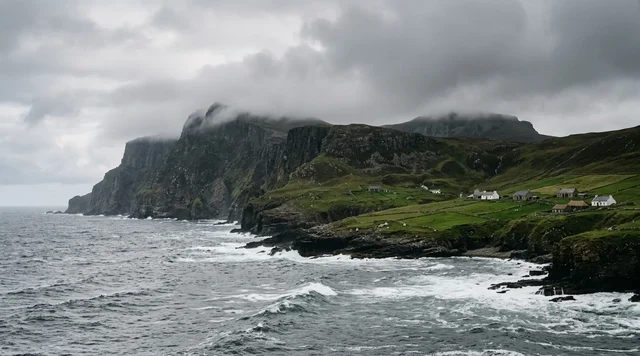
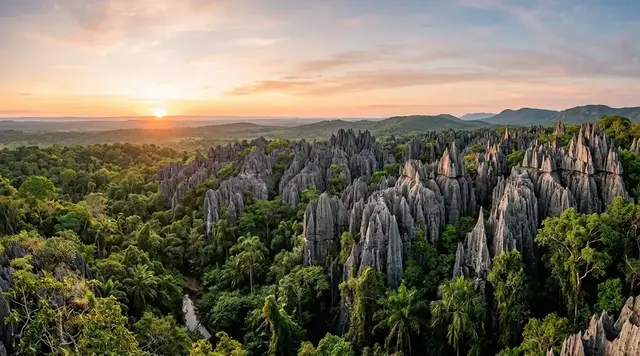
AI illustration
 Written and edited by
 Aldabra was completely under water at some point between 136,000 and 118,000 years ago, and everything living on it died. Flightless rail bones occur in deposits laid down before that drowning and in deposits laid down after it. The same lineage arrived twice from Madagascar and gave up flying twice, the second time in eighty to a hundred and thirty thousand years.
Silence Index — D-054
Effectively unvisited
Ranks 10 of 99 scored dossiers — quieter than 91% of the others we have scored. A low score is not a warning; it describes who else will be standing next to you.
How the total is weighted. These are the fixed weights of the four inputs, the same on every dossier — not this place’s scores. We do not publish per-input bars, because the per-input values were never recorded article by article and inventing four plausible numbers that sum to the total would be a fabrication dressed as a chart.
The index is a desk instrument scored by this publication, not a field measurement. How it is calculated, and where it fails.
This is a desk-researched dossier. Nobody from this publication has been to Aldabra, and almost nobody goes: the atoll averages a few hundred visitors a year under a permit regime run by the Seychelles Islands Foundation. It is built from the primary palaeontology in the Zoological Journal of the Linnean Society and PLOS ONE, SIF's own published material, the UNESCO World Heritage Centre, the IUCN World Heritage Outlook, and peer-reviewed reef, shoreline and marine-litter studies in Coral Reefs and Scientific Reports. Coordinates come from GeoNames.
The drowning, dated
Aldabra is a raised coral atoll, and its stratigraphy records something unusual: a unit called the Aldabra Limestone, dated by ²³⁰Th/²³⁴U to between 118,000 and 136,000 years before present, ± 9,000, which sits over the older deposits and under the younger ones. The palaeontological review by Hume, Martill and Hing is blunt about what that means. All the available geological and palaeontological evidence supports a complete inundation event during this period. Aldabra was seemingly completely submerged between the deposition of the Île Picard deposits and the Point Hodoul deposits, and the terrestrial fauna went locally extinct.
That is the pivot the whole story turns on. Everything on the atoll — tortoises, birds, whatever else — was gone. The land re-emerged, and a genetic calibration puts the last emergence of the Aldabra group at about 0.125 ± 0.02 million years ago.
Two fossil localities bracket the event. Bassin Cabri and Bassin Lebine on Île Picard hold deposits older than 136,000 years. Point Hodoul, on Malabar, is dated to around 100,000 years. Flightless Dryolimnas occurs in both. The pre-inundation specimen falls within the size range of the flightless population living on Aldabra today, which is the evidence that it was similarly flightless in the Upper Pleistocene.
What the 2019 paper actually claims
Hume and Martill's paper is titled, precisely, Repeated evolution of flightlessness in Dryolimnas rails (Aves: Rallidae) after extinction and recolonization on Aldabra. Its claim is that a flightless form of the same genus is present at two temporally separated Aldabran fossil localities deposited before and after the inundation, and that this constitutes fossil evidence for iterative evolution within the rail family.
The companion genetics paper by van de Crommenacker and colleagues puts numbers on the speed. The Aldabra rail shows 2.1 per cent absolute divergence in cytochrome b from the flying Madagascar form and 1.7 per cent from the poorly flying Assumption population; morphometrics show significantly shorter wings and tail and a significantly longer bill. Calibrated against the atoll's last emergence, that places the loss of flight at a maximum of eighty to a hundred and thirty thousand years — among the fastest documented in any bird.
SIF, which manages the atoll, adds the conservation consequence: the divergence is high enough that researchers argue the Aldabra rail should be treated as a full species rather than a subspecies of Dryolimnas cuvieri, which would change how it is managed and assessed. It is, on SIF's own description, the last surviving flightless bird in the western Indian Ocean.
What popular coverage gets wrong
In May 2019 this paper generated a global wave of headlines saying that an extinct bird had come back from the dead, returned to life, or resurrected itself. The framing spread through wire services, aggregators and science-adjacent social accounts, and it is still the version most readers have.
It is wrong in a specific way that matters. Nothing came back. A lineage of rails on Madagascar colonised an empty island, lost flight because there was no ground predator and nowhere to go, and was wiped out when the sea covered the island. Tens of thousands of years later the same still-existing Madagascar lineage colonised the re-emerged island again and lost flight again, for the same reasons. That is two independent evolutionary events with an extinction in between — the opposite of resurrection. The technical term the authors use, iterative evolution, describes a rule about islands, not a miracle about a bird.
Two further corrections belong here. First, the evidence is skeletal. There is no ancient DNA from the pre-inundation fossils, so whether the two flightless populations were the same species by any modern definition is not settled by this work and the authors do not claim it is. The bones say the older bird was flightless and the right size; they do not say it was conspecific with the bird alive today.
Second, the rail is often described as thriving across Aldabra, which understates how narrow the margin has been. Introduced cats extirpated it from Île Picard. It was reintroduced there in 1999, and by 2012 the Picard population had reached almost 3,000 birds against an atoll-wide estimate of about 10,000 breeding pairs. A bird that has lost flight twice on the same island was, in living memory, absent from one of its four.
Why an island does this to birds
The reason the same outcome arrived twice is that Aldabra offers the same conditions twice, and they are unusual conditions.
It is a raised coral atoll of four main islands — Grande Terre, Malabar, Polymnie and Île Picard — separated by narrow tidal passes, wrapped around a lagoon large enough to hold Mahé, the largest inhabited island of the Seychelles. It sits about 1,140 kilometres from that capital by great-circle distance. It has no native land mammal, and therefore no native ground predator capable of hunting an adult rail. Flight is metabolically expensive; on an island with nothing to escape from and nowhere better to fly to, the selection pressure that maintains it simply stops applying. Rails, which disperse far and colonise readily, are the family this happens to most often in the Pacific and Indian Oceans, which is why the fossil record has enough of them to notice a repeat.
The other thing Aldabra offers is an animal that shapes everything else. UNESCO's inscription describes the sole remaining habitat for giant tortoises among the Indian Ocean islands where they once lived, and SIF describes it as the only place in the world where a giant herbivorous reptile is the most dominant animal. Tortoise grazing maintains the turf, the turf maintains the ground-nesting birds, and the whole arrangement runs without a mammal in it. The atoll also holds over 400 endemic species by UNESCO's count and the world's second-largest frigatebird colony by IUCN's.
The numbers that do not agree
Aldabra is heavily studied and its headline figures still disagree, which is worth setting out because a reader who checks will find the discrepancies anyway.
On size: Hume and colleagues give the atoll as 34 km long and 13 km wide with a surface area of 380 km² and a lagoon of 196 km². SIF gives 35 km by 15 km, a land area of around 155 km² and a total protected area of 2,559 km², with the lagoon at 200 km². UNESCO's inscription record states 35,000 hectares — 350 km². These are measuring different things (land, land plus lagoon, the marine reserve) and none of them says which.
On tortoises, the gap is larger and harder to explain. SIF, the site manager, puts the population at approximately 100,000. UNESCO's World Heritage Centre states approximately 152,000. The IUCN World Heritage Outlook assessment finalised on 11 October 2025 says approximately 150,000. All three are describing the same animals on the same atoll and the difference is roughly half a Seychelles' worth of giant tortoise. We print all three and note that the manager's figure is the lowest.
On plastic, the discrepancy is between a paper and its own press release. Burt and colleagues, publishing in Scientific Reports after a five-week clean-up in March 2019, report 25.7 tonnes removed at a cost of US$224,537, an estimated 513 tonnes remaining (95% confidence interval 212–814), a projected US$4.68 million to remove all of it, and approximately 60,000 flip-flops weighing six tonnes among the material collected. The University of Oxford's release on the same study puts the flip-flop figure at 360,000. One of those is a count of what was picked up and the other appears to be an estimate of what is there; neither document says so plainly. What both agree on is the finding that matters: 83 per cent of the remaining litter by weight is fishing-industry material, on an atoll with essentially no permanent human population, supplying tuna markets on the other side of the world.
Whether the atoll is winning or losing
Two long-run measurements point in different directions and both are worth having.
The reefs took a severe hit. Cerutti and colleagues, in Coral Reefs, measured the 2014–2017 global bleaching event at Aldabra and recorded a 66 per cent loss of total live coral — hard corals down 35 per cent at 2 m on the lagoonal reef and 54 to 55 per cent at 5 and 15 m on the seaward reef, soft corals down 93 per cent to under 1 per cent cover, the genus Rhytisma effectively extirpated at over 99.9 per cent. Satellite degree-heating weeks peaked at 3.4°C-weeks in March 2016; in-situ lagoonal sensors recorded 4.8. For comparison, coral cover before the 1998 event exceeded 50 per cent and had fallen to 13.1 per cent at 10 m by November 1999. The 2014–2017 event was proportionally less lethal than 1998, which is a low bar and also a real signal.
Recovery has been quicker than expected. Koester and colleagues found that by 2019 lagoonal hard coral cover had returned to 93 per cent of its pre-bleaching level, with the western seaward site at 68 per cent and the eastern at 54, on annual gains of 3.0, 2.3 and 1.3 percentage points respectively.
The land, meanwhile, is holding. Constance and colleagues compared 1960 aerial imagery with 2011 satellite imagery across 85 per cent of Aldabra's shoreline and found no measurable change along 61 per cent of it, with 12 per cent eroding and 12 per cent accreting at almost identical mean rates of about 0.25 m a year. The extremes were local: 161 m of accretion at La Gigi on Picard, 214 m of erosion at Cavalier on Grande Terre. Against a regional sea-level rise of 2 to 3 mm a year, the atoll maintained its net shoreline and probably its total land area across fifty-one years. The authors are careful that this depends on sediment supply and reef health, which is where the bleaching numbers come back in.
Why the Silence Index is 90
Access friction is near-absolute and it is deliberate. Any visiting vessel must have SIF authorisation before it may anchor in Aldabra waters or go ashore, and the atoll averages 445 tourists a year against a daily impact fee of US$250 per passenger and crew. There is no airstrip on Aldabra. Footfall pressure is therefore among the lowest of any inscribed World Heritage property on Earth. Night darkness is total — the research station runs on a 25 kWp hybrid photovoltaic-diesel system and there is nothing else. What keeps this below the mid-nineties is the acoustic floor: this is one of the loudest wild places in the Indian Ocean, with the world's second-largest frigatebird colony and a hundred thousand or more tortoises moving through the scrub. Silence here means the absence of people, not the absence of sound.
What is coming for it
The IUCN World Heritage Outlook rates Aldabra's conservation outlook as good with some concerns. Its listed threats are climate change and coral mortality, remaining cats and rats after the successful eradication of goats and invasive birds, accumulated marine litter, and development pressure on the neighbouring island of Assumption.
That last one has a paper trail. In March 2018 the World Heritage Centre stated that an agreement had been signed between Seychelles and India regarding Assumption Island — about 27 km from Aldabra — but not ratified, and that an Environmental Impact Assessment examining effects on Aldabra's Outstanding Universal Value would have to be completed before any Seychelles government approval. The Seychelles National Assembly subsequently declined to ratify it. The IUCN's 2025 assessment lists the current Assumption concern as luxury resort construction and the biosecurity risk that comes with a staffed neighbour twenty-seven kilometres upwind of the last place on Earth where a giant reptile is the dominant land animal.
Rats and cats reached Aldabra once and took the rail off Picard. The atoll has already demonstrated what it does when it is emptied: it fills again, and it produces the same bird. That is a reassuring sentence only if you are prepared to wait eighty thousand years.
Corner Codex — D-054
- Place
- Aldabra Atoll, Aldabra Group, Seychelles
- Coordinates
- 9°24′S, 46°22′E — about 1,140 km south-west of Mahé
- Dimensions
- 34 km × 13 km (Hume et al.) or 35 km × 15 km (SIF)
- Lagoon
- 196 km² (Hume et al.) or about 200 km² (SIF) — Mahé would fit inside it
- World Heritage
- Inscribed 1982, criteria (vii)(ix)(x), 35,000 ha
- Giant tortoises
- About 100,000 (SIF) or about 150,000–152,000 (IUCN, UNESCO)
- The inundation
- Aldabra Limestone dated 118,000–136,000 YBP ± 9,000 by ²³⁰Th/²³⁴U
- Loss of flight
- A maximum of 80,000–130,000 years — among the fastest recorded in a bird
- Fossil localities
- Bassin Cabri, Île Picard (>136,000 YBP); Point Hodoul, Malabar (~100,000 YBP)
- Visitors
- An average of 445 tourists a year, on a US$250 per person per day impact fee
- Marine plastic
- 25.7 tonnes removed in 2019; about 513 tonnes estimated remaining
- Silence Index
- 90 / 100
The Traveler's Panel · checked
Changing information. Prices, permits, seasons and road access change, sometimes at short notice. Everything here is a starting point for your own confirmation — not a quote, and not a guarantee. Verify with the operator and the relevant official body before you book.
| Access | Vessel only. SIF authorisation required before anchoring or going ashore |
| Visitor numbers | An average of 445 tourists a year across the whole atoll |
| Impact fee | US$250 per day per passenger and crew, on SIF's own published figure |
| Manager | Seychelles Islands Foundation, a public trust established in 1979 |
| Status | UNESCO World Heritage, inscribed 1982; IUCN outlook good with some concerns |
| The rail | Extirpated from Picard by cats; reintroduced there in 1999 |
Getting there — Mahé → chartered or expedition vessel, about 1,140 km south-west → SIF authorisation → landing at Picard
- There is no airstrip on Aldabra and no scheduled service of any kind. Everyone arrives by sea, and SIF's stated position is that any visiting vessel must receive authorisation before it may anchor in Aldabra waters or go ashore.
- The atoll lies roughly 1,140 km south-west of Mahé by great-circle distance from gazetteer coordinates — closer to the Comoros and northern Madagascar than to the Seychelles capital.
- The research station sits on Île Picard, on the western side of the atoll, and is the normal landing point. SIF keeps a small research and logistics team there year-round.
- The daily impact fee published by SIF is US$250 per passenger and crew member. That is a per head per day charge, not a landing fee.
- SIF publishes separate regulations for tourism, for scuba and snorkelling and for drones. Read those before rather than after committing to a charter.
Indicative costs — verify before booking
| Impact fee | US$250 per day, per passenger and per crew member (SIF) |
| Charter | Not published. This is a vessel charter across 1,100+ km of open ocean |
| Realistic note | The gate here is authorisation, not price. SIF's tourism policy is explicitly limited and strictly controlled |
| What the fee funds | Management of a property with 445 visitors a year and 513 tonnes of other people's plastic on its beaches |
What to pack
- Nothing that could carry a rodent, a seed or an insect. Cats and rats are still present on the atoll and are on IUCN's current threat list; biosecurity is the single most consequential thing a visitor controls.
- Hard-soled footwear. The surface is champignon — undercut fossil coral limestone, and it is as sharp as it looks.
- Sun and heat protection at 9°S with almost no shade on the exposed platform.
- Everything medical. The nearest hospital is over a thousand kilometres away.
- A camera with reach. The tortoises are approachable and the frigatebird colony is not.
Where to stay
There is no accommodation on Aldabra. The research station on Île Picard houses a small SIF research and logistics team year-round and is not a lodge; it runs on a 25 kWp hybrid photovoltaic-diesel system. Visitors sleep on the vessel they arrived on. That is not an inconvenience the site is working to solve — it is the arrangement that produces an average of 445 visitors a year to a property the size of a small country's coastline, and it is why the atoll reads on every conservation assessment as an almost intact ecosystem rather than a managed one.
Safety & responsible travel
- Do not describe the rail as a bird that came back from the dead. It is two colonisations with an extinction in between, and the authors of the paper were careful about this even when the headlines were not.
- Follow SIF's authorisation process rather than treating it as a formality. It is the mechanism that keeps annual visitor numbers in the hundreds.
- Take nothing off the atoll and leave nothing on it, including on the water. Fishing-industry material already accounts for 83 per cent of the litter left there by weight.
- Keep clear of nesting frigatebirds and of tortoises in the heat of the day. Aldabra is the only place on Earth where a giant herbivorous reptile is the dominant animal, and that is a statement about their space, not about their tolerance.
- Support the clean-up work rather than photographing the debris. Removing what is already there was costed at US$4.68 million in a peer-reviewed paper.
Nearby, and quieter
Assumption Island, about 27 km away, is the atoll's nearest neighbour and its principal external risk: the site of a signed but unratified Seychelles–India agreement that the World Heritage Centre commented on in March 2018, and of the resort development that IUCN's 2025 assessment lists as a biosecurity threat to Aldabra. Cosmoledo and Astove complete the Aldabra Group. Everything else is a long way off — Madagascar to the south, the Comoros to the west, and Mahé over eleven hundred kilometres north-east. There is no circuit here and nothing to combine Aldabra with.
Getting there, in order
- 1Mahé
- 2chartered or expedition vessel, about 1,140 km south-west
- 3SIF authorisation
- 4landing at Picard
Each leg is a separate booking and a separate chance to be weathered out. Build spare days into the chain, not onto the end of it.
Where it is
Aldabra Atoll, Aldabra Group, Seychelles · 9.4100°S 46.3500°E · Open in Google Maps · OpenStreetMap
Key locations
- Île Picard (West Island) — the research station island and the site of the pre-inundation Bassin Cabri deposits
9.3830°S 46.2174°E - Malabar (Middle Island) — carries Point Hodoul, the post-inundation fossil locality dated to about 100,000 years
9.3749°S 46.3563°E - Polymnie Island — the smallest of the four main islands, on the northern rim
9.3733°S 46.2606°E - Grande Terre (Main Island) — the largest island; the Cavalier shoreline here lost 214 m between 1960 and 2011
9.4516°S 46.3755°E - Aldabra Research Station — the only permanently staffed place on the atoll, on a hybrid solar-diesel supply
9.4014°S 46.2058°E
Coordinates are for orientation and are accurate to roughly the width of the feature named, not to a doorway. Several of these points are inside protected areas or need a permit, a guide or a boat — read the access notes above before you plan a route to any of them.
Sources & further reading — checked
- Hume & Martill — Zoological Journal of the Linnean Society 186(3): 666–672 (2019). The paper's exact claim: flightless Dryolimnas at two temporally separated Aldabran fossil localities deposited before and after a Tarantian-age inundation that removed all terrestrial fauna, and the Aldabra rail as the last surviving flightless bird in the Indian Ocean
- Hume, Martill & Hing — PLOS ONE 13(3): e0192675 (2018), via PMC. The Aldabra Limestone dated to 118,000–136,000 YBP ± 9,000 by ²³⁰Th/²³⁴U; the Bassin Cabri and Bassin Lebine deposits on Île Picard older than 136,000 YBP; Point Hodoul on Malabar at about 100,000 YBP; the conclusion of complete submergence and local faunal extinction; and the atoll at 9°24′S 46°22′E, 34 km by 13 km, 380 km² with a 196 km² lagoon
- van de Crommenacker et al. — PLOS ONE 14(12): e0226064 (2019). Loss of flight within an estimated maximum of 80,000–130,000 years; 2.1% cytochrome b divergence from the Madagascar form and 1.7% from Assumption; shorter wings and tail and longer bill; and the calibration on the Aldabra group's last emergence at 0.125 ± 0.02 Ma
- Seychelles Islands Foundation — New research on flightlessness in the Aldabra rail (2020). SIF's own statement that the rail is the last surviving flightless bird in the western Indian Ocean, that divergence from Madagascar occurred between 70,000 and 130,000 years ago, and that the genetic and morphological differences may warrant full species status
- Seychelles Islands Foundation — Welcome to Aldabra. The atoll at 35 km by 15 km with about 155 km² of land and 2,559 km² of protected area; a 200 km² lagoon that would contain Mahé; a giant tortoise population of approximately 100,000; an average of 445 tourists a year at a US$250 per person per day impact fee; the 25 kWp hybrid photovoltaic-diesel research station; and the rail's reintroduction to Picard in 1999 reaching almost 3,000 birds by 2012 against about 10,000 breeding pairs atoll-wide
- Seychelles Islands Foundation — organisation and access policy. SIF established as a public trust by the government of Seychelles in 1979; its management of Aldabra, the Vallée de Mai and Fond Ferdinand; the limited and strictly controlled tourism policy; and the requirement that any visiting vessel obtain SIF authorisation before anchoring in Aldabra waters or going ashore
- UNESCO World Heritage Centre — Aldabra Atoll (ref. 185). Inscription in 1982 under criteria (vii)(ix)(x); the property area of 35,000 hectares; four main islands of coral limestone separated by narrow passes; over 400 endemic species; and the giant tortoise population given as approximately 152,000
- IUCN World Heritage Outlook — Aldabra Atoll conservation outlook assessment. The rating of 'Good with some concerns' finalised on 11 October 2025; a tortoise population of approximately 150,000; the world's second-largest frigatebird colony; and the threat list of coral bleaching, remaining cats and rats, marine litter and resort development on Assumption Island
- Burt et al. — Scientific Reports 10: 14458 (2020). The March 2019 five-week clean-up removing 25.7 tonnes at a cost of US$224,537; an estimated 513 tonnes remaining with a 95% CI of 212–814 tonnes; US$4.68 million to remove all of it; approximately 60,000 flip-flops weighing six tonnes; 83% of remaining litter by weight from the fishing industry; and the twenty-transect survey design
- University of Oxford — Millions of dollars to clean up tuna nets and flip flops (2020). The institutional summary of the same study, which gives the flip-flop figure as 360,000 against the paper's approximately 60,000 collected — the discrepancy this dossier prints
- Cerutti et al. — Coral Reefs 38 (2019), hosted by SIF. The 2014–2017 bleaching event at Aldabra: 66% total live coral loss; hard corals down 35% at 2 m lagoonal and 54–55% at 5 and 15 m seaward; soft corals down 93%; Rhytisma down over 99.9%; 3.4°C-weeks satellite and 4.8°C-weeks in-situ degree heating; and the 1998 comparison of over 50% pre-event cover falling to 13.1% at 10 m by November 1999
- Koester et al. — Scientific Reports 10: 17034 (2020). Recovery by 2019 to 93% of pre-bleaching hard coral cover in the lagoon, 68% at the western seaward site and 54% at the eastern, on annual gains of 3.0, 2.3 and 1.3 percentage points
- Constance et al. — Scientific Reports 14: 28970 (2024). Shoreline change over 51 years across 85% of Aldabra's coast: 61% with no measurable change, 12% eroding and 12% accreting at about 0.25 m/yr; 161 m of accretion at La Gigi on Picard and 214 m of erosion at Cavalier on Grande Terre; and net shoreline maintained against 2–3 mm/yr regional sea-level rise
- Thomson & Walton — Nature 240(5377): 145–146 (1972). The original ²³⁰Th/²³⁴U redetermination of Aldabra's chronology on which the later inundation dating rests
- UNESCO World Heritage Centre — statement on Assumption Island (22 March 2018). That an agreement between Seychelles and India on Assumption Island, about 27 km from Aldabra, had been signed but not ratified, and that an Environmental Impact Assessment addressing Aldabra's Outstanding Universal Value would be required before approval
- Seychelles Marine Spatial Plan — Marine Protection Areas (April 2020). That Aldabra is mapped as the Aldabra (Marine) Special Reserve within the national marine spatial plan's high-biodiversity-protection and sustainable-use zoning
- GeoNames — Aldabra atoll, settlement and research station, Seychelles. Coordinates for the atoll, for the settlement of twelve people, and for the Aldabra Research Station
- GeoNames — Île Picard (West Island), Aldabra. Coordinates for Île Picard, the island holding the Bassin Cabri and Bassin Lebine pre-inundation deposits and the research station
- GeoNames — Malabar (Middle Island), Aldabra. Coordinates for Malabar, the island holding the Point Hodoul post-inundation deposit
- GeoNames — Polymnie Island, Aldabra. Coordinates for Polymnie, the smallest of the four main islands
- GeoNames — Grande Terre (Main Island), Aldabra. Coordinates for Grande Terre, the largest of the four islands and the location of the Cavalier erosion maximum
Official and scientific bodies are the authority for safety, regulatory and scientific claims. Commercial operators are used only for practical detail such as tour length, meeting points and indicative pricing — never for a safety or scientific statement.
How this was made
Desk research. Compiled from official bodies, scientific and conservation sources, established journalism and licensed operators. Not based on a personal visit.
Editor’s method note — what we checked, corrected and could not verify
- Desk research only. Nobody from this publication has been to Aldabra.
- The brief's central claim survives checking and we have tightened it. The 2019 Hume and Martill paper's own title says 'repeated evolution of flightlessness … after extinction and recolonization', which is exactly the careful formulation the popular coverage abandoned.
- The brief put the loss of flight at a maximum of 80,000–130,000 years, citing van de Crommenacker et al. SIF's own summary of the same work gives a divergence window of 70,000–130,000 years. We print the published paper's figure and note SIF's.
- We could not reconcile the giant tortoise population. SIF, which manages the site, says about 100,000; UNESCO says about 152,000; IUCN's 2025 assessment says about 150,000. We give all three rather than choosing, and note that the manager's number is the low one.
- The atoll's dimensions and areas differ between the palaeontological literature, SIF and UNESCO because they measure land, land plus lagoon and the inscribed property respectively. None of the three states which it is measuring, so we set them side by side.
- The University of Oxford's press release on Burt et al. gives 360,000 flip-flops where the paper reports approximately 60,000 collected. We print both and do not resolve it.
- The distance from Mahé to Aldabra given in the codex is a great-circle distance computed from gazetteer coordinates, not a figure read from a source.
- Things we could not verify: whether the Aldabra rail has been formally elevated to species rank by any taxonomic authority since the 2019 papers; the current atoll-wide rail population, the most recent figure we found being from 2012; the outcome of the proposed reclassification's conservation-status implications, since the BirdLife and IUCN Red List pages we tried both returned errors; the date and terms of the most recent tortoise census and which of the three published figures it produced; the current status of resort development on Assumption Island and whether an Environmental Impact Assessment was completed; the precise coordinates of the Bassin Cabri, Bassin Lebine and Point Hodoul fossil localities, which the 2018 review does not publish; and Aldabra's exact protection zoning and its legal instrument under the Seychelles Marine Spatial Plan, which the plan's public map does not state.
AI is used to draft this text, and a human checks it. Every figure, date and quotation above was verified by Tony Hall against the source cited for it in the reference list; where sources disagree, the disagreement is shown rather than resolved, and where a claim could not be confirmed it is either marked unverified or left out. The illustrations are AI-created and labelled as such — no photograph on this site is presented as a record of a real place. Full disclosure · Editorial policy.
Access details change — recheck before you travel. Found an error? Tell us — corrections are dated and shown in place.